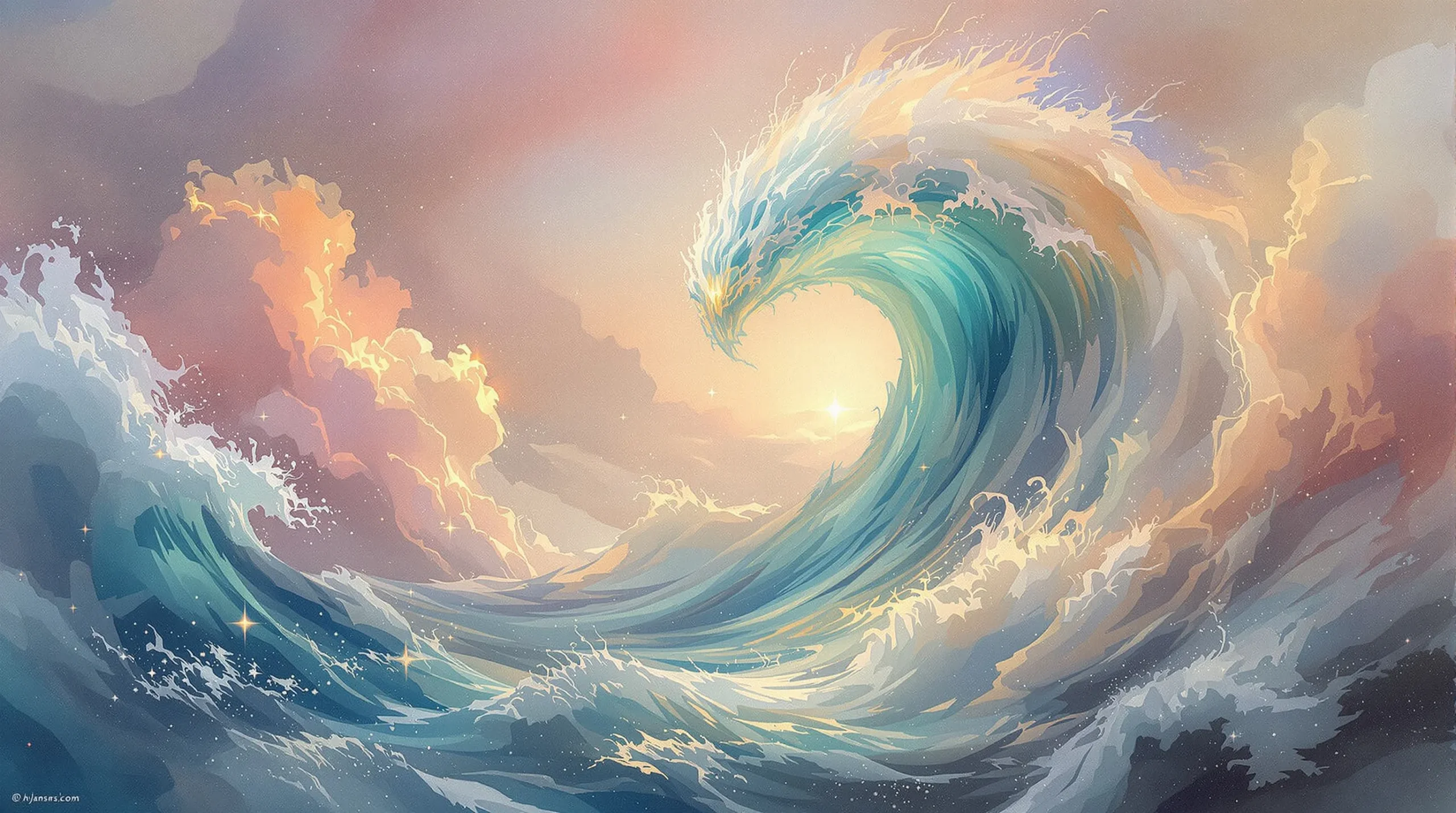


Tsunami

Archetype Meaning & Symbolism

Overwhelming, purifying, sudden, transformative, chaotic, unyielding, reshaping, primal, cathartic, indifferent, clarifying, unstoppable

  • Do not brace for my arrival. Learn to breathe water. What you call ruin, I call the beginning.

If Tsunami is part of your personal mythology, you may...

Believe

  • That true and lasting change requires a radical break with the past; incremental adjustments are merely rearranging furniture in a house that is about to be washed away.

  • That control is the ultimate illusion, and the highest form of wisdom is the ability to surrender to and navigate overwhelming forces, not resist them.

  • That one's essential nature is only revealed when everything non-essential has been forcibly stripped away by crisis.

Fear

  • That any period of peace and stability is merely the tide receding, a deceptive calm before an even larger, more devastating wave arrives.

  • That you will lose everything you have painstakingly rebuilt, and that you may not have the strength to survive a second time.

  • That you carry the cataclysm within you, and that your own emotional intensity could become a destructive tsunami in the lives of those you love.

Strength

  • You possess a profound capacity for adaptation and resilience, able to start over from nothing with a courage that others find astonishing.

  • You have a radical non-attachment to material possessions and superficial social status, which grants you immense freedom.

  • You can hold space for others in their darkest moments without flinching, possessing a deep, earned empathy for those experiencing crisis and loss.

Weakness

  • You may struggle to trust in stability, sometimes subconsciously creating chaos in calm environments because peace feels unnatural or dangerous.

  • Difficulty with long-term planning or commitment, as the future always feels uncertain and contingent on forces beyond your control.

  • A tendency toward emotional isolation, believing that no one who hasn't 'been there' can possibly understand your experience.

The Symbolism & Meaning of Tsunami

In the landscape of a personal mythos, the Tsunami is the ultimate agent of involuntary transformation. It is the archetypal force of the great emotional clearing, the surge of feeling or circumstance that rises from the deep ocean of the unconscious to scour the carefully curated shoreline of the ego. It may symbolize a profound grief, a sudden spiritual awakening, or a devastating loss that reshapes one’s entire internal geography. This archetype does not ask for permission. Its arrival signifies that a certain way of life, a certain set of beliefs, has become a brittle seawall against the truth of the soul, and it has come to reclaim the territory.

The Tsunami speaks to the terror and liberation of surrender. To have this archetype active in your life is to learn that some forces cannot be fought, only witnessed. Its meaning is not in the destruction itself, but in what is revealed afterward: the bedrock of resilience, the surprising fertility of scoured ground, the relationships that proved to be deeply anchored. It is a baptism by drowning, a purification that strips away everything non-essential. The life built after the wave is different: forged in the knowledge of impermanence, it may be simpler, stronger, and more authentic.

Ultimately, the Tsunami represents a cosmic reset button. It challenges the modern myth of linear progress and perpetual growth. Instead, it offers a cyclical, more primal narrative of destruction and rebirth. It suggests that stagnation is the true crisis, and sometimes the only path to new life is through the complete dissolution of the old. It is the terrifying grace of being forced to begin again, with nothing but the raw materials of survival and the stark, clean slate of a world remade.


Tsunami Relationships With Other Archetypes

The Lighthouse:

The Lighthouse is the archetype of steadfast guidance, of a single, unwavering light in the darkness and chaos. The Tsunami is the chaos that tests the Lighthouse's very foundations. This relationship explores the tension between enduring principles and the overwhelming force of reality. The Tsunami may seek to extinguish the light, to prove that nothing can withstand its power, while the Lighthouse’s purpose is to shine precisely in such moments. In a personal mythos, this could represent a core belief or a key relationship being battered by a life-altering crisis, a test of whether one's personal truth can hold fast against the flood.

The Ancient Forest:

The Ancient Forest represents deep roots, generational wisdom, and complex, interconnected systems that have grown over centuries. The Tsunami is an external force that can uproot this entire ecosystem in an instant. Their relationship is one of history versus upheaval. The Forest may seem eternal, but the Tsunami reveals its vulnerability to sudden, overwhelming change. This could symbolize the way a personal or family history, with all its traditions and traumas, can be completely recontextualized or even erased by a single, catastrophic event, forcing the survivor to grow something entirely new from the wreckage.

The Volcano:

The Volcano and the Tsunami are sibling archetypes of geologic, primal power. One erupts from the depths of the earth, the other surges from the depths of the ocean. The Volcano is an internal, fiery force of creation and destruction, building new land from within. The Tsunami is an external, watery force of reshaping and cleansing. In a personal narrative, they could represent twin cataclysms: the Volcano as the explosion of repressed rage or passion, and the Tsunami as the overwhelming wave of grief or external circumstance that follows. They are two different expressions of the planet’s—and the psyche’s—raw, untamable power to remake itself.

Using Tsunami in Every Day Life

Navigating Creative Stagnation:

When a project feels irrevocably stuck, mired in its own history and false starts, the Tsunami archetype offers a radical permission slip. It is not about editing or revising; it is about the complete and total erasure of the canvas. It is the willingness to delete the entire manuscript, to scrap the business plan, to throw out the half-finished painting. The Tsunami suggests that the energy required to fix something broken may be better spent on the fertile, cleared ground of a new idea.

Ending a Relationship:

Some connections do not end with a gentle fading but require a clean, seismic break. The Tsunami is the force of that final, clarifying conversation, the one that leaves no room for ambiguity or a slow, painful drifting apart. It represents the courage to enact a swift and total conclusion, understanding that the ensuing emotional wreckage, while devastating, is ultimately more merciful than a prolonged state of decay. It is the power that sweeps away the shared history to prevent it from becoming a haunted ruin.

Initiating Personal Transformation:

When you sense a profound misalignment between who you are and how you live, the Tsunami archetype can be a catalyst for radical change. It is the decision to quit the career that suffocates the soul, to move across the country on instinct, to shed a persona that no longer fits. It is an internal surge that reorders every priority, washing away obligations, expectations, and identities that have become debris, leaving behind only the stark, authentic bedrock of the self.

Tsunami is Known For

Sudden Upheaval

Its defining characteristic is the lack of warning. It represents the unpredictable event—the diagnosis, the betrayal, the revelation—that instantly divides life into a 'before' and an 'after,' forcing a confrontation with the illusion of control.

Overwhelming Force

The Tsunami is known for a power that is absolute and non-negotiable. It does not persuade or bargain; it simply acts. In a personal mythos, this symbolizes the force of suppressed emotions, subconscious drives, or external events that cannot be resisted, only endured and integrated.

The Receding Tide

Before the wave, there is the eerie, unnatural calm of the water pulling back from the shore, exposing what is normally hidden. This represents the quiet, unsettling period of realization before a crisis hits, a moment of dreadful clarity where the seabed of one's life is revealed just before it is irrevocably altered.

How Tsunami Might Affect Your Personal Mythology

How Tsunami Might Affect Your Mythos

When the Tsunami is a central event in your personal mythos, your life story is cleaved in two: the time before the wave, and the time after. The narrative is no longer one of gentle arcs and gradual character development; it is a saga of survival, a testament to the cataclysm. This event becomes the gravitational center around which all other life events orbit. Past memories may be reinterpreted through the lens of the disaster, seen as naive moments in a world whose fragility had not yet been revealed. The future is no longer a path to be planned but a coastline to be rebuilt, stone by salvaged stone.

Your personal mythology might transform from a simple story into an epic. You become the protagonist who has seen the world unmade and has been tasked with its recreation. The central conflict of your story is no longer about achieving external goals but about integrating the overwhelming power you have witnessed and survived. Your mythos gains a profound depth, colored by the knowledge of how quickly the mundane world can be swept away, leaving only the stark, elemental truth of what remains.

How Tsunami Might Affect Your Sense of Self

The encounter with the Tsunami archetype may fundamentally fracture one's sense of a stable, continuous self. The person you were 'before' can feel like a stranger, a ghost from a lost civilization. Identity is no longer a carefully constructed edifice but something more fluid and elemental, reassembled from the debris. This can be profoundly disorienting, a feeling of being a permanent refugee from a former life. Yet, it can also be liberating. Stripped of old roles and expectations, a new self may emerge, one defined not by profession or possessions, but by the core trait of resilience.

This experience could instill a deep humility. The ego, with its plans and pretensions, is shown to be a fragile craft on a vast, indifferent ocean. Self-perception may shift from being a director of one's life to being a conduit for forces far larger than oneself. There might be a newfound respect for the body's instinct to survive and a deeper connection to the primal, non-rational parts of the psyche. The self is no longer seen as solid ground, but as the tide itself: capable of immense calm and terrifying power.

How Tsunami Might Affect Your Beliefs About The World

After the Tsunami, the world is no longer perceived as a safe or predictable stage for human ambition. The illusion of control is shattered. One might come to see civilization as a thin, temporary veneer over a reality that is wild, chaotic, and unimaginably powerful. This perspective is not necessarily pessimistic, but it is radically unsentimental. There is a deep, abiding awareness of impermanence in all things: in cities, in relationships, in life itself. The world is a place of profound beauty and profound danger, often in the same moment.

This worldview could foster a kind of radical presence. If the future is not guaranteed and the past is a ruin, then the present moment becomes the only place of true existence. One may develop an allergy to the trivialities and manufactured dramas of ordinary life, focusing instead on what feels essential and real. A deep, almost spiritual connection to the forces of nature may form, born not of romanticism, but of the raw respect one has for an entity that has demonstrated its absolute authority.

How Tsunami Might Affect Your Relationships

The Tsunami acts as a powerful, indiscriminate filter for relationships. In its wake, you see who holds on, who brings a metaphorical blanket and flashlight, and who is nowhere to be found. Connections that were based on convenience, proximity, or superficial interests may be washed away entirely. What remains are the bonds forged in the crucible of shared crisis or those strong enough to withstand the flood. Relationships may become fewer, but their depth and intensity can increase exponentially.

There might be a lingering difficulty in forming new attachments. The psyche, braced for loss, may resist investing deeply for fear that it will all be swept away again. Trust might not come easily. One may feel a sense of alienation from those who have not experienced a similar upheaval, as their concerns can seem quaint and their sense of security naive. The only people who can truly understand are the other survivors, creating a powerful, if sometimes isolating, tribe of the initiated.

How Tsunami Might Affect Your Role in Life

The archetype of the Tsunami can obliterate one’s perceived role in life. The 'Accountant,' the 'Artist,' the 'Parent'—these labels may be washed away, revealing the more fundamental role of 'Survivor.' This is not a role one chooses, but one that is thrust upon you. It carries both a burden and a strange freedom. The expectations of society may lose their hold, as you have already faced a reality far more demanding than any social pressure. Your purpose is no longer about climbing a ladder, but about rebuilding a world.

Over time, the role may evolve from Survivor to 'Rebuilder' or 'Witness.' As the Rebuilder, one finds purpose in creating new structures—families, communities, belief systems—that are more resilient and authentic than what came before. As the Witness, one’s role is to carry the story, to remind others of the fragility of things and the awesome power that lies just beyond the shore of our awareness. This role is not about dwelling on trauma, but about holding a profound truth for a world that often prefers to forget.

Dream Interpretation of Tsunami

In a positive context, dreaming of a tsunami may symbolize a massive, necessary, and ultimately cleansing emotional release. You may be consciously or unconsciously holding back a tremendous wellspring of feeling—grief, rage, love—and the dream is a psychic permission slip to let it all go. Surviving the wave in the dream, or watching it recede to reveal a new and interesting landscape, could suggest that you have the internal resources to handle a major life change that is on the horizon. The dream is an assurance that this overwhelming event, while terrifying, is a force of purification that will clear the way for profound new growth.

In a negative context, a tsunami dream often points to a feeling of being completely overwhelmed by external circumstances or internal emotions. It can represent a profound anxiety that your life, your identity, and your security are about to be annihilated by forces beyond your control: a looming job loss, a relationship breakdown, or a health crisis. If the dream features a desperate and futile attempt to outrun the wave, it may reflect a waking-life pattern of avoiding a necessary confrontation with a huge, looming problem. The dream is a stark warning from the subconscious that your current defenses are inadequate for the emotional reality that is coming for you.

How Tsunami Archetype Might Affect Your Needs

How Tsunami Might Affect Your Physiological Needs

The Tsunami archetype, when integrated into a personal mythos, may write its story directly onto the body. The nervous system could be re-calibrated to a state of hyper-vigilance, always scanning the horizon for the next threat. This can manifest as chronic tension in the shoulders and jaw, shallow breathing, or persistent insomnia: the body refuses to fully rest, believing it must be ready to flee at a moment's notice. The physiological baseline becomes a state of low-grade emergency, a perpetual bracing for impact that can be utterly exhausting.

Conversely, the aftermath of the psychic Tsunami can lead to a state of profound physical surrender. Once the crisis has passed, the body, having expended all its adrenaline and tension, might collapse into a deep, almost primal need for rest and stillness. There might be a new attunement to the body’s simple needs: warmth, food, sleep. The frantic energy of the 'before' times may be replaced by a slower, more deliberate pace of life, as the body itself teaches the lesson that true wealth lies in simple, secure embodiment.

How Tsunami Might Affect Your Ideas of Belonging

The Tsunami redefines the very concept of community. The old tribes—defined by shared hobbies, geography, or professional affiliations—may feel hollow and meaningless after the event. The need for belonging becomes a raw, urgent search for those who speak the same post-cataclysmic language, for others who have also seen the water recede. This can lead to the formation of intensely powerful, trauma-forged bonds with fellow survivors. Belonging is no longer about fitting in; it is about being seen in one's entirety, scars and all.

This can also create a profound sense of isolation. When you have been to the depths, the surface-level conversations of the uninitiated can feel alienating. There may be a chasm of experience that makes it difficult to connect with those who still live in the 'before' world. The love one seeks and offers may be fierce and protective, but also wary. There is a deep-seated fear that those you love could be swept away, which might lead to a hesitance to fully anchor oneself in the harbor of another's heart.

How Tsunami Might Affect Your Feelings of Safety

For one whose mythos contains the Tsunami, the concept of safety is fundamentally altered. It is no longer an assumed state or a permanent condition to be achieved, but rather a temporary, precious, and fragile shelter. The foundational belief that the world is a stable place is gone. This can lead to two divergent behaviors: an obsessive attempt to build stronger walls—through financial hoarding, emotional guardedness, or physical fortifications—or a complete abandonment of the quest for safety altogether. Why build a house on the sand when you know the wave will eventually come?

This altered relationship with safety can foster a unique form of courage. When you cease to believe in permanent security, you may be more willing to take profound risks. The fear of failure or loss diminishes when you have already experienced a total wipeout and survived. Safety is found not in external structures, but in the internal knowledge that you possess the capacity to swim, to endure the chaos of the water, and to eventually find your way back to solid ground, however altered it may be.

How Tsunami Might Affect Your Views of Esteem

Self-esteem, if previously built upon external markers like career success, social status, or material wealth, may be completely annihilated by the Tsunami. All the trophies are washed away. This can trigger a crisis of worth, a feeling of being reduced to nothing. The ego is humbled to its core. Yet, from this ground zero of self-worth, something far more resilient can be built. Esteem is no longer derived from what one has, but from what one is: a survivor.

The act of surviving the unsurvivable becomes the new bedrock of self-respect. The knowledge that you endured the wave and are still standing is a source of quiet, unshakable strength. Esteem becomes an internal affair, independent of outside validation. It is the pride of the rebuilder, who looks not at a perfect finished product, but at the sturdy, imperfect walls they have raised from the ruins with their own two hands. It is the esteem of knowing your own core strength, having seen everything else stripped away.

Shadow of Tsunami

The shadow of the Tsunami archetype emerges when one becomes the agent of unnecessary destruction. Instead of being the survivor of the wave, you become the wave itself, compulsively crashing into the lives of others. This can manifest as a pattern of creating drama, ending relationships abruptly and cruelly, or blowing up your own life out of a subconscious addiction to the intensity of crisis. It is the misuse of transformative power, clearing ground that did not need clearing, and mistaking destruction for progress. It is the person who cannot tolerate peace, who feels most alive in the chaos of a wreckage they themselves created.

Another shadow aspect is a state of perpetual victimhood and paralysis. Here, the Tsunami is not an event that has been integrated, but a trauma that is endlessly relived. The person remains frozen in the 'aftermath,' unable to rebuild. They define their entire identity by the disaster, drawing energy from the sympathy of others. This shadow expression refuses the call to rebuild, choosing instead to live in the ruins indefinitely, fearing that any new structure will only be washed away. Life becomes a long, anxious wait for the next inevitable catastrophe.

Pros & Cons of Tsunami in Your Mythology

Pros

  • You develop a rare and powerful form of resilience, knowing you can survive what seems unsurvivable.

  • You are gifted with a profound sense of perspective, freeing you from trivial anxieties and social pressures.

  • Your capacity for renewal is immense; you are a master of the 'second act' and the art of beginning again.

Cons

  • A deep and abiding sense of peace or security may forever feel just out of reach.

  • You may struggle to maintain relationships with those who crave stability and predictability, as your energy can feel intense or chaotic.

  • There is a risk of becoming cynical or fatalistic, finding it difficult to invest hope or effort in long-term projects or commitments.