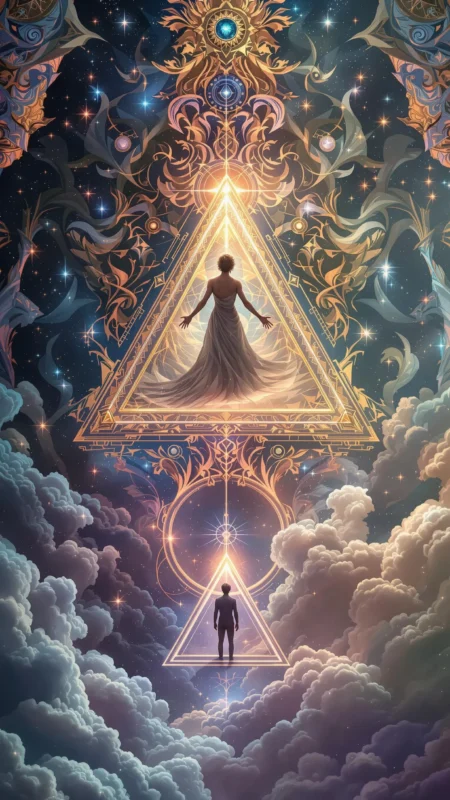
Triangle

Archetype Meaning & Symbolism

Stable, pointed, direct, structural, divisive, unifying, simple, tense, foundational, aspirational

  • My point is not an end, but a direction. My base is not a limit, but a foundation.

If Triangle is part of your personal mythology, you may...

Believe

  • Every conflict between two points can be resolved or understood by introducing a third perspective.

    A life without a clear point, a direction, is a life without meaning.

    The strongest structures are built from the simplest, most fundamental shapes.

Fear

  • The collapse of the structure: the fear that removing one element will cause everything else to fall apart.

    Flatness or circularity: the terror of a life without direction, purpose, or a peak to strive for.

    Being the unstable third point in a relationship, creating imbalance rather than stability.

Strength

  • The ability to create focus and direction out of ambiguity, to find the 'point' in any situation.

    A talent for synthesis, for finding the harmonious third way between two opposing forces or ideas.

    Structural thinking: an innate capacity to build stable, resilient systems, plans, or arguments from the ground up.

Weakness

  • A tendency to create or perceive conflict where none exists, framing everything as a triangulation of forces.

    Rigidity: an unwillingness to deviate from a chosen path or goal, even when it is no longer viable.

    An oversimplification of complex issues, reducing nuanced realities to a simple three-point problem.

The Symbolism & Meaning of Triangle

In the architecture of a personal mythos, the Triangle is the archetype of dynamic tension. It is simultaneously the most stable of shapes and the very image of conflict. Its base is a promise of foundation, a place to rest, yet its apex is a point of piercing aspiration or aggression. To have the Triangle within you is to understand that stability does not mean peace; it means the perfect, taut balance of opposing forces. Your life may be built not on tranquility, but on the strength forged in holding disparity together. You might find your greatest sense of self not in placid fields but on the high wire strung between two cliffs, where the tension itself is what holds you up.

The Triangle insists on the power of three. Where one is isolation and two is opposition, three is relationship, structure, and story. It is the synthesis that arises from thesis and antithesis. A mythos shaped by this archetype may constantly seek the “third way.” You might not see the world in black and white, but as black, white, and the gray space where life actually happens. You may feel that every dyad, every couple, every argument, is incomplete without a third element: a witness, a mediator, a consequence, a child. This third point is what creates dimension, transforming a flat line of opposition into a living, breathing space.

Its orientation is everything. You may feel the upward thrust of the pyramid, a life dedicated to a singular, culminating point of achievement, built upon a broad base of experience. Or you might resonate with the downward-pointing chalice, a life of receptivity, of gathering wisdom and pouring it into the world. Perhaps your personal symbol is the Seal of Solomon, two triangles interlaced, embodying the quest to balance the spiritual and the material, the upward striving and the downward grounding, the fire and the water of your own soul.


Triangle Relationships With Other Archetypes

The Circle

The Triangle’s relationship with the Circle is one of pointedness versus holism. The Triangle creates progress, direction, and sometimes, rupture. It seeks a destination. The Circle, conversely, represents cycles, eternity, and inclusion; its journey is one of return. In a personal mythos, this tension might manifest as a lifelong dance between ambition and acceptance. You may feel the Triangle’s sharp prod to achieve, to differentiate, to “make your point,” while the Circle archetype whispers of wholeness, of embracing the cyclical nature of failure and success, and of finding your place within a community rather than rising above it.

The Square

If the Triangle is dynamic tension, the Square is stolid, earthly stability. The Triangle builds a pyramid, reaching for the heavens from a firm base; the Square builds a fortress, concerned with security, order, and delineating what is inside from what is outside. A person might live out the Triangle’s energy in their youth—all sharp angles, ambition, and dramatic, triangular relationships—only to find themselves seeking the four-cornered certainty of the Square in maturity. Their personal mythos could be a narrative of learning how to ground the Triangle’s aspirational energy in the practical, reliable container of the Square, building a home instead of just a spire.

The Hero

The Triangle often provides the essential dramatic structure for the Hero’s journey. The Hero’s story is rarely a simple duality of good versus evil. It is almost always a triangulation: the Hero, the Antagonist, and the prize, the person, or the principle they fight over. This third point provides the motive and elevates a simple brawl into a mythic conflict. For a person whose mythos contains both archetypes, life’s challenges may be perceived as narrative triangles requiring a heroic choice. You are not just fighting a problem; you are at the apex of a fateful decision, and your action will define the relationship between the other two points forever.

Using Triangle in Every Day Life

Navigating a Difficult Decision

When caught between two seemingly irreconcilable choices, you might visualize them as the two base corners of a triangle. Instead of oscillating between them, you would meditate on the apex: the third position, the higher perspective from which both choices can be seen not as opposites, but as parts of a larger structure. This third point could represent a core value or a long-term goal that helps clarify which base point offers the most stable path forward.

Establishing Creative Focus

For the artist or entrepreneur facing a sprawling, unfocused project, the Triangle archetype could offer a focusing principle. You might distill the project's essence into three core pillars: perhaps theme, audience, and medium. This triad forms a stable base. From there, all creative energy is channeled upward toward a single apex: the ultimate, pointed intention of the work. It transforms overwhelming possibility into directed, purposeful creation.

Mediating a Dispute

When a conflict arises between two people, you may instinctively avoid taking a side. Instead, you could embody the Triangle's third point. Your role is not to join one of the base corners but to create a new, stabilizing geometry. You might introduce a common goal, a shared history, or an objective truth that allows the two opposing points to find a new, more harmonious relationship to one another, all held in tense balance by your perspective.

Triangle is Known For

Structural Integrity

It is the most stable and rigid of the simple geometric polygons. A force applied to its corner is distributed down its sides, making it the foundational shape for architecture and engineering, from the trusses of a bridge to the pyramids themselves.

The Trinity

Across countless cultures and mystical traditions, the number three, and thus the Triangle, represents a divine or cosmic completeness. It symbolizes concepts like mind-body-spirit, past-present-future, birth-life-death, and the resolution of duality into a creative third.

Directionality

Unlike a circle or square, a triangle possesses an inherent direction, a point. An upward-facing triangle often symbolizes aspiration, masculine energy, fire, and the climb toward heaven or enlightenment, while a downward-facing triangle may represent grace, feminine energy, water, and a descent into the material or subconscious world.

How Triangle Might Affect Your Personal Mythology

How Triangle Might Affect Your Mythos

When the Triangle is woven into your personal mythology, your life story may not be a linear progression but a series of directional shifts, each catalyzed by a moment of triangular tension. Your narrative is likely marked by pivotal choices between two compelling but mutually exclusive paths, with you standing at the apex, the point of decision that determines the future's geometry. These are the moments that define your myth: the choice between security and passion, loyalty to a person versus loyalty to a principle, the old life and the new. Your story is one of navigating these critical junctures, where the pressure to choose forges the very structure of your identity.

Your mythos could also be one of a builder, a creator of structures from the most fundamental forms. You may see your life's work as the construction of a great pyramid of meaning. Each significant relationship, career milestone, or moment of insight is a carefully placed block, forming a stable base. From this foundation, your story narrows and rises, aiming for a singular, culminating point: a legacy, a masterwork, a final, clarifying truth. Your narrative is not about wandering, but about ascending, with each chapter contributing to the structural integrity of the whole, building relentlessly toward that final, defining apex.

How Triangle Might Affect Your Sense of Self

Your sense of self may be defined not by a single, static quality, but by the dynamic, taut balance of three core forces. You might perceive your identity as the synthesis of your intellect, your emotions, and your physical body, a trinity that, when in harmony, creates a powerful and directed sense of being. You are not just one of these things; you are the triangular relationship between them. This can lead to a deeply integrated self-concept, but one that requires constant, conscious effort to keep in balance, as the neglect of one point threatens the stability of the entire structure.

Alternatively, the Triangle may shape your self-perception as being fundamentally directional. There is a “point” to you. You may see yourself as an arrow in flight, defined by your trajectory and your target. This can grant you a potent sense of purpose and an immunity to distraction. Your identity is fused with your mission. The risk, however, is that you might feel lost or worthless without a clear goal to strive for. The self becomes brittle, its value contingent on progress and the promise of reaching a destination, rather than on the inherent worth of the journey itself.

How Triangle Might Affect Your Beliefs About The World

Through the lens of the Triangle, the world may appear as a vast, interconnected system of tensions. You might interpret everything from geopolitics to family dynamics as a structure of thesis, antithesis, and a potential, often elusive, synthesis. You are less interested in who is right or wrong in a binary conflict and more fascinated by the third point: the unstated assumption, the external pressure, or the future outcome that holds the two opposites in their tense dance. Your worldview is one that seeks to understand the geometry of power and belief, always looking for the angle that reveals the whole picture.

Your worldview might also be unconsciously hierarchical. You may see the world as a series of pyramids, natural structures of order and aspiration. Some ideas, people, or efforts form the broad, supportive base, while others are destined to form the peak. This is not necessarily a judgment of worth, but an acknowledgment of function and structure. It's a perspective that sees leadership, influence, and mastery as the natural apex of a well-supported foundation, and you might believe that striving to ascend within these structures is a fundamental driver of progress and civilization.

How Triangle Might Affect Your Relationships

Relationships, for you, may be unconsciously organized around the number three. This doesn’t always signal the notorious “love triangle,” but could manifest in more subtle, structural ways. A strong romantic partnership might be viewed as a trinity: you, your partner, and the relationship itself, a third entity that must be nurtured and protected. In friendships, you may feel most stable and authentic in a triad, where the flow of energy is dynamic and balanced. You might also frequently find yourself in the role of the mediator, the third point that stabilizes a volatile dyad between two friends, colleagues, or family members.

The focused, pointed energy of the Triangle might also define your relational style. You may value directness, intensity, and a desire to “get to the point” of a connection. This can forge incredibly strong, honest, and purposeful bonds, free of ambiguity. However, it can also be piercing. Your directness could feel aggressive to more sensitive souls, and your need for a relationship to have a “point” or a direction might create impatience with connections that are simply meant to be, without a defined goal. The stability of the bond can become precarious if the shared apex of your ambitions shifts.

How Triangle Might Affect Your Role in Life

You may subconsciously adopt the role of the Keystone or the Mediator within any social system. In a family, a team, or a community, you might find yourself instinctively drawn to the position that balances the two most powerful or opposed forces. You become the third leg of the stool, without which the entire structure would collapse into conflict. Your purpose, as you see it, is not to lead or to follow, but to hold the shape together through a deep understanding of tension and balance. You provide the stability that allows others to function.

Conversely, you could perceive your role as the Apex. You are the one who provides the vision, the direction, the singular point toward which the group strives. Standing on the foundation of others' work and support, your function is to aim higher, to see further, and to guide the collective energy toward a specific goal. This is the role of the visionary, the strategist, the leader who is defined not by their command of the base, but by the clarity of their point. Your responsibility is one of direction, pulling the entire structure upward with you.

Dream Interpretation of Triangle

In a positive dream context, a triangle appearing as a clear, stable shape—perhaps a mountain, a pyramid, or a simple geometric form glowing with light—is a powerful symbol of integration and clarity. It could suggest that you have successfully harmonized conflicting parts of yourself, such as your ambitions and your ethics, or your heart and your mind. An upward-pointing triangle might signify a surge of focused energy and a clear path toward a goal. It is an omen of stability achieved through the successful balancing of forces, a sign that you are on the right track and your foundations are secure.

In a negative context, a dream triangle may appear distorted, broken, unstable, or threatening. An impossibly sharp, piercing triangle could symbolize painful words or a betrayal. Being trapped inside a triangle might represent feeling caught in an irresolvable conflict, such as a toxic work dynamic or a love triangle. A downward-pointing triangle that feels ominous or dark could indicate a draining of life force, a descent into despair, or a sense of being trapped by material circumstances. It’s a warning from the psyche that the structure of some part of your life is fundamentally unsound and at risk of collapse.

How Triangle Archetype Might Affect Your Needs

How Triangle Might Affect Your Physiological Needs

Your relationship with your body's fundamental needs might be one of architectural logic. You could see sleep, nutrition, and exercise as the literal foundation—the base of the pyramid—of your life. There's a clear, intellectual understanding that without this base being wide and stable, any attempt to build higher structures of thought, creativity, or ambition is doomed to fail. You might approach wellness with a structured plan, seeing each meal and hour of sleep as a crucial block being laid in the construction of your potential.

However, the Triangle’s aspirational energy can also create a conflict with physiological needs. The drive to reach the apex, to achieve the goal, can make the demands of the body feel like a frustrating anchor. You may be tempted to sacrifice sleep for work, to neglect meals when in a state of creative flow, or to push your body past its limits in pursuit of a peak experience. The body becomes part of the tension, the material base that must be transcended or conquered to reach the spiritual or intellectual point.

How Triangle Might Affect Your Ideas of Belonging

You may find your deepest sense of belonging not in a large crowd but in the dynamic intimacy of a triad. The trio is your natural habitat. It might be a friendship of three, where the conversation and support flow in a balanced, triangular pattern. Love itself may be conceptualized as a sacred trinity: the union of two individuals creating a third entity, the relationship itself, which requires its own care and attention. You feel most seen and at home when you are one point in a stable, three-part structure of love and connection.

Conversely, the Triangle archetype can complicate belongingness, casting it as an eternal choice. To align with one person or group (one corner of the base) might feel like a betrayal or abandonment of another. This can create a persistent feeling of being torn, of having to divide your loyalties. The geometry of the Triangle can become the geometry of the schism, making you feel that to belong in one place, you must create a sharp, painful division with another, rendering a sense of complete, unconditional inclusion almost impossible.

How Triangle Might Affect Your Feelings of Safety

A sense of safety, for you, might be built upon a triangulation of securities. It's not enough to have just financial stability or just a safe home; safety is a structure composed of at least three pillars. These could be financial resources, a trusted community, and robust physical health. The perceived integrity of your life depends on all three points holding firm. Consequently, a threat to any single one of these pillars might feel disproportionately terrifying, as it threatens not just one aspect of your life, but the entire geometry of your well-being.

The Triangle’s sharp point could also inform your approach to threats. Your strategy for safety may be less about building impenetrable walls (the Square's method) and more about developing a pointed, focused defense. This could manifest as becoming a sharp-witted debater, developing a specialized skill that makes you indispensable, or cultivating a piercing intuition that identifies danger before it fully materializes. Your safety lies not in being invulnerable, but in being able to make a strategic, decisive, and sharp point when necessary.

How Triangle Might Affect Your Views of Esteem

Your self-esteem may be inextricably linked to your ability to achieve, to progress towards a singular goal. It is the esteem of the Apex. You feel worthy and valuable when you have a clear point to your efforts and are actively moving toward it. Competence, focus, and directness are your cardinal virtues. Your self-respect is built on the foundation of your accomplishments and the clarity of your ambition. You are your purpose, and when that purpose is sharp, your esteem is high.

Alternatively, your esteem could derive from your role as a Stabilizer. You feel a deep sense of worth when you successfully resolve a conflict, synthesize two opposing ideas, or create a harmonious structure out of disparate elements. Your pride is not in personal ascension, but in your capacity to be the keystone in the arch of a family, the mediator in a team, the one who brings balance to chaos. Your value lies in your ability to hold things together, to be the third point that makes a relationship, a project, or a community viable and strong.

Shadow of Triangle

The shadow of the Triangle manifests as the principle of division for personal gain. It is the energy of the deliberate wedge, the one who thrives on creating conflict between others to consolidate their own power or to simply enjoy the ensuing drama. In this dark aspect, the Triangle is the architecture of betrayal. It seduces you into believing that stability can be found by unbalancing the relationships of others. This shadow plays out in office politics, family schisms, and friendships ruined by gossip. It is the cold, calculating geometry of using others as points in a game you control, forgetting the human cost of a collapsed structure.

Another facet of the shadow is a tyrannical and brittle focus. The upward-pointing triangle, in its extreme, becomes the fanatic's spike. It is a pursuit of an apex so relentless that it destroys its own foundation. This is the workaholic who sacrifices family and health for a promotion, the ideologue who tramples empathy in the name of a principle, the artist who destroys their life for their art. The point becomes everything, and the broad, stable base of compassion, connection, and well-being is seen as an obstacle. This shadow Triangle is dangerously unstable, a needle balanced on its point, ready to topple and shatter at the slightest touch.

Pros & Cons of Triangle in Your Mythology

Pros

  • An inherent sense of focus and the ability to set and pursue goals with powerful clarity.

    A gift for creating stability and resolving conflict by understanding the dynamic interplay of different forces.

    A capacity for profound thought, able to synthesize complex dualities into a new, insightful whole.

Cons

  • A risk of becoming rigid, dogmatic, or overly simplistic in your worldview.

    A tendency to introduce or be drawn to dramatic, triangular relationship dynamics.

    May sacrifice foundational well-being and relationships in the relentless pursuit of an apex goal.