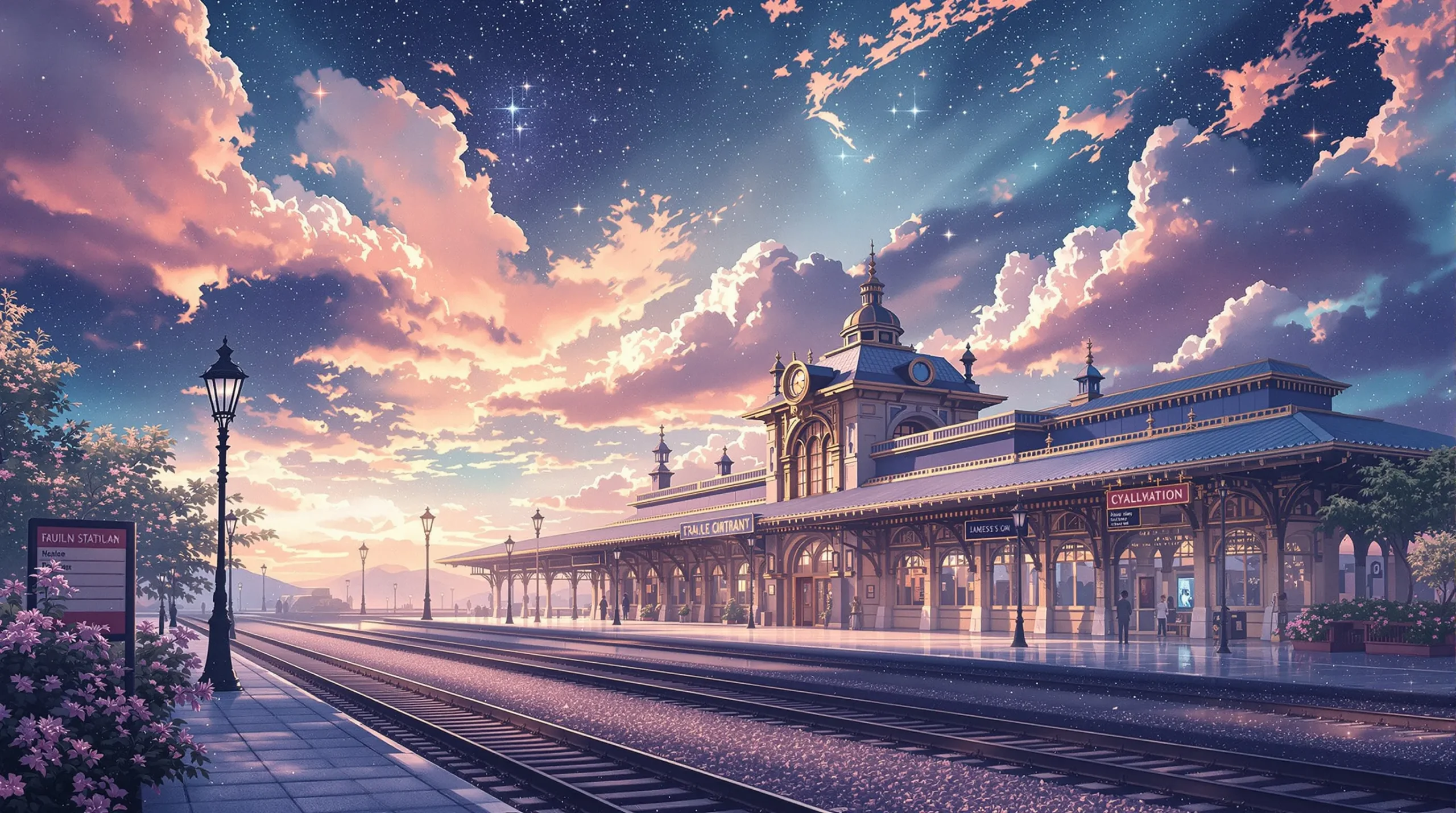


Train Station

Archetype Meaning & Symbolism

Transitional, liminal, bustling, desolate, echoing, punctual, delayed, anonymous, connective, impersonal

  • All tracks lead somewhere. The question is not where they go, but which one you are brave enough to choose. Do not mistake the waiting for the journey itself.

If Train Station is part of your personal mythology, you may...

Believe

  • Every ending is just the precursor to a new beginning.

    Stillness is not emptiness; it is the space where the next journey is chosen.

    The most important destinations are often the ones you didn't plan to travel to.

Fear

  • That you will miss your connection and be left behind permanently.

    That you will choose the wrong track and end up somewhere you can never leave.

    That you will spend your entire life waiting for a train that never arrives.

Strength

  • An exceptional adaptability to change and unforeseen circumstances.

    A deep capacity for observation and patience, finding meaning in the in-between moments.

    The courage to leave the familiar behind and embrace the uncertainty of a new journey.

Weakness

  • A reluctance to form deep, lasting attachments for fear of the inevitable departure.

    A chronic sense of restlessness and an inability to feel settled or 'at home.'

    A tendency to see people as temporary figures in your story, rather than as destinations in themselves.

The Symbolism & Meaning of Train Station

At its core, the Train Station is the premier symbol of liminality. It is a space that is neither here nor there, a physical pause button on the narrative of a life. When this archetype shapes your personal mythology, you may find that your story is defined not by its destinations but by these powerful, charged moments of transition. Career changes, new relationships, cross-country moves: these are not just events, but sacred spaces you inhabit. You understand that the person who buys the ticket is subtly different from the one who boards the train, and that this transformation happens in the echoing, waiting expanse of the station itself.

The archetype also embodies the duality of anonymity and interconnection. Within the station's walls, you are liberated from your usual roles. You are not a manager, a parent, or a neighbor; you are simply a traveler, a ghost in the machine of movement. This anonymity can be a profound comfort, a space for pure observation of the self and others. Yet, you are simultaneously part of a temporary, unspoken community. The collective groan when a delay is announced, the shared glance with a fellow passenger, the brief exchange with a ticket agent: these are moments of fleeting but authentic connection with others who also find themselves in the same state of suspension.

Perhaps most profoundly, the Train Station is where the myths of fate and free will collide. The tracks are fixed, the destinations are pre-printed on the schedule, suggesting a life path that is largely predetermined. There is a rigid structure, a timetable to which one must adhere. Yet, within this rigid system lies the radical freedom of choice. You decide which ticket to buy, which platform to stand on, or whether to rip up your ticket and walk out into the city instead. Your mythos may be a constant negotiation with this tension: how much of your life is subject to an unchangeable schedule, and how much is a result of your own brave, terrifying choices made under the flickering departure sign?


Train Station Relationships With Other Archetypes

The Traveler

The Train Station is the stage; the Traveler is the protagonist. Without the Traveler, the station is just an empty building, a monument to potential with no purpose. The Traveler archetype provides the intention, the story, and the kinetic energy that activates the station's meaning. For one whose mythos is the station, the Traveler may represent the active, willful part of the psyche. The station is the soul's contemplative, potential-filled landscape, while the Traveler is the aspect of self that dares to choose a destination, to endure the wait, and to step across the threshold onto the train, setting the entire narrative in motion.

The Clock

The Clock is the austere, indifferent deity of the Train Station. It governs every arrival and every departure, its hands sweeping with an authority that cannot be appealed. It is the source of all urgency and anxiety within the station's walls, a constant, ticking reminder of time's passage, of deadlines, and of the terror of being left behind. Your relationship with the Clock archetype defines your personal mythology of time. You may be one who lives in frantic obedience to its schedule, arriving hours early, or you may be a rebel, perpetually delayed, viewing the Clock not as a guide but as a tyrant whose power you refuse to acknowledge.

The Road

The Train Station and the Road both represent the journey, but they offer fundamentally different mythologies of movement. The Road archetype suggests freedom, improvisation, and the ability to change your destination at any moment; it is a path you create as you travel it. The Train Station, by contrast, speaks to a journey that is more structured, proceeding along pre-determined lines toward established stops. One whose mythos is the station might find the absolute freedom of the Road to be chaotic and aimless, preferring the clarity and purpose of the tracks. The Road offers infinite possibility; the station offers infinite choices among finite possibilities.

Using Train Station in Every Day Life

Navigating a Career Change

When you find yourself between jobs, you may reframe the experience not as unemployment but as a necessary layover. Instead of despairing in the void, you can see yourself in the grand concourse of your potential, studying the departures board. Each job application is a potential track, each interview a new platform. This perspective transforms a period of anxiety into one of strategic waiting and deliberate choice, allowing you to assess all possible destinations before committing to a ticket.

Ending a Significant Relationship

The conclusion of a partnership can feel like an abrupt, final stop. The Train Station archetype allows you to see it differently: you have simply arrived at the end of a specific line. The pain is real, but the station itself represents the truth that other tracks exist. It provides a mental space to grieve the journey that has ended while acknowledging that you are not stranded. You are in a place built for new beginnings, and your next great journey may be just a platform away, waiting to be discovered.

Feeling Stuck in Life

For periods of profound stasis, where life feels like it has ground to a halt, the archetype offers a powerful reframe. You are not stuck; you are between trains. This is not wasted time. It is a moment to get your bearings, to listen to the station’s announcements, to observe other travelers and learn from their journeys. It is a sacred pause, an opportunity to choose your next direction with intention rather than desperation, ensuring the next train you board is one you truly want to be on.

Train Station is Known For

The Schedule Board

A towering monument to time, choice, and consequence. It is the oracle of the station, displaying all possible futures

the express routes to success, the local stops of a slower life, the dreaded red letters of cancellation. It symbolizes the tension between a seemingly fixed destiny and the individual's choice of which train to board.

The Waiting Bench

This is the altar of the in-between. It’s a space of enforced stillness, where anxiety, hope, and boredom converge. Here, you are in a temporary community with strangers, each lost in their own narrative of transit. It represents the contemplative, often uncomfortable, pause required before any significant movement can occur.

The Concourse

The vast, echoing heart of the station, a river of humanity flowing in all directions. It is the physical manifestation of life's intersecting paths, where countless stories brush against each other for a fleeting moment and then diverge forever. The concourse is a symbol of both profound connection and utter anonymity.

How Train Station Might Affect Your Personal Mythology

How Train Station Might Affect Your Mythos

If the Train Station is central to your personal mythos, your life story may not be a seamless, linear narrative but an anthology of distinct journeys connected by periods of profound waiting. The major chapters of your life do not flow into one another; they are separated by the echoing concourse. You don’t just change careers; you spend time in the 'station' between them, a period of re-evaluation and choice that is as important as the job itself. You may see your past selves not as evolving versions of you, but as distinct people you had to leave on various platforms in order to catch the train to your present reality. Your mythos is one of punctuated equilibrium: long pauses of potential followed by dramatic, life-altering departures.

Your narrative might also be rich with the themes of chance encounters and synchronous timing. Life happens in the interactions on the platform. The stranger with whom you share a bench for twenty minutes might offer a piece of wisdom that changes your entire outlook. A missed train could lead you to meet the love of your life on the next one. Your story is not so much driven by your own heroic actions as it is by your attentiveness to the grand, intricate choreography of the station itself. You believe that everyone is moving according to their own timetable, and the magic lies in the brief moments when those timetables intersect with your own.

How Train Station Might Affect Your Sense of Self

You may perceive your identity not as a fixed entity but as a fluid state of being, constantly defined by the journey you are on or the one you are about to begin. This can be incredibly liberating. You are not confined by your past, because your past is simply a place you have departed from. At each new station in life, you feel you have the permission to reinvent yourself, to adopt a new persona suited for the next destination. You are a collection of tickets, a history of arrivals and departures, rather than a resident of any single place.

This fluid sense of self, however, can come with a shadow of rootlessness. If you are always in transit, where is home? Your comfort in anonymity and temporary connections might prevent you from ever feeling truly seen or grounded. There may be a persistent feeling that your “real” self is waiting for you at the next stop, and the person you are now is just a temporary traveler. This can create a quiet, existential loneliness, the feeling of a permanent passenger who can't remember what it feels like to unpack their bags for good.

How Train Station Might Affect Your Beliefs About The World

Your worldview might be that of a systems thinker. You see the world not as a collection of isolated places and events, but as a vast, interconnected network of tracks. You understand that a delay on one side of the world can have ripple effects thousands of miles away. This perspective fosters a deep appreciation for the complex, often invisible logistics that underpin society. You see the hidden schedules and connections that others miss. For you, life is not a series of destinations to be reached, but a dynamic, ever-shifting system of movement, and wisdom lies in understanding how the whole system works.

Furthermore, you may possess a profound patience and an acceptance of the “in-between” states of being. While contemporary culture often demonizes waiting as wasted time, you might see it as a necessary and even sacred part of any process. You understand that the moments of stillness on the platform are when the most important decisions are made. This view allows you to find meaning and purpose in periods of uncertainty and transition, seeing them not as a frustrating pause but as a crucial, contemplative space where the next leg of the journey is conceived.

How Train Station Might Affect Your Relationships

You may view relationships through the poignant lens of shared travel. People are not possessions, but fellow passengers. Some board the same train as you for a short distance, sharing stories and laughter between a few stops before their destination arrives. Others may be on the same long-haul journey, companions for a significant chapter of your life. This perspective can lend a beautiful, bittersweet grace to your connections. You can love people deeply for the part of the journey you share, and when it is time for one of you to get off, you can do so with gratitude rather than bitterness, wishing them well on their onward travels.

The shadow side of this is a potential for emotional transience and a fear of arrival. Believing that all connections are temporary, you might hesitate to fully commit, to truly unpack your heart. It can be easier to remain in the relative safety of the station's anonymous crowd than to risk the intimacy of a shared train car. You may unconsciously keep one foot on the platform in your relationships, always mentally prepared for the next departure. This can prevent you from building the deep, lasting bonds that require a belief in a shared destination, not just a shared journey.

How Train Station Might Affect Your Role in Life

In your personal mythos, you might not see yourself as a hero or a ruler, but as a transitional figure, a facilitator of movement for yourself and for others. Your role is that of the station master or the seasoned traveler who knows the timetables by heart. You are the one friends turn to when they are at a crossroads, for you understand the art of the in-between. You provide comfort and guidance during their 'wait,' helping them read the schedule of their lives and find the courage to board their next train. Your purpose is not to be a destination for others, but to be the safe, supportive space from which their greatest journeys can begin.

Alternatively, you could perceive your role as fundamentally passive, that of a perpetual passenger whose life is directed by an unseen conductor. You feel as though you are waiting for your track to be announced, for circumstances to dictate your next move. This can lead to a sense of disempowerment, a feeling that your life is something that happens to you, governed by a schedule you had no part in creating. The core challenge of your mythos, then, is to evolve from being a mere ticket-holder to becoming the one who reads the map, charts the course, and chooses the destination with authority.

Dream Interpretation of Train Station

When a train station appears in your dreams in a positive context, it often symbolizes an imminent and welcome change. A bright, clean, well-organized station with clear signage and on-time trains may suggest that you are psychologically prepared and aligned for a new chapter in your life, be it a new job, relationship, or personal transformation. Finding your ticket easily and seeing your train waiting at the correct platform can be a powerful affirmation from your subconscious that you are on the right path and that the transition ahead is one to be embraced with confidence and excitement.

In a negative context, a dream of a train station can manifest as a powerful anxiety symbol. A dark, labyrinthine station where you are lost and cannot find your platform may reflect a feeling of confusion and lack of direction in your waking life. A chaotic, crowded station with a constantly changing schedule board could represent feeling overwhelmed by choices or external pressures. The classic anxiety dream of missing your train often points to a fear of a missed opportunity, of being left behind by life, or of failing to act when the moment was right. It is the subconscious mind's rendering of the feeling of being stuck at a crossroads, paralyzed by indecision or fear.

How Train Station Archetype Might Affect Your Needs

How Train Station Might Affect Your Physiological Needs

From a mythological perspective, the Train Station archetype might influence your physiological state by placing it in a mode of perpetual readiness. Your baseline state may be one of energy conservation, a kind of alert stillness akin to a passenger waiting on a bench. You are not deeply relaxed, but rather in a low-power mode, saving your resources for the moment the 'train' arrives. This can manifest as a cycle of quiet, almost meditative calm punctuated by sudden bursts of intense, focused energy when it's time to act and move. Your body's rhythm is not steady; it’s the rhythm of 'hurry up and wait.'

Your approach to basic needs like food and drink might become purely functional, mirroring the grab-and-go culture of a station concourse. Sustenance may be viewed as fuel for the journey rather than an experience to be savored. A quick coffee, a protein bar, something to be consumed efficiently while checking the time: this could be your default mode. This prioritizes momentum over the grounding, restorative, and communal pleasures of a slow meal, reflecting a psyche that believes the 'real' experience is always about to happen somewhere else.

How Train Station Might Affect Your Ideas of Belonging

Belonging may be experienced not as membership in a fixed group, but as a series of temporary, intense moments of shared humanity. You find your tribe among other travelers. It is the unspoken bond with the person sleeping on the bench opposite you, the shared smile with someone who catches your eye, the collective gasp of a crowd watching a near-miss on the tracks. You belong to the state of transit itself. This creates an ability to forge deep, albeit ephemeral, connections with people from all walks of life, united by the common experience of being on a journey.

However, this can also foster a pervasive and deep-seated loneliness. By its very nature, the station is a place of goodbyes. Everyone you connect with is on their way somewhere else. This can lead to a feeling of being a permanent spectator to other people's lives. You may watch joyful reunions and tearful farewells from a distance, feeling like a ghost haunting the architecture. You are part of the scenery of belonging for others, but rarely the subject, which can create a profound sense of being on the outside looking in, forever passing through but never truly arriving.

How Train Station Might Affect Your Feelings of Safety

A sense of safety, for you, may be found not in fortification but in mobility and anonymity. The station feels secure because you are an unidentifiable face in a flowing crowd, a being in transit who is difficult to pin down. True security is not a locked door but a valid ticket to somewhere else. The knowledge that you can leave at any moment, that you have a planned exit, provides a unique kind of comfort. You are safe because you are not a stationary target; you are a moving one, protected by the very momentum of the system.

Conversely, this archetype can generate a profound sense of vulnerability. In the station, you are surrounded by countless strangers whose intentions are unknown. Your possessions, your plans, and your person feel exposed and unprotected. Your safety is also wholly dependent on a complex, impersonal system functioning correctly. A sudden cancellation, a strike, or a security alert can instantly dismantle your sense of control, leaving you feeling stranded, powerless, and exposed in a place that is not your own. Safety is therefore a fragile illusion, contingent on the schedule being honored.

How Train Station Might Affect Your Views of Esteem

Your self-esteem could be deeply intertwined with your competence as a navigator of life's transitions. You derive a sense of worth from your ability to read the 'schedule,' to adapt to a sudden platform change, to pack light and efficiently, and to bravely board a train into the unknown. Your value is not static; it is measured by your resilience, your adaptability, and your resourcefulness in the face of change. When you successfully manage a complex life transition, you feel a surge of pride and self-respect. You are the master of your own Grand Central, capable of getting anywhere.

The downside is that your esteem can become dangerously dependent on forward momentum. A period of waiting, a delay in your plans, or a 'cancellation' of an expected opportunity can feel like a direct reflection of your personal worth. You might equate stillness with failure. If you don't have a ticket in your hand and a destination in mind, you can feel useless and left behind. This makes you vulnerable to judging your own value not by who you are, but by where you are going and how quickly you are getting there.

Shadow of Train Station

In its shadow form, the Train Station archetype manifests as a debilitating paralysis of choice. Faced with the infinite destinations on the departure board of life, you become so terrified of choosing the wrong track that you never choose at all. The station transforms from a place of potential into a comfortable, familiar prison. You romanticize the act of waiting, telling yourself you are being strategic, when in reality you are hiding from the terror of commitment. You live perpetually in the concourse of your own life, watching others depart on their journeys while you endlessly study a schedule you have no intention of following.

The other primary shadow is a compulsive, meaningless transience. Rather than being paralyzed by the station, you become addicted to it. You fear arrival more than anything. This expresses itself as an inability to finish anything: you may leave jobs just as you are gaining mastery, end relationships as they deepen into true intimacy, or move cities just as you are putting down roots. It is a frantic escape from stillness. You mistake constant motion for progress, collecting ticket stubs as trophies but never building anything of lasting value. The journey is no longer a path to a destination but a flight from the self.

Pros & Cons of Train Station in Your Mythology

Pros

  • You possess a remarkable resilience and ability to navigate life's major transitions with grace.

    You are open to new experiences and possibilities, seeing life as a series of exciting journeys.

    You can find a peculiar peace in solitude and anonymity, allowing for deep introspection.

Cons

  • You may struggle with commitment and forming long-term, stable relationships.

    A constant feeling of restlessness can prevent you from ever feeling truly content or at home.

    You might feel that your life is dictated by external schedules and forces beyond your control.