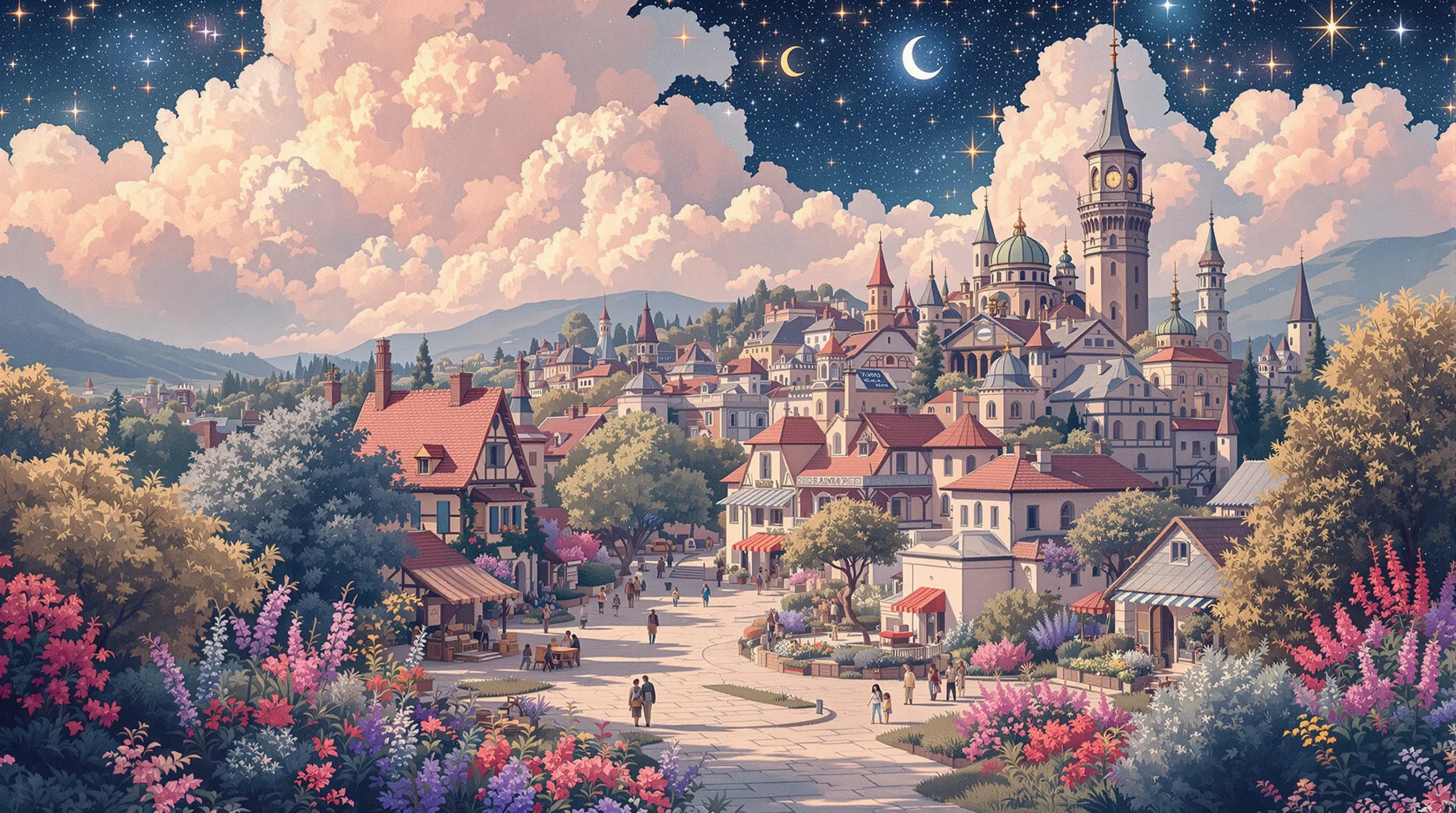


Town

Archetype Meaning & Symbolism

Communal, conventional, familiar, gossipy, insular, supportive, predictable, structured, rooted, provincial

  • Every wall has a story, every path a memory. Walk them long enough, and you become the story.

If Town is part of your personal mythology, you may...

Believe

  • You may believe that a person is defined by their roots and their responsibilities to the place they call home.

  • You may believe that tradition and social ritual are the essential glue that holds a chaotic world together.

  • You may believe that true fulfillment comes from being a valued and necessary part of a community, rather than from solitary achievement.

Fear

  • You may fear exile and ostracism more than physical harm, believing that social death is the ultimate tragedy.

  • You may fear the judgment of your neighbors and the power of gossip to define your reality.

  • You may fear the unknown that lies beyond the town limits: the chaos, the anonymity, and the loss of identity that comes with leaving the familiar world behind.

Strength

  • You may possess a profound capacity for loyalty and commitment, able to build and sustain long-term relationships and communities.

  • You may have a strong sense of civic duty and a natural talent for organizing and nurturing social networks.

  • You may find deep comfort and strength in routine, tradition, and the stability of a well-ordered life.

Weakness

  • You may have a tendency toward conformity and a resistance to necessary change, prioritizing harmony over truth.

  • You may be overly concerned with appearances and the opinions of others, sometimes at the expense of your own authenticity.

  • You may harbor a deep-seated suspicion of outsiders and new ideas, leading to a provincial or insular worldview.

The Symbolism & Meaning of Town

The Town, in your personal mythology, is the landscape of the known. It is the psychic map of your social contract, the place where the wilderness of pure individuality is tamed and cultivated into a community garden. It may symbolize the collection of rules, traditions, and shared stories that formed your primary identity. The Town is not merely a place but a state of being: one defined by its relationship to others, by its designated role within a larger organism. Its lamplit streets represent the comfort of the familiar path, while its town square is the arena where your public self is forged and tested against the expectations of the collective.

This archetype could represent a fundamental tension between belonging and freedom. To be a citizen of the Town is to accept a set of mutual obligations and, perhaps, to surrender a measure of personal wildness for the security of the fold. Its presence in your mythos might suggest a life narrative deeply concerned with community, heritage, and the search for one's proper place. The Town is the keeper of memories, the enforcer of norms, the silent witness to generations. It asks whether you are a product of its streets or a rebel charting a path beyond its borders.

Furthermore, the Town may be the embodiment of your conscience, a collective superego given geographic form. Its church bells could be the call to moral order, its gossiping neighbors the voice of internalized judgment. Navigating this internal landscape requires learning which of its laws are essential for your soul's flourishing and which are merely old bylaws that need repealing. Your story might be about renovating this Town, preserving its historic structures of kindness and support while tearing down the dilapidated prisons of prejudice and fear.


Town Relationships With Other Archetypes

The Forest

The Forest is the Town's primordial other, the untamed wilderness that lies just beyond the last streetlamp. In one's mythos, the Town defines itself in opposition to the Forest: it is order against chaos, culture against nature, the known against the unknowable. A journey into the Forest is a departure from the social contract, a venture into the subconscious where the rules of the Town no longer apply. The relationship is one of mutual necessity and deep suspicion, for the Town draws its resources from the Forest, yet fears its encroaching darkness and the wild truths it represents.

The Hero

The Town is often the Hero's point of origin and, ultimately, the world they must leave behind to begin their journey. It represents the ordinary world, the comfortable stasis that the call to adventure disrupts. For the Hero, the Town can be both a source of foundational strength and a suffocating force of provincialism. The Hero’s myth is defined by this departure, and their potential return is fraught with tension: will they be welcomed as a savior, or shunned as a changed person who no longer fits the old, familiar structures?

The Outcast

The Outcast is the living embodiment of the Town’s boundaries. By standing outside the accepted norms, the Outcast—be they a visionary, a scapegoat, or a pariah—starkly illuminates the community’s rules and its intolerance for deviation. The Town’s relationship with the Outcast is one of projection and repudiation. It defines its own righteousness by casting the Outcast into the symbolic wilderness, yet it may secretly rely on them to carry the shadow of the collective, the unlived lives and forbidden desires of its proper citizens.

Using Town in Every Day Life

Navigating Career Choices

When faced with a decision between a stable job in your hometown and a risky, high-potential opportunity elsewhere, the Town archetype may surface. It represents the gravitational pull of the known, the comfort of established networks versus the promise of the uncharted. Engaging with this archetype means asking not just what you want to do, but where and with whom you want to be. It is a negotiation between personal ambition and the deep-seated need for a place at the communal table.

Healing from Isolation

For those feeling adrift or disconnected, the Town archetype offers a blueprint for rebuilding a sense of community. It suggests that belonging is not a passive state but an act of construction. You might consciously build your own “town”: a network of trusted friends, regular haunts that feel like a town square, and shared rituals that create a collective history. It is the conscious cultivation of place and people to mend the fracture of loneliness.

Setting Personal Boundaries

The Town archetype can illuminate the boundaries of your own life. Just as a town has limits, you may need to define where your personal responsibilities to the community end and your private, individual self begins. This could manifest as learning to say no to social obligations that feel draining, or curating your social circle to reflect a more authentic “neighborhood” rather than an all-encompassing, demanding collective.

Town is Known For

The Town Square

The symbolic heart of the community, where public life unfolds, news is exchanged, and collective identity is affirmed. It is the nexus of commerce, governance, and social ritual, a stage upon which the town’s drama plays out for all to see.

The Main Street

The artery of daily life, lined with the familiar faces and facades of local enterprise. It represents the accessible, everyday transactions that bind a community together, a geography of routine and reliance where one’s reputation is currency.

The Neighborhood

The intricate web of private lives made public, where front porches serve as informal courtrooms and backyard fences are the borders between kingdoms. It is the space of intimate surveillance, of borrowed sugar and quiet judgments, the true fabric of the Town’s social order.

How Town Might Affect Your Personal Mythology

How Town Might Affect Your Mythos

When the Town archetype is central to your personal mythos, your life story may be framed as a narrative of place and belonging. The major plot points are not just personal achievements, but events that alter your relationship with your community. Leaving home is an epic departure, an exile. Finding a new community is the founding of a new settlement in the wilderness of your own life. Your personal history is a local history, filled with landmarks that are both physical and emotional: the corner where you had your first kiss, the house that holds a family ghost, the main street that represents your ambitions.

Your mythos might not be a solitary hero’s journey but a collective saga, where your identity is inextricably linked to a cast of recurring characters: the wise elder, the friendly shopkeeper, the neighborhood rival. The central conflicts may revolve around themes of loyalty versus authenticity, tradition versus progress, and insider versus outsider. You are not just the protagonist of your story; you are a citizen, and your tale is one of navigating the rights, responsibilities, and intricate politics of your own soul’s township.

How Town Might Affect Your Sense of Self

Your sense of self may be profoundly social, constructed from the reflections you see in the eyes of your neighbors. Identity is not a solitary discovery but a role granted and maintained by the community. You might understand yourself as a collection of relationships: a daughter, a friend, a colleague, a resident of a particular psychic street. This can provide a powerful sense of stability and purpose, a feeling of being a necessary part of a larger, living entity. The self is a landmark on a shared map, its meaning derived from its position relative to everything else.

Conversely, this can create a fragile sense of self, one that is overly dependent on external validation. The fear of social ostracism could feel like a threat of annihilation. You might struggle to distinguish your own desires from the expectations of the collective, leading to a feeling that your true self is hidden away in a back alley while a more acceptable public persona walks the main street. Authenticity becomes a quiet, personal rebellion, a garden cultivated behind a high fence.

How Town Might Affect Your Beliefs About The World

The world may appear as an archipelago of towns, each with its own customs, rules, and social contracts. Your worldview might be grounded in a belief that civilization is a fragile construct, a small, lit space carved out of a vast darkness, held together by mutual agreement and shared ritual. You may place immense value on tradition, social cohesion, and the institutions that maintain order. Change is approached with caution, as it could threaten the delicate ecosystem of the community. Outsiders are met with suspicion not out of malice, but from a deep-seated understanding that new elements can unpredictably alter the town’s chemistry.

This perspective could foster a powerful sense of localism and civic responsibility, a belief that meaning is found by tending to one’s own garden. However, it may also lead to a certain provincialism, a difficulty in understanding or valuing ways of life that do not conform to the familiar town model. The world beyond the town limits may seem abstract, chaotic, or irrelevant. Your primary lens for understanding global events might be how they affect your immediate community, reducing the vast complexity of the world to the scale of a town meeting.

How Town Might Affect Your Relationships

Relationships are likely viewed as public institutions as much as private affections. They come with roles, expectations, and a place in the community’s narrative. A partnership is not just a union of two individuals, but the merging of two families, two histories, two sets of social obligations. The health of a relationship may be judged by its stability and its contribution to the social fabric. There is a deep comfort in this: your connections are buttressed by the community, witnessed and supported by the collective.

This can also mean that relationships are subject to public scrutiny and the weight of tradition. The pressure to conform to established models of partnership or friendship can be immense. Privacy may be a scarce commodity, as the personal lives of citizens are considered, to some extent, public domain. Conflicts are not just personal matters but potential disturbances to the town’s equilibrium, creating a pressure to maintain a facade of harmony even when things are falling apart behind closed doors.

How Town Might Affect Your Role in Life

Your role in life may be perceived as a clearly defined, functional position within a social ecosystem. You are the Healer, the Builder, the Storyteller, the Keeper of the Peace. This provides a profound sense of purpose and clarity: you know what is expected of you and you understand your value to the whole. Your work is not just a job, but a calling, a civic duty. You may feel a deep satisfaction in fulfilling this role, in being a reliable and essential gear in the town’s clockwork.

The potential pitfall is that this role can become a cage. The identity of “the Teacher” or “the Banker” can overshadow the complex, multifaceted individual beneath. There may be little room for personal evolution if it means deviating from your established function. The Town archetype can make you feel that your worth is entirely conditional on your utility to others, leading to a fear that if you cease to perform your role, you will cease to exist in the eyes of the community.

Dream Interpretation of Town

To dream of a vibrant, welcoming Town may signal a deep sense of integration and belonging in your waking life. Perhaps you see yourself walking down a familiar Main Street, greeted by friendly faces, feeling a sense of peace and rightness. This could reflect a successful integration of your personal identity with your social or professional world. You may have found your tribe, your place, a psychic home where you are known and valued. The dream Town in this context is a symbol of psychological wholeness, a harmonious balance between the individual and the collective.

In a more negative context, a dream of a Town can be deeply unsettling. You might find yourself in a deserted, dilapidated town, suggesting feelings of alienation or the decay of a community you once valued. A dream of being lost in a labyrinth of identical, winding streets could symbolize feeling trapped by social convention or suffocated by expectations. If the townspeople are hostile or watch you with silent judgment, it may point to a profound fear of social rejection, paranoia, or the feeling that your true self is not welcome in your community.

How Town Archetype Might Affect Your Needs

How Town Might Affect Your Physiological Needs

If the Town is a cornerstone of your mythos, your physiological needs may be deeply entwined with rhythm, predictability, and the familiar sensory inputs of a stable environment. Your body might crave the cadence of a life with known quantities: the smell of coffee from the same shop each morning, the sound of the afternoon train, the specific quality of light at dusk on your street. This is not merely about comfort; it is a somatic need for a world that operates on a reliable timetable, allowing your nervous system to exist in a state of rest and digest, free from the constant hypervigilance required by the unknown.

This deep-seated need for environmental consistency means that disruption can feel like a physical threat. A sudden change in routine, a move to a new place, or the loss of a local landmark can be viscerally unsettling, creating a physiological stress response. Your body may interpret the unfamiliar as inherently unsafe, translating the chaos of the new into sleeplessness, anxiety, or a literal sense of being ungrounded. Your well-being is tied to the very bricks and mortar of your perceived world, to the physical manifestation of order and continuity.

How Town Might Affect Your Ideas of Belonging

Belongingness is the central sacrament of the Town archetype. It is not the fleeting warmth of being liked, but the profound, bedrock certainty of being *from* somewhere. Love and connection are woven into a shared geography and a collective memory. Belonging means being part of the town’s stories, having a place at the holiday table, and knowing that your joys and sorrows are witnessed and held by the community. It is the unspoken assurance that you are a thread in a larger tapestry, and your absence would leave a visible hole.

This powerful form of belonging may come at the cost of a certain kind of love: the one that embraces radical difference. The Town's love can be conditional, extending most readily to those who reflect its own image. Relationships might be subtly policed by the community, with pressure to partner, befriend, and associate with the “right” kind of people. The need to belong can become so potent that it overrides the need for authentic connection, leading one to accept a role in a loveless but socially acceptable relationship rather than face the loneliness of the outsider.

How Town Might Affect Your Feelings of Safety

Safety, within the Town's framework, is synonymous with social legibility. To be safe is to be known, to be predictable, and to adhere to the visible and invisible codes of the community. Your security may be derived from the network of watchful eyes, the neighbors who notice a strange car, the shopkeeper who knows your habits. This is the safety of the fish in a school: anonymity is danger, while being an identifiable part of the pattern is protection. The greatest threat is not a random act of violence, but the deliberate act of exclusion, of being cast out beyond the town walls.

This equation of safety with conformity means that true security might feel conditional upon your performance of an accepted identity. Stepping out of line, voicing a dissenting opinion, or revealing a non-conforming part of yourself could feel like dismantling your own fortress. The fear is not just of disapproval, but of losing the protective membrane of the collective. Safety is a fragile peace treaty with the community, and you might always be subconsciously monitoring your own behavior to ensure you are not in breach of contract.

How Town Might Affect Your Views of Esteem

Esteem, in the psychic landscape of the Town, is likely built upon reputation and contribution. Your self-worth is a public ledger, tallied through your acts of service, your reliability, and your adherence to the community’s values. You may feel a deep sense of pride in being a respected member of the community, a “pillar” that others can rely on. Esteem is not a private feeling but a public status, earned through consistent, visible action and affirmed by the nods of approval on Main Street.

The shadow side of this is that your self-esteem can be perilously fragile, held hostage by public opinion. A single misstep, a rumor, or a failure to meet expectations could trigger a catastrophic collapse of self-worth. You might live with a constant, low-grade anxiety about what “people” think, censoring your own impulses and desires to maintain your good standing. This can lead to a hollow sense of accomplishment, where the accolades of the town square fail to nourish a deeper, more private sense of intrinsic value.

Shadow of Town

The shadow of the Town archetype emerges when the desire for community curdles into a demand for conformity. It is the smiling, neighborly face that masks a ruthless system of social control. In its shadow form, the Town becomes a psychic panopticon, where every deviation from the norm is noted, judged, and punished through gossip, shunning, or outright exclusion. It is the intolerance that masquerades as “preserving our way of life,” the xenophobia that calls itself “protecting the community.” This shadow stifles creativity, punishes individuality, and creates a brittle peace built on the fear of being cast out.

When you are operating from the Town’s shadow, you might become an enforcer of these unspoken rules, participating in the judgment of others to secure your own position. Or, you may feel suffocated by it, your own life force dimming under the weight of a thousand tiny expectations. The shadow Town turns belonging into bondage, safety into a prison. It is the place where dreams go to die, not with a bang, but with the quiet, collective whisper of “that’s just not how we do things here.”

Pros & Cons of Town in Your Mythology

Pros

  • A powerful sense of belonging and a built-in support system that can provide comfort and aid in times of crisis.

  • A stable and predictable environment that can foster a deep sense of security and reduce the anxieties of a chaotic world.

  • A clear sense of identity and purpose derived from one’s role and contributions to the community.

Cons

  • A potential for intellectual and emotional stagnation, where new ideas are rejected and personal growth is stifled by tradition.

  • Intense social pressure to conform, which can lead to a loss of individuality and authenticity.

  • A limited or insular worldview that can foster prejudice against outsiders and a fear of the unknown.