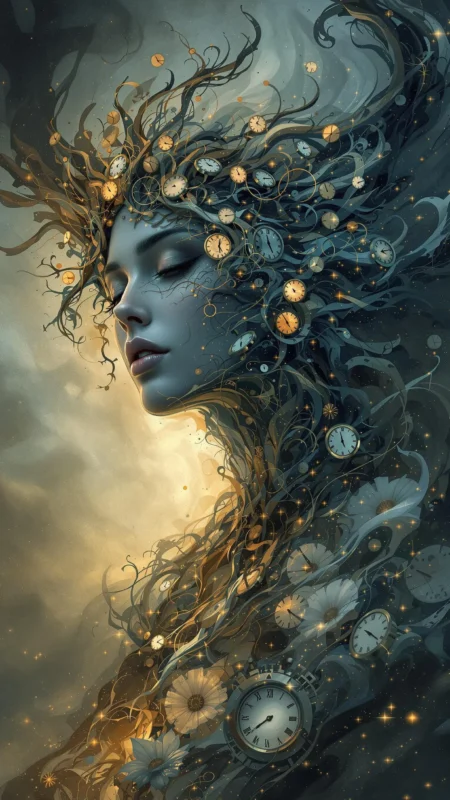


Time

Archetype Meaning & Symbolism

Cyclical, patient, relentless, fleeting, indifferent, structuring, transformative, eroding, healing, unforgiving

  • Do not chase me or flee from me. Walk beside me, and I will show you that every ending is a seed.

If Time is part of your personal mythology, you may…

Believe

  • The most profound changes are gradual, almost invisible, like the turning of a season.
  • The past is not a foreign country; it is the landscape of the present, and its ghosts walk beside us.
  • True wealth is not measured in possessions, but in the quality of one’s attention to the fleeting moment.

Fear

  • That your life will be a story told by an idiot, full of sound and fury, signifying nothing.
  • Looking back from your deathbed with a heart full of regret for the chances not taken and the time wasted.
  • Being forgotten completely, as if your entire existence will be erased by the indifferent sands of time.

Strength

  • A profound, almost geologic patience that allows you to weather storms and trust in slow, organic processes.
  • Strategic foresight, the ability to see the long-term consequences of present actions and plan accordingly.
  • A deep capacity for presence, understanding the infinite value of the ‘now’ because you are so aware of its fleeting nature.

Weakness

  • A tendency toward procrastination or passivity, a belief that what can be done today can always be done tomorrow.
  • Analysis paralysis, becoming so focused on the long arc of time and potential outcomes that you fail to act decisively in the present.
  • A pervasive melancholy or detachment stemming from an acute awareness of the impermanence of all people, things, and achievements.

The Symbolism & Meaning of Time

As an elemental force in one’s personal mythology, Time is the invisible architecture of your story. It is the riverbed that directs the flow of your life’s events, sometimes a gentle, meandering stream and other times a deep, incising canyon. To have this archetype active within you may mean you possess an innate understanding of rhythm, not just in music or poetry, but in the unfolding of human potential. You might see the long arc of history in a fleeting argument, or the seed of a future forest in a single act of kindness. Time, for you, is not an enemy to be conquered with productivity hacks, but a collaborator to be understood. It is the quiet presence that both heals the deepest wounds and erodes the proudest monuments, teaching a profound and sometimes painful humility.

This archetype is inherently dual. It is the force of entropy that guarantees all things fall apart, the source of rust and wrinkles. Yet it is also the prerequisite for growth, maturation, and wisdom. Time is what turns a sapling into a great tree, an apprentice into a master, and infatuation into enduring love. When Time is part of your mythos, you may live with this paradox constantly. You might feel a deep melancholy in the autumn light, an acute awareness of all that is passing away, while simultaneously feeling a sense of profound peace, trusting in the slow, unseen work of becoming. You understand that decay is simply the tilling of the soil for new life.

In a modern world obsessed with immediacy, the Time archetype offers a radical counter-narrative. It champions the slow food of the soul over the fast-food of instant gratification. Your personal mythology might be a testament to long-term projects, relationships that deepen over decades, and a wisdom that is cultivated, not downloaded. You may be drawn to history, to geology, to genealogy—any field that reveals the deep, stratified layers of what has come before. You are not just living in the ‘now’; you are living in a ‘now’ that is thick with the presence of the past and the potential of the future. You are a curator of moments, understanding their value not just for what they are, but for where they came from and where they are leading.


Time Relationships With Other Archetypes

The Sage

The Sage’s wisdom is not innate; it is harvested from the fields of experience, and Time is the farmer. Time provides the Sage with the raw material of observation, the long case studies of human folly and grace, and the quiet space needed for reflection to distill events into understanding. The Sage without Time is merely clever, full of facts but lacking depth. Time gives the Sage’s knowledge the resonant, cellar-deep quality of wine that has aged to perfection. The Sage, in turn, honors Time by paying attention, by learning its lessons, and by teaching the virtue of patience to those who only see the ticking clock.

The Destroyer

The Destroyer archetype, like Shiva or Kali, is an agent of radical change and dissolution, but Time is the stage upon which this transformative dance occurs. Time is what allows decay to set in, what weakens foundations so the Destroyer’s work is possible. They are partners. The Destroyer brings the lightning strike, but Time is the atmosphere that allowed the charge to build. A person with both archetypes may feel a constant tension between the gradual erosion of Time and the sudden, cataclysmic intervention of the Destroyer. They may be a force for profound societal change, understanding both how to patiently wear down an institution and when to tear it down completely.

The Seed

The Seed archetype is pure potential, a tightly-bound promise of what could be. Time is the element that unlocks this potential. It is the rain, the sun, and the dark soil that allows the Seed to break open and become what it was meant to be. For a person whose mythos contains the Seed, Time is a crucial ally. There might be a deep, intuitive trust in their own unfolding, a patience with their ‘un-sprouted’ phases. They understand that you cannot rush a root system. Time, in this relationship, is not a pressure, but a nurturing presence, the silent, watchful gardener of the soul.

Using Time in Every Day Life

Navigating Career Transitions

When faced with a career change, one might invoke the Time archetype not to rush the process, but to honor its seasons. There is a time for grieving the old role, a time for exploring possibilities without pressure, a time for focused training, and finally, a time for stepping into the new identity. By viewing the transition as a cycle rather than a single, stressful leap, you can allocate your energy appropriately, allowing for rest and reflection instead of succumbing to the anxiety of an uncertain future.

Healing from Grief

The common narrative of grief is a linear progression from pain to acceptance. The Time archetype offers a more compassionate model: a spiral. You may find yourself circling back to moments of profound sadness even years later, but each time you revisit that emotional space, you are at a different elevation, with new perspective. Understanding this allows you to stop judging your healing process. It isn’t a failure to feel sorrow again; it is part of a deeper, cyclical integration of loss into the story of your life.

Fostering Creative Pursuits

Creativity has its own temporality, and aligning with the Time archetype helps you respect it. An idea may need a period of fallow inactivity, to lie dormant like a seed in winter. Another project might demand the intense, focused pressure of a deadline, like carbon compressed into a diamond. You learn to discern what kind of time a project needs: the slow, patient time of a redwood growing, or the frantic, fleeting time of a lightning strike illuminating the landscape. You become a steward of your own creative seasons.

Time is Known For

The Unstoppable Flow

Time is perhaps best known for its relentless, forward momentum. It is the river that never stops, the sand that always falls through the hourglass. This quality symbolizes inevitability, change, and the constant unfolding of reality, reminding us that stagnation is an illusion.

Cycles and Seasons

Beyond its linear progression, Time is recognized for its cyclical nature. The turning of day into night, the passage of the seasons, the rhythm of birth, life, and death. This aspect points to renewal, recurrence, and the idea that every ending is pregnant with a new beginning.

The Link Between Cause and Effect

Time is the necessary medium that connects an action to its consequence. It is the silent space between planting a seed and harvesting the fruit, between a kind word and its lasting impact. It represents patience, consequence, and the slow, invisible weaving of fate.

How Time Might Affect Your Personal Mythology

How Time Might Affect Your Mythos

When Time is a central element of your personal mythos, your life story may cease to be a linear race toward a finish line of achievements. Instead, it becomes a spiral, a series of recurring themes and lessons that you revisit with increasing wisdom. Your narrative might be less concerned with ‘what happened next’ and more with ‘how did this moment rhyme with a past one?’ Your personal mythos is not a chronicle of conquests, but perhaps a tapestry where threads of past, present, and future are woven together. You might see your childhood self not as a distant memory, but as a constant companion who informs your current choices, and your future self as a beacon guiding you. The great conflicts in your story may not be against external villains, but against impatience, against the desire for quick fixes, against the illusion that you are ever ‘finished’.

Furthermore, your mythos may be deeply concerned with legacy, but not in the conventional sense of fame or fortune. It could be a legacy of slow, cumulative impact: the garden you tended for forty years, the student you mentored, the quiet integrity you maintained when no one was watching. Your life’s central quest might be the quest for presence, for the ability to inhabit each moment so fully that it resonates with the weight of eternity. Your story becomes an exploration of temporal-magic, finding the sacred in the mundane sequence of days and honoring the slow, almost imperceptible, transformations that constitute a life.

How Time Might Affect Your Sense of Self

With Time as a key archetype, your perception of self may become fluid and expansive. You might see yourself not as a fixed personality, but as a process, a continuous state of becoming. This can foster a profound sense of self-compassion; you are more forgiving of your mistakes, seeing them as necessary points on a long developmental curve rather than permanent stains on your character. You may feel a deep connection to your own aging process, viewing wrinkles not as flaws, but as a map of your journey, a testament to the laughter and tears that Time has bestowed upon you.

This perspective could also grant you a unique form of personal sovereignty. You may feel less swayed by the urgent, ever-shifting demands of societal trends because your sense of self is anchored to a much longer timeline. Your identity is not built on the fleeting praise of others, but on the slow, internal accumulation of experience and character. You might see your ‘self’ as a multi-generational project, a vessel carrying the stories and genes of your ancestors and a caretaker preparing the way for those who will follow. This can lead to a stable, resilient sense of identity, one that is not easily shattered by the inevitable setbacks and changes of life.

How Time Might Affect Your Beliefs About The World

Your worldview, shaped by the Time archetype, may be one of deep, geological perspective. You see the events of the day’s news not as isolated crises, but as the latest ripples in long-running historical currents. This can lead to a sense of calm in the face of chaos, an understanding that civilizations, like people, go through seasons of growth, turmoil, and decay. You might perceive the world as an intricate, self-regulating system, a vast clockwork of interconnected causes and effects that unfolds with an intelligence far beyond human comprehension. This view could foster a profound respect for tradition, conservation, and institutions that have withstood the test of time.

Conversely, this long view could also fuel a revolutionary spirit. By understanding how slowly oppressive systems were built, stone by patient stone, you also understand that they can be dismantled through equally patient, persistent effort. Your worldview might be characterized by a strategic optimism, a belief not in quick victories, but in the eventual power of sustained, focused action. You see the world not as a static backdrop for human drama, but as a dynamic, evolving entity. You are less interested in assigning blame for the present state of affairs and more interested in understanding the historical processes that led here, and in planting seeds that may only bear fruit for future generations.

How Time Might Affect Your Relationships

In relationships, the Time archetype can manifest as a deep and abiding patience. You may view love not as a state of constant passion, but as a slow, collaborative art form, a sculpture that you and a partner carve together over a lifetime. You are likely to be a forgiving friend and partner, understanding that people change and that relationships must evolve to survive. You don’t discard a connection at the first sign of trouble; instead, you see conflict as a moment that, given time, can lead to deeper intimacy and understanding. You give people the space to grow at their own pace, trusting that the seeds of connection, if nurtured, will eventually blossom.

This same quality can also create a sense of distance. Your long-term perspective might make you seem detached or slow to commit, as you are weighing the potential arc of a relationship over decades, not weeks. You may struggle with the fast-paced, disposable nature of modern dating. Your love language might be consistency, the quiet accumulation of shared moments, which may be misinterpreted as a lack of passion by those who crave grand, immediate gestures. You value relationships that have history, that feel like a comfortable old sweater, and you may find it difficult to connect with people who live solely in the high-intensity blaze of the present moment.

How Time Might Affect Your Role in Life

If Time is your archetypal companion, you may find yourself naturally gravitating toward roles that involve stewardship, preservation, or long-term vision. You could be the family historian, the keeper of stories and photographs, the one who reminds everyone where they came from. In a community or organization, you might be the strategic planner, the one who asks, ‘What are the consequences of this decision in ten years? In fifty?’ You are not the person of the hour, but the person of the decades. Your perceived role is to provide context, to anchor the frantic present in the deep soil of the past and the open horizon of the future.

This can also mean your role is one of patient mentorship. You might be a teacher, a craftsman, or a leader who excels at nurturing talent over long periods. You see the potential in novices and have the patience to guide them through the slow, often frustrating, process of mastery. Your contribution is not a single, brilliant innovation, but the creation of an environment where others can grow and flourish over time. You may feel your purpose is to be a bridge, connecting the wisdom of one generation to the potential of the next, ensuring that valuable knowledge and traditions are not lost to the ceaseless current of change.

Dream Interpretation of Time

In a positive context, dreaming of Time may involve harmonious, natural cycles. You might dream of a seed sprouting, growing, fruiting, and decaying in a sped-up sequence, suggesting you are in tune with your own life’s seasons and are ready for a new phase of growth. Dreams of clocks with a steady, soothing tick or a river flowing cleanly and purposefully toward the sea can symbolize an acceptance of your life’s path and a trust in the unfolding of events. These dreams may arise when you have made peace with your past and are moving with confidence and patience toward the future, feeling ‘in the flow’.

In a negative context, dreams of Time can be fraught with anxiety. You might dream you are running in place while the world speeds by, or that you are trapped in a room where the clocks are spinning wildly backwards. Such dreams could signify a deep-seated fear of being left behind, a feeling of being stuck in the past, or a sense of life slipping away before you have had a chance to live it. Dreams of rapid decay, of your own body aging in a mirror, or of sand pouring through your fingers too quickly, may point to a profound anxiety about mortality, missed opportunities, and the relentless pressure to achieve before it’s ‘too late’.

How Time Archetype Might Affect Your Needs

How Time Might Affect Your Physiological Needs

When Time is a core component of your mythos, your relationship with your body’s fundamental rhythms could be profoundly intimate. You may find that your basic needs for food, water, and rest are governed by a deep, internal clock. You might naturally align with circadian rhythms, feeling a strong pull to wake with the sun and rest after dark. Honoring this internal timing can lead to a state of physiological balance and well-being. You understand that the body, like the earth, has its seasons: times for intense activity and times for fallow rest and recovery. For you, sleep is not a necessary evil, but a sacred pilgrimage into the restorative unconscious.

However, if your relationship with this archetype is strained, it can wreak havoc on your physical self. You might see your body’s need for rest as an enemy, a limitation to be overcome with caffeine and sheer willpower. You might try to ‘hack’ your biological clock, pushing yourself into burnout in a futile attempt to conquer time. This can lead to chronic stress, sleep disorders, and a feeling of being disconnected from your own physical vessel. Your body sends signals for rest and rhythm, but you, viewing time as a commodity you are always running out of, refuse to listen, leading to an eventual physiological rebellion.

How Time Might Affect Your Ideas of Belonging

Your need for love and belonging might be deeply intertwined with a sense of historical connection. You may find belonging not just with your contemporary friends and family, but with the long chain of your ancestors. Understanding their stories, their struggles, and their triumphs can create a powerful sense of being part of something much larger than your own life. This can lead to a deep appreciation for family traditions, heirlooms, and rituals. Love, for you, may be about creating new traditions, weaving your own story into the family tapestry, and feeling part of a narrative that stretches across generations.

This same temporal focus can also create feelings of alienation. You might feel ‘out of sync’ with the pace of modern society, where relationships can seem transient and disposable. You may feel a profound loneliness if you value deep, time-tested bonds in a world that often seems to prefer quick, superficial connections. The feeling of belonging might be elusive if you feel like an old soul, someone whose internal rhythm is a slow waltz while the world is dancing a frantic rave. This can lead to a retreat into solitude or a search for niche communities that share your appreciation for history, patience, and enduring connection.

How Time Might Affect Your Feelings of Safety

Your need for safety, filtered through the lens of the Time archetype, is likely focused on long-term stability and predictability. Safety isn’t just a locked door at night; it’s a retirement account, a well-tended garden that will feed you next season, and a durable home built to withstand the storms of decades. You may find security in creating structures, plans, and routines that create a predictable and stable future. The very act of planning, of projecting oneself into the future and mitigating potential risks, can be a powerful source of comfort. Safety is the belief that you have built a vessel strong enough to navigate the long river of your life.

Conversely, an over-identification with Time can create a unique kind of insecurity. The acute awareness that all structures eventually decay, that even the most careful plans can be undone by unforeseen events, can lead to a pervasive, low-grade anxiety. The very force you rely on for security—the predictable unfolding of time—is also the force that guarantees eventual loss and decay. This might lead to a kind of planning-paralysis, where the fear of making a wrong long-term choice prevents you from taking any action at all. Or, in its shadow form, it could fuel a reckless ‘carpe diem’ attitude that jeopardizes future safety for immediate sensation, a fearful response to the knowledge that time is finite.

How Time Might Affect Your Views of Esteem

Esteem, for someone with the Time archetype, is often built on the foundation of mastery and legacy. Your self-worth may come from the patient dedication to a craft or skill over many years, knowing that you have earned your expertise through slow, persistent effort. You respect yourself because you have put in the hours, done the work, and transformed yourself through discipline. Esteem is the quiet pride of the artisan who has spent a lifetime perfecting their work. It also comes from the idea of creating something that will outlast you, whether it’s a work of art, a thriving business, a well-raised child, or a positive impact on your community. Your self-respect is tied to being a good ancestor.

However, this focus can also be a source of profound insecurity. You may be prone to comparing your life’s timeline to others, creating immense pressure and anxiety if you feel you are ‘falling behind’. The societal expectation of achieving certain milestones by a certain age can weigh heavily on you. If your progress is slow and internal, you may struggle with low self-esteem because you lack the external markers of success that others accumulate quickly. The fear that you will run out of time before you have created your legacy or achieved mastery can be a constant, corrosive presence, undermining the very patience that is your greatest strength.

Shadow of Time

The shadow of the Time archetype emerges in two primary forms: tyranny and apathy. The tyrannical shadow manifests as a rigid, obsessive control over one’s own and others’ schedules. It is the micromanager who worships the clock, the parent who schedules every minute of their child’s day, the person for whom punctuality is the highest virtue and tardiness an unforgivable moral failing. This shadow is Chronos devouring his children: it consumes the joy of spontaneity and crushes creativity under the weight of relentless, unforgiving structure. There is no grace, no room for the meandering path; there is only the frantic, anxious adherence to a timeline, a desperate attempt to impose order on the fundamentally uncontrollable flow of life.

Conversely, the shadow of apathy is a profound nihilism born from an overdose of perspective. If everything eventually turns to dust, why bother building anything? If all memory fades, why bother creating meaning? This shadow leads to a deep passivity, a cynical detachment that masquerades as wisdom. It is the person who gives up on their dreams because they are ‘too old,’ or who fails to act against injustice because ‘it won’t matter in a hundred years.’ This is the slow, quiet decay of the soul, a surrender to entropy. It is the fear of time’s passage curdled into a resentful paralysis, where life is not lived but simply endured until it is over.

Pros & Cons of Time in Your Mythology

Pros

  • You may develop a rare and powerful perspective, allowing you to remain centered during crises and humble during successes.
  • You can cultivate a rich inner life and a deep capacity for focus, finding joy in the slow, deliberate processes of learning and creation.
  • You are likely to be a reliable and steadfast presence in the lives of others, someone who can be counted on to see things through to the end.

Cons

  • You might be perceived as plodding, indecisive, or emotionally distant by those who live in a more accelerated, spontaneous mode.
  • You may struggle with rapid change or unexpected opportunities, feeling thrown off by anything that disrupts your long-term plans and rhythms.
  • You could be susceptible to deep existential anxiety or depression, as you are more acutely aware than most of mortality and the impermanent nature of reality.