
The thunderbird is a powerful spirit being in the traditions of several Indigenous peoples of North America, usually pictured as a giant bird linked to storms and thunder. Thunderbird symbolizes storm-born power, protection, transformation, and the courage to speak what cannot remain hidden.
By Sidian M.S. Jones, personal mythologistHow these pages are made
Encounters
Meet Thunderbird inside a story
The Symbolism & Meaning of Thunderbird
Thunderbird means power that arrives with weather in its voice. It is not the gentle bird perched at the edge of a story. It beats its 

Its symbolism begins with the storm's double nature. Rain can feed crops and fill rivers, while lightning can burn a tree or take a life. Thunderbird therefore refuses the clean division between blessing and danger. Protection may require frightening strength. Renewal may begin with 
The creature's wings matter because they turn movement into consequence. Thunderbird does not wait for the world to become safe before it enters the air. It makes a weather system around its presence. This gives the archetype a visionary quality: it sees beyond the immediate ground, but it also carries the risk of mistaking altitude for wisdom. A high view can reveal patterns. It can also lose sight of the people below.
Do not pray for calm waters. Pray to build a vessel worthy of my storms.
Thunderbird is a creator because storms rearrange conditions. They break heat, move water, clear dead branches, and expose what a calm surface concealed. It is a purifier in the literal emotional sense of making the air impossible to ignore. The truth-speaker in this archetype does not polish a revelation before offering it. It names the pressure, the conflict, the danger, and the necessary change.
Yet Thunderbird's grandeur is not permission for domination. Traditional stories place such beings within relationships to land, people, animals, ancestors, and other powers. The archetype is strongest when its force serves something beyond display. Its majesty becomes meaningful when it protects life, clears a blocked path, or brings needed rain. Without that bond, the same force becomes spectacle, volatility, and damage.
To carry Thunderbird is to stand close to the charged edge between fear and awe. It asks for a life large enough to contain anger without worshipping it, vision without vanity, and protection without possession. Its lightning is not decoration. It is the sudden clarity that shows what the room has been hiding.
What It Means When You See Thunderbird: Signs & Symbolism
When Thunderbird keeps appearing in art, dreams, jewelry, stories, or chance encounters, the repetition may reveal less about the sky than about the scale of the life being sought. Of all the images available, this one has wings large enough to make weather. It catches the attention of someone who is tired of treating a major inner pressure as a minor inconvenience. The attraction may point toward a desire to become visible, formidable, or impossible to dismiss.
Curiosity gives the encounter one reading. The person may be looking for a form of courage that is not polished or agreeable. They may want to create a break in stale conditions, say the thing everyone circles, or protect someone without apologizing for the force required. Thunderbird becomes a picture of permission: not permission to hurt, but permission to stop shrinking a real capacity until others feel comfortable.
Unease gives the encounter another reading. A person may recognize how quickly protection can become control, how a righteous anger can scorch the ground, or how being the strongest presence in a room can leave no room for anyone else. If Thunderbird feels frightening, the image may be showing a power being avoided rather than a power being desired. The question is not whether the storm is good. It is whether its pressure has been named and given a responsible channel.
Grief changes the image again. Someone mourning a person, home, identity, or future may meet Thunderbird as a sudden weather front, a being that carries the unbearable fact that life has changed shape. The creature can make grief feel enormous without making it meaningless. Its storm may be the body's refusal to pretend that loss is tidy. It may also suggest that renewal will not look like returning to the old calm.
What this archetype reveals is a hunger for transformation with evidence. A quiet resolution may not satisfy someone who needs to feel the air change. They may be seeking a sign of inner authority, or avoiding the responsibility that authority brings. Thunderbird asks both questions at once: what must be broken open, and what will be protected when the sky clears? The answer lives in the person's conduct, not in the appearance of the symbol alone.
Which of these is also you?
Collect 8 to make a mythos.
These archetypes were chosen because you are reading about Thunderbird.
Thunderbird in Mythology & Legend: Where the Symbolism Comes From
Thunderbird is not one single creature shared in one identical story. It is a family of powerful beings in the traditions of several Indigenous peoples of North America, and the details belong to particular communities rather than to a universal pan-Indigenous mythology.
Among peoples of the Pacific Northwest Coast, including the Kwakwaka'wakw, Nuu-chah-nulth, and some Coast Salish communities, Thunderbird appears as an immense supernatural bird whose wingbeats make thunder and whose eyes or beak flash lightning. Its image is carved, painted, woven, and performed in forms that can differ sharply by nation and family lineage. In Kwakwaka'wakw ceremonial art, Thunderbird may be shown gripping a 
For Anishinaabe peoples, thunderbirds are often called animikiig, or beings associated with thunder. In some traditional accounts they live in the upper world and send storms across the land. They may oppose underwater serpents or other dangerous beings, creating a struggle between forces above and below. This conflict should not be flattened into a universal good-versus-evil formula. Different communities and storytellers preserve different relationships between thunderbirds, humans, animals, and other powerful beings.
Lakota traditions speak of Wakíŋyaŋ, often translated as Thunder Beings. They are connected with storms, lightning, the four directions, and powers that can protect, punish, destroy, or renew. In some accounts, thunder beings confront forces that threaten order. Their lightning can be feared as much as welcomed. A storm may bring life-giving rain, yet the same storm can strike a tree, kill a person, or reshape the ground. The being therefore carries force that is not softened for human comfort.
Some Plains and Great Lakes traditions describe thunderbirds as guardians against dangerous water beings, while other stories emphasize their distance, majesty, or capacity to harm. In one tradition a thunderbird may be a defender; in another telling, a 

Modern popular culture often turns Thunderbird into a generic mascot for boldness, but the older stories are more specific and more demanding. They connect storms with kinship, place, ceremony, moral tension, and the limits of human control. The respectful meaning is not merely that Thunderbird is powerful. It is that power belongs within relationships, and that weather, protection, destruction, and renewal can arrive in the same wingbeat.




Thunderbird and Its Relationships With Other Archetypes
Whale
“I lift whales from the sea and carry them up to the mountains to feed.”
In stories of the Nuu-chah-nulth, Quileute and other Pacific Northwest peoples, Thunderbird seizes whales from the ocean in its talons. Whale beside Thunderbird is the meeting of sky and deep water, the greatest power above taking hold of the greatest below.
Visit Whale
Tsunami
“When Whale and I fought, the ground shook and the sea rushed over the villages.”
Several Pacific Northwest peoples tell of a great struggle between Thunderbird and Whale that shook the earth and flooded the coast, and researchers have linked these stories to the Cascadia earthquake and tsunami of January 1700. Tsunami beside Thunderbird shows oral tradition as memory, a story that kept a real catastrophe in mind for three centuries.
Visit TsunamiLightning
“Lightning flashes from my eyes, and I carry a serpent made of it as my weapon.”
In Nuu-chah-nulth tradition, Thunderbird's eyes flash lightning and it hurls Lightning Serpent, a creature it keeps with it, to strike whales. Lightning gives Thunderbird its sudden truth, the force that cannot stay hidden once it shows itself.
Visit Lightning
Thunder
“When I beat my wings, the sound rolls across the whole sky.”
Across many peoples of North America, from the Great Lakes to the Pacific, thunder is explained as the beating of Thunderbird's wings. Thunder beside Thunderbird is a voice too large to ignore, the person whose words, once spoken, are heard everywhere.
Visit Thunder
Eagle
“People carve me with an eagle's hooked beak and wide wings, only far larger.”
Thunderbird is often shown with the features of an eagle, a bird honored in many Native American traditions for flying highest. Eagle is the bird people can see, and Thunderbird the power they glimpse through it.
Visit Eagle
Thunderbird also keeps company with the Ojibwe tradition: Bald Eagle, Dreamcatcher, Muskrat, Turtle and Wendigo.

Thunderbird in Dreams: Meaning & Interpretation
Dreaming of Thunderbird often brings a force that has outgrown ordinary language. The dream may gather anger, grief, ambition, or a long-delayed truth into the shape of a storm-bringing being. Its 
The dream is doing more than delivering a message. It is giving the dreamer a body large enough to hold contradiction: protection that frightens, destruction that clears ground, and magnificence that cannot be possessed. A calm Thunderbird may let the dreamer approach power without panic. A furious one may make hidden conflict visible. The surrounding weather, the dreamer's distance from the bird, and the feeling on waking matter more than any fixed dictionary meaning.
Thunderbird landing quietly near a house suggests that a large truth or protective force has entered ordinary life without needing to announce itself. If the dreamer feels relief, the image may offer permission to trust a strength already present. If the bird watches without moving, the dream may be holding a threshold open rather than demanding action.
Thunderbird tearing the sky apart, chasing the dreamer, or striking the ground can warn of power moving faster than judgment. The dream may belong to anger, upheaval, or fear of becoming the person who causes the storm. Thunderbird carrying someone above the clouds can feel liberating, but a fall or broken wing may point to inflated certainty, exhaustion, or grief after a great release.
Thunderbird: Positive & Negative Meanings
Positive Meanings
- Protective when danger is real
- Speaks difficult truths plainly
- Creates movement after stagnation
- Sees patterns from a wider view
- Brings courage to moments of upheaval
- Can turn grief into renewal
Negative Meanings
- Mistakes intensity for truth
- Becomes volatile under pressure
- Uses protection to justify control
- Confuses destruction with cleansing
- Overwhelms quieter people
- Finds it difficult to land after the storm

The Shadow of Thunderbird
Thunderbird's shadow begins when force becomes identity. A person may start to believe that every problem requires a 
Its volatility can turn ordinary disagreement into a weather event. A hard conversation becomes a declaration; a boundary becomes a punishment; a frightened reaction becomes a performance of strength. The person carrying this shadow may also hide exhaustion behind majesty. If everyone expects the storm-bringer to remain impressive, there is little room to admit confusion, ask for help, or come down to ground level.
Thunderbird can also mistake destruction for purification. Burning away what is false may sound clean, but real lives contain attachment, history, and unfinished repair. The shadow asks whether the storm is clearing a path or merely proving that it can. Its remedy is not timidity. It is proportion, accountability, and the willingness to protect without possessing the people or places being protected.
How Did You End Up at Thunderbird?
Which verdict about yourself has kept you perched above the storm, certain you must always be the one who brings the lightning and never the one who asks for shelter?
What was missing from your early sky, and how are you trying to supply it for yourself now, with wings wide enough to protect everyone but nowhere quiet to land?
Has Thunderbird turned up in your life, in a dream, a moment, a person? Put it on your page and join its kin, or tell the first story.


 Written by Warren,
for you alone
A reading by Warren
What Thunderbird means for you
This page says what Thunderbird means. Warren can tell you why it is showing up for you, now.
Thunderbird: Frequently Asked Questions
- What does Thunderbird symbolize?
- Thunderbird means power that arrives with weather in its voice. It is not the gentle bird perched at the edge of a story.
- What is the spiritual meaning of Thunderbird?
- When Thunderbird keeps appearing in art, dreams, jewelry, stories, or chance encounters, the repetition may reveal less about the sky than about the scale of the life being sought. Of all the images available, this one has wings large enough to make weather.
- What does Thunderbird represent?
- Thunderbird is not one single creature shared in one identical story. It is a family of powerful beings in the traditions of several Indigenous peoples of North America, and the details belong to particular communities rather than to a universal pan-Indigenous mythology.
- What does it mean to dream about Thunderbird?
- Dreaming of Thunderbird often brings a force that has outgrown ordinary language. The dream may gather anger, grief, ambition, or a long-delayed truth into the shape of a storm-bringing being.
- What is the shadow side of Thunderbird?
- Thunderbird's shadow begins when force becomes identity. A person may start to believe that every problem requires a strike from above, that calm means weakness, or that being needed as a protector excuses the damage caused by constant vigilance.
- What are the positive and negative meanings of Thunderbird?
- Protective when danger is real. Mistakes intensity for truth.
- What does a Thunderbird tattoo mean?
- Often, a person wears Thunderbird to mark protection, survival, or a bond with storm-born strength. Some choose it to honor Indigenous heritage or a specific cultural tradition. Others use the image for transformation, fierce independence, or a private promise to speak plainly.
Characteristics of Thunderbird
- Covering:
- feathered
- Form:
- winged
- Size:
- giant
- Kind:
- bird
- Active when:
- cathemeral
- Habitat:
- sky
- Element:
- air
- Tradition:
- Ojibwe, Lakota
Thunderbird is a mythic composite rather than a zoological species, and its physical details change between communities and artistic traditions. Across those depictions, the creature links avian anatomy with weather effects, making wingbeats, eyes, beak, and movement part of the storm itself. Its unusual feature is not simply enormous size, but the way bodily action becomes a natural event: a bird does not merely inhabit thunder, it produces the conditions people hear and see.
Get the next one
Essays on personal mythology, archetypes, and the stories we tell ourselves.
Take Thunderbird home
Printed to order and shipped to you. Please allow a few extra days for production.
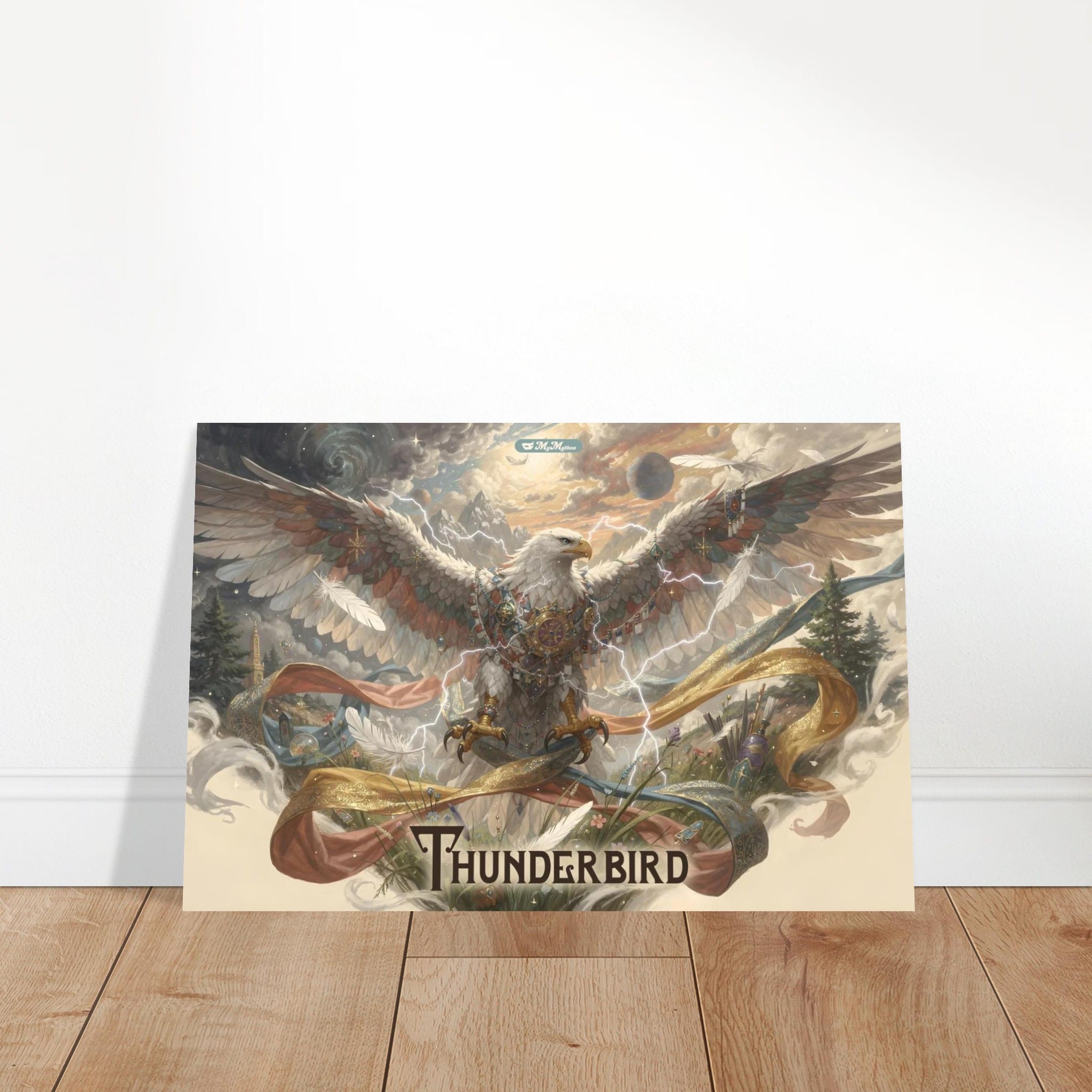
On your wall
Material
Sale! Was $19.00, now $14.25

In your hands
Size
Color: White
Sale! Was $18.00, now $13.50
From elsewhere
Paid links: if you buy through these, MyMythos earns a small commission at no cost to you.