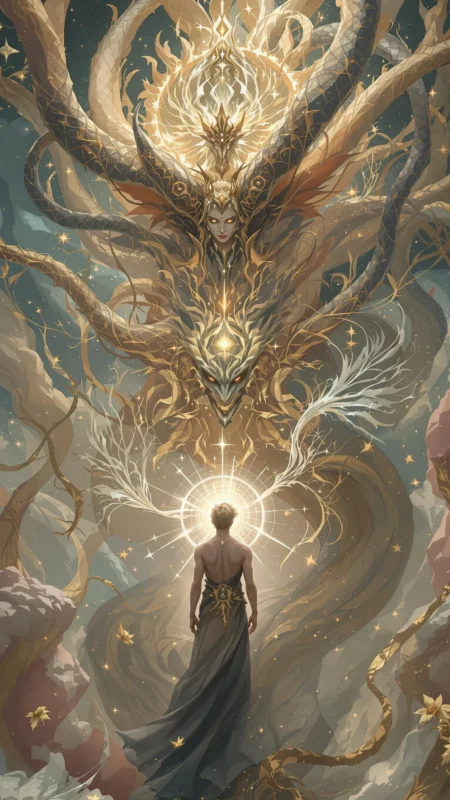


Thrud

Archetype Meaning & Symbolism

Strength, potential, legacy, coveted, protected, divine, valiant, resolute, untamed, nascent

  • My strength is not a prize to be won by cunning, but a river that carves its own course. Do not seek to dam it: learn to swim in its current.

If Thrud is part of your personal mythology, you may...

Believe

  • You may believe that your core strength is an inherited gift, a sacred trust passed down through your lineage, and your primary responsibility is to honor and cultivate it.
  • You may believe that true power does not need to be constantly demonstrated; its quiet existence is enough, and its greatest expression is often in wise restraint.
  • You may believe that your potential is worthy of protection and that it is wise to be discerning about who you allow into your inner world.

Fear

  • You may fear that your potential will be co-opted, used, or diminished by others before you have the chance to fully realize it for yourself.
  • You may fear that you will never live up to the immense potential you feel within, that you will remain a 'daughter of Thor' but never become a force in your own right.
  • You may fear that you are too dependent on others for protection, forever needing a guardian to fend off the world's challenges.

Strength

  • You possess a deep well of innate resilience and a foundational self-worth that is not easily shaken by external events or opinions.
  • You have a natural talent for discernment, an ability to sense the underlying motives of others and recognize those who seek to exploit versus those who seek to support.
  • You are a patient cultivator, capable of nurturing your own and others' talents over the long term, understanding that true strength takes time to mature.

Weakness

  • You might have a tendency toward passivity, waiting for your potential to be recognized or for a 'protector' to clear your path, rather than taking initiative yourself.
  • You may become overly reliant on the idea of your potential, using it as a substitute for tangible action or achievement in the world.
  • Your protective instincts can curdle into suspicion, making it difficult to trust new people and leading to a self-imposed isolation from potentially valuable connections.

The Symbolism & Meaning of Thrud

To carry the Thrud archetype within your personal mythology is to be intimately acquainted with the nature of potential. You are not defined by a litany of heroic deeds but by a profound and often unspoken capacity for them. Thrud is the embodiment of inherited strength: a force that exists within you as a birthright, independent of any external accomplishment. This archetype speaks to the part of the self that holds immense, sometimes intimidating, power in a latent state. It is the thunder before the storm, the coiled spring, the story waiting for its first line. Your personal narrative may revolve around the quiet, steady process of growing into this power, learning its weight and contours before you are ever called upon to use it.

The presence of Thrud also introduces a crucial theme: the protection of one's own nascent power. Like Thrud, coveted by the cunning dwarf Alvíss, your potential may attract those who wish to claim it, define it, or use it for their own ends. The central tension in your mythos might not be an external battle, but an internal and interpersonal one. It is the challenge of discernment, of learning to distinguish between those who see your value and those who see your utility. This archetype teaches that true wisdom lies not in hoarding one's gifts, but in being a judicious guardian of them, allowing them to mature in safety until their deployment can be an act of sovereign will, not of appropriation.

Ultimately, Thrud symbolizes a form of sovereignty that is inherent, not earned. She is the daughter of a god, and her value is a given. In a world that often demands constant proof of worth through productivity and performance, the Thrud archetype offers a radical alternative: the belief in a foundational, unassailable self-worth. Your value is not in what you do, but in the divine potential you carry. Life, therefore, may become less a quest for validation and more an act of inhabitation: learning to live comfortably and confidently within the temple of your own being, knowing its sacredness without needing a congregation to affirm it.


Thrud Relationships With Other Archetypes

The Sculptor

The Thrud’s relationship with The Sculptor is, perhaps, one of fraught, divine potential. Where the Thrud is a landslide of raw marble, all unformed power and jagged edges, The Sculptor is the quiet intention of the chisel. They may not see a force of destruction, but rather the magnificent, untamed material from which a masterpiece could be hewn. The interaction could be a painful one; every chip of the hammer a small death to the Thrud’s chaotic freedom, every moment of shaping a confrontation with the limitations of form. Yet, The Sculptor may be the only archetype capable of revealing the sublime figure hidden within the Thrud’s tumultuous existence, transforming a geological event into a god, suggesting that true power is not found in the avalanche, but in the statue that remains after the dust has settled.

The Glassblower's Pipe

One might view the Thrud as the searing, untamed breath of the furnace, a blast of pure, formless heat capable only of melting and destruction. In this dynamic, The Glassblower’s Pipe could represent the fragile, alchemical channel through which such raw energy is transformed into something of delicate, crystalline beauty. The relationship is one of profound symbiosis and immense risk. The Pipe must contain a power that could shatter it in an instant, yet without its narrow, guiding structure, the breath is merely a destructive tantrum. The Thrud, in turn, may find its overwhelming force given purpose and elegance, its chaotic exhalation spun into a vessel that can hold light. It suggests that the most overwhelming energies may require not a fortress to contain them, but a precise and vulnerable conduit to give them meaning.

The Unsent Letter

The Thrud’s very existence could be seen as a kind of Unsent Letter, a message of immense passion and weight that, in the fury of its composition, rips the very paper it is written on. The relationship here is one of tragic miscommunication, where intent and impact are forever divorced. The Thrud may possess a deep well of love, a brilliant idea, or a profound sorrow, but it is expressed with the force of a slammed door or a toppled shelf, the collateral damage obscuring the original, delicate sentiment. The words are all there, perhaps, but they are scrawled, blotted, and folded into an unrecognizable shape. This archetype reminds us that the Thrud’s path of destruction may be paved with the most earnest of intentions, each footprint a powerful, misunderstood syllable in a letter that will never, and could never, arrive as it was meant.

Using Thrud in Every Day Life

Developing Latent Potential

When you feel a deep, untapped well of talent within, the Thrud archetype provides a map. It suggests that this power is a birthright, not an anomaly. Instead of questioning its existence, you might focus on creating the right conditions for it to flourish, much like a garden requiring protection from pests and the right amount of sun. You may find yourself curating your environment and relationships to safeguard this burgeoning ability until it is strong enough to stand on its own.

Setting Energetic Boundaries

If you find your energy, ideas, or vitality are often sought after or co-opted by others, invoking Thrud offers a model for protection. Her mythology, particularly the tale of Alvíss, is a lesson in discernment. You may learn to recognize those who approach with transactional cunning versus those who approach with genuine respect. This archetype encourages not a wall of aggression, but a quiet, powerful assertion of sovereignty over your own inner resources.

Claiming Your Lineage

The Thrud archetype may surface when you are grappling with your family history or inherited traits. She represents the positive embodiment of a legacy. Instead of feeling burdened by the past, you could see yourself as the inheritor of a specific kind of strength, a unique gift passed down through generations. Your work then becomes not to escape this lineage, but to understand it, refine it, and express it in a way that is uniquely your own, carrying the ancestral fire into the future.

Thrud is Known For

Daughter of Thor and Sif

Her identity is inextricably linked to her parentage. She is the child of the God of Thunder and a golden-haired goddess, inheriting a potent combination of formidable power and divine grace.

The Pursuit of Alvíss

She is the object of desire in the poem *Alvíssmál*, where the dwarf Alvíss (All-Wise) attempts to win her hand. Her father, Thor, intervenes, tricking the dwarf into a contest of wits that lasts until sunrise, turning him to stone and protecting his daughter's sovereignty.

Valkyrie Association

Her name, meaning 'strength,' appears in lists of the Valkyries, the divine maidens who choose the slain and guide them to Valhalla. This associates her with fate, battle, and the raw power of life and death.

How Thrud Might Affect Your Personal Mythology

How Thrud Might Affect Your Mythos

When Thrud shapes your personal mythos, your life story may cease to be a linear progression of goals achieved and instead become a cyclical tale of self-discovery and preservation. The central plot is not about conquering the world but about cultivating the self. Your narrative is one of potentiality, where the most significant events are not loud victories but quiet moments of realization: the instance you recognize a deep, ancestral strength within you, the moment you successfully fend off an energy vampire with a firm but gentle boundary, the day you finally feel you have grown into your own skin. The antagonist in your story is often not a person, but a force: the subtle pressure to perform, the lure of external validation, or the cunning voices that seek to exploit your nascent talents.

The climax of a Thrud-infused mythos is often internal. It is the moment of sovereign claim, when you fully accept your own power and its attendant responsibilities. This is not necessarily a public declaration but a private coronation. Your life story becomes a testament to the idea that the greatest power is the one held in reserve, and the greatest wisdom is knowing when not to act. The supporting characters in your mythos are guardians and mentors, those who, like Thor, use their own wisdom to protect your growth, rather than those who, like Alvíss, seek to possess it. Your tale becomes a quiet epic, a subtle but profound journey toward becoming the person you were always meant to be.

How Thrud Might Affect Your Sense of Self

With Thrud as a guiding archetype, your perception of self could be anchored in a sense of innate, unshakable value. You might see yourself not as a project to be completed or a flawed being to be fixed, but as a vessel of immense, if sometimes dormant, power. This perspective can foster a deep and abiding self-respect that is not contingent on external achievements or the opinions of others. You may feel a kinship with things that grow slowly and powerfully: ancient trees, deep rivers, geological formations. Your identity is rooted in being rather than doing, and your self-worth is a quiet, foundational certainty, like bedrock beneath the shifting soils of daily life.

This may also lead to a feeling of being 'not yet complete,' but in a way that is hopeful rather than lacking. You might perceive your own potential as a tangible presence, a silent companion on your journey. This can cultivate a patient and compassionate relationship with yourself, allowing room for growth, mistakes, and fallow periods. You understand that power, true power, requires time to mature. Consequently, you may grant yourself the grace to exist in a state of becoming, trusting the process and honoring the divine inheritance that flows through you, even on days when it feels like a mere trickle.

How Thrud Might Affect Your Beliefs About The World

To view the world through the lens of the Thrud archetype is to see it as a landscape of energies, some nourishing and some draining. You may become acutely aware of the forces that seek to claim and commodify power, whether it be intellectual, creative, or spiritual. The world is not necessarily a hostile place, but it is one that demands discernment. You might develop a kind of 'energetic literacy,' learning to read the intentions behind people's words and actions. Your worldview is colored by the understanding that wisdom is a more effective shield than aggression, and that the greatest battles are often won not through direct confrontation but through clever, strategic defense of what is sacred.

You may also see the world as a place rich with lineage and inheritance. You might look at people and see not just individuals, but the culmination of ancestral stories, strengths, and struggles. This perspective fosters a sense of connection and a deeper appreciation for the invisible threads that bind us to the past. Society, in this view, is a complex tapestry of legacies, and your role is to weave your own thread with integrity and awareness. The world is not a blank slate for you to write on, but a sacred text to which you are privileged to add your own verse.

How Thrud Might Affect Your Relationships

In relationships, the Thrud archetype may compel you to seek connections that honor your sovereignty. You might gravitate towards people who act as 'guardians of your becoming'—friends, partners, and family who see your potential and want to see it flourish on its own terms, not for their benefit. These are the relationships that feel like a safe harbor, where you can be vulnerable in your growth without fear of your power being co-opted or your identity being shaped by another's agenda. You may find yourself assessing relationships based on a simple question: does this connection amplify my strength, or does it seek to harness it?

Conversely, you may develop a deep-seated wariness of relationships that feel transactional or possessive. You could have a low tolerance for flattery that feels like a key trying to unlock a vault, or for partnerships that demand you diminish your light to make someone else feel comfortable. The story of Alvíss serves as a constant cautionary tale, reminding you that intelligence and charm can mask an agenda of acquisition. This may sometimes lead to a protective isolation, a hesitancy to let others in. The challenge becomes learning to build a gate, not a wall, allowing worthy companions to enter the sacred garden of your inner world while keeping trespassers out.

How Thrud Might Affect Your Role in Life

Your perceived role in life, under the influence of the Thrud archetype, may shift from that of a protagonist to that of a vessel or a guardian. You may not feel called to be the hero who slays the dragon, but rather the sacred grove where the dragon sleeps, holding a power that is respected and left in peace. Your purpose could feel less about active achievement and more about cultivation and preservation. You are the keeper of a unique flame, and your primary duty is to ensure it is not extinguished by careless winds or stolen by those who covet its light. This role is not passive: it requires immense strength, vigilance, and wisdom.

You may see your function in your community or family as being a source of quiet, steady strength. You are the anchor in the storm, the one whose presence is a reminder of resilience. Your contribution is not always visible or loud, but it is foundational. You might find your calling not in leadership that directs, but in leadership that supports, creating the conditions for others to thrive. Your life's work could be the slow, deliberate process of embodying your own potential so fully that you inspire others to do the same, proving that the most profound impact is often made by simply being, authentically and powerfully, oneself.

Dream Interpretation of Thrud

In a positive context, dreaming of Thrud may signal a profound awakening to your own inherent power and worth. Her appearance could be a message from your subconscious that you are ready to acknowledge and begin integrating a deep, ancestral strength you may have previously ignored or been unaware of. She might appear as a powerful, serene figure, simply standing in a field or by a body of water, her presence alone a confirmation of your inner resources. Such a dream could be an invitation to step into a new phase of self-possession, to trust the potential that lies dormant within you, and to feel secure in your own skin without needing external validation. It is a dream of quiet coronation.

In a more challenging context, Thrud may appear in your dreams as a figure who is being pursued, trapped, or who is distant and inaccessible. You might dream of the dwarf Alvíss chasing her, symbolizing a part of you that fears your talents, energy, or kindness will be exploited by others. This dream could reflect anxieties about your boundaries being violated or your potential being 'stolen' before you have a chance to realize it for yourself. Alternatively, dreaming of Thrud locked in a tower or across an impassable chasm may represent a feeling of being disconnected from your own strength, a sense that your power is held captive by external circumstances, other people's expectations, or your own limiting beliefs.

How Thrud Archetype Might Affect Your Needs

How Thrud Might Affect Your Physiological Needs

The presence of Thrud in your mythos might translate physiologically into a deep, intuitive connection with your body's innate strength and resilience. Your physical needs are not just requirements for survival; they are sacred duties to the vessel of your power. Nourishment could become a conscious act of providing fuel for the inner divine spark, and rest is not laziness but the necessary quietude for power to gather. You may feel a pull toward activities that build foundational strength and endurance: weight training, long-distance hiking, or yoga practices that emphasize stability and rootedness. Your body is your first and most immediate legacy.

You might also develop a heightened sensitivity to what depletes your physical energy. You could feel, on a cellular level, when a situation or person is draining your vitality, prompting a visceral need for retreat and recharge. This is not hypochondria but a finely tuned internal compass guiding you toward a state of optimal potency. Health is not the absence of sickness, but the full and vibrant presence of your life force. Chronic fatigue or illness might be interpreted through this lens as a sign that your power is being mismanaged, blocked, or given away too freely, prompting a re-evaluation of your life's energetic budget.

How Thrud Might Affect Your Ideas of Belonging

When Thrud informs your need for belonging, the desire for love and connection becomes deeply intertwined with the concepts of lineage and sanctuary. Belonging is not about fitting in with the crowd, but about finding your 'clan'—the people who recognize the divine spark within you and honor it. These are the protective, Thor-like figures in your life who champion your growth and defend your sovereignty. Love, in this context, is an act of mutual guardianship, a shared commitment to protecting each other's becoming. You may seek friendships and partnerships that feel like a sacred alliance.

This can also create a powerful distinction between your inner circle and the outside world. The need for belonging is met by a few deep, resonant connections rather than a multitude of superficial ones. You may have a 'chosen family' that feels more real and significant than biological ties if those ties do not support your inherent nature. The risk here is a tendency towards clannishness or an excessive suspicion of outsiders. The deep comfort of your protective circle can make it difficult to trust new people, as the archetype constantly whispers the cautionary tale of the charming stranger with a hidden agenda.

How Thrud Might Affect Your Feelings of Safety

For one whose mythos includes Thrud, safety is not primarily an external construct of locks and alarms, but an internal state of capability and discernment. True security is rooted in the knowledge of your own strength and the wisdom to know when and how to wield it. You may feel safest not when you are hidden away, but when you are fully inhabiting your power, confident in your ability to handle whatever comes your way. This fosters a sense of 'portable safety'—a resilience that you carry within you, making you feel at home in the world because you are at home in yourself.

The myth of Alvíss provides a crucial layer to this sense of security: the importance of wisdom as a protective force. Safety, then, is also about intellectual and emotional vigilance. It is the ability to recognize a threat that comes disguised as an opportunity or a manipulator who comes bearing gifts. You may find yourself cultivating a sharp intuition and a habit of looking past surface appearances to perceive underlying motives. Your safety depends not just on your strength to fight, but on your wisdom to avoid the fight altogether by recognizing the 'dwarf' before he gets too close.

How Thrud Might Affect Your Views of Esteem

Esteem, through the lens of the Thrud archetype, is intrinsic and foundational. It is not built upon a scaffolding of achievements, praise, or social status. Instead, it arises from the quiet, certain knowledge of your own inherent worth and potential, a 'divine right' of the soul. Your self-esteem might be remarkably stable, less prone to the fluctuations of external success or failure. It is the esteem of the mountain, which does not need the validation of climbers to know its own majesty. This fosters a profound sense of self-possession and a quiet confidence that needs no announcement.

This deep-seated esteem means you may not be motivated by the same things as others. The pursuit of fame, accolades, or public recognition could feel hollow or irrelevant. Your sense of accomplishment comes from internal benchmarks: feeling that you have been a wise guardian of your energy, that you have acted with integrity, or that you have taken another step toward embodying your full potential. The danger is that this inner-directed esteem can sometimes appear to others as arrogance or aloofness. It is the challenge of the quietly powerful: to inhabit your self-worth without creating a chasm between yourself and the rest of the world.

Shadow of Thrud

The shadow of Thrud emerges when the archetype becomes unbalanced. In its diminished form, it manifests as chronic passivity, a perpetual state of 'potential' that never blossoms into kinetic energy. This is the individual who forever talks about the book they will write, the business they will start, or the person they will become, but who never takes the first concrete step. They see their strength as a given, an identity to be possessed rather than a capacity to be used. They may adopt the role of the perpetual damsel or prince, waiting for a 'Thor' to rescue them or a 'Alvíss' to give them purpose through conflict. Here, the sacred inheritance of strength becomes a comfortable prison, a justification for inaction, and a shield against the risks of genuine engagement with the world.

When the archetype is inflated, the shadow takes the form of arrogance and entitlement. The individual may believe their inherited 'divinity' or innate talent places them above others. They might look down upon those who have to struggle for what came to them as a birthright, showing a lack of empathy for effort and a disdain for earned wisdom. This shadow Thrud refuses to develop their gifts, believing their mere existence is sufficient. Relationships become tools for affirming their superiority, and they may surround themselves with sycophants who reflect their own un-examined grandeur. Their potential, instead of being a source of quiet confidence, becomes a bludgeon of social and spiritual elitism, isolating them in a fortress of their own perceived greatness.

Pros & Cons of Thrud in Your Mythology

Pros

  • You are likely to possess a deep, unshakable core of self-worth that is independent of external validation, providing immense emotional stability.
  • You are naturally protective of your personal energy and resources, making you less susceptible to manipulation or burnout.
  • You feel a powerful sense of connection to your heritage and legacy, providing a rich source of identity and meaning.

Cons

  • A focus on latent potential can lead to a state of passivity or procrastination, where the idea of future accomplishment replaces present action.
  • Your discerning and protective nature can easily sour into suspicion, making it difficult to form new relationships and fostering a sense of isolation.
  • You may be perceived by others as arrogant, aloof, or entitled due to your quiet confidence and lack of need for external approval.