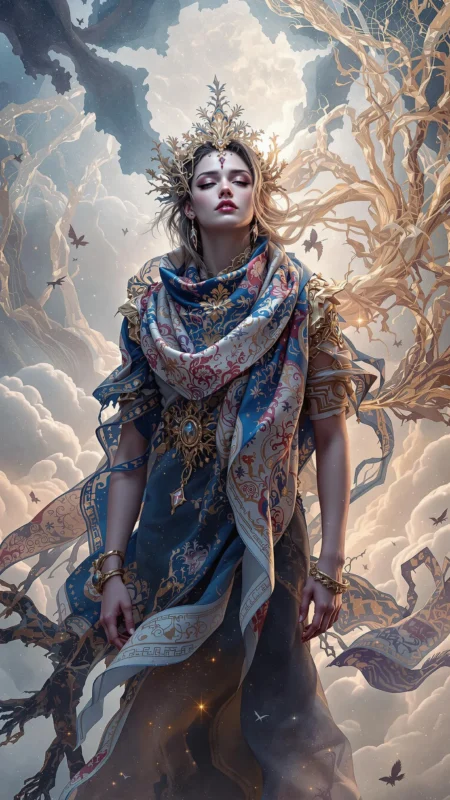


Silk Scarf

Archetype Meaning & Symbolism

Adaptable, fluid, elegant, fragile, concealing, revealing, decorative, binding, constricting, aspirational

  • Do not resist the wind that seeks to shape you; instead, learn to dance with it. True form is found in movement, not in stillness.

If Silk Scarf is part of your personal mythology, you may...

Believe

  • Beauty is not a luxury, but an essential form of communication and a moral good.
  • The most effective path is rarely the most direct; strength lies in yielding, adapting, and flowing around obstacles.
  • How something is said or done is just as important, if not more important, than what is said or done.

Fear

  • Being snagged, torn, or permanently stained, which represents an irreparable damage to your reputation or persona.
  • Being perceived as merely decorative, an accessory to someone else's story, without substance or agency of your own.
  • Crudeness, bluntness, and brute force—the aspects of the world that have no appreciation for delicacy and can shatter your carefully constructed harmony.

Strength

  • A profound adaptability, allowing you to gracefully navigate different social ecosystems and transform yourself to meet the moment.
  • A natural talent for diplomacy and social lubrication, capable of defusing tension and fostering harmony with a light touch.
  • A deep, life-enriching appreciation for aesthetics and beauty, which allows you to find and create elegance in the everyday.

Weakness

  • A tendency towards fragility and an aversion to conflict, which can lead to avoiding necessary confrontations and difficult truths.
  • A potential to use elegance and charm as a mask, concealing true feelings and creating a beautiful but impenetrable barrier to true intimacy.
  • A reliance on external markers of taste and appearance for self-worth, making your esteem vulnerable to criticism and imperfection.

The Symbolism & Meaning of Silk Scarf

In the personal mythology of a modern life, the Silk Scarf archetype may speak to the delicate membrane between our inner selves and the world we present. It is the curated surface, the beautiful, patterned story we weave about who we are. Its very nature is a duality: it is a shield, however fragile, from the world's coarseness, and yet it is also a signal, a beacon of taste and identity. To have this archetype in your mythos could mean you understand that surfaces are not necessarily superficial; they are the borderlands where our private reality meets public perception, and you are a master of this terrain. It suggests a life story not of epic battles, but of elegant solutions and subtle, decisive gestures.

The Silk Scarf could also symbolize inherited narratives. Like a vintage Hermès passed down through generations, it may carry the faint perfume of a grandmother, the stain from a mother's spilled champagne, the memory of a past life. Your personal mythology might be deeply connected to lineage, to the stories, tastes, and even the burdens of those who came before. You may feel that you are the current wearer of a long, complex story, and your role is to add your own knot, your own journey, to its fabric. The scarf is a tangible link to the past, a story worn on the skin.

Furthermore, this archetype is one of profound adaptability. It has no rigid structure of its own; it takes its shape from the wearer and the wind. For someone with the Silk Scarf in their mythos, this could translate to a core belief in fluidity. Identity is not fixed but situational. You may find power in your ability to be pliant, to fit into various social contexts with ease, to be the calming, decorative element in a chaotic room. It is the wisdom of yielding, the strength found not in rigidity but in the ability to flow around obstacles, to be carried by currents into unexpected, beautiful places.


Silk Scarf Relationships With Other Archetypes

The Antique Locket:

The Silk Scarf and the Antique Locket are both keepers of stories, but they operate on different principles of revelation. The Locket holds its secret—a photograph, a lock of hair—in a closed, metallic heart. Its story requires a deliberate act of opening. The Scarf, by contrast, wears its history on its surface. Its pattern is its story, its frayed edge a memory, its colors a mood. In a personal mythos, this relationship may represent the tension between the curated, public narrative (the Scarf) and the deeply private, protected core of the self (the Locket). One is for the world, the other is for the self, and you may find yourself navigating which story to tell and which to keep hidden.

The Wind:

The Wind is the Silk Scarf’s vital partner, the force that gives it life and motion. Without the Wind, the Scarf is a limp, folded square of potential. With it, it becomes a banner, a dancer, a streak of pure color against the sky. This relationship might symbolize a person’s deep connection to inspiration, to external catalysts that set their spirit in motion. They may feel most themselves when moved by an idea, a piece of music, or the energy of a charismatic person. The danger, of course, is a dependency on these external forces, a feeling of listlessness or uselessness when the winds of inspiration die down.

The Leather Jacket:

The Leather Jacket archetype offers a compelling counterpoint. Where the Jacket is about armor, grit, and a tough exterior built from experience, the Scarf is about vulnerability, grace, and a soft touch. They are opposing strategies for navigating the world. Yet, when they appear together in a personal mythos, they could signify a complex and integrated personality. This is the person who has built defenses against the world's harshness but has consciously retained a capacity for softness and beauty. It is the myth of the tender warrior, the sensitive soul with strong boundaries, the person who understands that one can be both protected and graceful.

Using Silk Scarf in Every Day Life

Navigating a Professional Transition:

When your career path feels like a dead end, the Silk Scarf archetype may suggest a change not of force, but of finesse. Instead of breaking down a door, you might find a new way to drape your skills over a different industry, using your adaptability to create a new, more flattering silhouette for your professional identity. It is about reframing your narrative, transforming your perceived limitations into unique, decorative features on your resume.

Mending a Delicate Relationship:

In a conversation fraught with unspoken tensions, this archetype could inform an approach of gentle intervention. It is the art of introducing a soft, beautiful subject to change the texture of the silence, of offering a comforting presence that doesn't demand, but simply covers the coldness for a moment. It is a way of binding a wound without pulling the knot too tight, allowing space for air and healing.

Reinventing Personal Style:

Feeling stuck in a static version of yourself may call for the Silk Scarf's medicine. This archetype encourages transformation through aesthetic play. It is the permission to add a splash of unexpected color, to try on a different persona for an evening. The scarf itself is an accessory, a non-permanent change that can alter an entire outfit, suggesting that identity itself might be something we can accessorize and experiment with, without committing to a total overhaul.

Silk Scarf is Known For

Elegance

It may represent a form of grace that seems effortless. The scarf does not shout; it whispers of heritage, of travel, of a certain knowingness. It is the finishing touch, the marker of deliberate and thoughtful beauty.

Transformation

A simple square of fabric, it can become a headband, a belt, a bandage, a flag of surrender, or a blindfold. It is known for its protean ability to shift its function and meaning based entirely on context and intent.

Concealment and Revelation

It is famous for the game it plays with visibility. It can hide a blemish, a scar, or an identity, yet its own beauty draws the eye. It reveals taste while concealing specifics, a paradox of simultaneous discretion and display.

How Silk Scarf Might Affect Your Personal Mythology

How Silk Scarf Might Affect Your Mythos

When the Silk Scarf becomes a central object in your personal mythos, your life story may eschew tales of brute force and epic confrontation in favor of a narrative of finesse. Your great victories might be quiet ones: the perfectly timed word that averted a crisis, the subtle shift in presentation that won the contract, the graceful exit from an untenable situation. Your mythos is not about changing the world through force, but about altering its texture, adding a layer of beauty or complexity that changes how everything is perceived. You are the diplomat of your own story, the artist, the one who understands that a whisper can be more powerful than a shout.

Your narrative may also be one of continuous, fluid transformation. You do not have one fixed identity but a wardrobe of them, each one authentic in the moment it is worn. Your story is less a linear progression and more a series of elegant adaptations. This can be a mythos of immense freedom, allowing you to move through different social worlds, professions, and relationships with ease. The central theme of your life might be the art of becoming, where the self is not a static entity to be discovered, but a beautiful fabric to be endlessly re-draped and re-imagined.

How Silk Scarf Might Affect Your Sense of Self

Your perception of self could be one of profound fluidity. You may not identify with a single, stable set of characteristics, but rather see yourself as a being capable of embodying different moods and energies, much like a scarf can be tied in countless ways. This can lead to a sense of resourceful adaptability, a confidence in your ability to meet any situation with the appropriate grace. You might pride yourself on your poise, your taste, and your ability to remain unruffled. The self is a work of art, a curation of beautiful surfaces and elegant gestures.

However, this self-perception might also carry a current of fragility. Silk snags easily. You may feel a persistent need to handle yourself with care, to avoid rough situations or coarse people who might damage your carefully constructed persona. There could be a fear that beneath the beautiful fabric, there is nothing substantial, or that your worth is entirely dependent on maintaining a flawless exterior. The self, in this view, is something precious and beautiful, but also terribly vulnerable and in constant need of protection from the unrefined world.

How Silk Scarf Might Affect Your Beliefs About The World

Your worldview may be filtered through a lens of aesthetics and subtlety. You might see the world not as a battlefield of competing truths, but as a tapestry of textures, colors, and currents. For you, beauty is not a frivolous extra; it is a fundamental language, a way of understanding and ordering reality. You may believe that the most profound changes happen not through revolution, but through the slow, steady introduction of a more beautiful, more harmonious way of being. Problems are not walls to be smashed but knots to be untangled with patience and a delicate touch.

This perspective could lead you to see connections and possibilities that others miss. You might notice the subtle shifts in social dynamics, the unspoken feelings that hang in the air like a scent. The world appears to you as a place of nuance, where the way something is done is just as important as what is done. You may find deep meaning in small gestures, in the quality of light on a building, in the drape of a stranger's coat. Life's meaning is found not in grand pronouncements, but in the accumulation of small, graceful moments.

How Silk Scarf Might Affect Your Relationships

In relationships, you may operate as the harmonizing element. You are perhaps the friend who knows how to gently change the subject when a conversation turns sour, the partner who can soothe a frayed nerve with a gesture of quiet comfort. Your approach to connection is likely artistic, viewing relationships as something to be composed with care and attention to detail. You may value tact, discretion, and unspoken understanding above blunt honesty, believing that some things are best left wrapped in a layer of protective grace.

This same tendency can create challenges. Your desire for harmony might lead you to avoid necessary conflicts, smoothing over problems rather than addressing them at their root. There is a risk of using your charm and grace as a beautiful screen, preventing others from seeing your true, unadorned self. You might bind yourself to others with threads of obligation and unspoken expectation, or feel constricted by partners who do not appreciate the nuance of your approach. The very elegance that draws people in could also be the thing that keeps them at a comfortable, artful distance.

How Silk Scarf Might Affect Your Role in Life

Your perceived role in life may be that of the quiet influencer, the éminence grise who shapes events from the wings rather than the center stage. You are not the monarch, but the trusted advisor whose soft-spoken counsel carries immense weight. Your power lies not in command, but in persuasion and atmosphere. You might see your function as bringing beauty, grace, and diplomacy to any group or situation you are a part of, transforming the mundane into something with a touch of magic. You are the one who elevates the conversation, the event, the project.

This can be a deeply satisfying role, but it also carries the risk of feeling like an accessory to someone else's life. If the Silk Scarf is always an addition—to an outfit, to a room, to a relationship—you may fear that you lack substance on your own. There can be a struggle against being seen as merely decorative, a beautiful object without its own agency or purpose. Your life's work might involve proving that your softness is a form of strength and that your decorative qualities are, in fact, essential.

Dream Interpretation of Silk Scarf

In a positive context, dreaming of a silk scarf—especially one that is flowing freely in the wind or being draped gently around you—can symbolize a newfound sense of freedom, creativity, and self-expression. It might suggest that you are entering a period of graceful transformation, shedding an old identity with ease. The scarf could represent a solution to a problem that requires finesse rather than force. To receive a silk scarf as a gift in a dream may point to a new, tender relationship or the recognition of your own elegance and worth by others.

Conversely, a dream featuring a silk scarf in a negative light can be unsettling. A scarf that is knotted too tightly, stained, torn, or used to bind you could symbolize feelings of being trapped, suffocated, or constricted by social expectations or a relationship. It might point to a secret that feels burdensome or a beautiful facade that is beginning to crumble under pressure. Dreaming of losing a precious scarf could represent a fear of losing your identity, status, or a cherished connection. It speaks to the anxiety of being exposed, damaged, or devalued.

How Silk Scarf Archetype Might Affect Your Needs

How Silk Scarf Might Affect Your Physiological Needs

From a personal mythology perspective, the Silk Scarf may elevate physiological needs beyond mere survival into the realm of aesthetics. The need for shelter becomes a need for a harmonious, beautiful space. The need for clothing transcends warmth and protection to become a primary mode of self-expression and sensory pleasure. You may feel a visceral aversion to harsh textures, discordant noises, or unpleasant smells, as they violate a fundamental need for a gentle and refined physical existence. Your body is not just a vessel to be maintained; it is a canvas to be adorned, a sensory instrument that requires pleasing input to function optimally.

This can mean that physical comfort is deeply intertwined with emotional well-being. A rough texture against the skin might feel like a personal affront, and a cluttered room could translate into genuine physical anxiety. Your physiological baseline requires a certain level of elegance and order. This is not mere fussiness; it is a core component of your mythos, where the physical world must reflect the soft, flowing nature of your inner self. Neglecting this need for a refined environment could lead to a sense of profound and inexplicable physical depletion.

How Silk Scarf Might Affect Your Ideas of Belonging

Your need for belonging and love may be fulfilled in circles that value what you value: subtlety, culture, and a certain aesthetic sensibility. You likely seek a tribe that speaks your language of nuance and unspoken understanding. The shared appreciation for a beautiful turn of phrase, a piece of art, or an elegant gesture can form a bond that feels more profound and authentic to you than more overt declarations of fellowship. The scarf itself can be a signal, a quiet signifier to others that you are one of them, creating an instant sense of rapport and belonging.

This can also lead to a sophisticated kind of isolation. Your refined tastes might make it difficult to connect with people you perceive as lacking in grace or subtlety, creating a self-imposed exile from the messier, more common aspects of human connection. You may feel a sense of belonging that is conditional, dependent on maintaining a certain standard of elegance. In romantic relationships, you might crave a partner who understands your need for beauty and space, but you may struggle if they cannot see past the decorative surface to the vulnerable person beneath.

How Silk Scarf Might Affect Your Feelings of Safety

Safety, through the lens of the Silk Scarf archetype, may be perceived less as a matter of physical fortitude and more as a game of strategic concealment and social navigation. True safety is not found in high walls or heavy armor, but in the ability to become a social chameleon, to blend in or stand out as the situation requires. The scarf offers a soft, thin barrier—it can hide you, misdirect attention, or signal that you belong, thus neutralizing a threat before it becomes physical. Safety is the art of not being a target, of moving through the world with such grace that you create no friction.

However, this reliance on finesse creates its own vulnerability. The silk scarf offers no real protection against brute force; it can be torn away in an instant. This may foster a deep-seated fear of raw, unpredictable aggression and a constant, low-level anxiety about the world’s potential for crudeness. Your sense of safety might be precarious, dependent on maintaining control of social situations and avoiding any context where your subtle arts of diplomacy would fail. You may feel safe only within civilized, predictable environments.

How Silk Scarf Might Affect Your Views of Esteem

Esteem, for you, could be intricately woven with your ability to project grace and poise. Self-worth may be derived from being perceived as tasteful, cultured, and effortlessly elegant. You might feel a deep sense of pride in your ability to handle difficult situations with a light touch, to create beauty in your surroundings, and to possess a certain ineffable charm that others admire. Your esteem is built on the successful performance of this elegant self, a self that never appears to be trying too hard.

This foundation for esteem can be fragile. Because it relies on external perception and the maintenance of a flawless facade, it can be shattered by a single misstep—a social gaffe, a poorly chosen word, a literal stain on your clothes. This could lead to a crippling perfectionism and a constant fear of being judged. A core challenge might be to untangle your intrinsic self-worth from this beautiful but precarious performance, to believe you are valuable even when you are wrinkled, unadorned, and imperfect.

Shadow of Silk Scarf

The shadow of the Silk Scarf archetype emerges when its grace curdles into deception. It is the art of the beautiful lie, the sophisticated manipulation that smiles while it suffocates. In its shadow form, the desire for harmony becomes a tyrannical force, demanding a placid, pleasing surface at all costs and silencing authentic, messy emotion. It is the passive aggression honed to a fine art, the compliment with a poisoned tip, the comfort that is actually a form of control. This shadow binds and constricts, wrapping others in a silky cage of expectations and unspoken rules, all under the guise of civility and taste.

Furthermore, the shadow can manifest as a profound paralysis, a life that remains purely decorative. The fear of being snagged or stained becomes so overwhelming that no risks are taken. The scarf remains perfectly folded in a drawer, its potential for flight and dance unrealized. This represents a capitulation to fragility, a choice to be an object rather than an agent. It is the tragedy of a life that prioritizes pristine appearances over lived experience, resulting in an elegant, empty mythos—a story that is beautiful to look at but signifies nothing.

Pros & Cons of Silk Scarf in Your Mythology

Pros

  • Your life is imbued with an appreciation for beauty and artistry, elevating the mundane into something meaningful.
  • You possess a rare talent for social navigation, allowing you to move through complex human dynamics with poise and effectiveness.
  • You can transform yourself and your environment with subtle grace, adapting to change with a sense of style and creativity.

Cons

  • You may be misjudged as superficial or frivolous by those who mistake your delicacy for a lack of substance.
  • A deep-seated aversion to conflict and messiness can lead to avoidance, preventing the resolution of important issues.
  • Your self-worth can become dangerously dependent on maintaining a flawless exterior and social poise, leading to high anxiety.