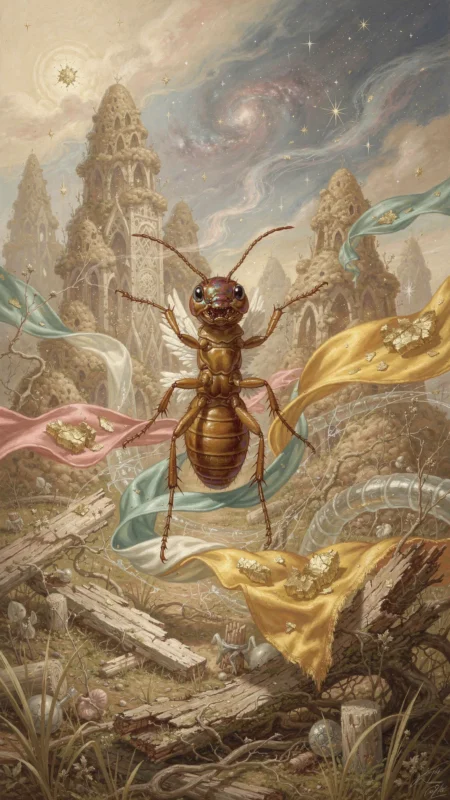
The House
The relationship between the Termite and the House may be one of the most intimate and quietly devastating in the archetypal landscape. The House stands as a monument to permanence, a bulwark of right angles and sealed rooms meant to shelter a life from the chaos of the outside world. Yet the Termite works from within, a silent congregation in the joists and beams, whispering of impermanence with every grain of wood it turns to dust. It is not a war of open siege, but a slow, digestive process; a hollowing out of strength, a transformation of structure into a fragile shell. This dynamic could represent the secret that erodes a family from the inside, the unspoken anxiety that consumes a mind, or perhaps the humbling truth that the systems we build for our own security are often undone by the very nature they seek to exclude.
The Forest
Where the Termite is a terror to the House, in the Forest it could be said to find its sacred purpose. Here, its tireless deconstruction is not a violation but a form of communion, an essential act in the great, untidy cycle of life and death. The Forest, with its fallen giants and decaying logs, does not see the Termite as a pest but as a crucial collaborator. It is the forest’s quiet digestive tract, the humble agent that coaxes the stubborn memory of a towering pine back into the soil, allowing new life to spring from what has been. In this context, the Termite might be seen as a custodian of humility, a force that ensures no life overstays its welcome, transforming the rigid architecture of the dead into the soft potential of the living.
The Archivist
The Archivist and the Termite may represent two opposing cosmic principles: the impulse to record and the inevitability of erasure. The Archivist builds a fortress of vellum, microfilm, and acid-free paper against the ravages of time, meticulously cataloging the past to preserve its narrative shape. The Termite, however, is an agent of pure entropy, for whom a historical manuscript and a discarded piece of lumber are one and the same—matter to be un-made. It tunnels through the very concept of the past, rendering it into a mouthful of indiscriminate pulp. This relationship, perhaps, speaks to the profound fragility of our stories. Every library, every museum, every carefully constructed legacy may have its own metaphorical termites at work—the slow fade of cultural memory, the misinterpretation of text, the physical decay that ensures no story, ultimately, is told forever.


 Believe
 Fear
Fear Strength
 Weakness