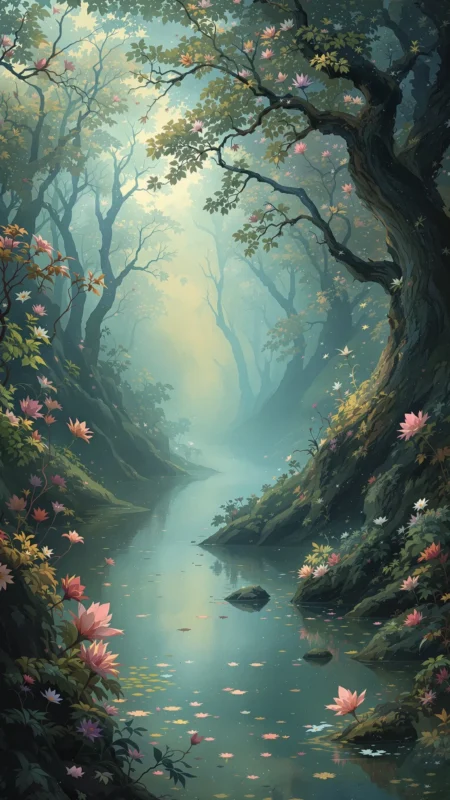
Swamp

Archetype Meaning & Symbolism

primordial, murky, fertile, stagnant, subconscious, teeming, deep, preservative, dangerous, generative, complex, mysterious

  • Do not fear what lies beneath the surface: it is the slow decay that feeds the most vibrant bloom.

If Swamp is part of your personal mythology, you may...

Believe

  • True growth requires a descent into the dark, the wet, and the messy.
  • What is hidden, submerged, or forgotten is often more potent than what is clearly visible.
  • Decay is not an end but a holy and necessary part of all creation.

Fear

  • Being completely submerged and losing the self in the overwhelming depths of the psyche or emotion.
  • Stagnation becoming permanent: a fear that the stillness will become a trap from which you can never escape.
  • That what lies beneath the surface, within yourself or others, is truly monstrous and irredeemable.

Strength

  • A profound capacity for introspection and a nuanced understanding of complex emotional states.
  • Resilience born from navigating ambiguity and accepting the cyclical, often messy, nature of life and death.
  • A unique and potent creativity that draws from the deep, generative well of the subconscious mind.

Weakness

  • A tendency towards inertia, melancholy, or becoming emotionally and motivationally 'stuck'.
  • Difficulty with decisive action or thriving in environments that demand speed, clarity, and linear thinking.
  • A potential to become enmeshed in the emotional states of others, absorbing their negativity like a sponge.

The Symbolism & Meaning of Swamp

In the personal mythos, the Swamp may represent the subconscious mind itself: a landscape that is deep, murky, and teeming with hidden life. It is the place within you where primal instincts, forgotten memories, and unexpressed desires reside, not as monsters to be slain, but as integral parts of a complex ecosystem. To have the Swamp in your mythology is to acknowledge that not everything within can or should be neatly categorized, drained, or paved over. It suggests a psyche that finds nourishment in its own depths, understanding that the roots of consciousness are fed by the very things society might label as dark, stagnant, or unproductive. It is an acceptance of the tangled, the complex, the beautifully messy reality of a rich inner world.

Furthermore, the Swamp could symbolize a state of profound transformation, one that is not fiery and sudden but slow, wet, and generative. It is the alchemical vessel where things dissolve to be reborn. When your life story enters the Swamp, it may be a period of apparent stasis, a time of waiting where progress seems impossible. Yet, beneath the still surface, a vital process of decomposition is at work, breaking down old identities, dissolving rigid beliefs, and creating a fertile ground for a new, more authentic self to eventually take root. This archetype teaches a patience that is almost geological, a trust in the unseen processes of growth that occur in darkness and quiet.

The Swamp also speaks to a reality that defies binary thinking. It is neither fully land nor fully water, but an liminal space between elements. For an individual, this may manifest as a deep comfort with ambiguity and paradox. It is the mythic space of the gray area, of the nuanced perspective, of the person who resists easy labels. It suggests a life path that doesn't follow a straight road but meanders through wetlands, where the way forward is not always clear, and where value is found not in the destination but in the rich, complex journey through an environment that is constantly changing, breathing, and alive.


Swamp Relationships With Other Archetypes

The River

The River is a cousin to the Swamp, yet their relationship is one of dynamic tension. The River represents flow, progress, and the linear journey, constantly bringing new water, sediment, and life downstream. It can feed the Swamp, replenishing it, or in a flood, overwhelm it entirely, changing its character. The Swamp, in turn, slows the River, catching its stories and its burdens, forcing it to spread out and relinquish its singular focus. In a personal mythos, this relationship might symbolize the interplay between active, directed change (The River) and periods of deep, integrative stillness (The Swamp), each necessary for the health of the other.

The Architect

The Architect archetype, with its love of plans, foundations, and clear, rational structures, may view the Swamp as a fundamental problem to be solved. The Architect seeks to drain, to build upon, to impose order on what it perceives as chaos. This relationship highlights a core conflict within the psyche: the drive for control, clarity, and predictable outcomes versus the wisdom of yielding to natural, organic, and often messy processes. When these two archetypes are at odds in one's mythos, it can create immense internal friction; when they learn to collaborate, the Architect may learn to build structures that honor and integrate the wild, fertile ground of the Swamp.

The Oracle

The Oracle and the Swamp share a deep kinship. The Oracle draws wisdom from mysterious depths, speaking in riddles and symbols that emerge from a place beyond conscious thought. The Swamp is often the physical embodiment of this source. Vapors rise from its surface like prophetic visions, and truths are not found in plain sight but are glimpsed in the reflective water or felt in the primal quiet. When the Oracle enters the Swamp, she is returning to her temple. This relationship suggests that one's deepest intuitive insights may arise from allowing the conscious mind to become still and murky, to listen to the buzzing, croaking, and bubbling life of the soul's wetland.

Using Swamp in Every Day Life

Navigating Emotional Depths

When confronted by a surge of unclassifiable emotion, you might invoke the Swamp not as a problem to be solved but as a landscape to inhabit. Instead of seeking a quick escape route, you could allow yourself to sink into the feeling's murky territory. This isn't about drowning, but about learning to breathe differently, to trust that the muddy bottom holds nutrients for future growth and that clarity isn't the only form of truth.

Incubating Creativity

For the artist or thinker facing a creative block, the Swamp archetype suggests a period of deliberate, generative stillness. It is the practice of letting ideas, images, and half-formed thoughts compost together below the surface of conscious effort. One might create a 'swamp' space in a journal or a project folder, a place to deposit fragments without judgment, trusting that a rich, complex ecosystem of thought will emerge in its own time.

Embracing the 'Undeveloped' Self

The Swamp provides a potent counter-narrative to the relentless cultural demand for polish and linear progress. It allows you to honor the parts of yourself that are still forming, that are messy, tangled, and perhaps not yet beautiful or productive. It is a mythology for the unfinished work, the unresolved past, and the ambiguous future, framing them not as failures but as vital, life-filled wetlands of the soul.

Swamp is Known For

Preservation

Bogs and swamps are famous for their anaerobic conditions, which can perfectly preserve ancient artifacts and bodies for millennia. This speaks to the archetype's power to hold memory, to keep the past intact and accessible beneath the surface of the present.

Biodiversity

Despite their sometimes forbidding appearance, swamps are incredibly rich ecosystems, teeming with a density of life unseen in more orderly landscapes. This points to a capacity for nurturing immense complexity and fostering life in unexpected forms.

Decomposition and Rebirth

The swamp is a master of alchemy, transforming death and decay into the rich, dark substrate for new life. It embodies the cyclical nature of existence, where endings are inextricably linked to beginnings in a slow, constant, and fertile process.

How Swamp Might Affect Your Personal Mythology

How Swamp Might Affect Your Mythos

If the Swamp is a central landscape in your personal mythology, your life story may not read like a hero's epic, but more like a naturalist's journal or a collection of alchemical notes. The major plot points are not battles won or peaks conquered, but rather descents, periods of incubation, and the slow, almost imperceptible emergence of new life from what was once thought dead. Your narrative could be one that honors the fallow periods, that sees wisdom in getting lost, and that defines progress not as forward motion but as deepening. Your mythos is less about becoming something new and more about discovering the incredible complexity of what has been there all along, submerged and waiting.

This archetype shapes a story that values roots over branches. Your personal history, your ancestry, and your deepest wounds are not things to be moved past, but are the rich, peaty soil in which your present self is grounded. Significant events may be understood as moments of sinking, where the solid ground of identity gave way and you were submerged in uncertainty. The subsequent chapters are not about escaping the Swamp but about learning to live within it, to map its hidden channels, and to harvest the strange and beautiful flora that only grow in its unique environment. Your legend becomes one of resilience through dissolution, and of strength found in surrender.

How Swamp Might Affect Your Sense of Self

Your sense of self, under the influence of the Swamp, might be fluid, layered, and deeply accepting of contradiction. You may not identify with a single, stable persona, but rather see yourself as an ecosystem, a composite of many different organisms, some beautiful, some unsettling, all belonging. This perspective could foster a profound self-acceptance, a comfort with your own 'messy' emotions, unresolved questions, and shadow aspects. The goal is not a purified or perfected self, but an integrated one, where the muck is acknowledged as the foundation for the lotus.

You may feel a kinship with the slow, patient processes of nature. This could lead to a temperament that is calm, introspective, and resistant to hurry. Your self-worth is likely not tied to productivity or external validation, but to a quiet, inner knowing. There could be a sense that your true self resides in a deep, interior place, and that the outer world only ever sees the surface ripples. This can be a source of great stability, but it may also create a feeling of being fundamentally misunderstood by those who only operate on the surface.

How Swamp Might Affect Your Beliefs About The World

A worldview shaped by the Swamp is one that embraces complexity and rejects simple answers. You may see the world not as a machine to be optimized or a battleground of good versus evil, but as a vast, interconnected wetland where life and death are partners in a constant dance of creation. This perspective allows for a high tolerance of ambiguity and nuance. You might be naturally suspicious of grand, over-simplified narratives, whether political, social, or spiritual, sensing that they ignore the tangled, murky realities underneath.

This lens could also foster a deep ecological consciousness, not just in a political sense, but in a spiritual one. You may perceive the intricate dependencies that bind all things, understanding that the health of the whole relies on the health of every part, even the seemingly insignificant or 'undesirable' ones. Problems are not things to be eliminated, but imbalances in the ecosystem to be understood. This can lead to a worldview that is less about fixing and more about healing, less about imposing will and more about patient, attentive cultivation.

How Swamp Might Affect Your Relationships

In relationships, the Swamp archetype may manifest as a capacity for immense depth and intimacy. You are perhaps not afraid of the murky, emotional waters that others navigate away from. You could be the friend or partner who can simply sit with another's pain without needing to offer solutions, providing a calm, non-judgmental presence. Your relationships may be built on a foundation of shared vulnerability and the acceptance of mutual imperfection, creating bonds that are resilient and profoundly nourishing.

However, this same quality can have a shadow side. The lack of clear boundaries, characteristic of a swamp, could translate into a tendency towards enmeshment. You might unconsciously absorb the emotional states of others, becoming bogged down in their dramas. There could be a risk of emotional stagnation in a relationship, where unresolved issues are not dealt with but allowed to fester beneath the surface. The challenge is to maintain the Swamp's depth and empathy while also allowing for the clear, flowing currents of differentiation and healthy separation.

How Swamp Might Affect Your Role in Life

Your perceived role in life might not be that of the leader, the innovator, or the trailblazer. Instead, you could see yourself as a keeper of depths, a guardian of the complex and the forgotten. You may be drawn to roles that require deep listening, patience, and the ability to navigate ambiguity: a therapist, a poet, a historian, a researcher, or a soul-care practitioner. Your contribution is not about creating something new out of thin air, but about revealing the richness of what is already present, hidden beneath the surface.

You might feel your purpose is to be a grounding force for others, a reminder of the slow, cyclical, and mysterious nature of life in a world obsessed with speed and certainty. You could be the one in a family or community who remembers the ancestors, who honors the past, and who understands that real growth is often a slow, quiet, and internal process. Your role is not to lead the charge, but to hold the space where transformation can organically occur, to be the living embodiment of the fertile quiet.

Dream Interpretation of Swamp

To dream of the Swamp in a positive context could be a powerful signal from your subconscious that you are entering a deeply fertile period of inner work. The dream may be inviting you to slow down, to cease striving, and to pay attention to the rich world of your intuition, emotions, and memories. Seeing lush growth, clear water filtering through the muck, or discovering a treasure within the mud suggests that a period of apparent stagnation is, in fact, an essential phase of incubation. It is an affirmation that by embracing the unknown and the messy aspects of yourself, you are on the path to profound healing and creativity.

Conversely, a negative dream of the Swamp might reflect feelings of being stuck, overwhelmed, and directionless. You might dream of being trapped in mud, pursued by unseen creatures from the depths, or hopelessly lost in a tangled maze of roots and vines. This could symbolize a fear of being consumed by depression, anxiety, or unresolved emotional trauma. The dream isn't a curse, but a warning: it may be pointing to a situation in your waking life where you are stagnating, avoiding a necessary change, or allowing negative emotional patterns to fester. It is a call to find a way to get moving again, to find a current, however small, to carry you out of the bog.

How Swamp Archetype Might Affect Your Needs

How Swamp Might Affect Your Physiological Needs

From a mythological perspective, the Swamp archetype might influence your physical needs toward a state of groundedness and sensory immersion. You may feel a deep-seated need for slowness, for time when the body is not required to perform with speed or precision, but can simply be. This could manifest as a love for long baths, for lying on the earth, or for activities that involve a patient, receptive stillness. Your body might reject sterile, overly-controlled environments, craving instead humidity, the scent of damp earth, and the ambient sounds of nature.

There might be a physiological pull toward cycles of rest and activity that mirror the slow rhythms of the wetland. The pressure to maintain constant energy and output could feel physically violating. Instead, your body may demand periods of low-energy hibernation or 'sinking in,' recognizing these not as laziness but as essential times for physical and energetic resources to be replenished. Your very cells might seem to hum with a primordial, slow-moving life force that is at odds with the frantic pace of the modern world.

How Swamp Might Affect Your Ideas of Belonging

Belonging, through the lens of the Swamp, is not about conforming to a group or finding a neat social slot. It is about finding one's niche within a complex and diverse ecosystem. You may feel you belong not with people who are just like you, but in environments where a wide variety of life is tolerated and understood as necessary. Your sense of connection is not to a polished ideal of community, but to the messy, interdependent reality of it, recognizing that even decay and conflict play a vital role in the health of the whole.

This can also foster a profound sense of belonging to the earth itself, to a history that is deeper and older than human society. You might feel a kinship with ancient life forms, with the slow processes of geology and decomposition. This can be a deeply grounding feeling, but it can also be isolating. It may be difficult to feel a sense of belonging in superficial or fast-paced social settings, as they can feel alien to your more primordial, patient nature. You may find your truest kin among the quiet, the deep, and the misunderstood.

How Swamp Might Affect Your Feelings of Safety

For you, safety may not be found in high walls, bright lights, and clear lines of sight. Instead, a sense of security could arise from the ability to blend in, to become unseen, and to know the hidden pathways. The Swamp's safety is one of camouflage and deep familiarity with a complex terrain. You may feel most secure when you have depths to retreat into, both literally and metaphorically, places where the outside world cannot easily follow. True security is not the absence of danger, but the knowledge that you can navigate the murky waters that would overwhelm others.

However, this archetype also brings its own set of safety concerns. The primary threat is not the visible predator, but the unseen one: the snake beneath the water, the disease carried by mosquitos, the sudden patch of quicksand. This might translate into a deep-seated anxiety about hidden dangers, betrayal, or subconscious forces that could suddenly pull you under. The fear is of stagnation turning toxic, of the life-giving waters becoming a source of poison, and of being trapped by forces you cannot see or fight directly.

How Swamp Might Affect Your Views of Esteem

Esteem, when filtered through the Swamp archetype, is not built upon a foundation of achievements, accolades, or social approval. It is a quieter, more resilient form of self-worth rooted in radical self-acceptance. Your esteem could come from your ability to navigate your own inner depths without flinching, and to find value in the parts of yourself that others might reject. It is the confidence of the lotus, which knows its beauty is inextricably linked to the mud from which it grows.

This internal validation means you may be less susceptible to the highs and lows of external opinion. However, it can also make it difficult to celebrate your own successes in a conventional way. If your worth is tied to your inner complexity, the external markers of success can feel hollow or irrelevant. The challenge to your esteem is not failure, but the feeling of being skimmed over, of having your depths unseen or unappreciated by a world that often only values the surface.

Shadow of Swamp

When the Swamp archetype falls into shadow, its life-giving stillness curdles into true, paralyzing stagnation. This is not the patient waiting of incubation but the hopeless inertia of a spirit that has given up. In this state, one might wallow in past grievances and psychic muck, refusing any current of change or breath of fresh air. The subconscious becomes not a source of wisdom, but a septic tank of resentments, unprocessed grief, and fear, poisoning all new experiences. The comfort with ambiguity becomes a weaponized passivity, an excuse to never act, decide, or take responsibility, trapping both the self and others in a state of perpetual emotional mire.

The shadow can also manifest as a manipulative force, using emotional murkiness to control others. It is the passive-aggression that clouds every interaction, the refusal to communicate clearly, forcing others to wade through a swamp of hints and unspoken expectations. It might be a deliberate cultivation of a 'deep' and 'mysterious' persona to avoid genuine connection or accountability. In its deepest shadow, the Swamp is the quicksand that lovingly pulls others down into its own misery, convinced that this shared drowning is a form of intimacy.

Pros & Cons of Swamp in Your Mythology

Pros

  • You possess a deep connection to your subconscious, intuition, and the generative power of the unknown.
  • You have an ability to find beauty, meaning, and life in places, people, and feelings that others may deem ugly, barren, or frightening.
  • You likely have a patient, profound, and organic approach to creativity, problem-solving, and personal growth.

Cons

  • You may be prone to periods of depression, aimlessness, or feeling overwhelmed by the weight of your own inner world.
  • To others, you can appear passive, withdrawn, indecisive, or stubbornly resistant to change and progress.
  • There is a persistent risk of getting lost in your internal complexities, neglecting the practical demands and relationships of the external world.