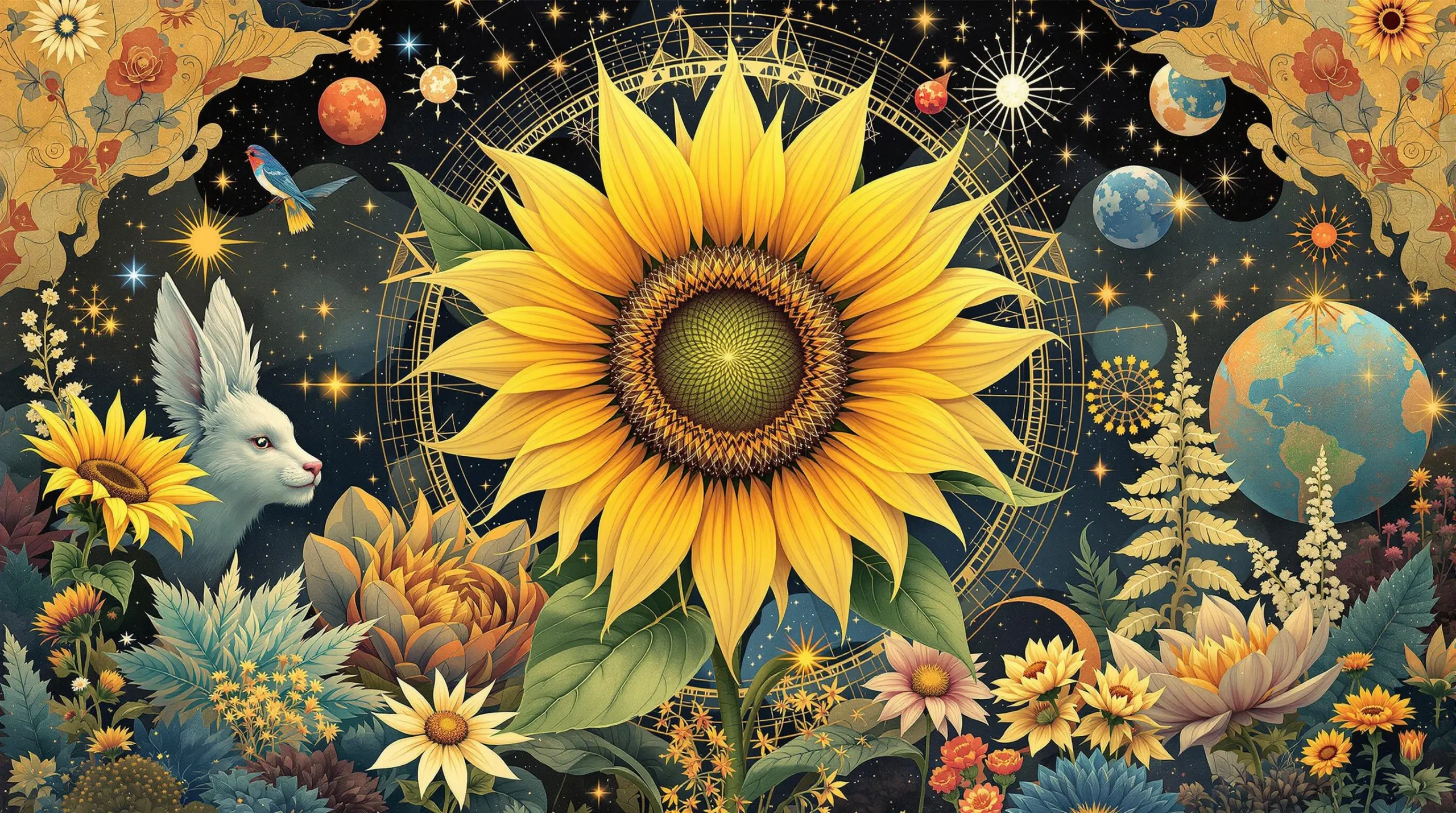


Sunflower

Archetype Meaning & Symbolism

Optimistic, heliotropic, conspicuous, bountiful, stalwart, simple, radiant, communal, seasonal, naive

  • My secret is not in seeking the sun, but in becoming a sun for the seeds I carry within.

If Sunflower is part of your personal mythology, you may...

Believe

  • You may believe that your life has a singular, guiding purpose, and that your primary task is to align every aspect of your being with that central truth.
  • You may believe that true strength is shown not only in vibrant growth but in the grace with which you handle decline and the generosity with which you offer your life’s harvest to others.
  • You may believe that optimism is not a feeling but a discipline, a conscious and continuous act of turning yourself toward the light, regardless of the weather.

Fear

  • You may fear obscurity above all else: the thought of living a life in the shadows, unnoticed, and wilting without ever having truly bloomed.
  • You may fear a spiritual or creative drought, a 'great clouding' where your personal sun disappears, leaving you without direction, purpose, or a source of warmth.
  • You may fear that your impressive, radiant exterior is a hollow facade, and that when the time comes, you will have no seeds of substance to offer the world.

Strength

  • You likely possess an extraordinary ability to focus on a goal, pursuing it with a devotional energy that others find inspiring and formidable.
  • You have a natural warmth and a radiant optimism that can make you a beacon in your community, drawing others to you for guidance and hope.
  • You have a profound capacity for legacy, understanding how to transition gracefully from a phase of personal achievement to one of nourishing the growth of others.

Weakness

  • Your single-minded focus can become a form of willful ignorance, causing you to miss important nuances, complexities, and truths that lie in the shadows.
  • Your self-worth may be precariously balanced on an external source of validation—a person, an ideal, a job—making you vulnerable to a crisis of identity should that source fail you.
  • Your inherent need to be visible can leave you overly exposed to criticism and attack, while your optimism can leave you unprepared for the harsh realities of failure or betrayal.

The Symbolism & Meaning of Sunflower

To have the Sunflower in your personal mythology is to be tethered to the principle of devotional optimism. This is not the saccharine smile of ignorance, but the disciplined, muscular act of turning your face toward a source of light, even on an overcast day. This archetype suggests a life built around a central, nourishing truth: a spiritual path, an artistic muse, a philosophical ideal. It is a mythos of focus. Your story may be one of finding your personal sun and organizing your entire existence around its warmth, believing that growth only happens when you are properly oriented toward what feeds you.

The intricate geometry of the sunflower's seed head, a perfect expression of the Fibonacci spiral, suggests an underlying order to abundance. For a person, this may symbolize a belief that life’s chaotic, creative bursts have an inherent, elegant logic. Your personal myth might not be a straight line but a spiraling outward of potential. The symbolism here is one of trusting the pattern. Even when life feels like a dizzying array of choices and consequences, the Sunflower archetype whispers that a divine, mathematical grace is shaping your growth, and that the seeds of your future are already being arranged in a perfect, life-giving design.

The life cycle of the Sunflower offers a complete narrative arc for a personal mythos. There is the audacious growth, the spectacular, sun-facing bloom, and finally, the heavy, bowed head that offers its life's work back to the earth. This archetype is not just about the glory of the peak, but the grace of the decline. It may inform a life story that values a period of vibrant, visible achievement followed by an equally important phase of quiet generosity. The ultimate meaning is found not in being seen, but in the act of feeding the future, of becoming the sustenance for the next generation of growth.


Sunflower Relationships With Other Archetypes

The Sun

The Sunflower’s relationship with The Sun archetype is one of disciple to deity, acolyte to an aloof source of power. In a personal myth, this could manifest as an intense bond with a mentor, a grand philosophy, or a spiritual belief that provides all meaning and direction. The Sunflower-person organizes their life around this external brilliance, their every move a reaction to its light. The power of this dynamic is its potential for incredible focus and growth; the danger is a complete loss of self, the inability to generate one's own warmth or find direction should the sun ever be eclipsed.

The Field

With The Field, the Sunflower explores the tension between the individual and the collective. One may be a singular, spectacular bloom, yet they exist within a community of others just like them, all swaying to the same breeze, all facing the same direction. This relationship speaks to a mythos of being a star within a constellation, not a lone comet. It might represent a person who thrives in a corporate culture, a political movement, or an artistic school, drawing strength from shared identity while still striving for individual prominence. The core conflict is navigating how to be both part of the pattern and a unique point within it.

The Bee

The relationship with The Bee is one of productive symbiosis. The Bee comes for nectar, an act of taking, but in the process facilitates pollination, an act of creation. In a personal mythology, this could symbolize relationships that are fundamentally transactional yet mutually life-giving. It’s the story of the artist and their agent, the thinker and their editor, the lover who challenges and in doing so, helps create something new. This archetype suggests that growth is not a solitary act, but a process of exchange with others who, while on their own path, become essential catalysts for one's own fertility.

Using Sunflower in Every Day Life

Navigating Career Transitions

When faced with a professional crossroads, the Sunflower archetype offers a clarifying principle: turn towards what nourishes your growth. This may not be the most prestigious or logical path. It is the one that feels like light. The mythos encourages a journey not up a ladder, but in a slow, deliberate arc across a sky, following a personal sun. A career, then, is not a series of jobs but a process of heliotropism: a conscious orientation towards the work, people, and ideas that foster your most radiant self.

Cultivating Community

The head of a single sunflower is a universe of tightly packed seeds in a perfect spiral. When feeling isolated, one might use this archetype to reframe community. It's not about finding a place in a vast, chaotic field, but about recognizing the community you already contain and create. Your role may be to nurture the complex, interwoven lives that rely on you, to be the central point from which a network of support, like the Fibonacci sequence, logically and beautifully expands.

Finding Joy in Simplicity

In moments of overwhelming complexity, the Sunflower models a radical simplicity. Its entire existence is a dialogue between soil and sun. For a person, this could translate into a practice of identifying the two or three essential elements that sustain them: perhaps a creative practice and a core relationship. By focusing exclusively on nurturing these, one might strip away the non-essential anxieties and ambitions, finding a profound and sturdy joy in a life reduced to its most vital, sun-seeking rhythm.

Sunflower is Known For

Heliotropism

The famous habit of tracking the sun across the sky, a powerful metaphor for devotion, focus, and the conscious pursuit of a nourishing source of energy or truth.

Abundance

The production of a massive head filled with hundreds, sometimes thousands, of seeds, symbolizing generosity, fertility, and the potential that lies within a single, successful bloom.

Height and Visibility

Its tendency to grow taller than surrounding flora, making it conspicuously visible. This represents unapologetic presence, ambition, and the courage to stand out from the crowd.

How Sunflower Might Affect Your Personal Mythology

How Sunflower Might Affect Your Mythos

When the Sunflower shapes your personal mythos, your life story may cease to be a linear progression and instead become a gallery of devotions. The chapters of your life are not marked by age or location, but by the 'suns' you oriented yourself toward. There was the University Years, when you turned your face to the light of a particular professor. Then the Berlin Years, when your sun was a throbbing artistic movement. The narrative arc of your life is a series of profound, deliberate turns. Your personal legend is defined by what you chose to worship with your attention, and how that light transformed you.

Your mythos may also be a vertical drama, a story about the singular struggle to rise. The primary conflict in your narrative is not external, but internal: the fight to grow out of the dark, tangled soil of self-doubt or humble beginnings and into the light of full self-expression. Your legend is one of becoming visible, of claiming your patch of sky. The climax of your story is not a victory over an enemy, but the moment you finally stand tall enough to be seen, your face a brilliant, unapologetic declaration of your own existence, if only for a glorious season.

How Sunflower Might Affect Your Sense of Self

Your view of self may be inextricably linked to a source of external inspiration. Self-worth is a measure of alignment: how well are you facing your sun? This can foster a radiant and deeply purposeful identity, a self that is clear in its convictions and energized by its mission. You may see yourself as a disciple, an apostle for an idea or a person that gives you light. The inherent fragility of this self-concept is its defining feature. You may feel a persistent, low-grade anxiety about what happens when the sun sets, when the sky clouds over, or when your gaze is forced, by circumstance, to turn away.

Alternatively, your sense of self could be structured around your eventual utility. The brilliant bloom is merely a phase, a temporary spectacle. The true self, the enduring self, is the seed. You may see your present actions, your vibrancy, and your public face as a means to an end: the creation of something that will nourish others later. This fosters a self-concept that is both humble and ambitious. The self is not a final, static masterpiece, but a factory for producing future potential. You are what you will one day give away.

How Sunflower Might Affect Your Beliefs About The World

A worldview shaped by the Sunflower may be one of powerful, clarifying simplicities. The world is not a murky place of endless gray nuances; it is a space defined by light and shadow. There are right and wrong directions to face. This perspective could cultivate a philosophy of profound optimism and moral clarity, a belief that for every problem, there is a 'sun' a single, correct solution or guiding principle that one must simply turn towards. It is a worldview that abhors cynicism and finds immense power in a focused, unwavering gaze.

This worldview may also be deeply cyclical, finding meaning in the inevitable patterns of nature. Life is not a frantic, linear race to accumulate, but a graceful, recurring cycle: a time for audacious growth, a time for peak radiance, and a time for the dignified, heavy-headed bow that precedes a release into the world. This perspective sees decline not as failure, but as a necessary and beautiful part of the process, the generous act of clearing the way and providing the resources for whatever must grow next. It finds peace in the rhythm of emergence and return.

How Sunflower Might Affect Your Relationships

In relationships, you may find yourself drawn into a heliotropic orbit. You might seek a partner who functions as your 'sun' someone you admire, whose brilliance feels like a source of warmth and guidance around which you can organize your own life. This can create partnerships of intense devotion and adoration, where one partner is the steadfast admirer and the other the radiant center. The risk in this dynamic is a gravitational imbalance, a tendency to lose your own axis in the worship of another's light, forgetting that you, too, have a face that can generate its own warmth.

Conversely, you may take on the role of the sun for others. You might build your relationships by being a beacon of optimism, a source of unwavering support and cheerful guidance for your friends, family, and lovers. They turn to you for light in their dark moments. This role can be deeply fulfilling, casting you as the strong, central figure in your social constellation. The challenge is the quiet exhaustion of constant radiance, the lonely pressure to never show your own moments of drooping, and the difficulty of admitting when your own head feels too heavy to hold up.

How Sunflower Might Affect Your Role in Life

Your perceived role in life could be that of the 'Exemplar.' You feel a quiet, powerful duty to be a living testament to a life lived with purpose and optimism. Your role is to grow conspicuously, to be the tallest, brightest flower in the garden, not out of ego, but to serve as a landmark for others who are lost in the weeds. This is a life of performance, where your every act of turning toward the light is a public lesson. You feel responsible for demonstrating what is possible when one lives with unwavering focus and a courageous, open face.

Another primary role is that of the 'Benefactor' or 'Provider,' a role that comes into focus after your season of peak bloom. Your purpose shifts from spectacular display to profound utility. You may see your life's ultimate work not in the accolades you received, but in the seeds of wisdom, opportunity, or capital you can now offer. Your role is to bow your head gracefully, understanding that this is not an act of defeat but the ultimate act of strength: the distribution of your life's accumulated energy. Your purpose is not to be the spectacle, but to become the sustenance for future spectacles.

Dream Interpretation of Sunflower

To dream of a field of healthy sunflowers, all turning in unison toward a brilliant sun, may suggest a profound sense of alignment and purpose in your waking life. This dream could be an affirmation from your subconscious that you are on the right path, in harmony with your core values, or drawing nourishment from a worthy source of inspiration. It speaks to a coming season of growth, clarity, and vibrant self-expression. It is a symbol of being in sync with your personal mythos, feeling the pull of your true north.

A dream of a single, withered sunflower, its head drooping or broken under a gray sky, could signify a crisis of faith or a loss of direction. It may point to a deep disillusionment with a person, belief, or goal that once served as your sun. This dream might also reflect a state of creative exhaustion or depression, a feeling that your source of energy has been depleted. To dream of being devoured by birds while in the form of a sunflower may represent a fear that your generosity is being exploited or that your life's work is being consumed without appreciation.

How Sunflower Archetype Might Affect Your Needs

How Sunflower Might Affect Your Physiological Needs

For the Sunflower archetype, physiological needs are not just biological imperatives; they are mythic requirements. The body is a plant that must be tended with devotional specificity. This might translate into a non-negotiable, almost ritualistic need for daily sunlight, a diet centered around 'pure' or 'natural' foods like seeds and grains, or a deep-seated physical need for 'grounding' by walking barefoot on the earth. Physical well-being is seen as a direct consequence of environmental alignment. Your body is not a machine to be fueled, but a living organism to be nourished by the correct elements.

The narrative of health becomes one of conscious orientation. Illness or fatigue may be interpreted not just as a physical failing, but as a sign of being in the wrong place, facing the wrong direction, or drawing from a polluted source. This creates a hyper-vigilance about what one consumes: not just food, but also the energy of people and places. Your physiological story is one of maintaining purity and ensuring your stalk is firmly planted in soil that can sustain your ambitious growth toward the light.

How Sunflower Might Affect Your Ideas of Belonging

A sense of belonging, for one with a Sunflower mythos, is often discovered in a community of shared focus. You find your tribe in a field of others who are also facing the same sun. This could be a professional organization, a spiritual group, or a collective of artists, where the comfort of belonging comes from a shared orientation and a common language of purpose. To belong is to sway in the same breeze, to feel the warmth of the same light alongside your peers, and to know you are not the only one on this devotional journey.

Yet, the archetype also holds a deep-seated paradox of loneliness within the crowd. While part of a collective field, each sunflower is on its own stalk, rooted in its own small patch of earth. This can create a feeling of being simultaneously part of a group and fundamentally solitary. The need for love and connection, therefore, may be a search for those who understand this tension. True belonging is found not just in shared admiration for a distant sun, but with those who can stand beside you, respecting the space between your stalks and appreciating your singular, sovereign bloom.

How Sunflower Might Affect Your Feelings of Safety

From the Sunflower’s perspective, safety is paradoxically found in visibility. The greatest danger is being lost in the shade, trampled by the unseen. Security, therefore, is achieved by growing tall, by claiming a prominent place where one cannot be overlooked. This primal need may manifest as a powerful drive for public recognition, a career that offers status, or the creation of work so singular it cannot be ignored. Safety is not a fortress to hide in; it is a conspicuous position above the fray, a place in the sun.

This very prominence, however, creates its own distinct vulnerability. The tallest flower is the most exposed to wind, hail, and the hungry bird. The mythos of safety for the Sunflower is therefore one of calculated exposure. It involves building a fibrous, resilient stalk—an inner core of strength—to withstand the inevitable challenges that come with being seen. Safety is not about avoiding danger, but about being strong enough to stand tall in the midst of it, trusting that your roots are deep enough to hold you steady.

How Sunflower Might Affect Your Views of Esteem

Esteem, in the first act of the Sunflower mythos, is earned through verticality and radiance. Self-worth is measured by how tall you stand and how brightly you shine. Achievements are petals to be displayed, and the admiration of others is the sunlight that validates your existence. High self-esteem is derived from being seen, from fulfilling your potential for brilliance, and from the quiet satisfaction of knowing you are a spectacular sight. It is the esteem that comes from successful, unapologetic self-expression.

In the second act, the foundation of esteem undergoes a profound shift. It moves from radiance to release, from being seen to being consumed. Self-worth is now found in the weight of the seeds you offer, in your capacity for generosity. The respect of self comes from becoming a source of nourishment for others, from seeing your life's work fuel the potential of the next generation. This creates a durable, two-stage model for esteem: first, the confidence that comes from being a glorious individual, and second, the deeper esteem that comes from becoming an essential resource.

Shadow of Sunflower

When the Sunflower’s shadow falls, it manifests as a kind of tyrannical optimism. It is the self that insists on facing the sun even as it burns you, a performative cheerfulness that denies the existence of clouds, night, or sorrow. This shadow self cannot abide ambiguity or melancholy in itself or others; it polices emotion, demanding that everyone turn toward the light. Its radiance becomes a harsh glare, its stalk so rigid with forced positivity that it cannot bend in the wind, but instead snaps. In its obsession with its own light, it may become parasitic, draining all the nutrients from the soil around it, starving its neighbors to grow an inch taller.

The other shadow aspect is a descent into a hollow heliotropism, a complete abdication of personal agency. The Sunflower archetype becomes a shell, its life a mere reflection of its chosen sun, whether that be a charismatic leader, a rigid ideology, or an all-consuming romance. This shadow self will twist its own stalk, abandon its roots, and stunt its own growth just to catch a sliver of borrowed light. When its sun inevitably sets or moves on, the shadow Sunflower does not just droop: it collapses into a heap, having never learned to generate its own warmth or find its own way in the dark.

Pros & Cons of Sunflower in Your Mythology

Pros

  • Having the Sunflower in your mythos provides a powerful, intuitive compass for life, simplifying complex choices by asking the core question: 'Does this path lead me toward my light?'
  • It fosters a natural magnetism and an ability to inspire, as your focused energy and visible growth can serve as a potent source of hope and a practical model for others.
  • The archetype contains an elegant, built-in narrative for a full life, offering a graceful transition from a season of vibrant self-expression to a season of profound generosity and legacy.

Cons

  • A tendency toward a simplistic, sun-or-shadow worldview can make it exceptionally difficult to navigate the moral gray areas and complex realities of modern life.
  • An over-reliance on a singular source of inspiration or validation creates a fragile sense of self, one that is highly susceptible to a devastating crisis if that external source is lost or revealed to be flawed.
  • The constant, quiet pressure to be radiant, optimistic, and a beacon for others can be deeply exhausting, making it difficult to acknowledge, process, or express your own authentic feelings of doubt, sadness, or weariness.