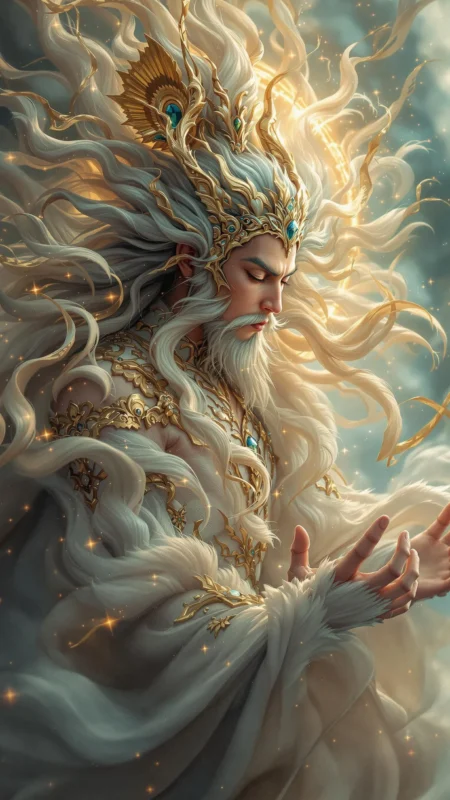
Sun Wukong

Archetype Meaning & Symbolism

rebellious, clever, mischievous, arrogant, loyal, restless, resourceful, transformative, indomitable, impatient

  • The heavens have rules. The earth has laws. They are lovely suggestions. I have plans.

If Sun Wukong is part of your personal mythology, you may...

Believe

  • You may believe that all rules, hierarchies, and limitations are merely temporary obstacles for a sufficiently creative will.
  • You may believe that the universe possesses a sense of humor and that the greatest truths are often revealed through a cosmic punchline.
  • You may believe that redemption is not a gift to be received but a prize to be earned through a long, arduous, and action-packed journey.

Fear

  • You may fear being pinned, trapped, or otherwise rendered completely powerless, with no clever trick or escape route available.
  • You may fear irrelevance: to be forgotten by history, to have your great deeds go unrecorded, to be a monkey screaming in a soundproof box.
  • You may fear that your rebellious nature is not divine, but merely a flaw, and that you will never achieve the self-mastery needed to find peace.

Strength

  • An almost supernatural resilience and an indomitable spirit that refuses to be broken by failure or confinement.
  • A boundless, mischievous creativity that allows you to generate unorthodox solutions to seemingly impossible problems.
  • A fierce and unwavering loyalty to the few individuals you choose to include in your questing fellowship.

Weakness

  • A profound arrogance and impatience that often leads you to underestimate opponents and create unnecessary conflict.
  • A disdain for any process that requires slow, methodical work, leading you to abandon projects that do not offer immediate, spectacular results.
  • A self-sabotaging need to challenge authority for its own sake, even when it works against your own best interests.

The Symbolism & Meaning of Sun Wukong

To have Sun Wukong as a feature in one’s personal landscape is to live with the restless mind personified. He is the brilliant, untamed ego that believes itself the center of the universe, a whirlwind of potential that must be both celebrated and contained. In a modern context, he may symbolize the disruptive innovator, the precocious genius, the sacred clown who speaks truth through absurdity. His story is a caution against the hubris that often accompanies great talent, a reminder that celestial power without worldly wisdom is a recipe for a magnificent, self-inflicted downfall. The journey with him is never one of simple ascendance: it is a cycle of rebellion, capture, humility, and heroic service.

He is also, perhaps, the patron saint of the second act. His initial burst of glory is pure id: selfish, spectacular, and ultimately unsustainable. The true story begins after the fall, when he is bound by the golden fillet and a sacred duty. This part of the mythos suggests that our greatest purpose may be found not in the pursuit of our own glory, but in the humbling service of a quest larger than ourselves. His transformations and clever tricks, once used for self-aggrandizement, are repurposed to protect the innocent and defeat genuine evil. This could mean that your own wild, untamable gifts find their truest expression only when yoked to a noble purpose.

The Monkey King is a paradox: a divine being who is deeply flawed, a force of chaos essential for maintaining cosmic balance. He challenges the very notion of a static, orderly heaven, suggesting that periodic upheaval is necessary for growth. Within your own mythos, he may represent the part of you that must test every boundary, question every authority, and kick down every door just to see what’s on the other side. He is the internal agent of change, the one who saves you from the prison of your own certainty by throwing everything into delightful, terrifying disarray.


Sun Wukong Relationships With Other Archetypes

The Celestial Bureaucrat

The relationship between the Sun Wukong archetype and the Celestial Bureaucrat is perhaps one of the most fundamental antagonisms in any narrative cosmology. It is the clash of the untamable, living impulse against the brittle perfection of the ledger. The Bureaucrat, in all his forms, represents the logic of the system, the serene and maddening hum of rules that presume to govern all things. Sun Wukong, then, may be seen as the universe’s chaotic response, a divine prank played on the very notion of cosmic paperwork. He is the irrepressible weed cracking the immaculate pavement of heavenly procedure, not out of a considered philosophy of anarchy, but from a surfeit of life that simply cannot be contained or categorized. Their conflict is not a war but a kind of cosmic friction, the vital, roaring fire of existence testing the limits of the kiln designed to hold it.

The Unbreakable Staff

More than a mere weapon, the Unbreakable Staff could be understood as the physical grammar of the Monkey King’s will. Its ability to shrink to the size of a needle or expand to stir the seas is a perfect mirror for his own mercurial ego and boundless, untethered potential. This is not the relationship of a craftsman to a tool, but something more symbiotic, more intimate, like a tongue to a thought. The staff does not grant him power so much as it gives his inherent, chaotic power a tangible form. It is the focused manifestation of his defiance, a singular, obedient line drawn against the sprawling, complex map of a universe he seeks to dominate. In its simple, impossible physics, the staff may represent the purity of a talent so great that it becomes its own logic, a portable, personal law of nature wielded by a being who respects no other.

The Patient Master

With the Patient Master, the archetype finds its most transformative and paradoxical relationship. Here, the raging river of Sun Wukong’s power is met not with a dam, but with a new and gentle shoreline that guides its course. The Master—frail, mortal, and armed only with conviction—could be seen as the quiet center around which the whirlwind is finally forced to spin. This figure represents a wisdom that does not seek to break the monkey’s spirit but to harness it, suggesting that the ultimate form of strength is not unbridled power but directed purpose. The golden fillet, that circlet of control, is less a manacle and more a tuning fork, an instrument that introduces a painful, clarifying harmony into his chaotic noise. It is through this bond, a strange alchemy of submission and devotion, that the rebel perhaps discovers the one thing his immortality and strength could never grant him: a reason for the journey.

Using Sun Wukong in Every Day Life

Navigating a Stifling Bureaucracy:

When confronted by a system of interlocking forms and intransigent gatekeepers, the Sun Wukong archetype does not fill out the paperwork in triplicate. It may instead find the one loophole, the forgotten clause, the sympathetic clerk in a back office who can be charmed or tricked into providing the necessary stamp. It is about treating the obstacle not as a wall, but as a puzzle box, and using wit where brute force fails. You could find yourself employing a kind of strategic mischief, a performance of compliance while subtly rerouting the entire process to your advantage.

Breaking a Creative Impasse:

Staring at the blank page or the silent instrument, one might feel trapped under a mountain of self-doubt. To channel Sun Wukong is to invite a bit of chaos into the studio. It means trying the absurd, the ‘wrong’ technique, pulling a hair and transforming it into a thousand bad ideas just to find the one that works. It is permission to make a mess, to be boastful in your experimentation, to playfully challenge the very form you are working in, knowing that innovation is often born from a sublime disregard for established taste.

Confronting a Personal Failing:

After a significant failure, a fall from grace fueled by one’s own hubris, the Wukong mythos offers a specific map. It is not about shame, but about service. The journey of penance is not passive suffering: it is an active, arduous quest. You may find yourself accepting a humbling role, protecting something or someone other than your own ego. This journey, with its endless demons and distractions, becomes the very crucible that refines your raw power into true, disciplined strength. The golden fillet, the band that tightens with every misstep, becomes a tool for self-mastery, not just punishment.

Sun Wukong is Known For

The 72 Earthly Transformations

An esoteric art that grants the ability to change form into nearly any object or being. This power represents ultimate adaptability, a capacity to meet any situation by becoming what is necessary: a temple to hide in, a fly on the wall, a demon to fight a demon. It is the symbol of a fluid identity.

Revolt in Heaven:

The signature act of youthful hubris. After being denied a title he felt he deserved, Sun Wukong single-handedly laid waste to the celestial bureaucracy. This event symbolizes the eternal conflict between raw, untamed talent and rigid, established hierarchy. It is the story of ambition that overreaches, demanding recognition on its own terms.

The Ruyi Jingu Bang:

The magical staff that can shrink to the size of a needle or grow to span the cosmos. It was once a pillar used to measure the oceans, a tool of cosmic order. In Wukong's hands, it becomes a weapon of sublime chaos. This may represent the principle that the tools of creation and control can, in the right hands, become instruments of glorious rebellion.

How Sun Wukong Might Affect Your Personal Mythology

How Sun Wukong Might Affect Your Mythos

When the Monkey King leaps into your personal narrative, your life story may cease to be a linear progression and become, instead, an epic journey punctuated by chaotic episodes and transcendent breakthroughs. Your past mistakes are not cast as shameful detours but as your own 'Revolt in Heaven': necessary acts of hubris that led to the 'mountain' of consequence under which you were forced to learn humility. This archetype reframes failure as the essential prerequisite for the true quest. Your mythos becomes one of redemption, not through piety, but through action. Life is a pilgrimage westward, a constant battle against external and internal demons, where your cleverness and resilience are your primary spiritual tools.

Furthermore, your story could take on the quality of a divine comedy. The cosmos, in this view, is not a cold, indifferent machine but a trickster god’s playground. Synchronicities may be seen as cosmic winks, and obstacles as tests set by a celestial bureaucracy you are destined to outwit. Your personal myth may be filled with a cast of characters mirroring the journey: a grounding, moral 'Tripitaka' you are sworn to protect, a pragmatic 'Sandy,' and a gluttonous, earthy 'Pigsy'. Your narrative arc is not about becoming a perfect saint but about becoming a perfected instrument, flaws and all, in a mission that is far more important than your own comfort or ego.

How Sun Wukong Might Affect Your Sense of Self

To see yourself through the eyes of Sun Wukong is to embrace a profound internal contradiction. You may perceive yourself as a being of immense, perhaps limitless, potential, a rogue element of brilliance in a world of plodding conformity. This can foster a powerful sense of self-reliance and an unshakeable belief in your ability to solve any problem. You are the star of your own epic, a hero of dazzling wit and strength. There is a grandness to this self-perception, a feeling of being chosen for a special, albeit difficult, destiny.

However, this self-view is shadowed by the golden fillet, the circlet of control. You may also be acutely aware of your own worst impulses: your arrogance, your impatience, your capacity for causing chaos. There could be a constant internal negotiation between the wild monkey and the disciplined pilgrim. This creates a self-concept that is dynamic, not static. You are not a finished product but a work in progress, a raw power being refined in the crucible of a sacred task. Self-acceptance, in this framework, is not about loving your flaws, but about recognizing them as the very things that make your strength and eventual mastery so meaningful.

How Sun Wukong Might Affect Your Beliefs About The World

With Sun Wukong as your guide, your worldview may become one of sacred irreverence. You could see systems of power, be they corporate, governmental, or even spiritual, as elaborate constructs, full of pomp and circumstance but often hollow at the core. They are not to be taken at face value but are to be probed, tested, and, if necessary, gleefully disrupted. This is not nihilism: it is a profound belief that truth and value are not found in titles or institutions, but in demonstrable power, adaptable intelligence, and unwavering will. The world is a stage for a grand, cosmic joke, and you are in on it.

This perspective may also foster a deep appreciation for the journey over the destination. The goal, enlightenment or the sacred scriptures, is important, but the real meaning is forged in the 81 trials along the way. Your worldview might prioritize experience, challenge, and even hardship as the primary means of growth. You may see the universe not as a set of rules to be obeyed, but as a series of obstacles designed to make you stronger, smarter, and ultimately, more whole. It is a philosophy of engagement, a belief that one must leap into the fray, staff swinging, to truly understand the nature of reality.

How Sun Wukong Might Affect Your Relationships

In relationships, the Sun Wukong archetype might manifest as a fierce, almost feral loyalty, but one that is tested by an equally fierce need for freedom. You may be a steadfast protector, willing to battle any demon for those you consider part of your questing fellowship. Your love is active, demonstrated through deeds of daring and clever solutions to their problems. You are the one who fixes things, who finds a way, who moves mountains for your chosen few. This can create bonds of incredible strength and intensity.

Yet, this same energy can make conventional relationships challenging. The restless spirit chafes at routine, the arrogant mind bristles at being told what to do, even by a loved one. You may attract a 'Tripitaka' figure, someone whose quiet, moral certainty both grounds you and drives you to distraction. There may be a pattern of creating relational chaos simply to feel alive, of testing the boundaries of your partner’s patience. The central challenge is learning that true companionship is not a cage, and that the pilgrim’s journey is made not only possible but meaningful by the presence of the others in the party.

How Sun Wukong Might Affect Your Role in Life

Your perceived role in life may be that of the catalyst, the sacred agent of chaos. You might not see yourself as the builder or the maintainer, but as the one who arrives to shake a stagnant situation to its core. This could be the innovator in a company, the artist who breaks with tradition, or the family member who speaks the uncomfortable truth at the holiday dinner. Your purpose, as you see it, is to reveal weakness, expose hypocrisy, and force evolution through disruption. You may feel that it is your job to be gloriously, purposefully difficult.

This role, however, carries a hidden weight. You may often feel misunderstood, your noble intentions perceived as mere troublemaking. The loneliness of the Monkey King is profound: he is surrounded by companions on his quest, yet none truly understand the nature of his power or the burden of his restraints. You might feel a similar isolation, a sense that you are an essential part of the machine of progress, but a part that is destined to be sharp, unruly, and ultimately replaced once its disruptive work is done. Your role is vital, but it may also be transient.

Dream Interpretation of Sun Wukong

To dream of Sun Wukong in a positive light is to receive a visitation from your own untamed potential. It may be a signal from your subconscious to be more clever, more daring, to break free from a self-imposed prison of convention or fear. If he is joyfully somersaulting on clouds, it could suggest a coming period of creative freedom and unexpected solutions. If he hands you his staff, it may be an invitation to take up your own power and challenge an oppressive situation in your waking life. This dream is an affirmation of your resilience and a call to embrace your inner trickster for a noble cause.

Conversely, a negative dream of the Monkey King could be a potent warning from your shadow self. If he is on a rampage, destroying things indiscriminately, it may reflect an unchecked ego or a rebellious streak that has become self-destructive. Dreaming of being trapped under the mountain alongside him, or feeling the crushing weight of his punishment, might signify a profound sense of powerlessness or the consequences of your own hubris coming home to roost. If the golden fillet is tightening on your own head in the dream, it is a stark symbol of a painful but necessary lesson in self-control you are being forced to learn.

How Sun Wukong Archetype Might Affect Your Needs

How Sun Wukong Might Affect Your Physiological Needs

The Wukong archetype can translate physiological needs into a kind of spiritual hunger. The body may be viewed not as a temple to be quietly maintained, but as a vehicle for epic deeds, a resilient machine that runs on challenge and adrenaline. There could be a fundamental restlessness, a physical need for movement, travel, and constant stimulation that mirrors the monkey’s own inability to be still. Sustenance is not just food, but experiences that feel like ‘peaches of immortality’: moments of peak performance, thrilling victories, and life-affirming risks that make you feel truly alive and ageless.

This can also manifest as a sublime disregard for the body's mundane limits. Sleep, rest, and proper nutrition may be seen as secondary concerns, inconvenient interruptions to the grand quest. You might push yourself to the point of collapse, operating on the belief that your indomitable will can simply command the flesh to obey. There is a danger here of burnout, of treating your physical form like one of Wukong’s disposable, transformed hairs, forgetting that even the stone monkey has vulnerabilities that cannot be outwitted forever.

How Sun Wukong Might Affect Your Ideas of Belonging

Belonging, within the Wukong framework, is not about fitting in. In fact, it is predicated on a shared sense of not fitting in. Love and community are forged in the crucible of a shared journey, a fellowship of pilgrims bound by a sacred and arduous task. You may find your 'tribe' not in a neighborhood or a social club, but in a small, dedicated team of fellow misfits, where each member’s unique, even problematic, skills are essential to the group’s survival. It is the bond of the barracks, the questing party, the startup team pulling an all-nighter: deep, loyal, and tested by trial.

This creates a powerful, but perhaps narrow, sense of connection. While fiercely loyal to your sworn companions, you may remain an outsider to the wider world. There is a loneliness in this kind of belonging. You are with the group, but your nature as the trickster, the warrior, keeps you slightly apart. You protect the 'Tripitaka' of the world, but you may never fully share their innocent perspective. You may belong to the quest, but your membership is conditional on your utility and your ability to keep your chaotic nature in service of the goal.

How Sun Wukong Might Affect Your Feelings of Safety

For one with the Monkey King in their mythos, the concept of safety is inverted. Stability, predictability, and quietude, the hallmarks of a secure life for many, may feel like a cage. Safety is not found in a fortress, but in one's own boundless capacity for adaptation. You might feel most secure when in motion, in the heart of a crisis, because that is where your talents for improvisation and problem-solving are most potent. Security is a verb, not a noun: it is the ability to shape-shift, to outwit, to escape any trap. The ultimate safety lies in being so clever and powerful that no one can hold you for long.

However, the primal fear is not danger, but confinement. The memory of the five-peaked mountain, the ultimate state of helplessness, may be the central trauma of this archetype. This could manifest as a deep-seated claustrophobia, not just of physical spaces, but of commitments, jobs, or relationships that feel too binding. The greatest terror is a situation with no clever exits, no loopholes, no possibility of escape. It is the fear of being pinned, silenced, and made irrelevant, your power completely neutralized by a force greater than your own.

How Sun Wukong Might Affect Your Views of Esteem

Esteem, for the Monkey King archetype, is initially sourced from external validation and spectacular displays of power. It is the roar of the crowd, the fear in your enemies’ eyes, the celestial title that confirms your greatness. There may be a powerful hunger for recognition, a need to prove your unique genius and have it acknowledged by the highest authorities. You derive self-worth from your ability to win, to be the best, to perform feats that no one else can.

However, the deeper lesson of the mythos is the transformation of this esteem need. The fall from heaven and the subsequent journey teach that true self-worth is forged in humility and service. Esteem is no longer about titles, but about mastery. It is the quiet confidence that comes from mastering your own impulses, the satisfaction of successfully protecting your companions, the internal validation of fulfilling a difficult vow. It is the shift from 'Look at how great I am' to 'Look at what I was able to accomplish for a cause greater than myself.' The ultimate esteem is earning your own freedom, not by rebellion, but by discipline.

Shadow of Sun Wukong

When the Sun Wukong archetype falls into shadow, the divine trickster becomes a malicious troll. The rebellion loses its purpose, becoming chaos for chaos's sake. This shadow manifests as a narcissistic personality that thrives on creating drama, undermining others for sport, and using its considerable intelligence to exploit and manipulate. It is the brilliant mind that squanders its genius on petty scams and self-aggrandizement, the eternal adolescent who refuses to grow up and take responsibility. The shadow Wukong is the revolt in heaven with no quest to follow, leaving only a trail of wreckage and broken relationships in its wake, all while crowing about its own cleverness.

The other, more passive shadow is the monkey trapped under the mountain of its own fear. This is the individual with immense, untapped potential who has been so thoroughly crushed by a past failure that they refuse to even try again. They become cynical and bitter, using their wit not to solve problems but to rationalize their own inaction. They see every challenge as an insurmountable mountain, every authority figure as the Buddha whose palm they can never escape. This shadow is a profound waste of talent, a self-imposed prison where the brilliant monkey convinces himself there is no key, no escape, and no point in even looking for one.

Pros & Cons of Sun Wukong in Your Mythology

Pros

  • You possess an extraordinary capacity for adaptation and innovation, making you invaluable in a crisis or a rapidly changing environment.
  • Your life is a grand adventure, filled with epic challenges and dazzling victories that protect you from the slow death of boredom.
  • You can act as a powerful catalyst for change, challenging stagnant ideas and inspiring others to break free from their own limitations.

Cons

  • Your inherent opposition to authority and structure can lead to a life of constant conflict, struggle, and exhaustion.
  • Your impatience and arrogance may sabotage your own success, damaging professional prospects and alienating potential allies and loved ones.
  • The path of the sacred disruptor is often a lonely one, as very few people can understand your motivations or keep pace with your chaotic energy.