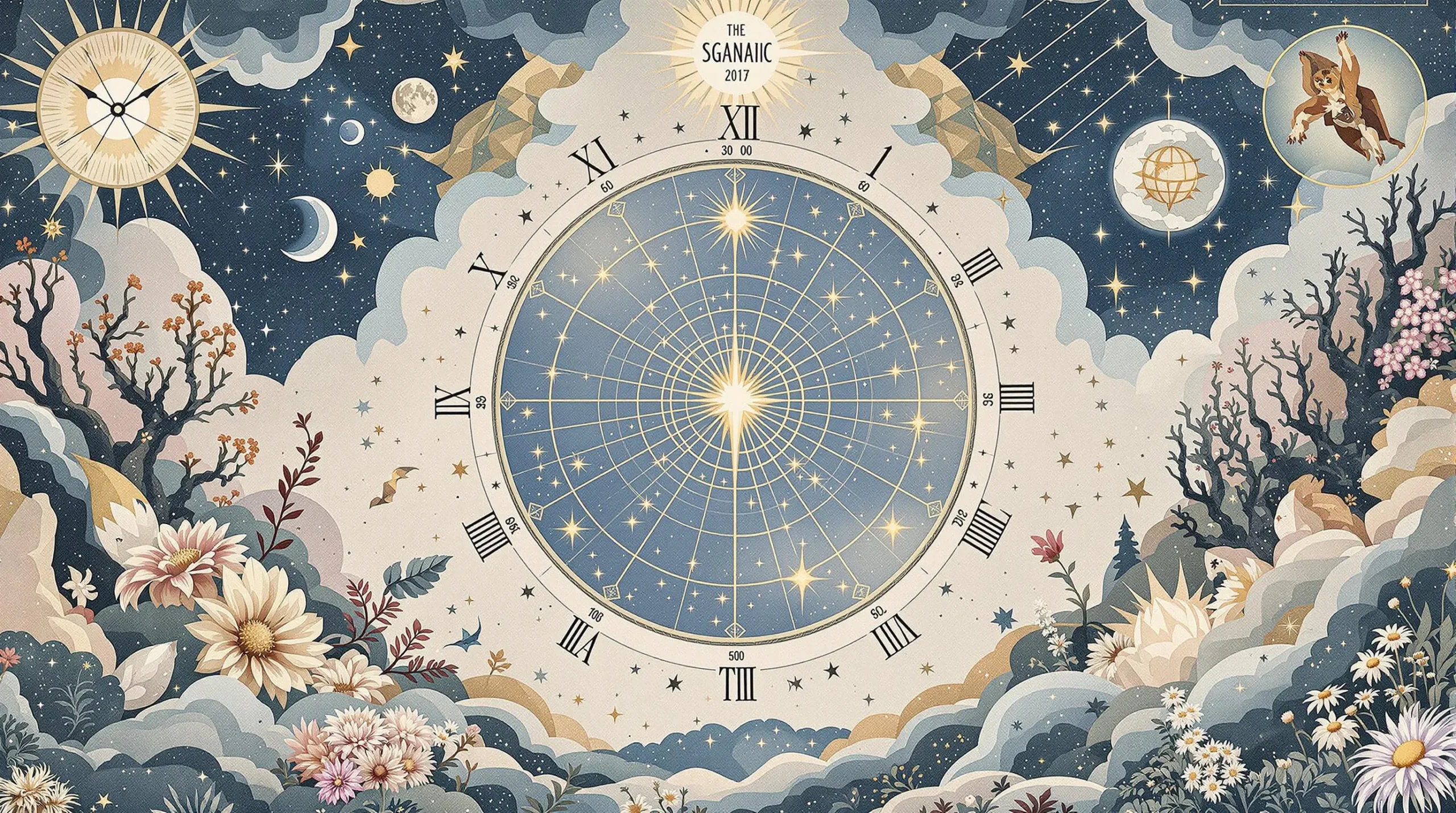


Star Chart

Archetype Meaning & Symbolism

Cosmic, complex, predictive, ancient, navigational, intricate, personal, cyclical, abstract, rigid

  • Look not for a map to follow, but for the constellations within; your path is a story told by distant fire, not a line drawn in the sand.

If Star Chart is part of your personal mythology, you may...

Believe

  • That every person is a unique universe of potential, and their moment of birth imprints a map for their journey.

  • That timing is everything, and life unfolds according to a sacred, cosmic rhythm that can be understood and aligned with.

  • That there are no accidents, only synchronicities and lessons encoded in the patterns of the cosmos, waiting to be read.

Fear

  • That your fate is irrevocably sealed, and you have no real power to change a difficult destiny written in the stars.

  • That you will misunderstand the map and miss your true calling, or fail to heed its warnings until it is too late.

  • That your life is ultimately just a small, predictable pattern in an indifferent universe, rendering your struggles and triumphs insignificant.

Strength

  • A profound sense of purpose and an unwavering belief that your life has inherent meaning and a distinct direction.

  • The ability to see patterns and find meaning in life's challenges, viewing them not as punishments but as necessary catalysts for growth.

  • A deep patience and trust in life's unfolding, understanding that some developments cannot be rushed and that fallow periods have their own wisdom.

Weakness

  • A tendency towards fatalism, relinquishing personal responsibility for your choices and circumstances by blaming the planets.

  • Analysis paralysis, becoming so absorbed in the chart's infinite complexities and future possibilities that you fail to live fully in the present.

  • A subtle spiritual superiority, a tendency to prematurely judge or categorize others based on their astrological placements.

The Symbolism & Meaning of Star Chart

To have the Star Chart as part of your personal mythology is to believe that your life is not an accident. It is to hold the conviction that the moment of your first breath was imprinted with a cosmic signature, a celestial photograph of that instant's unique blend of energies. This chart is not a rigid sentence, but perhaps a sacred contract or a blueprint of potential. It symbolizes the soul's chosen curriculum for this lifetime: a specific set of strengths to hone, challenges to meet, and paradoxes to embody. It is the ultimate expression of the Hermetic axiom, "As above, so below," suggesting that the vast, impersonal dance of the planets is mirrored in the intimate, intricate choreography of a single human life.

The chart functions as a profound mirror, reflecting the inner landscape with a vocabulary that transcends ordinary language. It gives names to the warring factions within the psyche: the part that craves security, the part that yearns for rebellion, the part that seeks communion. For someone whose mythos includes the Star Chart, self-discovery is an act of translation, of decoding these celestial symbols to understand their own mysterious heart. It may provide a container for contradictions, allowing one to hold the tension of being both gentle and fierce, disciplined and wild, by seeing these qualities as different planetary voices in a complex, cosmic choir.

More than a static portrait, the Star Chart introduces the symbolism of cycles and timing. It suggests that life moves not in a straight line toward a final goal, but in spirals and seasons. There are times for planting (a Jupiter transit), times for painful pruning (a Saturn square), and times for profound, volcanic change (a Pluto opposition). This perspective fosters a deep, almost agricultural patience. It teaches that fallow periods are not failures but necessary moments of rest, and that periods of intense growth must be honored. Life becomes a dance of attunement to these larger rhythms, a constant listening for the music of the spheres.


Star Chart Relationships With Other Archetypes

The Weaver

The Star Chart and The Weaver are deeply intertwined, like a blueprint and its artisan. The Star Chart provides the grand pattern, the intricate design of fate, potential, and cosmic influence with its threads of planetary aspects and zodiacal signs. The Weaver, however, is the one who sits at the loom of daily life, taking these symbolic threads and actively weaving them into the tangible tapestry of lived experience. A difficult Saturn aspect on the chart is just a line on paper until The Weaver makes the conscious choices, endures the hardships, and builds the structures that bring that symbolism to life. The chart may outline the myth, but The Weaver lives it, their hands giving form and texture to the celestial ink.

The Wanderer

The Wanderer may have a conflicted relationship with the Star Chart. On one hand, the chart can represent the ultimate confinement: a map that dictates the terrain of one's life, a destiny that curtails true freedom. The Wanderer might reject its pronouncements, seeking to walk off the map entirely and prove that will alone shapes the journey. On the other hand, The Wanderer could secretly consult the chart as a cosmic compass. It might not tell them where to go, but it could affirm the nature of their journey, reassuring them that their restlessness is a fated part of their path, their desire for new horizons written in the stars, thus validating their seemingly aimless quest with a sense of higher purpose.

The Sovereign

For The Sovereign, the Star Chart may function as their divine right to rule, the celestial mandate that legitimizes their authority and purpose. A powerful sun placement or a regal Leo ascendant becomes the cosmic coronation, proof that their leadership is not a personal ambition but a sacred duty bestowed by the heavens. They may see their life's story, with its triumphs and trials, as a direct reflection of their chart's promise, and their kingdom—whether a family, a company, or a creative project—as the earthly manifestation of their celestial design. The chart is not just a personal map; it is the constitution of their realm, its principles the laws by which they govern themselves and their domain.

Using Star Chart in Every Day Life

Navigating Career Transitions

When faced with a professional crossroads, the Star Chart may not offer a new job title, but it could illuminate the underlying celestial weather. A challenging aspect from Saturn, the planet of structure and discipline, to your Midheaven, the angle of career, might be interpreted not as a failure, but as a cosmic mandate to build a more authentic professional foundation, even if it requires temporary dismantling. It reframes uncertainty as a sacred phase of reconstruction, guided by a planetary timetable.

Understanding Relationship Dynamics

In moments of interpersonal friction, projecting the conflict onto the framework of a Star Chart can be revealing. It's perhaps not merely a disagreement over finances, but a fundamental clash between your security-seeking Taurus Moon and a partner's freedom-loving Sagittarius Venus. The chart provides a mythology for the conflict, transforming a personal failing into an archetypal dance. This shift in perspective may not solve the issue, but it can create the space for a more compassionate and less accusatory dialogue.

Finding Meaning in Crisis

A sudden loss or crisis can feel like a violent tear in the fabric of reality. The Star Chart archetype could offer a container for this chaos, suggesting the event corresponds with a potent transit, like Pluto, the planet of death and rebirth, crossing a significant point in your chart. This does not erase the pain, but it may weave it into a larger narrative of transformation. The crisis becomes a fated descent into the underworld, a necessary catalyst for a profound psychological and spiritual renewal that was, in some cosmic sense, scheduled.

Star Chart is Known For

Celestial Cartography

The Star Chart is fundamentally a map

a two-dimensional representation of the three-dimensional sky at a precise moment in time and space, typically a birth. It plots the positions of the sun, moon, and planets against the backdrop of the zodiac, creating a unique cosmic snapshot.

Symbolic Language

Its power lies in a deeply layered symbolic language. Each planet represents a psychological function (e.g., Mars as drive, Mercury as communication), each zodiac sign a style of expression, and each house a domain of life. The meaning is derived from the intricate combination of these elements.

Predictive Potential

It is perhaps most famous, or infamous, for its use in forecasting. By tracking the ongoing movements of the planets relative to their positions in the birth chart, practitioners purport to identify periods of opportunity, challenge, growth, and transition, offering a glimpse into the rhythm of an individual's unfolding life story.

How Star Chart Might Affect Your Personal Mythology

How Star Chart Might Affect Your Mythos

When the Star Chart integrates into your personal mythos, your life story ceases to be a sequence of random events and becomes a structured epic. Each significant happening, from a chance encounter to a major life crisis, may be reframed as a chapter in a pre-written, albeit interpretable, celestial narrative. You might start to see your childhood not just as a collection of memories, but as the activation of your Moon placement. A period of intense struggle could be mythologized as your "Saturn Return," a classic rite of passage in the hero's journey. Your mythos gains a plot, with rising action, climaxes, and denouements timed not by chance, but by the majestic, predictable orbits of the planets. This imbues your story with a sense of inevitability and profound significance, as if it were a legend the universe itself intended to tell.

This archetype also enriches the cast of characters in your personal myth. The people who enter your life may be seen as archetypal players sent to activate certain parts of your celestial blueprint. A challenging boss might be the embodiment of a difficult Pluto transit, a catalyst for your transformation. A loving partner could be the Jupiterian figure who brings expansion and joy exactly when your chart promised a season of grace. Your personal narrative becomes less about you as an isolated protagonist and more about your soul's interaction with a series of cosmic agents. The world becomes a stage, and everyone who walks upon it has a role to play in your unfolding, astrologically-scripted drama.

How Star Chart Might Affect Your Sense of Self

To see oneself through the lens of a Star Chart is to embrace a multifaceted and often paradoxical identity. You are no longer a singular, unified 'I', but a dynamic interplay of cosmic forces. One might say, "My Aries Sun wants to charge ahead, but my Cancer Moon needs to retreat and feel safe." This framework can foster a radical self-acceptance. Traits that previously seemed like flaws or weaknesses may be re-contextualized as essential components of your unique celestial design. That stubbornness is your Taurus nature; that emotional intensity, your Scorpio rising. It can provide a compassionate distance, allowing you to observe your own impulses and compulsions as the expression of planetary energies rather than as personal failings.

However, this can also lead to a fragmentation of self, or what could be called 'archetypal excuses'. Instead of integrating difficult aspects of the personality, one might simply outsource responsibility to the planets: "I can't help being critical, my Mercury is in Virgo." The self can become a collection of neatly labeled boxes, losing its fluid, un-nameable essence. There is a risk of over-identifying with the map and forgetting the territory. The goal is to use the chart as a tool for understanding the self's complexity, not as a definitive and static label that prevents growth and absolves one of the difficult work of personal integration.

How Star Chart Might Affect Your Beliefs About The World

Adopting the Star Chart as a key to reality fundamentally shifts one's worldview from one of random coincidence to one of intricate synchronicity. The world is no longer a series of disconnected events but a resonant web of meaning where inner and outer realities mirror each other. A political upheaval might be seen to correspond with a major planetary alignment; a personal insight may coincide with Mercury stationing direct. This creates a perception of the universe as an intelligent, communicative entity that speaks in a language of symbols. Life becomes a dialogue with the cosmos, and the individual's role is to learn to interpret its subtle, ever-present messages. The mundane becomes magical, and every moment is potentially saturated with significance.

This worldview also reshapes the understanding of time. Instead of a uniform, linear progression, time becomes qualitative and cyclical. There are auspicious times for beginnings and necessary times for endings, dictated by the celestial weather. This perspective cultivates a different kind of rhythm for living, one that is less about forcing outcomes and more about aligning with the prevailing cosmic currents. One learns to flow with periods of intense activity and to honor periods of quiet incubation. It is a worldview that prioritizes timing, patience, and attunement over brute force and relentless, linear progress, seeing wisdom in the universe's grand, cyclical breathing.

How Star Chart Might Affect Your Relationships

In the realm of relationships, the Star Chart archetype introduces the concept of cosmic contracts. Connections are rarely seen as accidental. Instead, they are viewed as fated encounters designed to catalyze specific growth, heal old wounds, or fulfill a shared purpose, all legible in the synastry, the comparison of two charts. This can infuse relationships with a profound sense of meaning and destiny. A difficult partnership is not just a struggle; it is a karmic lesson. An easy, flowing connection is a cosmic gift. This perspective encourages looking beyond surface-level annoyances to the deeper, archetypal dynamics at play, fostering a more patient and mythologically rich view of intimacy.

This lens, however, can also depersonalize connection. A partner's hurtful behavior might be excused as them just "acting out their Mars-Saturn square." While this can create space for compassion, it can also be a way to avoid addressing real, tangible problems in the relationship. It risks turning people into collections of planetary data rather than flesh-and-blood individuals. The danger is in prioritizing the chart's interpretation over the lived, felt experience of the other person. The relationship can become a fascinating astrological experiment to be analyzed rather than a human bond to be nurtured, potentially creating an intellectual distance that inhibits true vulnerability and emotional presence.

How Star Chart Might Affect Your Role in Life

Embracing the Star Chart may instill the powerful conviction that you have a specific, pre-ordained role to play in the world. Your purpose is not something you must invent from scratch, but something you must discover and align with, a destiny encoded in your celestial DNA. Placements like the North Node or the Midheaven become sacred signposts, pointing toward your soul's mission or vocational calling. This can be an incredible source of motivation and resilience, providing a 'why' that can endure almost any 'how'. The role feels less like a choice and more like a calling, a sacred duty to manifest the highest potential of your unique cosmic design.

This archetypal influence also creates a fascinating tension between fate and free will. Is your role simply to be the actor reading the lines of a script written at your birth? Or is your role that of a co-creator, consciously working with the raw material of your chart to build a meaningful life? This can lead to the perception of one's role as a kind of cosmic artisan. You are given a specific set of tools and materials (the planets and signs), and your life's work is to use them with skill, consciousness, and heart. The role is not to passively follow the map, but to be the heroic navigator who charts a course through the territory it describes, making choices that honor its spirit.

Dream Interpretation of Star Chart

In a positive dream context, encountering a Star Chart—perhaps one that is luminous, clear, or being explained by a wise figure—could symbolize a profound moment of self-acceptance and clarity. It may suggest that the dreamer is aligning with their true path and beginning to understand their place in the universe. The dream could be a message from the subconscious that the perceived chaos of life has an underlying order and that the dreamer possesses a unique and valid purpose. To see the constellations of one's own chart shining brightly in a dream is to receive an affirmation of one's own inner light and cosmic significance.

Conversely, dreaming of a Star Chart that is torn, blank, illegible, or spinning wildly out of control may point to a deep-seated fear of meaninglessness or a feeling of being hopelessly lost. It could represent a disconnection from one's own intuition and inner guidance, a sense that one's life story makes no sense. This dream might also symbolize a fear of being trapped by fate, overwhelmed by the feeling that a negative destiny is already written and inescapable. It is the nightmare of having a map but being unable to read it, or reading it and discovering it leads only to despair.

How Star Chart Archetype Might Affect Your Needs

How Star Chart Might Affect Your Physiological Needs

When the Star Chart informs one's mythos, physiological needs may be interpreted as earthly echoes of celestial states. The body is not just a biological machine but a microcosm of the cosmos. A period of sluggishness and a need for rest might not be seen as laziness, but as the body responding to a heavy Saturn transit, requiring conservation of energy. A sudden burst of physical restlessness could be linked to Mars, the planet of action, making a significant aspect, demanding an outlet through exercise. Basic needs for food, water, and sleep become rituals of attunement, ways of honoring the planetary energies currently active in the body's temple.

This perspective could foster a deep, intuitive listening to the body’s wisdom, viewing its cycles and symptoms as a symbolic language. For instance, medical astrology associates signs and planets with specific body parts. A sore throat might prompt a look at one's Taurus placements, leading to a deeper inquiry into issues of self-worth and sensual expression. This doesn't replace medical care but supplements it with a layer of mythological meaning, treating physical well-being as inseparable from the health of one's personal story and its cosmic correspondences.

How Star Chart Might Affect Your Ideas of Belonging

Belongingness can be found in the shared cosmology of astrology. To speak the language of signs, planets, and aspects is to enter a global community that transcends other social boundaries. Sharing your chart with another person can be an act of profound intimacy, a way of saying, "Here is the blueprint of my soul; can you see me?" This creates a unique form of kinship, a sense of being understood on a level that everyday conversation rarely reaches. One belongs to a tribe that sees the universe as a place of magic and meaning, and finds connection in deciphering its mysteries together.

Conversely, the Star Chart can also provide a mythology for alienation. An individual with a chart full of unusual placements or challenging aspects might frame their lifelong feeling of being an outsider not as a personal defect, but as a cosmic signature. "My Uranus-heavy chart means I'm destined to be a rebel, to not fit in." This can be a comforting, esteem-preserving narrative. It transforms the pain of not belonging into the honor of having a unique, non-conformist path. It suggests that one's tribe may not be found in conventional places, but among other celestial outliers and innovators.

How Star Chart Might Affect Your Feelings of Safety

A sense of safety may be profoundly shaped by the Star Chart's predictive capacity. It can function as a celestial early warning system. By tracking upcoming challenging transits, one may feel they can prepare for life's storms, whether they be emotional, financial, or relational. This creates a feeling of security rooted in knowledge and foresight. Even if the 'weather' is bad, having a forecast allows one to find shelter, gather resources, and navigate the turbulence with awareness rather than being blindsided by it. Safety, in this context, is not the absence of difficulty, but the ability to meet difficulty with a map in hand.

On the other hand, this same function can severely undermine one's sense of safety. Awaiting a notoriously difficult transit, like a Saturn or Pluto opposition, can create immense anxiety and a feeling of impending doom. The chart can become a source of dread, a calendar marking future crises over which one has no control. This can lead to a state of hyper-vigilance or fatalistic resignation, where one feels cosmically targeted and perpetually unsafe. The belief that hardship is written in the stars can erode the sense of personal agency required to feel secure and capable in the world, fostering a belief that one is merely a pawn in a dangerous and unforgiving cosmic game.

How Star Chart Might Affect Your Views of Esteem

Esteem may be deeply affirmed by the Star Chart archetype. It offers a kind of divine validation for one's core nature. The chart essentially says: you were intended to be this way. Your sensitivity, your ambition, your eccentricity—these are not random personality quirks but deliberate brushstrokes in your cosmic portrait. This can be incredibly empowering, providing a solid foundation for self-worth that is not dependent on external achievements or the approval of others. Esteem comes from the knowledge that your very being is a unique and unrepeatable celestial event, worthy of existence by its very nature.

However, esteem can also become fragile and conditional, tied to how 'well' one is living out their chart. This creates a new, esoteric form of the 'ideal self' that one can fail to live up to. An individual might feel their life is not as grand as their Jupiter placement suggests it should be, or that they are failing to embody the transformative power of their Pluto. Comparing one's own chart to another's can also be a source of 'astro-envy', diminishing self-esteem by focusing on perceived cosmic disadvantages. The chart, intended as a tool for self-acceptance, can become another metric by which to judge oneself and fall short.

Shadow of Star Chart

The shadow of the Star Chart emerges when the celestial map becomes a prison. In this shadow, the chart is not a guide for navigating the territory of life, but a rigid set of instructions that dictates every move and limits every possibility. It fosters a deep fatalism, an abdication of free will where personal responsibility is outsourced to the planets. "I can't commit, I have Venus square Uranus." "I'm destined to be poor because of my second house Saturn." Agency dissolves. The individual becomes a passive observer of their own life, waiting for favorable transits to grant permission to act and using unfavorable ones as justification for inertia. The sacred language of the cosmos is twisted into a litany of excuses, and the search for meaning ends in a beautifully decorated cage.

Another dark manifestation of this archetype is its use as a sophisticated tool for prejudice and ego. The chart becomes a system for sorting humanity into neat, cosmically-ordained boxes. It is used to label, judge, and dismiss the immense complexity of another soul with a quick, pithy diagnosis: "He's a textbook Scorpio, you can't trust him." This intellectual arrogance masquerades as spiritual wisdom, creating a hierarchy of the 'astrologically aware' versus the unenlightened masses. It fosters division rather than connection, reducing the mystery of human encounter to a cold calculus of planetary aspects. The promise of cosmic unity curdles into a methodology for spiritual segregation.

Pros & Cons of Star Chart in Your Mythology

Pros

  • Provides a rich, symbolic language for self-reflection that can articulate complex and contradictory inner dynamics.

  • Offers a framework that can transform perceived chaos into a meaningful narrative, giving purpose to life's trials and tribulations.

  • Can foster a profound sense of connection to a larger, mysterious, and intelligently ordered universe.

Cons

  • Can lead to a dangerous fatalism and the abdication of personal responsibility for one's life choices.

  • May encourage an over-intellectualization of life, leading one to analyze their experiences rather than live them directly.

  • Can be misused as a sophisticated system for stereotyping and judging oneself and others, inhibiting genuine connection.