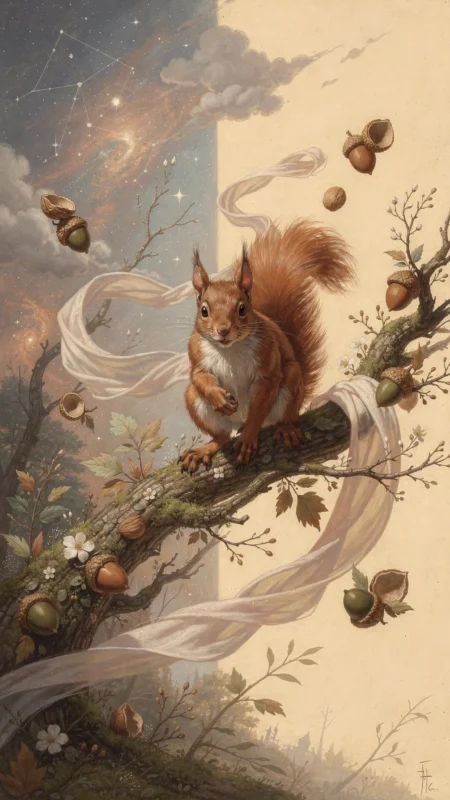
The Oak Tree
With The Oak Tree, The Squirrel may find its most profound and unequal partnership. The Oak is a vessel of slow time, a sprawling, patient cathedral of seasons, while The Squirrel is a frantic burst of kinetic energy, a nervous parishioner scuttling through its woody aisles. This relationship is less a conversation than a coexistence of wildly different scales of being. The Oak offers up the very object of The Squirrel’s obsession—the acorn—and in doing so, provides the raw material for its anxiety. In return, The Squirrel, a creature of imperfect memory, becomes an unwitting agent of the Oak’s future, planting its seeds far and wide in caches it will never find. It is a symbiosis of planetary patience and mammalian panic, a quiet pact between the rooted and the restless.
Winter
Winter is not so much an enemy to The Squirrel as it is a cosmic deadline, the great, cold silence that gives the chattering arias of autumn their meaning. It is the looming, abstract pressure that forges purpose from instinct. Without the promise of Winter’s scarcity, The Squirrel’s existence might dissolve into a series of aimless, sun-drenched afternoons. The relationship, then, could be seen as the fundamental engine of The Squirrel’s character; Winter is the white, empty canvas upon which The Squirrel must frantically paint a portrait of survival. One cannot fight a season, so The Squirrel instead engages in a battle of wits with a concept, building a small, insulated fortress of foresight against the inevitable siege of stillness and cold.
The Forgotten Cache
Perhaps the most poignant of its relationships is with The Forgotten Cache, the quiet ghost of its own frantic labor. Each nut buried and lost is a small, earthy monument to the fallibility of memory and the futility of perfect control. This hidden hoard represents a small failure, a miscalculation in the desperate arithmetic of survival. Yet, it is also a site of accidental grace. The Forgotten Cache is an unintentional gift to the future, a node of potential that escapes the fearful economy of the self to become, perhaps, a sapling or sustenance for another. It is a quiet acknowledgment that our most meticulously planned efforts may find their truest meaning only when they have slipped our minds, released from the tight grip of our own intentions.


 Believe
 Fear
Fear Strength
 Weakness