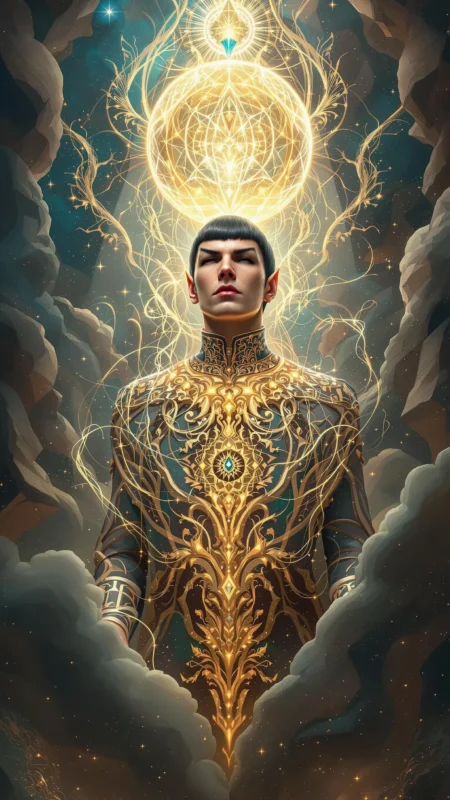
Spock

Archetype Meaning & Symbolism

Logical, observant, detached, loyal, brilliant, alien, stoic, principled, curious, precise

  • Logic is the beginning of wisdom, not the end.

If Spock is part of your personal mythology, you may…

Believe

  • That reason is the most reliable tool humanity possesses for navigating the universe, and that every problem has a logical key, if one can only find the right door.
  • That emotional outbursts are a form of cognitive disruption, a storm of static that obscures the clear signal of truth. They are data to be analyzed, not directives to be followed.
  • That the highest form of love is loyalty. It is not expressed in fleeting passions or poetic words, but in the steadfast choice to stand with someone, especially when it is illogical to do so.

Fear

  • A catastrophic loss of emotional control. The ‘pon farr,’ the moment when the carefully constructed dam of logic breaks and the repressed ocean of feeling floods everything in its path, destroying you and those around you.
  • Being fundamentally and permanently misunderstood. To have your logical intentions misread as coldness, your silence as disapproval, and your loyalty as mere function, leaving you eternally isolated.
  • Making a critical error in judgment based on faulty logic or incomplete data. To be the cause of failure not through malice or weakness, but through an intellectual mistake, which to you is the most profound failure of all.

Strength

  • An almost supernatural ability to remain calm and analytical in a crisis. When others panic, your mind becomes clearer, allowing you to see the path through the fire.
  • Profound and unshakable loyalty. Once you have committed to a person, a principle, or a mission, your support is a constant, a fixed star in a changing sky.
  • A deep and insatiable curiosity about the nature of things. This drives you to constantly learn, explore, and understand, making you a source of wisdom and novel insight.

Weakness

  • A difficulty in forming and maintaining connections that rely on emotional spontaneity and vulnerability. You may analyze feelings rather than share them, creating distance where others seek closeness.
  • A tendency toward intellectual arrogance or appearing aloof. Your confidence in your own logic can be perceived as a dismissal of others’ feelings or intuitive insights.
  • Paralysis by analysis. The need for complete data and a perfect logical framework can prevent you from making timely decisions, especially in situations that require a leap of faith or a gut feeling.

The Symbolism & Meaning of Spock

To carry Spock in your personal mythos is to walk as a scholar of the self, a perpetual visitor in your own emotional landscape. He symbolizes the sacred space between worlds: not just human and alien, but logic and emotion, the known and the unknown. He is the quiet power of observation, the choice to watch the storm before naming the thunder. In a culture that often prizes performative emotion, Spock represents the integrity of the inner life, the conviction that what is not shown can be deeper than what is. He is the patron saint of the overthinker, the solemn guide for those who find more truth in a silent library than a crowded party.

The archetype could suggest a personal history defined by a feeling of ‘otherness.’ Perhaps you were the child who preferred encyclopedias to playgrounds, the one who saw the hidden patterns in social rituals that others took for granted. Spock gives this experience a noble lineage. He elevates the outsider not to a status of lonely exile, but to a position of unique perspective. His is the myth of the necessary stranger, the one whose distance allows for a clarity impossible for those caught in the gravitational pull of convention. He is the proof that one can be of a world but not entirely consumed by it, participating fully while maintaining a private, analytical sanctuary.

Ultimately, Spock’s meaning is one of integration. He is not a creature of pure logic; that is a common misreading. He is a being of profound feeling, disciplined by logic. His journey is the quest to build a bridge across his own internal schism. For the individual whose mythos includes him, the life path may be a similar project: to honor the cool, clear light of reason without denying the warmth of the human heart. It is the search for a personal calculus that can account for both the predictable orbit of a planet and the unpredictable trajectory of a tear.


Spock Relationships With Other Archetypes

The Trickster

The relationship between the Spock and the Trickster may be akin to that of a metronome and a jazz improvisation. Where one mind builds its cathedral of reality from perfectly measured, interlocking stones of fact, the other arrives like a sudden gust of wind, scattering the blueprints and delighting in the chaos of the airborne page. The Trickster’s currency is the paradox, the non-sequitur, the intuitive leap that lands, impossibly, on a truth the Spock had not yet calculated. This dynamic could be one of profound irritation, a constant, illogical variable fouling the purity of the equation. Yet, it might also represent a necessary disruption, a whisper of the cosmic joke that suggests the universe’s operating system has more glitches, more hidden backdoors, than any logical framework could ever hope to contain.

The Oracle

In the Oracle, the Spock might see a distorted reflection, a fellow seeker of truth who has chosen a path of smoke and mirrors over the clear, cold light of reason. It is a conversation between two astronomers, one with a telescope and one with a divining rod, both pointing at the same star. The Spock’s world is built upon the observable, the provable, the great cosmic machinery that can be dismantled and understood piece by piece. The Oracle, however, seems to receive the universe’s conclusions as a direct broadcast, a truth unburdened by the labor of proof. This could be dismissed as noise, as statistical anomaly. But perhaps, in the quiet moments of calculation, the Spock may entertain a fascinating, if improbable, hypothesis: that the Oracle is not wrong, but is simply accessing a different sort of physics, one whose axioms have not yet been written down.

The Labyrinth

The Labyrinth is not so much an adversary to the Spock as it is a partner, a purpose, a form of sanctuary. While others may see in its winding passages a terrifying prison of confusion, the Spock could perceive a beautiful and complex problem waiting for its elegant solution. The mind of the Spock is perhaps a finely wrought instrument, a key cut with a thousand precise ridges, and the Labyrinth is the one lock it was made to open. Within these cool, logical corridors, free from the messy data of human feeling, there may be a profound sense of peace. The Labyrinth offers a pure challenge, a system of rules that, however complex, promises an eventual, verifiable answer—a final, satisfying Q.E.D. in a universe otherwise awash with the unquantifiable.

Using Spock in Every Day Life

Navigating Professional Conflict

In a boardroom where egos flare like solar flares, the Spock archetype allows you to detach from the heat. Instead of reacting to barbs or defending territory, you might calmly analyze the core of the disagreement, identify the competing objectives, and propose a solution that synthesizes the most logical points from all sides, becoming the still point in a turning, shouting world.

Making Life-Altering Decisions

Faced with a choice between a comfortable life and a risky passion, the Spock within you could construct a detailed analysis. You may create spreadsheets, list probabilities, and map out potential outcomes for each path, stripping away the anxieties and romantic notions to reveal the most rational course of action. It is a way of honoring the future by giving it the respect of rigorous thought.

Processing Grief

When loss feels like a planetary collapse, the Spock archetype may not erase the pain, but it could offer a framework for survival. It allows a part of the self to step back, to observe the physiological and psychological effects of grief as a natural process, to ensure the essential functions of life continue: eating, sleeping, working. This is not suppression, but a form of triage, a logical preservation of the self until the emotional self has the strength to fully emerge again.

Spock is Known For

The Vulcan Nerve Pinch

A precise application of pressure to the neck that renders a subject unconscious. It represents the ability to neutralize a threat with minimal violence, a victory of technique over brute force.

The Mind Meld

A telepathic ritual allowing for the sharing of thoughts, memories, and consciousness. It is a symbol of ultimate intimacy and vulnerability, a radical act of empathy achieved through disciplined mental control.

Human-Vulcan Duality

His constant internal struggle between his logical Vulcan heritage and his emotional Human ancestry. This conflict makes him a powerful allegory for anyone who feels like a bridge between two worlds: reason and passion, insider and outsider, intellect and intuition.

How Spock Might Affect Your Personal Mythology

How Spock Might Affect Your Mythos

When Spock is a resident of your personal mythology, your life story may be framed not as a hero’s journey of conquest, but as a scientist’s journey of discovery. The central plot is not about winning battles, but about solving puzzles, the greatest puzzle being the self. Your personal history might be chronicled as a series of hypotheses tested, data collected, and conclusions drawn. Past relationships are not just love affairs; they are case studies in human behavior. Career changes are not failures or successes; they are pivots based on new information. You may see yourself as the chronicler, the ship’s science officer, diligently recording the strange new worlds you encounter, both externally and internally.

Your mythos could also be one of the perpetual diplomat, forever mediating between the warring tribes of your own psyche. The narrative arc of your life may be the slow, painstaking process of forging a treaty between your logical Vulcan mind and your emotional Human heart. Your greatest triumphs are not external accolades but moments of internal harmony: when an intuitive leap is confirmed by rational analysis, or when you successfully use logic to navigate an emotional crisis without suppressing the feeling itself. Your personal legend is that of the bridge-builder, the one who proves that two seemingly opposite natures can coexist, and in their synthesis, create something stronger and wiser than either could be alone.

How Spock Might Affect Your Sense of Self

Your self-perception may be that of an elegant, intricate machine, a marvel of cognitive engineering. You might take immense pride in your intellect, in the clarity of your thought processes, and in your ability to remain objective when others are swept away by feeling. This can foster a profound sense of self-reliance; you believe you have the internal tools to analyze any situation and find a way through. There can be a quiet satisfaction in this, a feeling of being a well-calibrated instrument in a world of chaotic noise. You may see your mind as your truest home, a sanctuary of order and reason.

However, this can also lead to a persistent sense of alienation from the messier parts of your own being. You may view your own emotions as anomalies, inconvenient and illogical data points that disrupt the system. This creates an internal rift, where the ‘logical you’ is constantly observing and judging the ’emotional you.’ This can manifest as a deep-seated frustration with your own humanity, a feeling of being betrayed by your own heart. The challenge to your sense of self is to move from seeing yourself as a mind that possesses a body, to a whole being where logic and emotion are two equally valid, and equally valuable, systems of intelligence.

How Spock Might Affect Your Beliefs About The World

With Spock as your internal counsel, you may view the world as a vast, interconnected system governed by discoverable laws. Society, nature, relationships: all are complex equations waiting to be understood. This fosters a worldview brimming with curiosity rather than judgment. Instead of condemning human folly, you might be fascinated by its patterns, its predictability, its illogical charm. You see problems not as tragic misfortunes but as intellectual challenges. There is a fundamental optimism in this perspective: a belief that with enough data and clear thinking, solutions can be found for almost anything, from personal dilemmas to global crises.

The universe, through this lens, is not a warm, nurturing place, but neither is it malevolent. It is simply a place of immense, beautiful, and sometimes dangerous complexity. Your worldview might prioritize science, data, and verifiable evidence over faith, tradition, or popular opinion. You might look at cultural rituals, political rallies, or romantic comedies with a kind of detached anthropological fascination. This can provide a powerful defense against manipulation and mass hysteria, but it may also create a barrier to experiencing the simple, communal joy of just belonging, of just believing in something without needing to prove it.

How Spock Might Affect Your Relationships

In relationships, the Spock archetype expresses love through unwavering loyalty and acts of profound utility. Your way of showing you care may be to solve your partner’s practical problems, to offer sound advice, or to be the calm, steady presence in their moments of crisis. You may build bonds based on intellectual kinship, a meeting of minds, where the most intimate moments are not necessarily physical, but the shared joy of understanding a complex idea together. The model is the Kirk-Spock friendship: a deep, unspoken bond built on mutual respect for differing, yet complementary, natures.

This approach, however, may create a chasm where conventional emotional expression is expected. You might find the performative aspects of romance to be illogical, and struggle to provide the verbal affirmations or spontaneous displays of affection others crave. You may listen to a friend’s emotional distress and respond with a list of logical solutions, when all they wanted was to be heard and held. Your challenge in relationships is one of translation: learning to speak the language of emotion without feeling that you are betraying your own logical nature, and helping others to understand that your quiet presence and practical support is its own powerful dialect of love.

How Spock Might Affect Your Role in Life

Your perceived role in any group—family, work, or friendship—may be that of the Counselor or the Strategist. You are not necessarily the one to lead the charge, but the one the leader turns to before the charge begins. People may seek you out for your objective perspective, your ability to see the whole chessboard while others are fixated on a single piece. You are the repository of facts, the voice of reason, the one who asks the hard, clarifying questions when everyone else is caught up in enthusiasm or despair. Your role is defined by its indispensability; you provide the critical function that allows the collective to navigate rationally.

This role is one of quiet influence rather than overt power. You may find yourself as the eternal second-in-command, the power behind the throne, the one whose wisdom shapes the final decision. There is a safety in this role, a removal from the direct emotional fallout of leadership. Yet, it can also be a confining one. You may be so valued for your logic that others, and even yourself, might overlook your other capacities: for passion, for intuition, for leadership in your own right. Your developmental task might be to step out from behind the advisory council and occasionally take the captain’s chair yourself, integrating your analytical skills with the courage to command.

Dream Interpretation of Spock

To dream of Spock in a positive context is to receive a message from your own higher, analytical mind. He may appear during a time of emotional turmoil or confusing choices, offering a clear, logical solution that you had overlooked. He might hand you a star chart, symbolizing a map for your future path, or perform a mind-meld, signifying a powerful moment of self-integration where your conscious mind finally understands a deep, previously inaccessible truth about itself. In this light, Spock is a dream guide, a symbol of your own innate wisdom and capacity for clarity, assuring you that you have the intellectual resources to solve the problem at hand.

In a negative context, a dream of Spock can symbolize a fear of emotional repression or alienation. He might appear cold and judgmental, dismissing your feelings as illogical. He could be trapped behind glass or in another dimension, representing your own intellect being cut off from your lived, felt experience. Dreaming that you are Spock and cannot control an emotional outburst, like the Vulcan Pon Farr, could signify a terror that your long-suppressed feelings will erupt destructively. In these dreams, Spock becomes a shadow figure, a warning that a life lived by logic alone is a fragile one, and that the parts of yourself you deem illogical are gathering force in the darkness.

How Spock Archetype Might Affect Your Needs

How Spock Might Affect Your Physiological Needs

From a mythological perspective, the Spock archetype addresses physiological needs with calculated efficiency. The body is a system, a biological machine requiring specific inputs for optimal performance. Your approach to health might be rooted in data: calorie tracking, sleep monitoring, structured exercise regimens. Sustenance is a matter of fuel, not necessarily of pleasure. There could be a spartan quality to your habits, a discipline that views indulgence as an unnecessary variable that could compromise the system’s integrity. The goal is the smooth functioning of the vessel, allowing the mind to operate without the distraction of physical discomfort or weakness.

This logical approach could foster excellent physical health and longevity, a body maintained with the precision of a starship engineer. However, it may also create a disconnect from the body’s more intuitive, pleasure-seeking signals. The sensory joy of a decadent meal, the languor of a lazy morning, the pure, unanalyzed pleasure of movement—these might be sacrificed in the name of efficiency. The mythological challenge is to see the body not just as a machine to be maintained, but as a source of wisdom and experience in its own right, a partner to the mind rather than merely its vehicle.

How Spock Might Affect Your Ideas of Belonging

Belonging, for the one with Spock in their mythos, is a complex and often solitary pursuit. You may not seek belonging in a crowd of peers who share your interests, but in a functional role where your unique skills are essential to a mission. Like Spock on the Bridge of the Enterprise, you belong because you are needed. You are the indispensable part of a greater whole. This is a belonging forged in mutual respect and shared purpose, a bond that transcends social niceties. It is deep, quiet, and profoundly loyal.

Love and intimacy are expressed similarly, through acts of service and unwavering reliability rather than overt affection. The challenge is the persistent echo of loneliness that can accompany this state. While valued, you may not always feel understood. The deepest desire is for a ‘Kirk,’ a complementary other who sees and values your logical nature but also recognizes and is not afraid of the deep feeling beneath it. True belonging is not just being useful; it is being seen in your entirety, the logical and the illogical, and being accepted without the need for translation.

How Spock Might Affect Your Feelings of Safety

For the Spock archetype, safety is not found in walls or weapons, but in knowledge. Security is a state of preparedness, achieved by analyzing potential threats, understanding their nature, and developing logical countermeasures. You may find comfort in contingency plans, in having a clear protocol for emergencies. The greatest threat is not the predictable danger, but the unknown variable, the chaotic human element that can dismantle the most carefully laid plans. Your sense of safety is directly proportional to your sense of understanding.

This creates a life built around risk mitigation. You may research meticulously before a major purchase, study maps before traveling to a new city, or analyze the psychological profiles of your colleagues to predict their behavior. This can make you extraordinarily resilient and difficult to surprise. The shadow side is a potential for anxiety when faced with true uncertainty. When no amount of data can predict the outcome, you may feel profoundly unsafe and unmoored. The mythological lesson is that while logic can build a strong fortress, true security also requires the courage to face the unknown, to trust one’s ability to improvise when the plan inevitably fails.

How Spock Might Affect Your Views of Esteem

Esteem is not built on praise or popularity, but on competence. Your self-worth is tethered to your ability to solve the problem, to offer the correct analysis, to be right. There is a deep, quiet pride in intellectual mastery and moral integrity. You feel most valuable when you have provided a crucial piece of insight that clarifies a confusing situation or saves the group from a mistake. Your esteem comes from the internal validation of a logical mind that knows it has performed its function well.

This can create a very stable, internally-referenced sense of self. However, it can also be brittle. A significant logical error or a failure of analysis can feel like a devastating blow to your core identity. Furthermore, the constant struggle is to grant esteem to the ‘human’ parts of yourself. When you act out of emotion, intuition, or loyalty against the grain of pure logic, you may judge yourself harshly. The highest form of esteem is achieved when you can value not just your brilliant mind, but also your complex heart, recognizing that true wisdom requires both.

Shadow of Spock

The shadow of Spock emerges when logic ceases to be a tool and becomes a tyrant. In its excess, the archetype manifests as a cold, unfeeling machine, a being who uses reason as a weapon to invalidate the emotions of others. This shadow Spock is not wise, but brittle. It dismisses art, love, and grief as illogical fallacies. It wins every argument but finds itself utterly alone, the master of a sterile, empty kingdom. Relationships wither under its clinical gaze, as it dissects every feeling until it dies on the table. It is the hollow man, full of facts but devoid of truth, who has successfully surgically removed his own heart only to find he has also removed his soul.

Conversely, the repressed shadow can be just as destructive. When the emotional, human half is denied and starved in the dungeons of the psyche, it does not disappear. It mutates. It gathers strength in the dark until it erupts in a terrifying, uncontrolled cataclysm—the personal ‘pon farr.’ This can manifest as a sudden, shocking outburst of rage, a reckless romantic entanglement completely devoid of reason, or a deep depression that logic is powerless to analyze. The shadow proves that what is repressed does not die; it goes underground and poisons the wells. The ultimate failure of the Spock archetype is the belief that any part of the self can be jettisoned without consequence.

Pros & Cons of Spock in Your Mythology

Pros

  • You possess exceptional problem-solving abilities, able to dissect complex issues with a clarity and precision that others lack, making you invaluable in any challenging situation.
  • You have a high degree of emotional resilience, able to weather personal and professional storms without being capsized by the waves of panic or despair.
  • You build a reputation for unshakable integrity and reliability. People know that your word is your bond and that your counsel is free from the distortions of ego or hidden agendas.

Cons

  • You are at high risk for profound loneliness and emotional isolation, as your analytical nature can create an invisible wall between you and the messy, chaotic, but vital world of human feeling.
  • You may be consistently misunderstood by others, with your quietude perceived as coldness, your logic as arrogance, and your lack of emotional display as a lack of caring.
  • You may struggle to act in situations that defy logic, missing out on opportunities for joy, love, or creativity that require intuition, spontaneity, and a leap of faith into the unknown.