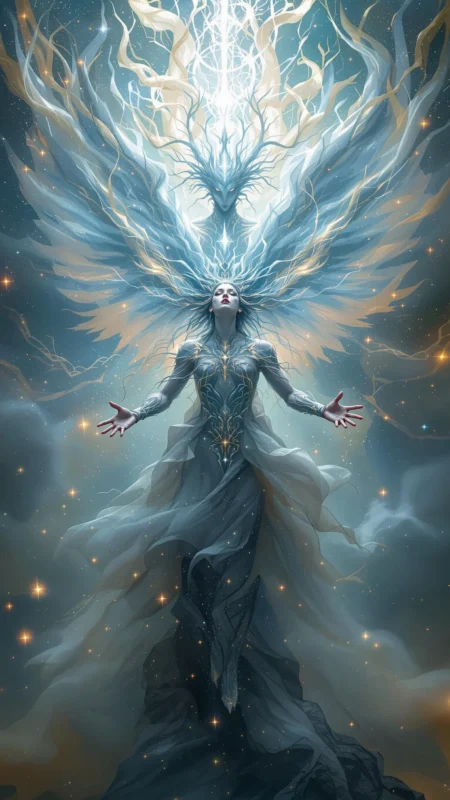
Spirits

Archetype Meaning & Symbolism

Ethereal, guiding, mischievous, ancient, elemental, chaotic, wise, fleeting, collective, ancestral

  • Listen to the wind, it talks. Listen to the silence, it speaks. Listen to your heart, it knows.

If Spirits is part of your personal mythology, you may...

Believe

  • The world is sentient, and everything from a river to a city street possesses a unique consciousness or spirit with which one can commune.
  • Coincidences are rarely just coincidences: they are whispers from the unseen, moments of synchronicity where the veil between worlds thins, offering guidance or affirmation.
  • My intuition is a form of communication with these guiding forces, and learning to listen to it with clarity and discernment is my most vital spiritual practice.

Fear

  • Offending or being abandoned by the spirits that guide and protect me, leaving me psychically vulnerable and utterly lost in the world.
  • Losing my sanity, becoming unable to distinguish between genuine spiritual insight and psychological projection, delusion, or wishful thinking.
  • Becoming overwhelmed by the sheer volume of spiritual 'noise,' unable to function in the mundane world due to a hyper-sensitivity to the energies of people, places, and the unseen.

Strength

  • A powerful and reliable intuition that guides you through life’s complexities, often providing elegant solutions and profound insights that defy logical explanation.
  • A deep, unshakable sense of connection to the web of life, which provides immense resilience and a fundamental feeling of never being truly alone.
  • A boundless well of creativity, as you see yourself not as the sole creator but as a willing and open channel for inspiration from a source beyond the individual ego.

Weakness

  • A tendency towards passivity or fatalism, waiting for signs or divine permission before taking decisive action, sometimes missing crucial opportunities.
  • Difficulty maintaining healthy personal boundaries, as your porous sense of self can make you susceptible to absorbing the emotional states and energies of others.
  • A potential for superstition or paranoia, attributing mundane misfortune, random events, or psychological issues to the influence of malevolent spiritual forces.

The Symbolism & Meaning of Spirits

To invite the archetype of the Spirits into your personal mythology is to consent to a world that is not fully knowable, at least not by the metrics of the waking, rational mind. It symbolizes the power of the unseen, the validity of intuition, and the hum of consciousness in places you were taught to believe were inert. The Spirit is the ghost in the machine of reality, the awareness that a coincidence might be a carefully placed breadcrumb, that a sudden shiver might be a message. In your own story, this archetype represents the voice that whispers from just outside the firelight of your ego, offering guidance that sidesteps logic and speaks directly to the soul. It is the part of you that trusts the gut feeling, the strange dream, the inexplicable affinity for a place or person.

The Spirits are also the keepers of place, the genius loci. Your personal mythology may become deeply rooted in geography, not as a backdrop but as an active character. The corner of the yard where the light hits just so, the specific bend in a river, the palpable energy of a city block: these places may feel like they have their own consciousness, their own story that intersects with yours. You might feel a responsibility to these places, a sense of dialogue. This archetype fosters a belief that you are in a constant, subtle relationship with your environment, and that the health of your soul is tied to the health of the land you inhabit, whether it be a wild forest or a concrete canyon.

Finally, this archetype connects you to a vast, invisible collective. This could be ancestral: the feeling that you carry the unfinished stories and accumulated wisdom of those who came before. It might be elemental: a kinship with the spirits of wind, water, and fire. It could even be chaotic, a brush with the mischievous, unpredictable sprites that delight in upending your carefully laid plans. This symbolism dissolves the illusion of the isolated self. You are a nexus, a meeting point where these many unseen forces converge, and your life is the unique pattern that their weaving creates.


Spirits Relationships With Other Archetypes

The Vessel

The Spirits may have their most intimate and precarious relationship with The Vessel, for what is an ethereal force without a form to inhabit? The Vessel could be the physical body of a comedian like Robin Williams, a theater stage, or even the silent, expectant marble awaiting the sculptor's hand. It is a consecrated space, a chalice whose very purpose is to be filled with the effervescent, and often volatile, wine of inspiration. Yet, this union is fraught with peril. The energy of The Spirits might sanctify The Vessel, but it could also strain its seams, cracking the very container that gives it expression. Perhaps the tragedy and the glory are one and the same: that a finite form dares to house an infinite, untamable current, risking its own dissolution for a brief, brilliant flash of communion with the sublime.

The Anchor

If The Spirits are a kite, soaring on unpredictable updrafts of mania and insight, The Anchor is the steady hand holding the string. This grounding force—a patient loved one, a daily routine, the simple, humbling gravity of the body—may seem, at first, to be a limitation. It is the necessary counterweight, the tether to the terrestrial that prevents the kite from being torn to shreds in the stratosphere or lost entirely to the void. This relationship is a quiet, profound tension between ascent and stability. The Anchor offers a harbor, a place for the storm to rest, yet its very presence could be felt as a drag on transcendent flight. One might suggest that The Spirits can only truly play amongst the clouds because they know, somewhere below, The Anchor ensures there is a world to which they can, eventually, return.

The Audience

The relationship between The Spirits and The Audience is not one of performer and observer, but perhaps of a flame and the oxygen it craves. The Spirits do not simply exist; they exist *for* and *through* the collective gaze. Laughter, applause, even a held breath—these are not mere reactions, but a form of spiritual currency, an energy transfer that fuels the ecstatic display. In this sense, The Audience could be seen as a vast, resonant chamber, amplifying the frequency of The Spirits into a shared experience of catharsis or wonder. But this dependence is a double-edged sword. The chamber can just as easily fall silent, its vacuum starving the flame. The Audience, then, is a fickle god, capable of elevating The Spirits to a state of grace or, with a collective shift of attention, abandoning them to the cold silence of an empty stage.

Using Spirits in Every Day Life

Navigating Uncertainty

When you stand at a crossroads, a place where maps dissolve, you might invoke the Spirits. This is not about asking for a direct answer, a divine decree printed on the air. It is, perhaps, about attuning your senses to the subtle currents of the moment: the way the light falls, the sudden memory that surfaces, the intuitive pull toward one path that your logical mind cannot justify. It is the art of reading the world’s quiet grammar.

Creative Blocks

An artist or writer, facing the profound silence of a blank page, might engage with this archetype to dismantle a creative impasse. Inspiration, in this mythology, is not a resource to be plundered from the self, but a visitor to be welcomed. It requires preparing a space, a mental clearing. You treat creativity as a spirit that is drawn to hospitality: to openness, to ritual, to the patient willingness to simply sit and listen for a voice that is not entirely your own.

Healing from Grief

In the landscape of loss, where absence has a physical weight, the Spirits archetype can reframe grief. It may transform a painful void into a form of communion. The departed are not gone, but changed, their presence now a part of the ancestral chorus. Grief becomes a dialogue with memory, a way of tending to a relationship that has crossed a threshold. This presence could inform and enrich the ongoing story of your life, making you a keeper of their flame.

Spirits is Known For

Guardianship

Spirits are often conceived as protectors of a specific place, people, or principle. A river has its genius loci, a family its ancestral guardians, a forest its collective soul. To walk through the world with this awareness is to feel watched over, and to understand that every place has its own silent, powerful sovereign.

Intermediaries

They frequently act as messengers between the human and divine realms, the seen and the unseen. They are the carriers of omens, the substance of synchronicity, the voice in a dream. They traffic in the subtle information that weaves the cosmos together, bridging the chasm between matter and meaning.

Elemental Embodiment

Spirits often give form to the fundamental forces of nature. They are the sudden fury in a summer storm, the patient, quiet growth of a moss-covered stone, the immutable presence of a mountain. They represent the world’s animus, its raw and untamable life force, reminding you that you are part of an entity far older and wilder than yourself.

How Spirits Might Affect Your Personal Mythology

How Spirits Might Affect Your Mythos

When the Spirits become a character in your personal mythos, your life story ceases to be a straightforward, linear progression driven solely by your own will. It becomes, instead, a tapestry woven with invisible threads. Your narrative may be punctuated by moments of inexplicable synchronicity, of guidance arriving from unexpected quarters. The plot is no longer just about what you do, but about what you notice. A wrong turn that leads to a life-changing encounter is no longer a mistake; it's a course correction from an unseen hand. A recurring dream is not just neural noise; it’s a chapter of your myth being written in a symbolic language you must learn to decipher.

Your mythos shifts from a heroic epic of conquest to a subtle mystery of attunement. The central conflict may not be you against the world, but your noisy, rational mind against your quiet, intuitive knowing. The protagonist—you—learns that true power lies not in asserting control, but in achieving a state of graceful alignment with the currents of life. Victories are measured differently: a moment of perfect, unbidden creative flow, a flash of insight that solves a long-standing problem, the deep peace of feeling perfectly in place. Your story becomes richer, less predictable, and imbued with a sense of wonder, as you realize you are a collaborator in your own destiny, co-authoring your life with the silent, whispering world.

How Spirits Might Affect Your Sense of Self

Embracing the Spirits archetype may profoundly alter your concept of self. The hard, defined borders of the ego could begin to soften, becoming more porous and permeable. You may no longer see yourself as a self-contained unit, a singular consciousness piloting a body. Instead, you might feel like a vessel, a channel through which other energies, intelligences, and memories flow. The 'I' becomes a 'we,' a confluence of your personal history, the echoes of your ancestors, the spirit of the place you inhabit, and the creative muses that choose to visit.

This can be both humbling and empowering. The pressure to generate all your own answers and inspiration is lifted; you learn to listen instead. Your identity might become less about your achievements and more about your quality of attention. This shift can foster a deep humility, a recognition that your personal consciousness is but one small note in a vast, cosmic symphony. It may also grant you a profound sense of resilience, as you feel connected to resources of wisdom and strength far greater than your own isolated psyche. You are a part of a larger conversation, even in your most solitary moments.

How Spirits Might Affect Your Beliefs About The World

With the Spirits as part of your inner pantheon, the world transforms from a collection of inert matter into a vibrant, living organism. It is a philosophy of radical enchantment. A forest is not just a stand of trees; it is a community with a collective consciousness. A city is not just steel and glass; it has a soul, a palpable mood shaped by the millions of lives lived within it. The wind is not just moving air; it carries stories. This animistic worldview dissolves the subject-object dichotomy that underpins so much of modern thought.

Consequently, your place in the world shifts from that of an owner or observer to that of a participant. You are not separate from nature; you are one of its many expressions. This may cultivate a profound ecological ethic, a sense of responsibility born not of guilt, but of kinship. Exploiting the world becomes unthinkable, akin to harming a member of your own family. Your perception sharpens to the subtle life of things, and the universe ceases to be a cold, indifferent expanse. It becomes a home, filled with myriad forms of intelligence, all engaged in a silent, eternal dialogue.

How Spirits Might Affect Your Relationships

In the realm of human connection, this archetype might lead you to perceive relationships as having their own 'spirit' or third entity, a unique energy field created by the interaction of two people. You may become exquisitely sensitive to the unspoken dynamics, the atmosphere of a room, the emotional weather that passes between individuals. Your focus could shift from the literal content of conversations to the subtle music beneath the words, allowing for a deeper, more intuitive form of empathy and understanding.

This perspective also expands the very definition of a relationship. You might cultivate a conscious relationship with non-human entities: a particular tree, your home, the memory of an ancestor, or even an idea. This can be a profound antidote to loneliness, fostering a sense of companionship and connection that transcends the human social sphere. However, it may also present challenges. A hyper-attunement to subtle energies could become overwhelming, and the preference for the uncomplicated communion with the unseen might, at times, make the messy, demanding work of human relationships feel less appealing.

How Spirits Might Affect Your Role in Life

Your perceived role in life may undergo a fundamental shift, moving from active to receptive, from architect to channel. You might see your purpose not as something to be achieved through sheer force of will, but as something to be discovered through listening. Your life's work could be framed as a form of stewardship: perhaps you are a caretaker of a piece of land, a keeper of your family's stories, a guardian of a specific craft or tradition. You are the vessel through which something larger than yourself seeks expression.

This reframes ambition. The goal may no longer be personal glory or material success, but the clarity of the channel you provide. Success is measured by your fidelity to the spirit that moves through you, whether that spirit is one of creativity, healing, or community. This can lead to a life of profound meaning and service, detached from the approval of the outside world. Your role is not to invent, but to attend. Not to conquer, but to commune. Your most important work is to stay open to the whispers.

Dream Interpretation of Spirits

When Spirits appear in your dreams in a positive context, as luminous beings, helpful animals, or a gentle, guiding presence, it may signify a powerful breakthrough of your intuition into your conscious awareness. This could be your subconscious, or something deeper, offering guidance, reassurance, or a solution to a waking-life problem. Such dreams often leave you with a feeling of peace and clarity. They may suggest that you are in alignment with your deeper self and on the right path. They are an invitation to trust the unseen forces at play in your life and to pay closer attention to the subtle synchronicities of your day.

Conversely, if Spirits manifest as chaotic, menacing, or parasitic figures in your dreams, it might point to ignored or repressed aspects of your own psyche. These are the parts of you that have been denied a voice and now scream for attention from the shadows. Such dreams could also reflect anxieties about the unknown, a fear of losing control, or a feeling of being overwhelmed by external forces. They might be a warning that you are psychically porous, absorbing negative energy from your environment or relationships. The dream is not necessarily a literal spiritual attack, but a symbolic depiction of an internal state of imbalance, urging you to strengthen your psychological and spiritual boundaries.

How Spirits Archetype Might Affect Your Needs

How Spirits Might Affect Your Physiological Needs

From a mythological perspective, the Spirits archetype intimately links your physiological needs to your spiritual state. The body is not a machine to be fueled, but a sacred vessel, and its aches and energies are a form of divination. A persistent feeling of fatigue might be read not just as a need for sleep, but as a symptom of 'soul loss' or a disconnection from your guiding spirits. Health becomes a matter of spiritual hygiene as much as physical. You may find that clean air, pure water, and nourishing food are sought not just for their biological benefits, but because they are offerings to the spirit that animates your form.

Sustenance itself becomes a ritual. The act of eating could be seen as an integration of other life forces into your own, an act requiring gratitude and mindfulness. You might feel drawn to preparing food with intention, honoring the plants and animals that provide your nourishment, and seeing each meal as an opportunity to ground yourself and commune with the spirit of life. This perspective elevates basic physiological needs into a constant, embodied spiritual practice, where caring for the body is an act of reverence for the soul within.

How Spirits Might Affect Your Ideas of Belonging

The Spirits archetype offers a radical solution to the ache of existential loneliness. Your sense of belongingness may expand far beyond the human tribe to encompass the entire living world, and even the worlds beyond. You may feel a deep kinship with animals, plants, and landscapes, perceiving them as fellow beings in a vast, interconnected family. This animistic belonging can provide a constant, unwavering source of connection, a feeling that you are never truly alone because you are part of a cosmic, conscious whole. You belong not just to a community, but to the cosmos itself.

This deep connection also extends to the past and the future. You might feel a profound sense of belonging with your ancestors, seeing yourself as the current bearer of a long, unbroken chain of life. Your life has context, rooted in those who came before you. This can be immensely grounding and comforting. The potential shadow of this is that the rich, easy companionship of the unseen world could sometimes feel more compelling than the messy, demanding, and often disappointing world of human relationships. The challenge becomes integrating this cosmic belonging with the practical, everyday work of loving the flawed, tangible people in your life.

How Spirits Might Affect Your Feelings of Safety

The need for safety, through the lens of the Spirits archetype, extends beyond physical security into the realm of spiritual harmony. You might find a profound sense of safety in the belief that you are watched over by guardian spirits, ancestral protectors, or the benevolent consciousness of a place. A home is not just shelter from the elements, but a sanctuary whose spiritual atmosphere must be tended to through ritual, cleansing, or intention. This can provide a powerful psychological buffer against the anxieties of an uncertain world, a feeling of being held and protected by unseen allies.

However, this worldview can also introduce new dimensions of fear. Safety is no longer just about locking the doors; it's about maintaining right relationship with the spirit world. You may develop a fear of spiritual transgression: of offending a local spirit, of attracting negative entities, or of wandering into a place with a malevolent atmosphere. Safety becomes a delicate balance, requiring not just physical vigilance but also spiritual awareness and discernment. You might feel a need for psychic shielding or protective rituals to navigate a world perceived to be pulsing with invisible influences, both benevolent and harmful.

How Spirits Might Affect Your Views of Esteem

With the Spirits archetype integrated into your mythos, the foundations of your self-esteem may shift from external validation to internal attunement. Your worth is not measured by promotions, accolades, or social media likes, but by the clarity of your intuitive channel. You might derive profound self-respect from your ability to perceive the subtle energies of a situation, to receive creative inspiration, or to feel a deep, resonant connection with the spirit of a place. Esteem becomes a function of your relationship with the unseen.

This provides a stable, internal locus of control for your self-worth, one that cannot be given or taken away by others. The respect you cultivate is for the part of you that listens, the part that trusts the quiet inner voice over the loud outer world. This fosters a sense of quiet confidence and integrity. The potential vulnerability, however, lies in moments when that connection feels weak or severed. During such 'dark nights of the soul,' when the spirits seem silent, your esteem might plummet, as its source has temporarily gone quiet, requiring a deep faith to endure the silence.

Shadow of Spirits

The shadow of the Spirits archetype emerges when the whisper becomes a siren's song, luring you away from the shared, tangible world. It is the descent into magical thinking so profound that you lose your footing in reality. Every falling leaf is a portent, every conversation is thick with hidden meaning, and you become a paranoid detective in a mystery of your own making. This can lead to a state of profound alienation, a fortress of personal symbolism that no one else can enter. You may abdicate all personal responsibility, attributing every failure and success to the whims of capricious spirits, becoming a passive marionette in your own life story.

Another shadow manifestation is the inflation of the ego under the guise of spirituality. One might claim special access to the spirit world, not out of genuine connection, but as a way to wield power and influence over others. This is the charlatan, the self-proclaimed guru who uses the language of spirits to manipulate and control. Here, the archetype is not a source of humility but of arrogance. The 'channel' is not clear but is muddied by the desire for significance. The connection becomes a commodity, the sacred is profaned for personal gain, and the profound mystery of the unseen is flattened into a tool for self-aggrandizement.

Pros & Cons of Spirits in Your Mythology

Pros

  • Fosters a profound reverence for nature and a sense of sacred responsibility for the environment, viewing it not as a resource but as kin.
  • Unlocks deep sources of creativity, intuition, and wisdom that are not accessible through purely rational or analytical modes of thought.
  • Provides a powerful antidote to modern alienation and loneliness, creating a sense of belonging to a vast, interconnected, and living cosmos.

Cons

  • Can lead to a disregard for scientific evidence or logical reasoning, creating a vulnerability to superstition and misinformation.
  • May create social friction or isolation, as this deeply personal and animistic worldview can be difficult for those outside of it to understand or accept.
  • Carries a risk of psychological instability if one cannot develop the discernment to differentiate between genuine spiritual insight and mental health challenges.