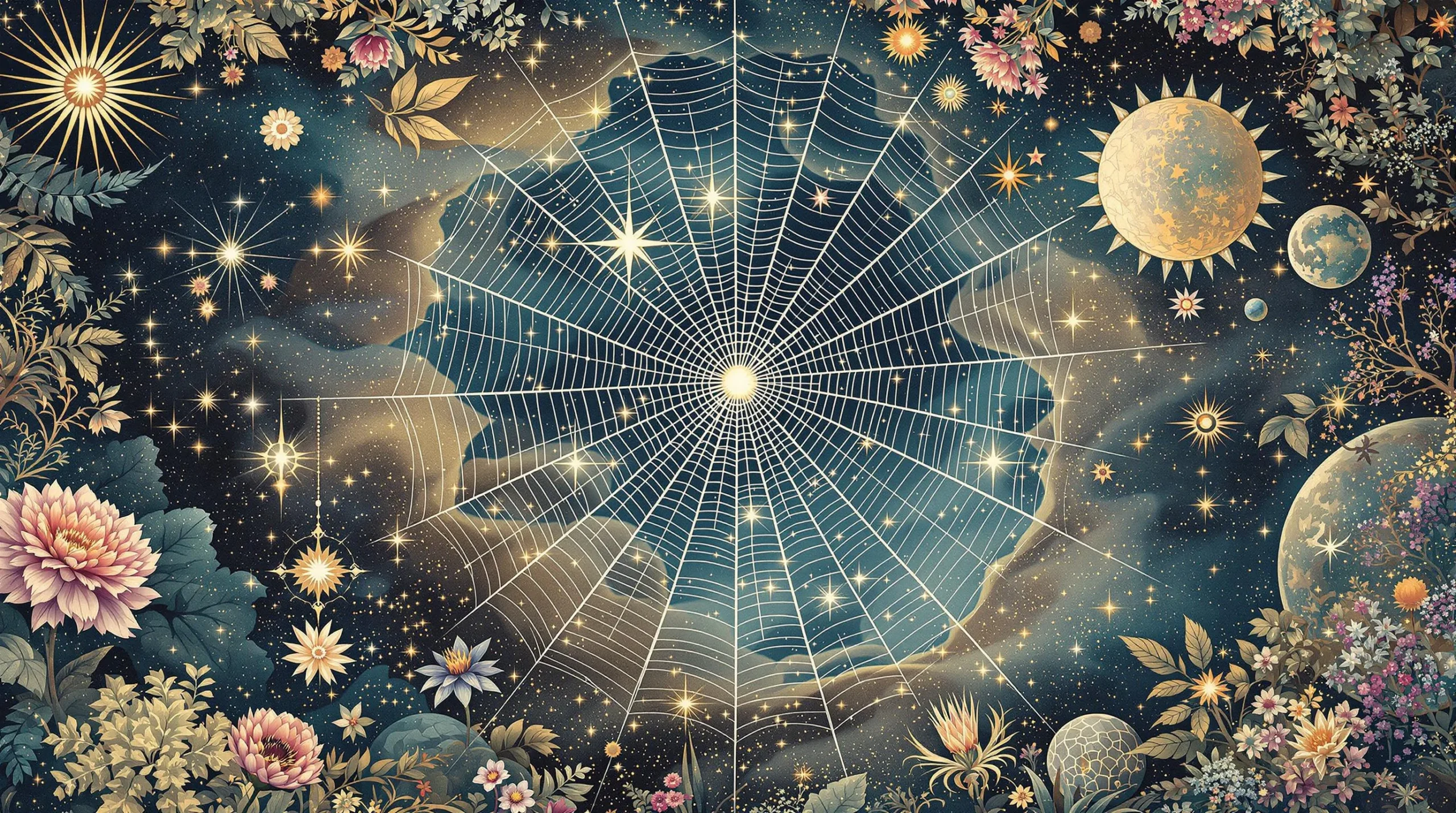


Spiderweb

Archetype Meaning & Symbolism

Intricate, interconnected, patient, creative, ensnaring, delicate, resilient, transparent, systematic, fatal

  • What you build to catch your sustenance may also become your prison. Weave wisely.

If Spiderweb is part of your personal mythology, you may...

Believe

  • Everything is connected; there are no coincidences, only patterns not yet perceived.
  • Patience and strategic positioning are more powerful than brute force.
  • What you create to sustain yourself will ultimately define you.

Fear

  • A sudden, catastrophic event that rips apart your carefully constructed reality.
  • Becoming so entangled in your own creations—your business, your rules, your relationships—that escape is impossible.
  • Invisibility; that the intricate, painstaking work of your life will go unseen, unappreciated, and ultimately be swept away without a trace.

Strength

  • Systemic thinking: an innate ability to see connections, patterns, and leverage points that others miss, allowing you to navigate complexity with ease.
  • Profound patience: the willingness to wait for the right moment, to let plans unfold organically, and to let opportunities come to you rather than chasing them frantically.
  • Creative construction: a talent for building complex, resilient, and often beautiful structures from scratch, whether they be ideas, businesses, or communities.

Weakness

  • Over-complication: a tendency to weave unnecessarily complex plans, systems, or relationships when a simpler, more direct approach would be more effective.
  • Calculated passivity: a reliance on the web to bring things to you can lead to missed opportunities that require proactive, assertive action.
  • Manipulation: the temptation to use your intimate understanding of networks and connections to subtly control people and outcomes for your own benefit, often without their awareness.

The Symbolism & Meaning of Spiderweb

In personal mythology, the Spiderweb may symbolize the universe of your own making. It is your network, your life’s work, your creative output—a tangible map of your mind spun out into the world. Its construction requires immense patience and an instinct for architecture, a trust in the process of building something complex from a single point of origin. To have the Spiderweb in your mythos is to see your life as a creation, a structure that is both your home and the means by which you draw sustenance from the world. It is the original World Wide Web, a network of connections that transmits information through the faintest vibration, reminding you that everything you build is, in some way, alive and listening.

The web is also a potent symbol of fate and entanglement. It could represent the intricate patterns of karma, the unyielding logic of cause and effect that holds you. The sticky threads may be the obligations, expectations, and historical circumstances you feel caught within. This is the web as a system, be it social, economic, or digital, that feels both inescapable and subtly predatory. It speaks to the ways we are held by our own patterns of thought and behavior, spinning a reality that inadvertently traps us. The web asks a difficult question: are you the weaver, or are you the fly?

The deepest meaning of the Spiderweb archetype lies in its duality. It is both a cradle and a tomb, a work of art and a weapon, a symbol of connection and of deadly isolation. It dissolves the binary between creating and destroying. The web sustains the spider’s life by ending the lives of others. For the individual, this might point to a profound, if unsettling, acceptance of life’s cycles. It suggests that your own survival and success may be predicated on systems that, for others, are a trap. It is the beautiful, terrifying lattice of interconnectedness, where to touch one thread is to tremble the whole.


Spiderweb Relationships With Other Archetypes

The Spider

The Spider is the conscious artist; the Spiderweb is its masterpiece and its extended mind. This relationship is one of origin and manifestation. If the Spider is your will, your creative impulse, your patient ambition, the Web is the evidence of that will made tangible. It is the business you built, the family you nurtured, the social network you command. One cannot exist without the other. To embody the Web without acknowledging the Spider is to feel adrift in a structure without a center, a pattern without a purpose. To be the Spider without the Web is to be a creature of pure potential, all thought and no action, a weaver with no silk.

The Wind

The Wind is the agent of chaos and change, the unpredictable force that tests the Web’s resilience. It can be a bearer of gifts, blowing unsuspecting nourishment into the sticky threads, or it can be a harbinger of ruin, tearing the delicate architecture to shreds. In a personal mythos, the relationship between the Web and the Wind speaks to your own structure’s ability to withstand external pressures. A life built too rigidly will be destroyed by the first gale of misfortune. A life built with flexibility, with an understanding of how to bend and where to anchor, may survive the storm and even be cleared of old debris. The Wind is the world’s indifference; the Web is your elegant, persistent response.

The Fly

The Fly is the other, the external element, the random encounter that becomes ensnared in your story. The Fly can be a victim, yes, but it is also sustenance. It is the job offer that lands unexpectedly, the new friend who stumbles into your life, the difficult problem that demands your attention. Once caught, the Fly becomes part of the Web’s story. This relationship highlights the porous boundary between you and the world. Your personal mythology is not a closed system; it is constantly fed and altered by what it catches. The Fly archetype forces you to consider the ethics of your web: what do you do with that which you capture? Do you drain it for your own gain, or do you integrate it in a way that strengthens the entire structure?

Using Spiderweb in Every Day Life

Navigating Complex Social Networks

When confronted with a complex social or professional environment, you might embody the Spiderweb by mapping it out. Instead of seeing a chaotic group of people, you may perceive the lines of influence, the strong and weak ties, the central connectors, and the peripheral players. This allows you to position yourself strategically, to know which thread to pluck to get a message across the entire network, and which frayed ends signal instability. You don't barrel through; you feel the vibrations.

Building a Creative Project

A large project, be it a novel, a business, or a body of research, can feel overwhelming. The Spiderweb archetype suggests starting not with a grand, rigid blueprint, but with a single, strong anchor point: a core idea or question. From there, you patiently spin out radial threads—major themes or components—and then begin the meticulous spiral of connecting them. Each new part reinforces the whole. The structure emerges organically yet with profound internal logic, creating something resilient and complex that can catch and hold attention.

Processing Intergenerational Patterns

You may use the archetype to visualize inherited family dynamics or trauma as a vast, sticky web spun through generations. Understanding this doesn't mean you are hopelessly entangled. It means you can see the pattern. You can identify the load-bearing threads of connection you wish to preserve and the sticky, trapping filaments of dysfunction you need to carefully sever. The work is not to destroy the web of your history, which is impossible, but to mend and modify it, making it a place of support rather than a trap.

Spiderweb is Known For

Intricate Design

A marvel of innate engineering, the Spiderweb is known for its geometric precision and structural integrity, a functional mandala spun from the body of its creator.

A Functional Trap

Its primary purpose is to ensnare. It is a passive, patient tool of predation, using deception—near-invisibility and stickiness—to secure sustenance from the unsuspecting.

Ephemeral Strength

Famously stronger than steel by weight, yet vulnerable to a clumsy gesture or a strong gust of wind. This paradox of immense strength and profound fragility is central to its identity.

How Spiderweb Might Affect Your Personal Mythology

How Spiderweb Might Affect Your Mythos

When the Spiderweb is a core component of your personal mythos, your life story may cease to be a linear progression and become a radial map of connections. The narrative is not 'this happened, then that happened,' but rather 'this central event connects to these people, which in turn influences those ideas.' You may see yourself as the weaver of your own fate, not in a bombastic sense, but in a quiet, architectural way. Your mythos is the story of what you have built, thread by patient thread. The major plot points are not heroic battles, but moments of connection, of mending a tear in the fabric, or of completing a complex and beautiful new section of the web.

The mythos may also be one of profound entanglement, where the past is never truly past. Old relationships, former selves, and past decisions are not memories left behind but sticky threads that continue to vibrate in the present. The central conflict of your story might be navigating this intricate, self-made labyrinth. The hero’s journey is not a march forward into the unknown, but a careful journey inward, toward the center of your own creation, to understand the logic of its design and, perhaps, to change it from within. Your life story becomes a testament to the idea that we are ultimately defined by the patterns we create and inhabit.

How Spiderweb Might Affect Your Sense of Self

Your sense of self may be intricately tied to your connections and creations. Identity is not a solid, immutable core, but a pattern, a nexus point from which the threads of your life radiate. You may feel most yourself when you are at the center of your network, whether it's a family, a company, or a social circle, feeling the vibrations and understanding your influence. This can foster a distributed sense of self, one that is relational and systemic, leading to a profound understanding that 'I' am a function of 'we.'

Conversely, this can lead to a precarious sense of identity, one that feels dangerously dependent on the integrity of the web. If the network collapses, if the project fails, who are you? There may be a persistent fear of being nothing without your connections, a hollow center defined only by the strands attached to it. The self can feel diffuse, spread thin across a hundred different obligations and relationships, leading to a feeling of being caught in a construct of your own making, a stranger in the house you built.

How Spiderweb Might Affect Your Beliefs About The World

To see through the lens of the Spiderweb is to perceive the world as a single, monumentally complex, and interconnected system. Coincidence may seem like a failure of perception; everything is linked, and every action sends ripples across the entire structure. This perspective cultivates an intuitive grasp of systems thinking. You understand that a problem in one area of life—or society—cannot be solved without understanding its connections to seemingly unrelated areas. This can foster a deep sense of responsibility and a holistic approach to life, where the personal, political, and ecological are not separate categories but interwoven threads of the same fabric.

This same worldview, however, could foster a sense of paranoia or fatalism. If everything is connected, then the world can appear as a series of interlocking traps. You may see the hidden strings of power, the sticky algorithms of social media, the ensnaring nets of economic systems, and feel overwhelmed by the complexity. The world is a web, and you are just a fly. This can lead to a cynical withdrawal, a desire to retreat to the perceived safety of one’s own small corner, or a paralyzing awareness of the infinite consequences of any single action.

How Spiderweb Might Affect Your Relationships

In relationships, you may operate as a master weaver. Connections are not things that happen to you; they are things you build, cultivate, and maintain with intention and care. You may be the person who holds a friend group together, the one who remembers the birthdays, the one who understands the intricate dynamics at play. You value the tensile strength of loyalty and communication, and you work to repair any fraying threads before they snap. Love, for you, is perhaps a conscious act of co-creation, weaving your web together with another's to create a stronger, more complex, and more beautiful home.

However, there may be a tendency to view relationships in a utilitarian or transactional light. People can become nodes in a network, resources to be managed, or flies to be caught. The focus might be on the pattern of connection rather than the person at the end of the thread. This can lead to a subtle manipulativeness, using your understanding of the web to pull strings and orchestrate outcomes. There may also be a deep fear of enmeshment, a terror of being so tightly woven into another's life that your own identity is lost, or of being smothered by the sticky demands and obligations of others.

How Spiderweb Might Affect Your Role in Life

Your perceived role in life could be that of the Architect or the Connector. You are the one who designs the system, builds the framework, and creates the space for others to interact. This might manifest as being an entrepreneur, a community organizer, a project manager, or simply the logistical and emotional hub of your family. Your contribution is often the structure itself, the invisible-but-essential lattice that allows the group to function and thrive. You find purpose in bringing order from chaos and creating something of lasting, interconnected value.

Alternatively, your role could slip into that of the Schemer or the Puppeteer. From your central position, you may be tempted to manipulate people and events, seeing them as pieces on a board you control. The web of influence becomes a web of control. On the other end of the spectrum, you might perceive your role as the Captive. You feel stuck in a position defined by a web of expectations—familial, cultural, professional—that you did not choose and cannot escape. Your life feels governed by threads pulled by unseen hands, and your role is simply to play your part in a drama you did not write.

Dream Interpretation of Spiderweb

In a positive context, to dream of a spiderweb—perhaps one glistening with dew in the morning sun or a masterfully built orb in a safe corner—may symbolize an awakening to your own creative power and the intricate beauty of your life. It can suggest that a period of patient, solitary work is coming to fruition. The dream may be an affirmation from your subconscious that the networks you are building, whether professional, social, or internal, are strong and well-designed. It is a symbol of wholeness, interconnectedness, and the successful manifestation of a complex idea.

In a negative context, dreaming of walking into a spiderweb, being wrapped in one, or seeing old, dusty, broken webs can be deeply unsettling. This imagery often points to a feeling of being trapped, entangled, or stuck. It may signal a warning about a manipulative relationship, a suffocating job, or a web of lies—your own or someone else's. A dusty, tattered web might represent neglected projects, abandoned connections, or a personal world that is falling into disrepair. It is your psyche's way of alerting you to the sticky, unseen forces that are limiting your freedom and draining your vitality.

How Spiderweb Archetype Might Affect Your Needs

How Spiderweb Might Affect Your Physiological Needs

From the perspective of personal mythology, the Spiderweb archetype may instill a profound focus on the body as a network and on sustenance as something to be secured through careful strategy. Physiological needs are not left to chance; they are met by creating a 'web' of resources. This could manifest as meticulous meal planning, a carefully managed budget that ensures a steady supply of funds for food and shelter, or an exercise regimen designed to maintain the body’s complex systems in perfect balance. Health is viewed as an interconnected system where a disturbance in one area can affect the whole.

The shadow of this is a heightened sensitivity to any disruption in the system. A minor illness might be perceived as a catastrophic tear in the body's delicate web. Financial instability could trigger a primal panic, as the very structure for capturing sustenance feels threatened. There may be a tendency toward hypochondria or obsessive control over diet and environment, a constant, anxious monitoring for any vibration that signals a threat to the body’s fragile, interwoven equilibrium.

How Spiderweb Might Affect Your Ideas of Belonging

Belongingness and love are achieved through the conscious and artful weaving of social connections. You may be a natural community builder, the person who instinctively knows how to link one friend to another, creating a strong, resilient social fabric. Love is not a passive falling, but an active building. A romantic partnership might be seen as a project of co-weaving two lives together, creating a shared world, a web that is both a sanctuary and a testament to the relationship's strength. You feel you belong when you are an essential node in a vibrant network.

This can, however, lead to a feeling of being isolated at the very center of the connections you've created. You may be connected to everyone but feel truly intimate with no one, the manager of the network rather than a participant in it. The need for belonging can also manifest as enmeshment, where the threads of love and connection become suffocating strands of obligation and codependency. The fear of being alone might compel you to create webs that trap others, or to allow yourself to be trapped, sacrificing authentic selfhood for the security of the web.

How Spiderweb Might Affect Your Feelings of Safety

Safety, for someone with the Spiderweb in their mythos, is an act of construction. It is not an ambient state but a deliberately woven network of security. This could be a web of financial assets, a diverse set of professional skills, a network of powerful allies, or a home fortified with smart technology. Safety lies in information and preparedness. You may feel most secure when you understand all the moving parts of your environment and have contingency plans for potential threats. The web is your early warning system and your first line of defense.

This drive for a constructed safety can easily curdle into hyper-vigilance. You may find yourself constantly 'feeling' the threads of your life for any threatening vibration—a shift in the economy, a strange comment from a boss, a change in a friend's behavior. The structure built to create peace of mind can become a source of profound anxiety, requiring constant, exhausting maintenance. The fear is not of a direct, head-on attack, but of the insidious, unseen tear that could unravel the whole carefully wrought creation.

How Spiderweb Might Affect Your Views of Esteem

Self-esteem may be sourced directly from your creative output and your ability to manifest complexity. You feel a deep sense of pride and worth when you look upon the 'web' you have built—be it a successful company, a well-run home, a beautiful work of art, or a thriving community. Your value is reflected in the tangible evidence of your patience, ingenuity, and strategic mind. Esteem is not granted by others' applause so much as it is earned through the solitary, masterful act of creation.

This makes your self-esteem potentially fragile and dependent on the external structure. A major project failure, a business collapse, or a social network falling apart can feel like a direct assault on your core identity, a dissolution of self. You might fall into the trap of comparing the size, intricacy, or 'catch' of your web to others', leading to a constant, anxious state of striving. Your worth becomes perilously tethered to the integrity of your creation, making you vulnerable to any force that might tear it.

Shadow of Spiderweb

When the Spiderweb archetype falls into shadow, it becomes a suffocating matrix of control and predation. The web is no longer a home or a creative expression but a prison for others and, ultimately, for the self. The weaver ceases to be an artist and becomes a pure predator, seeing people not as fellow beings but as flies—resources to be trapped, drained, and discarded. Relationships become wholly transactional, and connection is twisted into a system of strings to be pulled. This shadow weaver lives in a state of paranoid isolation at the center of their creation, any vibration on the web perceived not as communication but as a threat to their dominion. It is the mythos of the master manipulator, the reclusive tyrant, the one whose security system has become an inescapable jail.

The inverse shadow is a life of tatters and fragmentation. This is the archetype's energy turned inside out, resulting in an inability to build or maintain any coherent structure. Life feels like a series of random, disconnected events and fleeting relationships. Projects are started with a single thread but are never woven into a whole, leaving a trail of dusty, useless fragments. This person may feel perpetually adrift, caught momentarily in the webs of others but unable to create their own center of gravity. This shadow manifests as chronic loneliness, a lack of purpose, and an inability to build anything of lasting value, a ghost haunting the ruins of its own potential.

Pros & Cons of Spiderweb in Your Mythology

Pros

  • A deep, intuitive understanding of interconnectedness allows you to navigate complex social, professional, and intellectual landscapes with grace and foresight.
  • You are a natural creator, capable of building intricate and enduring systems, projects, or communities from simple, humble beginnings.
  • Your patience is a veritable superpower, enabling you to work toward long-term goals and visions that people with shorter attention spans would abandon.

Cons

  • You may feel trapped or suffocated by the very networks, responsibilities, and complex structures you have meticulously created.
  • There can be a tendency toward a detached passivity or a subtle manipulativeness, waiting for prey to stumble into your plans rather than engaging with the world in a direct and open way.
  • Your sense of self-worth might be perilously and anxiously tied to the external success and integrity of your creations, making you vulnerable to failure and criticism.