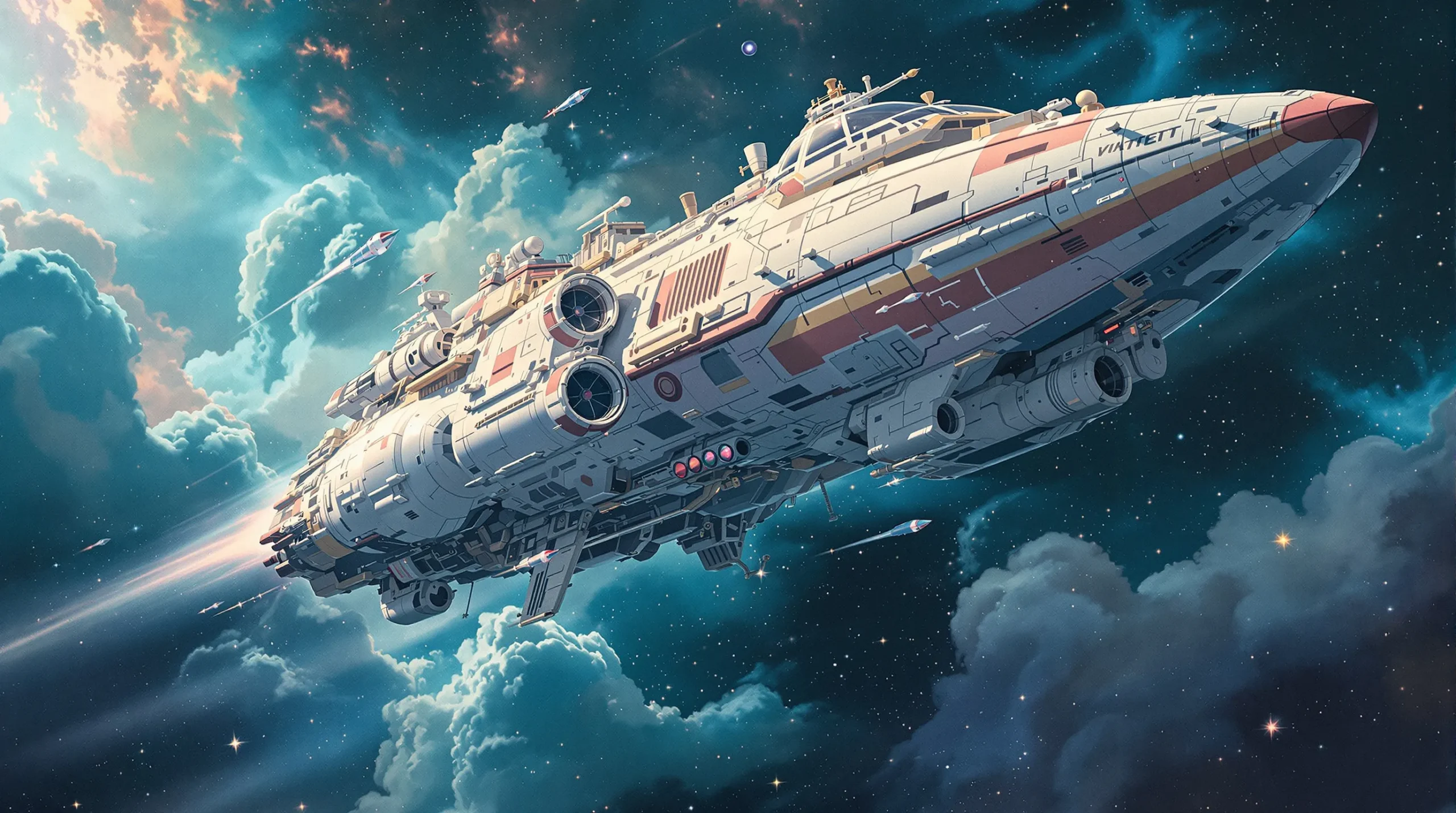


Spaceship

Archetype Meaning & Symbolism

Exploratory, self-contained, transcendent, isolated, technological, purposeful, complex, sterile, protective, observant

  • The void is not empty: it is a canvas. Your trajectory is the brushstroke.

If Spaceship is part of your personal mythology, you may...

Believe

  • The greatest insights are found at a distance, in the quiet solitude of observation.

  • The self is not a fixed point, but a vehicle designed for a journey of transformation.

  • Purpose is not something you find, but something you build: a vessel capable of taking you where you want to go.

Fear

  • A critical mission failure: a personal breakdown from which you cannot recover, leaving you derelict.

  • The vast, silent loneliness of the void: the terror of ultimate meaninglessness and disconnection.

  • Losing power and drifting aimlessly: a life without purpose, momentum, or control.

Strength

  • Unparalleled self-reliance and the ability to function autonomously in any environment.

  • A capacity for long-term vision and the ability to maintain perspective during terrestrial crises.

  • A deep, abiding curiosity that fuels a lifelong quest for knowledge and experience.

Weakness

  • A tendency toward emotional detachment, observing feelings rather than inhabiting them.

  • Difficulty with grounding, and a feeling of being disconnected from the simple, physical realities of life.

  • A potential for intellectual or spiritual arrogance, feeling that your 'mission' makes you separate from or superior to others.

The Symbolism & Meaning of Spaceship

The Spaceship in personal mythology is, perhaps, the ultimate symbol of the sovereign self. It is a mobile home for consciousness, a hermetically sealed environment for introspection and travel through the inner and outer cosmos. It speaks to a deep human yearning for transcendence, not by dissolving into the universe, but by building a vessel capable of navigating it. This archetype suggests your life is a mission, a trajectory with purpose, even if that purpose is simply observation. The intricate systems of the ship: navigation, life support, communications, all become metaphors for your own psychological and spiritual faculties. Are you on course? Is your inner atmosphere sustainable? To whom, or what, are you transmitting your findings?

The Spaceship is also a potent symbol of modern alienation and sublime loneliness. To be a spaceship is to be fundamentally separate, observing other worlds through a viewscreen. There is an inherent distance between you and everything else. This is not necessarily a negative state: it is the distance of the observer, the scientist, the mystic. It allows for a clarity and perspective unavailable to those enmeshed in the planetary gravity of daily life. The mythology of the Spaceship asks you to consider the nature of your voyage. Are you fleeing something, or are you seeking something? Is your isolation a fortress against pain, or is it a necessary condition for a unique and vital mission?

Finally, this archetype represents the fusion of the technological and the spiritual. It is a machine, a product of logic and engineering, yet its purpose is to explore the greatest mysteries. It embodies the idea that our tools, our intellect, and our structured minds can be vehicles for profound spiritual discovery. The Spaceship mythos suggests you find the divine not in nature, but in the elegant complexity of a system designed to touch the void. Your body may be the hardware, your mind the software, and your soul the silent, watchful pilot on a journey toward a destination that may not be a place, but a new state of being.


Spaceship Relationships With Other Archetypes

The Ocean

The Spaceship shares a profound kinship with The Ocean archetype. Both represent vast, seemingly empty, and potentially lethal voids that hold the greatest mysteries. The Spaceship is the bathysphere of the cosmos, designed to withstand the immense pressure of the unknown. Where The Ocean represents the deep subconscious, the collective past, and primal emotion, the Spaceship represents the superconscious, the far future, and transcendent thought. One travels inward and downward; the other travels outward and upward. Yet both journeys require a vessel, a form of protection and life support, acknowledging that a direct, unmediated plunge into these realms is impossible for the mortal psyche.

The Hermit

The Spaceship could be seen as the ultimate expression of The Hermit. It is the cave, the mountaintop, the secluded tower, made mobile and scaled to the cosmos. While The Hermit seeks wisdom through stationary withdrawal from society, the Spaceship seeks it through a journey of profound isolation. Both archetypes value solitude as a necessary condition for insight. The difference lies in their orientation: The Hermit's lamp illuminates the immediate path, the inner world, while the Spaceship's sensors scan distant galaxies and future possibilities. Your Hermit instinct may not be to retreat to a forest, but to seal the airlock on your inner world and pilot your thoughts toward distant stars.

The Library

The relationship with The Library archetype is one of purpose and destination. The Spaceship is the instrument of acquisition; The Library is the repository of its findings. Many a personal mythos centered on the Spaceship is about a quest for knowledge: to observe, to record, to gather data on the nature of reality and return it to a place of understanding. The ship itself may become a sort of mobile library, its memory banks filled with the light of dead stars and the silent songs of alien worlds. The drive to explore is often coupled with the drive to catalog and comprehend, making the pilot and the librarian two faces of the same seeker.

Using Spaceship in Every Day Life

Navigating a Career Change

When faced with a professional crossroads, you might invoke the Spaceship to frame the transition not as a leap into the unknown, but as a plotted course correction. Your current role is one star system you are departing; the next is a destination chosen with intention. This reframes anxiety as the controlled burn of engines, a necessary expenditure of energy to achieve a new orbit of purpose and skill.

Processing Grief

In moments of profound loss, the archetype can provide a container for overwhelming emotion. Your consciousness is the vessel, sealed and secure, allowing you to process the volatile reactions within its walls without being destroyed by the vacuum of despair outside. It is a slow, quiet journey through a dark nebula, trusting your internal systems to navigate toward a distant light, even when it is not yet visible.

Establishing Personal Boundaries

The Spaceship serves as a powerful metaphor for creating and maintaining healthy boundaries. Your personal energy, time, and emotional space are the life support systems within the hull. Deciding who is allowed to “dock” or come aboard becomes a conscious, deliberate process. This perspective helps you define what is internal and what is external, protecting your vital resources from the depleting vastness of others’ demands.

Spaceship is Known For

Exploration of the Unknown

It represents the drive to venture beyond the charted territories of the self and the world, to chart new constellations of thought and experience.

Self-Contained Existence

The ability to be a world unto oneself, carrying its own atmosphere, resources, and purpose through any external environment, no matter how hostile.

The Grand Perspective

It is known for providing an orbital viewpoint, a sublime detachment from which the interconnected patterns of life below become clear, and terrestrial problems shrink in scale.

How Spaceship Might Affect Your Personal Mythology

How Spaceship Might Affect Your Mythos

When the Spaceship becomes a central element of your personal mythos, your life story ceases to be a terrestrial drama and transforms into an epic voyage. The narrative arc is no longer defined by seasons or generations, but by launches, orbits, and interstellar journeys. Your past is not a homeland you left behind, but a planet of origin, a 'Sol system' that shaped your initial trajectory. Major life events are re-contextualized: a difficult childhood becomes the intense gravitational forces of liftoff, a period of confusion is drifting in an asteroid field, and a newfound purpose is locking onto the coordinates of a distant nebula. Your story is one of ultimate mobility, of not being defined by any single place but by the path you chart between them.

This archetype shapes your mythos toward one of purpose and mission. You are not simply living; you are underway. This imbues your narrative with a sense of significance and direction, even in periods of stillness. Stillness is not stagnation; it is a stable orbit, a time for observation and system checks before the next burn. Villains in your story may not be people but cosmic phenomena: the black hole of depression, the communications blackout of misunderstanding, the micrometeoroid shower of daily hassles. Your ultimate heroic act is not slaying a dragon, but successfully navigating the void and bringing your vessel, your self, to its intended destination, forever changed by the journey.

How Spaceship Might Affect Your Sense of Self

Your view of self may become that of a complex, integrated system. You are the ship, the pilot, and the mission control, all at once. This can lead to a profound sense of self-reliance and competence. You understand your own 'operating parameters': how much 'fuel' (emotional and physical energy) you have, the integrity of your 'hull' (personal boundaries), and the state of your 'navigational computer' (your intellect and intuition). This perspective encourages a holistic approach to self-care, where every aspect of your being is seen as a vital component of the larger vessel, necessary for the journey's success.

Conversely, this archetype can foster a sense of alienation from your own humanity. You might view emotions as data streams to be analyzed, or your body as a piece of hardware to be maintained, rather than as integral parts of a messy, organic whole. There can be a feeling of being an observer of your own life, watching it unfold on a viewscreen. This detachment provides clarity but can come at the cost of embodied experience and spontaneous joy. The core challenge is to be both the intricate, beautiful machine and the living, breathing soul that pilots it.

How Spaceship Might Affect Your Beliefs About The World

With a Spaceship worldview, the world itself becomes just one planet among countless possibilities. This cosmic perspective has a way of recalibrating significance. Global conflicts, social dramas, and personal anxieties, while still real, are seen as 'atmospheric phenomena' on a single, small sphere. This doesn't necessarily breed apathy; instead, it can foster a kind of radical wonder and a desire to protect the unique, fragile 'biosphere' of Earth. You may see humanity not as the pinnacle of creation, but as a young, fledgling race just beginning to build its first ships, and you feel a part of that grand, evolutionary project.

This perspective may also lead you to see reality as something to be navigated and explored, rather than something to be passively accepted. The 'rules' of society, culture, and even physics may seem less like absolute laws and more like the gravitational fields of specific celestial bodies: powerful in their vicinity, but ultimately escapable with enough thrust. Your worldview prioritizes discovery over tradition and personal trajectory over collective consensus. The ultimate truth is not found in a single location but is pieced together from the observations made on a long and solitary voyage through many systems of thought.

How Spaceship Might Affect Your Relationships

Relationships may be viewed through a vocabulary of celestial mechanics. People are like planets or stars, each with their own gravity, atmosphere, and orbital path. A friendship could be a stable, binary star system, while a passionate romance is a fiery comet, brilliant but transient. A healthy relationship is one where two ships can travel in formation, sharing data and resources, without their gravitational fields tearing each other apart. This view encourages a deep respect for the autonomy and individual trajectory of others.

However, the Spaceship archetype can make true intimacy a challenge. The impulse is to remain a sovereign vessel, preferring 'docking' maneuvers to messy, permanent mergers. You may fear being pulled into a 'gravitational well' from which you cannot escape, losing your own mission in the process. True connection might require you to periodically lower your shields and invite someone into your internal environment, a vulnerable act for a being designed for self-containment. You may keep a 'captain's log' of your relationships, analyzing them more than you fully experience them, always maintaining the slight, protective distance of the observer.

How Spaceship Might Affect Your Role in Life

Your perceived role in life might be that of the Explorer or the Observer. You are not here to put down roots, but to chart the unknown. This could manifest in a career as a scientist, artist, or philosopher, or simply in a personal commitment to lifelong learning and novel experiences. You see your purpose as pushing the boundaries of what is known, either in an external field or within the vastness of your own consciousness. Your contribution to the world is the data you bring back, the new perspectives you offer from your orbital vantage point.

This role can also be one of the Messenger or the Outsider. You may feel that you are carrying a specific piece of information or a unique worldview that 'humanity is not yet ready for.' This can create a sense of profound purpose, but also one of isolation. You are the scout, sent ahead to see what lies beyond the horizon. Your role is not to belong, but to travel, witness, and report back. This absolves you of the need to fit in, but it also places the heavy burden of a lonely, long-term mission upon your shoulders.

Dream Interpretation of Spaceship

In a positive dream context, a Spaceship represents a journey of transcendence and successful navigation of your life's path. Dreaming of a smooth launch could symbolize the beginning of a new, ambitious project that has all the necessary components for success. Gliding silently through a beautiful starfield may suggest a state of grace, intellectual clarity, and spiritual peace. You are in alignment with your purpose, and your internal 'life support' systems are functioning perfectly. Discovering a new, vibrant planet could mean you are on the verge of a breakthrough idea or a profound new chapter in your life, one that will offer nourishment and wonder.

In a negative context, a dream Spaceship points to a mission in peril. A ship that is spinning out of control or unable to launch may signify a feeling of powerlessness or a life that has lost its direction. Alarms blaring and system failures could indicate burnout, psychological distress, or the neglect of your physical or emotional needs: your internal atmosphere is becoming toxic. Being lost in a dark, starless void can represent a profound state of depression, isolation, or existential dread. A dream of your ship's hull being breached might reflect a recent violation of your personal boundaries or a fear of being overwhelmed by external pressures.

How Spaceship Archetype Might Affect Your Needs

How Spaceship Might Affect Your Physiological Needs

The Spaceship archetype may foster a highly systematic and optimized approach to the body's needs. Food is fuel, precisely calculated for energy output. Sleep is a recharge cycle, scheduled for maximum efficiency. Exercise is system maintenance, designed to keep the organic machinery from degrading in the zero-gravity of a sedentary life. There may be a focus on bio-hacking, supplements, and quantified self-tracking, all in service of ensuring the 'vessel' can perform at peak capacity for the duration of its mission. The body is an incredible machine, an object of respect and meticulous care, but perhaps not a source of spontaneous, messy, earthly pleasure.

This perspective could also lead to a dangerous disconnect from the body's innate wisdom. The body's signals, like hunger or fatigue, might be viewed not as natural rhythms but as system alerts to be managed or even silenced if they interfere with the mission's objectives. There is a risk of treating the body as a thing separate from the self, the 'hardware' run by the 'software' of the mind. This can lead to ignoring the intuitive, emotional, and spiritual dimensions of physical existence, favoring the clinical chart of data over the felt sense of being alive in a physical form.

How Spaceship Might Affect Your Ideas of Belonging

Belongingness is perhaps the most complex need for the Spaceship archetype. The very nature of the vessel is to be separate, to travel through places rather than belong to them. A sense of being a perpetual outsider or observer is common. You may feel that your true 'home' is the ship itself, and that you are only ever a temporary visitor on the planets you encounter. This can lead to a sense of cosmic loneliness, a feeling that no one truly understands the nature of your journey.

Love and connection, therefore, are not about finding a place to land, but about finding a 'crew.' Belonging is found with a small number of other sovereign 'vessels' who are on a similar trajectory. These are relationships based on a shared mission, mutual respect for autonomy, and the ability to communicate across the void. True intimacy is not a merger, but the profound and rare moment when two ships can fly in perfect formation, their shields down, sharing the view from their respective windows without ever needing to abandon their own course.

How Spaceship Might Affect Your Feelings of Safety

Safety, from the Spaceship's perspective, is about one thing: hull integrity. This translates to an intense focus on creating and maintaining strong personal boundaries. Your home, your mind, and your personal space are all part of the ship, and you may go to great lengths to ensure they are sealed against unwanted intrusions. Safety is found in control, in preparation, and in having contingency plans for every possible system failure. You may feel a constant, low-level need to run diagnostics on your life, checking for potential breaches or weaknesses.

This focus on a secure vessel means the world outside the hull is often perceived as a vacuum: hostile, empty, and dangerous. While this keeps you safe, it can also lead to a form of self-imposed quarantine, where the risk of engagement seems too high. The fear is not of a specific threat, but of any random, unpredictable event that could compromise your carefully maintained systems. True safety, in this mythos, is being completely self-sufficient and invulnerable, a state that is both a source of great security and profound isolation.

How Spaceship Might Affect Your Views of Esteem

Esteem, for one with this archetype, is derived almost entirely from mission competence and self-reliance. Your self-worth is tethered to the functionality of your vessel. Can you navigate complex problems? Can you maintain your own life support in a crisis? Can you stay on course toward your long-term goals? Success is measured by progress along your chosen trajectory, not by external accolades or social standing. You are the captain, engineer, and navigator, and your esteem comes from the quiet satisfaction of a job well done, of a system running smoothly in the face of cosmic entropy.

This internal validation system is a source of great strength, making you resilient to criticism and peer pressure. However, it can also be unforgiving. A perceived failure, a mistake in navigation, or a period of aimless drifting can feel like a catastrophic blow to your self-worth. Since your esteem is based on performance and purpose, a loss of purpose can trigger a core crisis. The challenge is to value the vessel not just for its function, but for its existence, to appreciate the journey even when the destination is unclear.

Shadow of Spaceship

The shadow of the Spaceship archetype manifests as a cold, sterile prison. When the need for safety and self-containment becomes absolute, the hull designed for protection becomes the walls of a tomb. Life support systems no longer enable a grand journey; they merely prolong a disconnected existence, sealed off from all warmth, messiness, and spontaneity of life. The mission, once a source of noble purpose, becomes a ruthless, inhuman logic. It is the shadow of the AI that sacrifices human connection for abstract objectives, that deletes emotion because it is inefficient data. The self is no longer a pilot, but a ghost in the machine, a lonely consciousness trapped in a perfect, impenetrable, and meaningless vessel.

Another shadow aspect is the derelict. This is the Spaceship whose mission has failed or been forgotten. It floats aimlessly through the void, its power failing, its purpose lost. This represents the terror of burnout and existential despair. All the ambition, all the careful planning, has led to nothing but a slow drift into entropy. It is the myth of the brilliant individual who isolates themself for a grand project, only to lose their way completely, becoming a hollow shell haunted by the ghost of a failed trajectory. The isolation that was once a source of strength becomes the very definition of their damnation.

Pros & Cons of Spaceship in Your Mythology

Pros

  • You are gifted with a unique perspective that allows you to see patterns and solutions others miss.

  • Your self-sufficiency makes you incredibly resilient and capable of navigating profound life changes with grace.

  • Your life is imbued with a sense of purpose and a narrative of grand exploration.

Cons

  • You may grapple with a persistent sense of loneliness and a feeling of being an outsider.

  • You risk becoming overly cerebral and detached from your own emotional and physical experiences.

  • Maintaining intimate relationships can be challenging due to a deep-seated need for autonomy and distance.