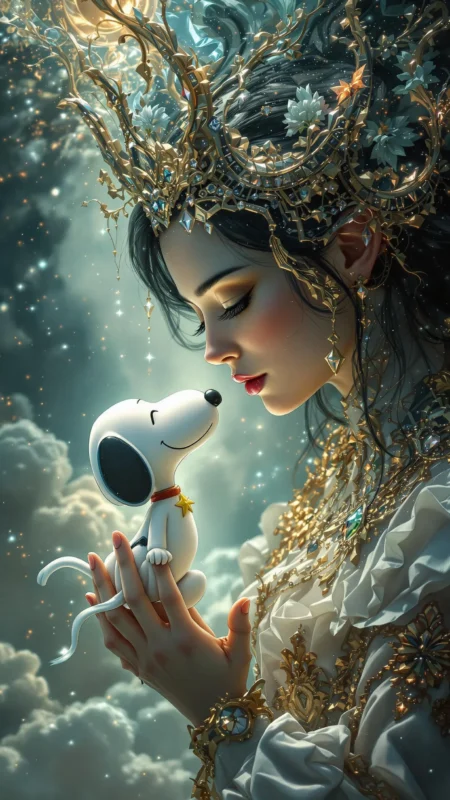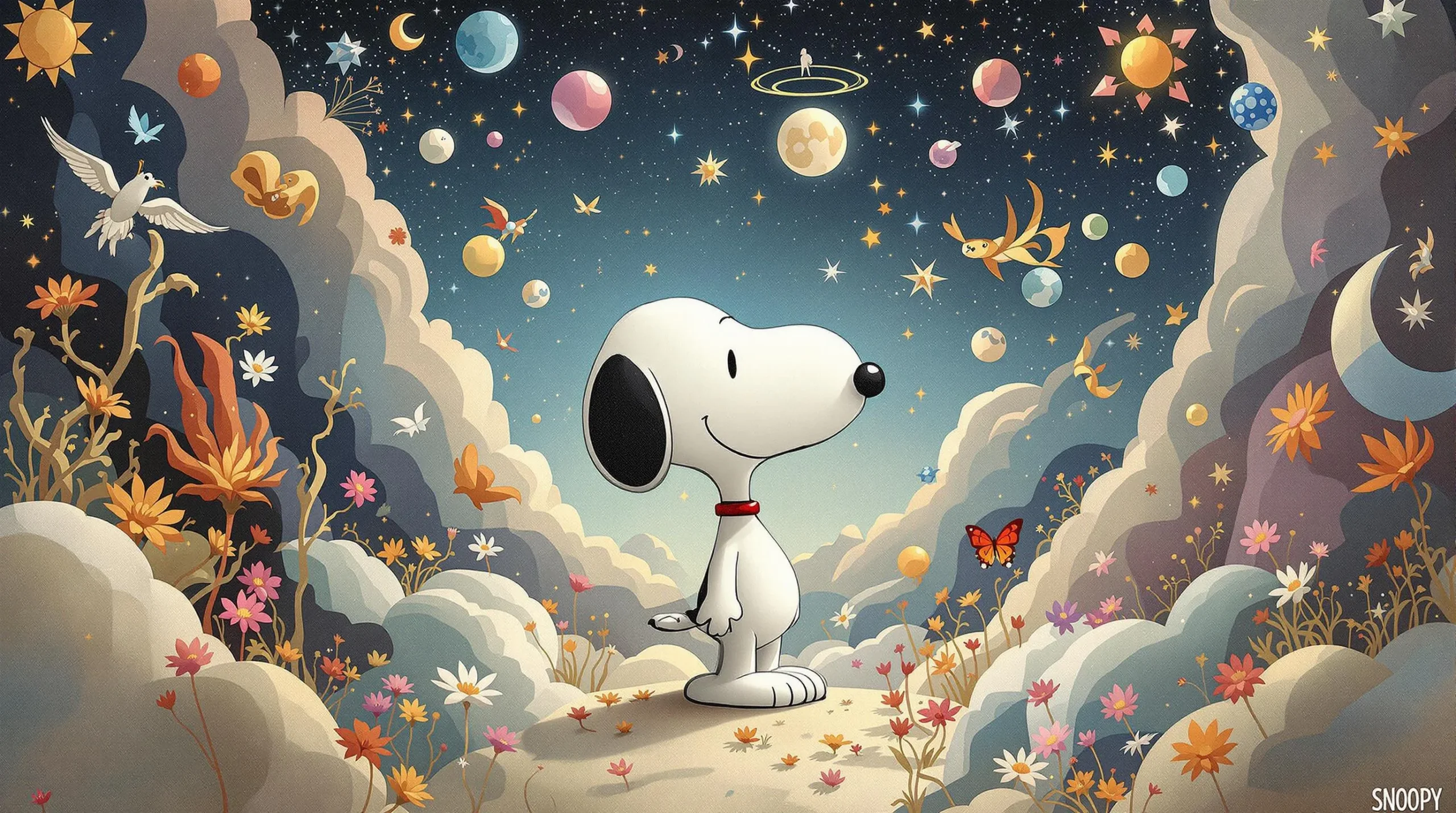


Snoopy

Archetype Meaning & Symbolism

Imaginative, resilient, philosophical, dramatic, independent, loyal, melancholic, epicurean, aspirational, eccentric

  • Yesterday I was a dog. Today I'm a dog. Tomorrow I'll probably still be a dog. Sigh... There's so little hope for advancement.

If Snoopy is part of your personal mythology, you may...

Believe

  • You may believe that the richness of your inner life is your most valuable asset, a realm where you are eternally free.
  • You may believe that identity is not a static fact but a creative performance, and you are the playwright, director, and star.
  • You may believe that true resilience lies in the ability to find ecstatic joy in small, recurring rituals, especially in the face of existential dread.

Fear

  • You may fear a life of unfulfilled potential, of remaining forever a 'beagle' when you know you were meant to be a Flying Ace.
  • You may fear that your complex inner world is ultimately untranslatable, that you will never be truly seen or understood by those you love.
  • You may fear the recurring 'Red Baron' of your life: that one persistent obstacle, creative block, or internal critic that always seems to find you in the sky.

Strength

  • A profound imaginative capacity, allowing you to reframe adversity, beautify the mundane, and entertain yourself endlessly.
  • Fierce independence and a strong inner compass, leading to a sense of self that doesn't rely on external validation.
  • Emotional resilience, the ability to bounce back from disappointment with a philosophical sigh and a quick pivot to a new adventure or a simple pleasure.

Weakness

  • A tendency towards escapism, using your rich imagination to avoid confronting difficult or painful realities.
  • A flair for melodrama, sometimes inflating minor inconveniences into grand existential tragedies.
  • A potential for emotional distance, becoming so absorbed in your own inner narrative that you may appear aloof or unavailable to others.

The Symbolism & Meaning of Snoopy

To invite Snoopy into one's personal mythology is to consecrate the power of the inner world. He is the patron saint of the daydream, the quiet philosopher in the suburban yard. His symbolism is not one of grand, external quests, but of the epic scope of the imagination. His doghouse is not merely a shelter; it is a stage, a cockpit, a writer’s garret. It suggests that our station in life, our 'dogness,' is merely the setting, not the story. The real narrative unfolds in the sky of the mind, in the heroic personas we adopt to face the day. Snoopy represents a profound truth: that our reality is shaped less by our circumstances and more by the fictions we choose to inhabit.

The archetype could also be a meditation on a kind of gentle, dignified absurdism. Snoopy exists in a world of children who speak with the weary wisdom of adults, a world where little is explained and much is felt. His presence introduces a figure who lives according to his own unshakeable, if bizarre, internal logic. He dances for supper, he consults with a bird, he battles a phantom nemesis. This may symbolize the ultimate freedom: the freedom to live by one's own mythos, even if it seems nonsensical to the outside world. He teaches that a meaningful life may not be a 'sensible' one, but one that is true to the unique, strange music of the self.

Furthermore, Snoopy embodies a complex balance of dependence and fierce independence. He is Charlie Brown's dog, reliant on him for food and shelter, yet he possesses a psychological and emotional autonomy that his owner often lacks. He may be tethered to a single backyard, but his mind roams continents and eras. This duality speaks to the modern condition: we may be bound by jobs, relationships, and responsibilities, yet the Snoopy archetype insists that the spirit can, and must, remain a free agent. It is a symbol of finding boundless freedom within apparent limitation, of being loyal without being subservient.


Snoopy Relationships With Other Archetypes

The Unseen Adversary

The Snoopy archetype may require a foil, a ghost in the machine of his own magnificent self-conception. The Red Baron, then, is less an enemy and more a necessary fiction, the dark ink against which the hero’s white scarf might brilliantly flutter. This adversary, forever just over the horizon, could be the gravitational pull that organizes an otherwise free-floating inner world into a narrative of purpose. The dogfights are perhaps not battles of aggression but a kind of celestial ballet, a ritualized dance with one's own limitations and aspirations. The true nemesis may not be the Baron at all, but the crushing silence of an unwritten sky, a void that The Snoopy must populate with drama to feel the contours of his own soul.

The Foreign Tongue

In the Little Yellow Bird, The Snoopy could find a confidant whose language is a secret garden, inaccessible to the prose of the everyday world. Their conversations, a flurry of typewriter pecks and inscrutable glyphs, may represent a communion that transcends mere speech, a soul-deep understanding that renders vocabulary obsolete. This feathered companion is not a sidekick but a co-pilot in the vast cockpit of imagination, a tiny, fluttering anchor in the sometimes-lonely expanse of the doghouse roof. The bird might be the fragment of The Snoopy's own spirit that learned to fly, a testament to the idea that the most profound friendships are often scripted in a language of shared silence and intuitive grace.

The Stubborn Muse

The Typewriter could stand as a kind of mechanical altar upon which The Snoopy lays his grandest ambitions. It is both a portal and a prison, a clattering, ink-stained bridge between the boundless continents of the mind and the stark, unforgiving shoreline of the blank page. Each staccato tap may be a prayer sent into the void, a hope for literary immortality that is often met with the thud of a rejection slip. This relationship is perhaps the archetype’s most human trial: the artist's eternal duel with the medium, a wrestling match with a stubborn muse who offers the promise of expression but demands a toll of relentless effort. The machine, in its cold indifference, may serve as the perfect, impartial mirror to The Snoopy's own fluctuating faith in his genius.

Using Snoopy in Every Day Life

Reframing the Mundane

When faced with a tedious task, a commute, or a bland Tuesday, the Snoopy archetype offers a model for internal alchemy. You may not be able to change the task, but you can change the narrative around it. The spreadsheet becomes a complex flight plan. The grocery store, a reconnaissance mission deep in enemy territory. It is the practice of overlaying a more mythic reality onto the profane, not as an escape, but as a way to engage with a deeper sense of purpose and play.

Cultivating Stoic Joy

Snoopy's life is one of small disappointments and existential sighs, punctuated by moments of pure, unadulterated bliss: the arrival of supper, a letter in the mail, a nap in the sun. This archetype teaches the art of weathering existential dread by fiercely celebrating small, tangible pleasures. When feeling overwhelmed by large, abstract anxieties, one might consciously perform the 'supper-time dance': a ritual of finding ecstatic release and gratitude in the most basic, reliable comforts of life.

Navigating Solitude and Society

The Snoopy archetype provides a blueprint for being in a group but not entirely of it. It sanctions the need for profound solitude and a rich inner life, even while maintaining deep, if unconventional, loyalties. One might use this model to set boundaries: to be a loving friend, partner, or family member, but to also unapologetically retreat to the 'doghouse roof' of one's own mind to write novels, fight the Red Baron, or simply be alone with one's thoughts, trusting that true connection does not require constant performance or presence.

Snoopy is Known For

The World War I Flying Ace

Perhaps his most enduring fantasy, where atop his doghouse-turned-Sopwith-Camel, he engages in aerial dogfights with the unseen but ever-present Red Baron, embodying a spirit of daring, adventure, and noble, if imagined, conflict.

Sleeping Atop His Doghouse

An iconic and physically defiant posture. Snoopy rarely sleeps inside his doghouse, preferring its roof. This may symbolize a refusal to be defined by one's given space, a preference for the precarious but open vista over the enclosed and conventional shelter.

The Author

Often seen with his typewriter, perpetually starting his novel with the line, 'It was a dark and stormy night...'. This represents the eternal struggle and aspiration of the creative spirit, the battle with the blank page, and the profound, often lonely, work of bringing an inner world to life.

How Snoopy Might Affect Your Personal Mythology

How Snoopy Might Affect Your Mythos

When Snoopy becomes a central figure in one's personal mythos, the narrative of a life may shift from a linear progression of external achievements to a collage of internal states. The story is no longer 'what I did' but 'who I was while doing it.' Mundane periods are not empty chapters but rich interludes where the self was being a World War I Flying Ace, a famous author, or Joe Cool. Disappointments, like a rejected manuscript or a failed romance, are not narrative dead ends; they are plot points in an ongoing, grand melodrama, complete with sighs, existential ponderings, and the eventual, resilient turn towards the next fantasy or the simple joy of a supper dish. The mythos becomes less about conquering the world and more about successfully interpreting it.

This archetype could also introduce the theme of the 'secret identity' into one's life story. On the surface, one might be an accountant, a parent, a student: a 'beagle' in a definable role. But the personal mythos is enriched by the knowledge of the secret life of the mind. The core story becomes one of a quiet, unassuming figure who contains multitudes, whose true adventures are invisible to the uninitiated. It frames a life not by its public face, but by the richness of its private theatre. The central conflict in this mythos is not against external foes, but against the 'Red Baron' of mediocrity, the threat of a life lived without imagination.

How Snoopy Might Affect Your Sense of Self

To see oneself through the lens of the Snoopy archetype is to grant permission for profound self-acceptance, not of one's limitations, but of one's contradictions. One may be simultaneously melancholic and capable of ecstatic joy, deeply loyal yet fiercely independent, an animal with the soul of a poet. It allows for a fluid concept of self, where identity is not a fixed point but a continuous performance. You are not just one thing. You are the dog, and you are also the pilot, the author, the skater, the attorney. This perspective could dismantle the pressure to be consistent, fostering instead a sense of self rooted in imaginative potential.

This archetypal influence may also cultivate a form of psychological resilience based on self-entertainment and self-soothing. The self is not something that needs to be validated from the outside; it is a self-sufficient ecosystem of stories, characters, and rituals. Esteem is generated internally through the 'success' of one's imaginative forays. This could lead to a quiet confidence, a sense that even in moments of profound loneliness or misunderstanding, one has a rich and vibrant inner world to retreat to, a companion in the self that is endlessly creative and surprisingly durable.

How Snoopy Might Affect Your Beliefs About The World

A worldview shaped by the Snoopy archetype might be one of gentle absurdism. The world is not a rational, predictable machine but a slightly strange, often disappointing, yet ultimately benevolent stage for small, personal dramas. It encourages one to view the grand, self-important machinations of the world with a certain philosophical distance, much like Snoopy atop his doghouse observing the foibles of the children below. It suggests that the proper response to the inherent strangeness of existence is not anxiety, but a creative sigh, a dramatic flourish, and a return to one's own meaningful projects.

Furthermore, this perspective may color the world with a layer of potential narrative. A tree is not just a tree; it's a potential lookout post. A rainy day is not just bad weather; 'it was a dark and stormy night...'. This worldview resists the disenchantment of modern life, insisting that magic and meaning are not things to be found, but things to be actively projected onto the world. It is a fundamentally creative stance, viewing reality as a collaborator, a set of prompts waiting for an imaginative response. The world becomes less a series of facts to be navigated and more a poem to be interpreted.

How Snoopy Might Affect Your Relationships

In relationships, the Snoopy archetype could foster a unique form of loyalty: steadfast, present, but not all-consuming. The love Snoopy shows for Charlie Brown is deep and abiding, yet it does not prevent him from having his own, entirely separate life of the mind. One with this archetype in their mythos may be a profoundly reliable partner or friend, the one you can always count on to be there, yet they may require significant personal space, a 'doghouse roof' to which they must retreat. They may show love not through constant communication, but through shared presence and quiet, dependable acts.

This archetype may also influence friendships toward the model Snoopy shares with Woodstock. It is a relationship between two different species, built on a shared language that no one else understands. It could mean seeking friendships that are less about shared backgrounds or social circles and more about a unique, almost telepathic, connection. It's a bond of mutual aid and companionship in adventures both real and imagined. The person embodying this archetype might not have a large circle of friends, but they may cultivate a few profound, almost symbiotic, relationships that exist in a world of their own.

How Snoopy Might Affect Your Role in Life

The Snoopy archetype fundamentally challenges the idea of a fixed life role. It suggests that one's role is a costume, a persona to be adopted and discarded at will. You may have a job title, a familial role, a social function—your 'beagle' identity—but your true role is that of the performer, the artist of the self. This could lead to a playful, experimental approach to one's position in life, a refusal to be entirely defined by any single label. One's purpose is not to 'be' a lawyer, but to 'play' the role of a lawyer, just as one might play the role of a hockey star or a legionnaire.

This can be deeply liberating, freeing one from the anxiety of 'finding their purpose.' The purpose is the act of creation itself. The role is that of the dreamer. This might manifest as a portfolio career, a series of passionate hobbies, or simply a mental attitude that treats all of life's demands as opportunities for performance. The perceived role shifts from a static noun to an active verb: to imagine, to create, to become. One's contribution to the world is not a product or a service, but the quiet, persistent act of keeping imagination alive in a world that often demands its surrender.

Dream Interpretation of Snoopy

To dream of Snoopy in a positive light, perhaps seeing him dancing, flying his Sopwith Camel against a bright blue sky, or contentedly asleep on his doghouse, may signal a renaissance of one's own creative spirit. It could be an invitation from the subconscious to embrace play, to find joy in simple rituals, and to allow your imagination to take flight as a valid and necessary part of your life. Such a dream might suggest that you are successfully integrating your inner world with your outer reality, finding a healthy balance between responsibility and fancy. It is an affirmation of resilience and the power of a positive, self-created narrative.

Conversely, dreaming of Snoopy in a negative context—seeing him perpetually frustrated by his typewriter, shot down by the Red Baron, or ignored by the children around him—could symbolize a growing disconnect between your imagination and your reality. It may point to a fear that your inner life is merely escapism, a fantasy that is failing to protect you from real-world problems. This dream could be a warning that you are retreating too far into your own world, leading to loneliness, creative blocks, or a sense that your unique gifts are going unseen and unappreciated. It might be a call to ground your imaginative flights with more tangible action or connection.

How Snoopy Archetype Might Affect Your Needs

How Snoopy Might Affect Your Physiological Needs

The Snoopy archetype might transform the fulfillment of physiological needs from base necessity into high ritual. The most prominent example is food. The 'suppertime' dance is not merely about hunger; it is a dramatic performance of anticipation, climax, and sated bliss. For a person with this mythos, preparing and eating a meal could become a sacred, joyful act, a daily anchor of ecstatic release that elevates the simple need for calories into an expression of identity and a celebration of being alive. It’s a refusal to let the fundamental be mundane.

Similarly, the need for shelter and rest is reinterpreted. Snoopy's doghouse, a basic shelter, becomes the most important stage prop in his life. He rarely enters it, preferring the precarious, open-air platform of the roof. This may suggest a psychological need where rest and security are not found in enclosure, but in a chosen vantage point, a place of observation and dreaming. The physiological need for sleep becomes an opportunity not just for restoration, but for adventure in the subconscious realm, a launchpad for the night's narratives.

How Snoopy Might Affect Your Ideas of Belonging

The Snoopy archetype offers a model of belonging that cherishes both connection and autonomy. He is undeniably a part of the Peanuts gang, a fixture in their lives, yet he operates on a different plane. He belongs, but on his own terms. This might translate into a life where one cultivates deep, loving bonds without surrendering one's essential otherness. It’s the comfort of knowing you have a pack, a Charlie Brown who will always fill your supper dish, but also the freedom to communicate with your Woodstock in a language no one else needs to understand. It is a sense of belonging that does not demand conformity.

For someone with this archetype, the need for love and intimacy might be met through quiet companionship and shared experience rather than constant verbal affirmation. Snoopy's deepest relationship, with Woodstock, is almost entirely non-verbal. It is built on mutual presence through adventures, storms, and quiet moments. This could foster a preference for relationships where love is demonstrated through steadfast loyalty and shared being, rather than performative declarations. It’s a love that respects the silent, sovereign territory of the other's inner world.

How Snoopy Might Affect Your Feelings of Safety

Within the Snoopy mythos, safety is less a matter of physical fortification and more a function of psychological resilience. The world is filled with threats, real and imagined: the cat next door, the kite-eating tree, and the relentless Red Baron. Snoopy's approach is not to build higher walls but to re-frame the threat as a worthy adversary in a grand narrative. The Red Baron is terrifying, but he is also what gives the Flying Ace his purpose. This could influence an individual to meet life's challenges not by avoiding them, but by incorporating them into their personal story as a source of meaning and growth. True safety is the unshakeable belief in one's ability to write the next chapter, no matter the cliffhanger.

This archetype may also suggest that ultimate security is found not in external circumstances, which are always precarious, but in one's inner resources. Snoopy's perch on the doghouse roof is objectively unsafe; a strong wind could knock him off. Yet, it is his command center. This implies that one might feel safest not when life is predictable and stable, but when one feels most in command of their own imagination and internal world. Security is the knowledge that you can always retreat to that inner command center to regroup, re-imagine, and sally forth again.

How Snoopy Might Affect Your Views of Esteem

Esteem, in the world of Snoopy, is almost entirely self-generated. It is not derived from the opinions of others; after all, he is frequently called a 'stupid beagle.' Instead, esteem is built upon the successful execution of his internal projects. The victory is not winning a prize but finishing a dogfight with the Red Baron in a satisfying way. The accomplishment is not getting a novel published but conquering the blank page for another day. This archetype could foster a robust sense of self-worth that is insulated from external criticism or praise.

This leads to an esteem built on competence, but the competence is in the art of living itself. Mastery of a persona, like Joe Cool, becomes a source of profound satisfaction. It is the feeling of successfully being the person you imagine yourself to be in that moment. This archetype suggests that respect from others is secondary to self-respect, which is earned by honoring the integrity of one's own imagination and living out its truths, however small or strange they may seem to the outside world.

Shadow of Snoopy

The shadow of Snoopy manifests when the daydream becomes a dungeon. It is the point where imagination ceases to be a tool for engaging with the world and becomes a wall that separates one from it. In this shadow aspect, the individual may be so lost in their internal personas—the Flying Ace, the Author—that they neglect their actual responsibilities, relationships, and even their own well-being. The charming eccentricity curdles into a profound dissociation. They are no longer a person who daydreams, but a daydream that has displaced a person. Connection with others becomes impossible, as real people cannot compete with the perfectly crafted characters of the inner world.

Another facet of the shadow is a subtle, pervasive narcissism. When the world is merely a stage for one's own dramas, other people are relegated to the role of props or supporting cast. Their needs, feelings, and realities become secondary, or even irrelevant, to the central narrative of the self. The 'supper-time dance' is no longer a joyful ritual but a demanding expectation that the world exists to serve one's needs. The philosophical distance becomes cold indifference. The shadow Snoopy is not just independent; he is isolated, self-absorbed, and ultimately trapped by the same imagination that was once his greatest source of freedom.

Pros & Cons of Snoopy in Your Mythology

Pros

  • You likely possess an inexhaustible source of inner entertainment and comfort, making you less prone to boredom and more capable of handling solitude.
  • Your creative approach to life allows you to find meaning, beauty, and humor in situations that others might find dull or dispiriting.
  • Your resilience is remarkable; you can metabolize disappointment into new narratives, allowing you to recover from setbacks with philosophical grace.

Cons

  • You may be perceived by others as flaky, impractical, or not grounded in reality, which can create friction in professional or personal relationships.
  • Your preference for your own inner world might sometimes become a barrier to forming deep, vulnerable connections with others, leading to periods of loneliness.
  • There can be a persistent, low-grade disappointment when the messy, imperfect real world fails to measure up to the elegance and excitement of your imagined one.