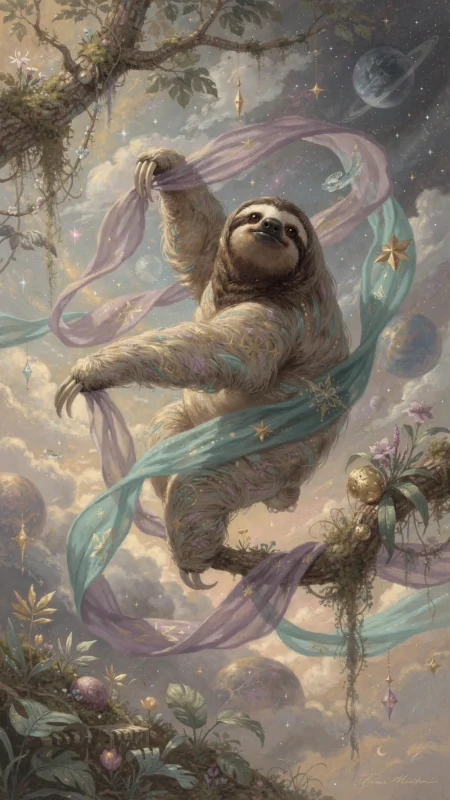
The Ancient Tree
The Sloth and the Ancient Tree do not so much coexist as co-compose a single, silent canticle of being. The Tree, a cathedral of branches reaching for a slow-motion heaven, may see in The Sloth its own life, only given the gift of gentle locomotion. The Sloth, in turn, seems to treat the Tree not as a habitat but as an extension of its own body, a vast, patient nervous system whose every groove and leaf is known intimately. This is not a relationship of dependence but of fusion, a quiet agreement between two entities that have seceded from the frantic union of time. The Sloth could be the slow, dreaming thought of the Tree, a living prayer hanging in the dappled light, a testament to the profound truth that the deepest connections are often those measured in stillness, not in movement.
The Hummingbird
To the Hummingbird, that frantic jewel of pure momentum, The Sloth may be perceived less as a creature and more as a geological feature—a mossy, breathing stone. The Hummingbird’s life is a fever-dream of nectar and flight, a constant, shimmering vibration against the perceived inertia of the world. Any exchange between them would be a dialogue between a thunderclap and a held breath. The Hummingbird could view The Sloth’s deliberate pace as a kind of failure, a baffling refusal to participate in the urgent dance of survival. Yet, from the Sloth’s suspended perch, the Hummingbird’s life might seem a beautiful but exhausting blur, a life burned away in a flash of iridescent panic. Their relationship is perhaps the ultimate schism in lived experience, a canyon of temporal understanding that neither can cross, each serving as a silent, profound critique of the other's existence.
The River
The River is the archetype of relentless passage, the liquid embodiment of time’s arrow. The Sloth’s relationship with it is one of sublime indifference. While the River carves canyons and rushes all things toward the great sea of what-has-been, The Sloth remains suspended above the fray, a comma in the world’s breathless, run-on sentence. It does not attempt to dam the River or even drink from it, but simply observes its flow from a dimension set at a right angle to its current. For The Sloth, the River’s ceaseless movement could be a form of noise, a constant chatter that distracts from the deeper work of just being. It represents a quiet but radical dissent, suggesting that wisdom lies not in navigating the current, but in finding a stable branch from which to watch it pass, understanding that the most profound journeys may involve no travel at all.


 Believe
 Fear
Fear Strength
 Weakness