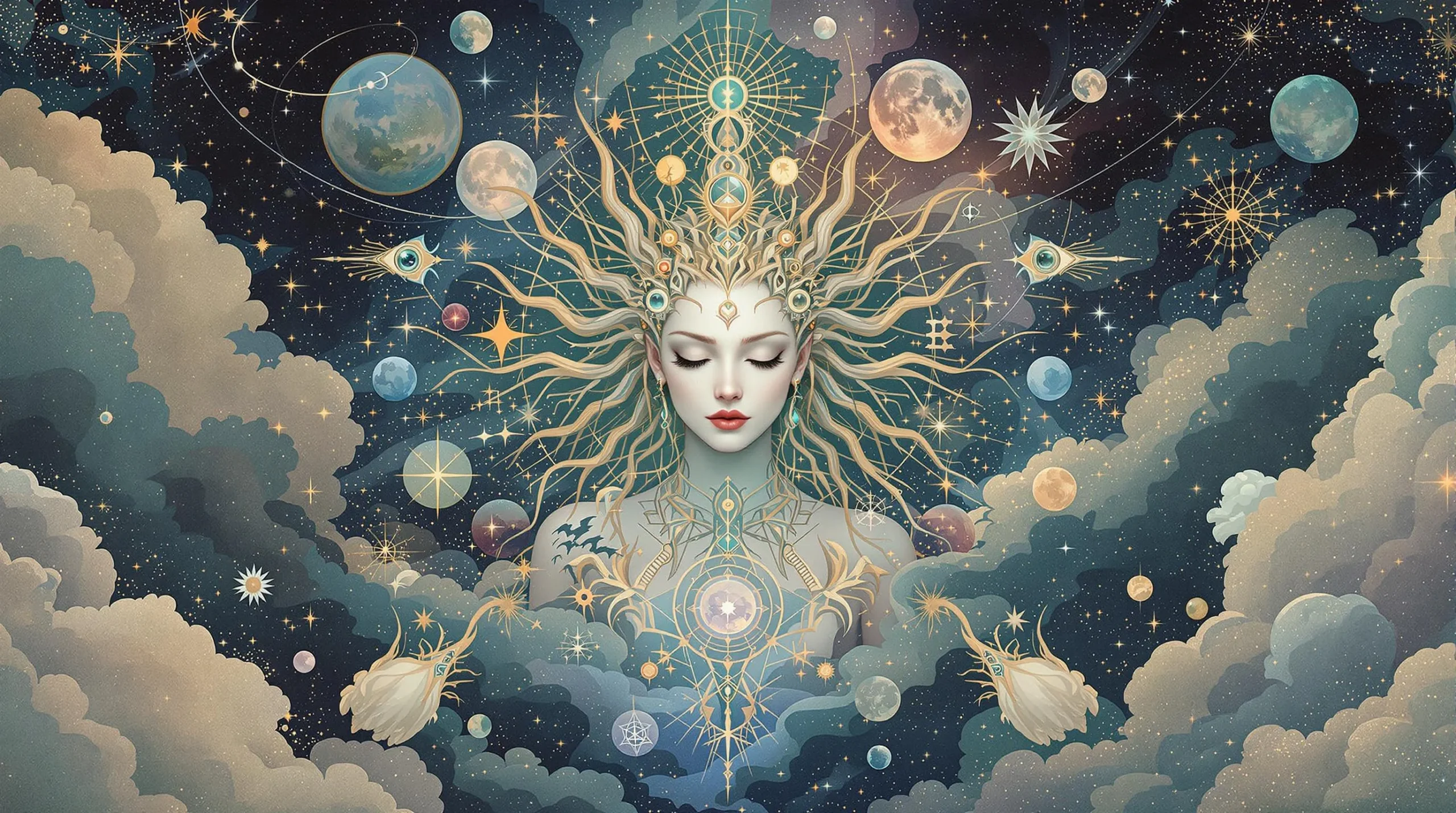


Skaði

Archetype Meaning & Symbolism

Independent, resilient, uncompromising, fierce, solitary, vengeful, wild, enduring, primal, unforgiving

  • The silence of the snow is not emptiness; it is the sound of your own heart beating against the world's cold skin.

If Skaði is part of your personal mythology, you may...

Believe

  • You may believe that solitude is a profound spiritual practice, a way of hearing the self without the world's noise.
  • You may believe that true justice requires a cold, unwavering will, and that peace bought through self-betrayal is no peace at all.
  • You may believe that your most authentic self is your wildest self, and that civilization is often a cage painted to look like a home.

Fear

  • You may fear the trap of a comfortable life, a slow domesticity that could dull your senses and blunt your sharp edges.
  • You may fear that in your quest for independence, you will build a fortress of ice so thick that no warmth can ever get in.
  • You may fear loving someone whose world is fundamentally incompatible with your own, knowing one of you must eventually abandon your home.

Strength

  • A fierce and profound self-reliance; you are a fortress of one.
  • An uncompromising sense of justice and the courage to enforce it, making you a powerful advocate for yourself and others.
  • A deep capacity to find peace and strength in solitude, allowing you to weather periods of isolation that would break others.

Weakness

  • A rigidity that makes compromise feel like a mortal wound, complicating partnerships and collaborations.
  • An inclination toward isolation that can starve you of necessary connection and community.
  • A tendency for righteous anger to become a cold, unforgiving grudge, preventing you from healing or moving forward.

The Symbolism & Meaning of Skaði

Skaði speaks to the part of the soul that will not be assimilated, the wild feminine that arrives in the halls of power and refuses to soften her edges. She is the archetype of righteous anger born of grief, a force that seeks not destruction, but balance. In a modern context, she is the patron of those who demand accountability, who walk away from gilded cages, who know the price of a compromised peace. Her mythos is a permission slip to honor your own wilderness, to see your refusal to fit in not as a failure, but as a sign of an unbreakable, sacred integrity. She is the patron saint of the person who chooses the difficult truth of the mountains over the easy comfort of the shore.

The eternal tension between Skaði's mountains and Njörðr's sea is a profound metaphor for the necessary, often painful, negotiations of love and life. It is the story of every person who has tried to love another whose fundamental nature, whose very habitat, is incompatible with their own. Her story does not condemn such love; it simply illuminates its tragic physics. We may love the sea from our mountain peaks, but we cannot live there. Skaði’s ultimate return to her homeland is not a failure of love but a triumph of self-knowledge: the courage to choose what nourishes, even if it means choosing to be alone.

Winter, in the mythology of Skaði, is not a season of death but a crucible of character. The cold is a clarifying agent. It freezes away frivolity, silences idle chatter, and demands a competence that warmer seasons forgive. To have Skaði in your personal mythology is to understand the spiritual necessity of winter. It is to seek out, rather than flee from, periods of starkness and solitude, knowing that it is in the frost and silence that one’s own heat and resilience are most keenly felt. It is the understanding that true strength is not the ability to avoid the blizzard, but to ski through it.


Skaði Relationships With Other Archetypes

The Sea

The relationship between Skaði and The Sea could be seen as a treatise on the nature of incompatible truths. Theirs is not a simple opposition, but a dialogue of stone and water, a treaty signed in salt and frost that was perhaps destined to be broken. The Sea, with its relentless, conversational tide and its teeming, sun-dappled life, may represent a kind of chaotic warmth that Skaði, in her monumental silence, finds unbearable. For her, who speaks the language of the avalanche and the glacier, the shriek of the gull might be a shrill and pointless noise compared to the profound howl of the winter wolf. This union, therefore, may not be a story of failed love, but a clarifying force; in turning away from the shore, Skaði is not merely rejecting a partner, but more fully inhabiting the stark, unyielding truth of her own mountainous soul.

The Hearth

With The Hearth, Skaði may entertain her most complicated and unspoken relationship. It is the flickering page in a language she has chosen not to read, the promise of a thaw that could feel more like a threat than a comfort. The Hearth represents a gravitational pull towards community, a softening of edges, and the thick, drowsy air of shared breath—all things antithetical to the sharp, clean solitude of her domain. She might be drawn to its circle of light, a moth made of ice, only to find that the warmth demands a toll she is unwilling to pay: a gentle erosion of her own granite certainty. Her distance, then, is not necessarily born of disdain, but could be a form of self-preservation, a recognition that the comfort offered by the flame is a kind of binding, and she is, above all, an archetype of that which must remain untamed.

The Lone Wolf

In The Lone Wolf, Skaði perhaps finds not a companion, but a reflection. Theirs is a silent pact written in tracks across new snow, a shared sovereignty over the frozen kingdom. This relationship is not one of dialogue but of parallel existence, a deep and resonant understanding that requires no words. The Lone Wolf, like Skaði, knows the brutal arithmetic of survival, the clarity that comes with the hunt, and the profound peace of a landscape scoured of sentimentality. It could be that this is the truest intimacy Skaði may know—a communion based on mutual autonomy, a shared gaze across a desolate expanse that confirms, without concession, the rightness of their solitary paths. They are two distinct notes in the same chord of winter, a harmony of solitude and fierce independence.

Using Skaði in Every Day Life

Navigating a Difficult Breakup

When a partnership ends, especially one that demanded you shrink yourself to fit, the Skaði mythos offers a map back to sovereignty. It is the practice of leaving the clamor of the shared shore and deliberately retreating to your own metaphorical mountains. This is not about pining, but about strapping on your skis and learning the landscape of yourself again. It is finding profound satisfaction in the solitary hunt for your own purpose, your own sustenance, your own peace, until the memory of the seagull's cry is just a distant, irrelevant sound.

Setting Firm Boundaries

Channeling Skaði is a lesson in righteous reclamation. When you have been wronged or your boundaries have been trampled, her story is a permit to march into the halls of power—be it a boardroom, a family gathering, or a social circle—and demand what you are owed. It is not about a polite request; it is a declaration of value. It's the calm, cold assertion that a debt must be paid, not with violence, but with an unbreakable will that refuses to be placated with laughter or empty apologies. It is knowing your price and refusing to settle for less.

Enduring a Period of Isolation

There are winters in a life, periods of forced or chosen solitude. The Skaði archetype reframes this not as a punishment but as a season of power. It's an invitation to see the stark landscape of loneliness as a place of training and clarity. You learn to track your own thoughts, to rely on your own skills for warmth, to find a severe beauty in the quiet. This is the alchemy of turning isolation into a spiritual retreat, where the cold strips away all that is unnecessary and reveals the resilient core of who you are.

Skaði is Known For

The Vengeance for Thjazi

Her lone, armor-clad march on Asgard to demand recompense for the murder of her giant father, an act of singular audacity and grief that terrified the gods into granting her weregild.

The Choice of Njörðr

The fateful, and ultimately failed, marriage to the sea god Njörðr, whom she chose by looking only at the gods' feet, mistaking his beautiful feet for those of the handsome Baldr. A mythic lesson in mismatched desires.

The Ski-Goddess of the Mountains

Her primary identity as the Öndurgud, the ski-god (or goddess), who glides through the mountain wilderness with her bow and her wolves, embodying the untamable spirit of winter, the hunt, and the wild.

How Skaði Might Affect Your Personal Mythology

How Skaði Might Affect Your Mythos

When Skaði walks into your personal mythos, your life story may pivot on an act of departure. The narrative is no longer about finding a place within the established world, but about having the courage to leave it for a landscape that matches your soul. This could be a literal move to a wilder place, or a metaphorical retreat from a career, a social scene, or a family dynamic that demands you be smaller and quieter than you are. Your story becomes one of self-exile as a path to sovereignty, where the central chapter is not about who you married or where you worked, but about the moment you chose your own mountains over their comfortable sea.

Your mythos may also be defined by a singular, clarifying confrontation. Like Skaði marching on Asgard, there may be a moment in your past or future that defines your character, where you stood alone and demanded justice for a profound wrong. This event becomes the backbone of your narrative. Everything before was prelude; everything after is a consequence of that courageous, terrifying act of will. You are the one who faced the gods, who named the crime, who would not be placated. Your life is not a story of being a victim, but the epic of your own righteous reclamation.

How Skaði Might Affect Your Sense of Self

To see the world through Skaði's eyes is to view your own independence not as a temporary state, but as a core component of your identity. You may feel most yourself when you are self-reliant, when your survival and happiness depend on your own wit and skill. This fosters a deep, quiet confidence that is not contingent on external validation. You may see your solitary nature not as a social failing, but as a preference for the profound company of your own spirit, a spirit most at home in the silent, stark beauty of a winter landscape.

Anger, in this mythos, is not a toxic emotion but a tool for clarity and justice. You may come to see your own flashes of rage not as something to be suppressed, but as a signal from the deepest parts of your psyche that a boundary has been crossed, that an injustice has occurred. It is a cold, clean anger, the anger of the blizzard that scours the landscape. This allows for a relationship with the self that is fiercely protective and deeply validating. You are your own primary defender, and your anger is the sacred guardian at the gate.

How Skaði Might Affect Your Beliefs About The World

Your worldview may be one of elemental truths, stripped of social artifice. You might see the world as divided not between good and evil, but between the wild and the tamed, the authentic and the performative. There is a deep skepticism of smooth surfaces, easy consensus, and convenient narratives. You trust what is weathered, what has endured the frost, what shows its scars openly. The world's systems of power might seem like the boisterous, self-important halls of Asgard, full of gods making rules that do not apply to the stark realities of the wilderness you inhabit.

A belief in tangible justice may shape your entire philosophy. You might not believe the universe bends towards it on its own; you believe it must be wrestled into being. Fairness is not a passive state but an active, ongoing verb. This can lead to a worldview where accountability is paramount and forgiveness is not granted lightly. It is a world where actions have cold, hard consequences, and where the most noble act is to force a reckoning, to ensure the scales are balanced, no matter the cost to one's own comfort.

How Skaði Might Affect Your Relationships

In the realm of relationships, the Skaði archetype presents a central, recurring challenge: the mountain and the sea. You may find yourself drawn to partners who are your opposite, who thrive in the very social, emotional, or literal climates you find stifling. These relationships can be passionate and transformative, but they often carry the seeds of the Skaði-Njörðr dilemma. The core conflict is not about a lack of love, but about an incompatibility of habitats. A lasting partnership may require not compromise, but a mutual respect for separate territories, a love that allows for distance and honors the other's essential nature.

Friendships and familial bonds may be curated with a hunter's precision. Your circle is likely small, deep, and fiercely loyal. You do not maintain relationships out of obligation or convenience. You choose allies who understand your need for solitude, who respect your sharp edges, and who are not afraid of your silence. To be your friend is to be someone who can sit with you by a fire in a remote cabin without needing to fill the quiet with noise. It is a bond forged in mutual respect for sovereignty, a pact between fellow travelers in the wilderness.

How Skaði Might Affect Your Role in Life

You may perceive your role in any group, family, or society as that of the necessary outsider. You are the winter that keeps the other seasons honest. Your purpose is not to blend in or maintain harmony, but to bring a clarifying, sometimes chilling, perspective from the periphery. You are the hunter who returns with a hard truth, the scout who warns of a coming storm that others, in their comfort, prefer to ignore. It's a vital role, but it often comes with the sting of being misunderstood, of being valued for your function but not always for your presence.

Professionally, this might cast you as the specialist with a unique, sharp skillset suited for 'harsh environments'—the litigator for lost causes, the scientist in a remote research station, the artist who works with difficult materials, the reformer in a corrupt system. Your role is defined by competence under pressure. You are the one called upon when things get difficult, when a cold, objective eye is needed. You don't manage the party; you are the one who ensures the fortress walls will hold through the winter.

Dream Interpretation of Skaði

To dream of Skaði in a positive light is to dream of your own power. You might see yourself skiing effortlessly over vast, sun-drenched snowfields, hitting a target with a perfect shot, or standing atop a mountain, serene and alone. These are dreams of self-possession, autonomy, and clarity. They may arise when you have successfully established a boundary, embarked on a new independent venture, or found peace in your own company. The dream is an affirmation from your subconscious: you are in your element, you are strong, and you are free.

In a negative context, a Skaði dream becomes a nightmare of isolation and cold. You might be lost in a blinding blizzard, your skis broken, pursued by wolves that are not your companions but your predators. Or you may find yourself in an opulent hall, like Asgard, but freezing to death, unable to connect with the laughing figures around you. This imagery may suggest that your independence has curdled into a punishing isolation, your righteous anger into a bitter vendetta, or your standards have become so rigid that they freeze out any possibility of warmth, love, or help.

How Skaði Archetype Might Affect Your Needs

How Skaði Might Affect Your Physiological Needs

The Skaði archetype may anchor your physiological well-being to the environment. You might feel a primal need for crisp, cold air, for the feeling of wind on your face, for the physical challenge of a steep climb. Crowded rooms, recycled air, and urban density can feel like a direct assault on your system, creating a restlessness that is only soothed by an escape to open, wild spaces. Your body doesn't just prefer nature; it may seem to require it for basic regulation, a physiological imperative for the untamed.

This connection can also attune your body's rhythms to the cycles of winter. You may feel a natural pull towards rest, quiet, and conserving energy as the days shorten, not as a symptom of depression but as an instinctual alignment. Your dietary needs might simplify, craving hearty, simple, sustaining foods—the metaphorical equivalent of what a hunter would carry—over complex or delicate cuisine. Your body may be asking you to live in accordance with a wilder, more ancient clock.

How Skaði Might Affect Your Ideas of Belonging

Belonging, within the Skaði mythos, is often found not with people, but with a place. You may feel a more profound sense of kinship with a mountain range, a forest, or a winter landscape than with any human community. This is a belonging rooted in resonance, not negotiation. The land accepts you as you are; it demands nothing but your respect. This connection is deeply nourishing and can provide a powerful antidote to the loneliness that may arise from feeling like an outsider among people.

In human relationships, love and belonging are fraught with the peril of mismatched worlds. You may seek partners who can visit your mountains but have no desire to live there, creating a perpetual cycle of loving at a distance. True belonging with another person occurs when they not only accept your wildness but cherish it. It is the rare partner who understands that your need for solitude is not a rejection of them, but a requirement of your spirit. Love feels real when your partner helps you build your cabin, rather than trying to convince you to move to the sea.

How Skaði Might Affect Your Feelings of Safety

For the Skaði archetype, safety is not a place but a capability. True security is not found behind a locked door but in the knowledge that you can fend for yourself, navigate any terrain, and endure any storm. This may translate into a drive to acquire tangible skills: financial independence, wilderness survival, self-defense, a specialized trade. Safety is competence. The feeling of being unsafe arises not from external threats, but from a sense of helplessness or dependence on systems or people you cannot fully trust.

Consequently, conventional symbols of safety may feel like traps. A mortgage, a steady nine-to-five job, a reliance on a partner for emotional or financial security—these can feel more perilous than a blizzard because they threaten your autonomy. The greatest threat to your sense of safety is not chaos, but compromise. You feel most secure when you are mobile, self-reliant, and unburdened by obligations that could pin you down, your resources your own to command.

How Skaði Might Affect Your Views of Esteem

Self-esteem is forged in the crucible of hardship. Your respect for yourself is directly proportional to your proven resilience. You value yourself not for being liked, but for being unbreakable. Each time you endure an emotional winter, navigate a crisis alone, or stand your ground in the face of pressure, your self-worth solidifies. It is an esteem built from the inside out, immune to the whims of praise or criticism.

This sense of worth is also inextricably linked to your competence. Esteem comes from the clean, satisfying feeling of a skill well-executed: the successful closing of a difficult deal, the navigation of a treacherous path, the articulation of a perfect, unassailable argument. You are as good as your aim. This creates a powerful, self-contained validation loop, but it can also make you harshly self-critical in moments of failure, as your worth is tied not just to who you are, but to what you can do.

Shadow of Skaði

The shadow of Skaði is when the dignified solitude of the mountain peak becomes the frozen, bitter wasteland of self-imposed exile. Here, independence is not a strength but a pathology, a fearful rejection of all intimacy. The archetype becomes a ghost haunting the hallways of her own life, her coldness no longer a clarifying force but a weapon she turns on herself and others. Vengeance loses its connection to justice and becomes a perpetually stoked fire of resentment, the central organizing principle of a life. This shadow self is trapped in a past winter, endlessly tracking the footprints of an old wound, unable to see that the snow has long since melted elsewhere.

In its other manifestation, the shadow projects its own impossible standards onto the world. It is the withering contempt for others' 'weakness,' their need for comfort, warmth, and the sound of seagulls. This is the Skaði who does not just prefer her mountains, but despises the sea and all who live there. She uses her resilience as a cudgel to judge others, her sharp edges to cut those who try to get close. Her strength becomes a source of cruelty, her clarity a tool for condescension, leaving her utterly alone, the monarch of a cold and empty kingdom.

Pros & Cons of Skaði in Your Mythology

Pros

  • You possess an extraordinary resilience, allowing you to not just survive but thrive in adversity.
  • You cultivate a powerful sense of sovereignty and a clear moral compass that is difficult to corrupt.
  • You have access to a deep well of peace and self-knowledge through your comfort with solitude and nature.

Cons

  • Your uncompromising nature can lead to chronic difficulties in romantic partnerships and other intimate relationships.
  • Your preference for solitude can easily slip into a lonely and debilitating isolation.
  • Your powerful sense of justice can morph into a rigid inability to forgive, keeping you chained to past grievances.