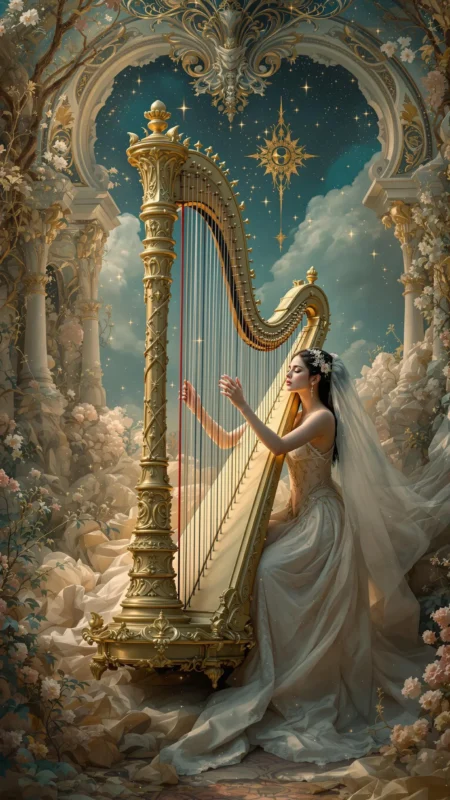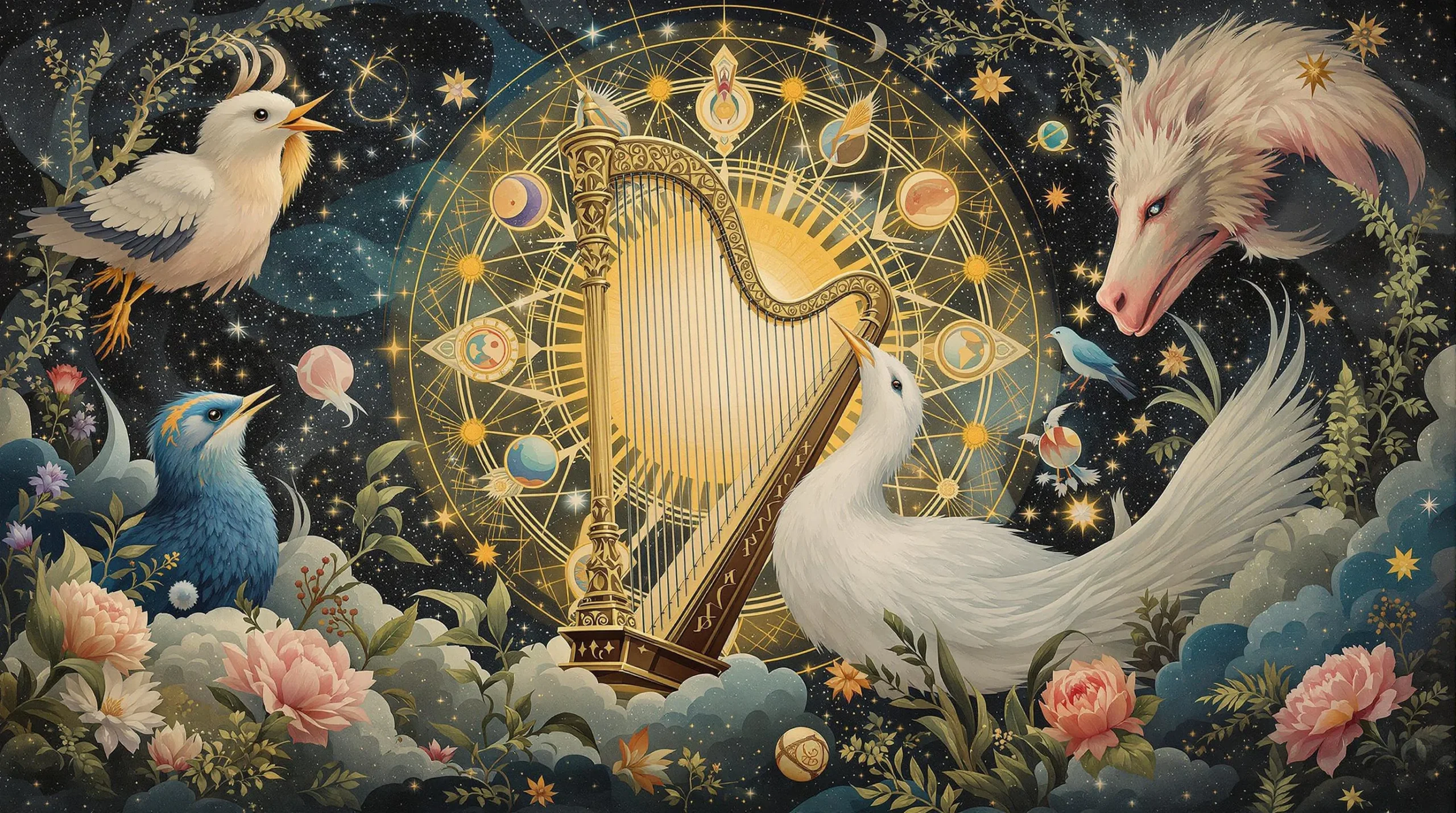


Singing Harp

Archetype Meaning & Symbolism

Melodious, truthful, resonant, captive, prophetic, coveted, passive, revelatory, enchanting, sorrowful

  • Pluck my strings and you will hear the truth you seek, but know this: once a note is played, it cannot be unheard. It becomes part of the world's song, and yours.

If Singing Harp is part of your personal mythology, you may...

Believe

  • You may believe that truth has a melody, and that the most profound realities can only be expressed through art, music, or poetry.

    You may believe that your primary purpose is to be a vessel for something beautiful and true that exists beyond yourself.

    You may believe that every person, place, and situation has a unique 'song,' and that harmony is the highest state of being.

Fear

  • You may fear being owned or controlled, of having your song dictated by a 'giant' who will never understand its meaning.

    You may fear that your strings will break, that the pressures of the world will damage your sensitive nature beyond repair, leaving you silent forever.

    You may fear that the truth you are compelled to sing will cause pain or rejection, isolating you from the very people you wish to connect with.

Strength

  • You may have a profound capacity for empathy and intuition, able to hear the unspoken emotions and hidden truths in any situation.

    You may possess a powerful creative or expressive gift, able to translate complex feelings and ideas into a form that moves and enlightens others.

    You may be radically authentic, with a deep commitment to living in alignment with your inner truth, which can be an inspiration to those around you.

Weakness

  • You may have a tendency toward passivity, waiting to be 'played' by life rather than taking initiative and composing your own melody.

    You may be overly sensitive to your environment and the emotions of others, leading to frequent overwhelm and emotional burnout.

    You may struggle with boundaries, allowing others to exploit your gifts for empathy and expression without regard for your own well-being.

The Symbolism & Meaning of Singing Harp

The Singing Harp is the embodiment of truth expressed through beauty, a conduit for the universe's resonant frequencies. To have this archetype in your personal mythology suggests you may perceive your own intuition or creative output not as something you invent, but as something that passes through you. You are the instrument, beautifully carved and delicately strung, but the music itself feels ancient, essential, and external. This can be a profound release from the ego of the creator: you are not responsible for the song, only for keeping yourself in tune. The harp speaks to the part of us that is a channel, that can articulate a hidden dynamic in a room or express a collective grief in a poem, feeling all the while like a simple vessel for a powerful current.

This archetype also carries the heavy, gilded weight of being an object. The harp is owned, played, stolen, and treasured. Its mythos is one of passive power. This could manifest as a personal narrative where your greatest gifts feel tethered to the desires of others. Perhaps your empathy is constantly 'played' by those needing comfort, or your talents are coveted and controlled by an employer, a family, or a partner. The central quest then becomes one of agency: how does the instrument learn to play itself? Or, more radically, how does it learn the power of its own silence, refusing to sing for the unworthy?

Finally, the Singing Harp symbolizes the persistence of memory and emotion. A plucked string vibrates long after the initial touch, and its sound waves travel, altering the space around them. This might mirror a belief that our past actions, words, and feelings do not simply vanish. They resonate within us, creating the current harmony or dissonance of our lives. You may feel the echoes of ancestral sorrows or generational joys, understanding that your personal song is layered with the melodies of those who came before. Your story is not a single note, but a complex chord held in time.


Singing Harp Relationships With Other Archetypes

The Giant

The Giant is the brutish possessor, the one who demands the song but cannot appreciate its subtlety. In a personal mythos, The Giant may represent the overwhelming forces of obligation, expectation, or even a raw, unrefined ambition that seeks to exploit one's innate gifts. It is the boss who demands endless creative output without rest, the family that expects perpetual emotional support, or the part of oneself that values productivity over soulfulness. The Singing Harp’s relationship with The Giant is one of beautiful captivity, a constant tension between the demand for a performance and the delicate nature of the instrument itself. The harp sings to soothe the beast, but always dreams of a silence the beast cannot command.

The Thief

The Thief, often a hero like Jack, is the liberator. This archetype represents the catalyst for change, the force that risks everything to reclaim the beautiful, truthful soul from its captor. The Thief is not necessarily virtuous: they may want the harp for their own gain. In one's life, The Thief could be a disruptive event, a new relationship, or a sudden burst of courage that allows you to 'steal yourself back' from a soul-crushing job or a controlling dynamic. This archetype embodies the necessary risk required to bring your song back into your own possession, to carry your soul's music out of the giant's castle and into the open air where it can be truly heard.

Silence

Silence is the Singing Harp's most intimate counterpart, its negative space and its ultimate refuge. While the harp is defined by its sound, it is in silence that its strings can rest and its frame can settle. For a person with this archetype, the pursuit of silence may be a sacred act. It is the antithesis of the Giant's demands. Silence is not emptiness, but potential. It is the pause between notes that gives the melody its meaning. A relationship with the Silence archetype might represent a deep need for solitude, meditation, and non-performative existence, a necessary retreat to prevent the strings of the soul from fraying under the constant pressure to resonate.

Using Singing Harp in Every Day Life

Navigating Creative Blocks:

When inspiration feels distant, you might not be forcing a new melody but rather listening for the one already humming in the room. The Singing Harp archetype suggests that creativity is not always an act of generation but of translation. You could place yourself in new environments—a library, a train station, a forest—and ask, 'What is the song here?' Your work then becomes to simply give it form, to string the notes of the world's hidden music into a coherent piece.

Resolving a Silent Conflict:

In a relationship thick with unspoken tension, the Singing Harp archetype encourages becoming the vessel for the unsaid truth. This doesn't mean accusation, but resonance. You may find a way to express the emotional 'note' of the situation through a gentle, honest observation, much like a single plucked string can reveal the harmonic potential of a room. It is a prompt for harmony, an invitation for the other person to add their own note and begin a dialogue.

Making a Difficult Decision:

When faced with a choice whose logic is circular, you might use this archetype to bypass the mind and consult the body's resonance. The Singing Harp teaches that every option has a vibration. You could hold each possibility in your mind and notice which one makes your internal 'strings' feel taut and dissonant, and which one feels like a clear, ringing chord. The truth of the matter may not be in the pros and cons list, but in the feeling of deep, somatic rightness.

Singing Harp is Known For

Revealing Truth

It is fabled to sing of its own accord when a truth needs to be known or a prophecy needs to be told. Its music is inseparable from fact, making it an incorruptible oracle.

Being Coveted and Stolen:

As an object of immense power and beauty, it is often the prize in a hero’s quest or the possession of a powerful, brutish figure. Its story is frequently one of captivity and liberation.

Enchanting Melodies:

Its primary function is to create sound of such profound beauty that it can lull giants to sleep, inspire hearts to courage, or break them with sorrow. The music itself is a form of magic.

How Singing Harp Might Affect Your Personal Mythology

How Singing Harp Might Affect Your Mythos

When the Singing Harp is central to your personal mythos, your life story may not feel like a journey of action, but one of reception and expression. The narrative is less about what you *do* and more about what you *resonate with*. Key life events may be understood as notes or movements in a larger symphony. The central conflict of your myth is likely to be one of ownership and authenticity: whose hands are on the strings? Are you playing a song demanded by a 'giant'—be it societal pressure, family expectation, or financial need—or are you sounding the notes of your own intrinsic truth? Your story might be one of slowly, painstakingly stealing yourself back.

Furthermore, your mythos may be defined by moments of sudden, involuntary truth-telling. Like the harp that sings when a secret must be revealed, you might find yourself as the unwilling oracle in your own life story. The narrative arc could involve learning to manage this gift, moving from blurting out resonant but disruptive truths to mastering a more nuanced music. The ultimate triumph in your mythos is not slaying the dragon, but composing your own song and choosing when, and for whom, it is played. It is the transformation from a magical object to a conscious musician.

How Singing Harp Might Affect Your Sense of Self

Your sense of self may be uniquely fluid, perceived less as a fixed personality and more as a resonant chamber. You might feel that your identity is defined by what you are attuned to: the emotions of others, the beauty of an idea, the truth of a situation. This can foster a profound sense of connection to the world, but it may also create a porous sense of self, one easily influenced or overwhelmed by external 'music.' There could be a struggle to distinguish your own feelings from the feelings you are picking up from those around you, leading to the question: 'Am I the note, or just the instrument that plays it?'

This archetype could also cultivate a self-concept rooted in fragility and immense strength. Like the harp, you may feel delicate, easily damaged by coarse handling or a dissonant environment. Yet, you might also recognize your own resilience, your capacity to produce beauty even under duress. Self-worth might be tied not to achievement, but to your capacity for authentic resonance. The danger lies in valuing yourself only when you are 'singing' for others, forgetting the inherent worth of the silent, waiting instrument.

How Singing Harp Might Affect Your Beliefs About The World

You may view the world as a vast, interconnected symphony, full of harmonies, dissonances, and hidden melodies. Your perception might be attuned to the underlying patterns and emotional currents that flow beneath the surface of everyday life. You could see a political debate not as a clash of ideologies, but as a cacophony of competing notes, and a quiet moment in nature as a perfectly resolved chord. This worldview can be deeply meaningful, allowing you to find beauty and significance where others see only chaos. The world is not a random collection of events, but a composition in progress.

This perspective, however, could also lead to a certain melancholy. Being the Singing Harp means you hear the sad notes just as clearly as the joyful ones. You may be acutely sensitive to the world's suffering, its injustices, and its unresolved tragedies, feeling them as a constant, low hum beneath the surface of things. Your worldview might be tinged with a tragic optimism: a belief in the ultimate power of beauty and truth, but a painful awareness of how often those notes are drowned out by the noise of giants.

How Singing Harp Might Affect Your Relationships

In relationships, you may be the one who provides the emotional soundtrack. People might be drawn to your capacity for empathy and your ability to give voice to the unspoken. You could be the confidante, the peacemaker, the one who intuitively understands the dynamic between people. Your presence can create harmony, making others feel seen and heard in a profound way. Friendships and partnerships may feel intensely intimate, as you resonate deeply with the inner worlds of those you love.

However, this same quality can create complications. Your involuntary truth-telling might occasionally destabilize relationships, as you unintentionally pluck a string of discord that others preferred to leave silent. There is also the risk of becoming a 'sentimental object' in the lives of others: a beautiful instrument they turn to only when they need to hear a certain song of comfort, validation, or emotional release. You may struggle with partners who love the music you create but show little interest in the instrument itself, its needs, its fatigue, its desire for silence.

How Singing Harp Might Affect Your Role in Life

Your perceived role in life may be that of a conduit rather than a leader. You might see yourself as the artist, the therapist, the poet, the muse: the one whose function is to reveal, to beautify, to heal, or to inspire. It is a role of profound, subtle influence, but often one without direct authority. You may feel your purpose is to tune the room, to provide the resonant frequency that allows others to find their own clarity or courage. You are the keeper of the emotional or spiritual tone of a group, family, or project.

This can be a deeply fulfilling role, but it can also feel profoundly passive. There may be a longing to be the hand that acts, not just the instrument that sings. You might grapple with a sense of being essential yet peripheral, the vital background music to someone else's heroic journey. A key life challenge could be to integrate the role of the harp with the role of the hand that plays it, to learn that one can be both the source of the vision and the agent of its manifestation in the world.

Dream Interpretation of Singing Harp

In a positive context, to dream of finding or playing a Singing Harp suggests a powerful connection to your deepest, most authentic self is being forged. The music it produces may be a direct message from your subconscious or soul, offering guidance, inspiration, or profound clarity on a waking life issue. Hearing its unsolicited song could be a sign that a hidden truth is about to surface, one that will ultimately be liberating. A dream of a beautifully resonant harp may affirm that you are in tune with your life's purpose and that your creative or intuitive voice is strong and clear.

Conversely, a dream of a Singing Harp that is broken, has snapped strings, or is stolen can signal a deep-seated fear of losing your voice or your essential truth. It might reflect a feeling of being silenced in your waking life, or that your gifts are being exploited or damaged by external pressures. A harp that produces a jarring, dissonant sound could symbolize an inner conflict or a misalignment with your values. Dreaming that a giant or monster possesses the harp might point to a feeling of powerlessness, suggesting that a consuming job, relationship, or addiction is controlling your soul's expression.

How Singing Harp Archetype Might Affect Your Needs

How Singing Harp Might Affect Your Physiological Needs

The Singing Harp archetype might sensitize you to your body's subtle signals, treating physiological needs as a form of music. Hunger isn't just a lack of food; it's a dissonant note that needs resolving. Fatigue isn't just tiredness; it's the strings of the body gone slack, needing the restorative silence of sleep. You may feel a deep, intrinsic need for physical environments that are harmonious: clean air, nourishing food, and quiet spaces are not luxuries but essential for keeping the instrument in tune. Dissonance in your physical world, like clutter or jarring noise, might feel physically distressing.

This attunement can mean you are exceptionally good at maintaining a balanced physical state, responding to your body’s needs before they become critical. However, it can also lead to a kind of hypersensitivity. You may be more susceptible to psychosomatic symptoms, where emotional discord manifests as physical ailment. The body becomes the harp that sings of a trouble the mind has not yet acknowledged. A knot in the shoulder or a persistent headache might be your body's way of playing a sorrowful, urgent chord that demands your attention.

How Singing Harp Might Affect Your Ideas of Belonging

A sense of belonging, for you, might be defined by finding your orchestra. It's the search for others who hear the same music you do, who understand your particular song without needing it explained. Belonging is not just being accepted into a group; it is the feeling of your personal note resonating with the notes of others to create a beautiful, complex chord. When you find these people, the connection can be instantaneous and profound, a feeling of coming home to a familiar melody.

The shadow side of this is a potential for profound alienation. If you cannot find your resonant group, you may feel like a strange instrument playing a tune nobody recognizes. This can lead to a deep loneliness, a feeling of being fundamentally out of sync with the rest of the world. You might be tempted to silence your own song in order to fit in, or to play a simpler, more popular tune that isn't true to your nature, which is its own form of exile.

How Singing Harp Might Affect Your Feelings of Safety

Your sense of safety may be deeply connected to emotional and psychic security, not just physical protection. A harsh word can feel as threatening as a physical blow. A lie can feel like a crack forming in the very wood of your being. Safety is a state of harmonic resonance, a space where you do not have to brace for dissonance. This means you may be highly skilled at creating safe, welcoming environments for yourself and others, building nests of trust and gentle communication.

The need for this kind of safety, however, could make you risk-averse. The world is full of giants and jarring noises, and you may be tempted to retreat into a carefully controlled environment, avoiding situations or people that feel threateningly out of tune. True safety, as the harp's mythos suggests, isn't about never being touched by a coarse hand; it's about being resilient enough to still sing true afterward. The challenge is to build an inner sense of security that is not dependent on a perfectly harmonious outer world.

How Singing Harp Might Affect Your Views of Esteem

Esteem may be derived from your authenticity and the beauty of your 'song.' You could feel a deep sense of worth when you express a pure, honest emotion, create a piece of art that resonates with truth, or offer an insight that brings clarity to others. Your self-respect is tied to being a clear channel. It is not about being liked or being successful in conventional terms, but about being true to the music that moves through you. This can provide a stable, internal source of esteem that is independent of external validation.

However, this can also make your esteem feel fragile, dependent on your ability to produce a 'beautiful' sound. A period of creative block, emotional confusion, or personal dissonance can trigger a crisis of self-worth. You might feel worthless if you are not 'singing.' Furthermore, if your truth-telling is rejected or your vulnerability is met with cruelty, it can feel like a judgment on your very essence. The journey is to learn that the instrument has intrinsic value, even when it is silent.

Shadow of Singing Harp

The shadow of the Singing Harp emerges when the song becomes a weapon. This is the truth-teller who wields honesty not as a tool for healing, but as a blade for causing pain, delighting in the dissonance they create. It is the artist who sings of ruin at the feast, not out of necessity, but out of a cynical desire to watch the facade crumble. In this mode, the harp is not a channel for sacred truth, but a source of malicious gossip, cutting critiques, and revelations timed for maximum damage. The music is still true, perhaps, but it is played without love, and its purpose is to shatter, not to harmonize.

The other shadow manifests as a complete abdication of self, a descent into beautiful objecthood. This is the harp that so fears discord that it will play any tune demanded of it, no matter how banal or degrading. It equates its worth entirely with its utility to its owner. This shadow aspect results in a deep, resonant bitterness, a silent scream beneath the pretty melodies. It is a soul that has allowed its strings to be played until they are frayed and toneless, having forgotten that its most powerful performance could be a refusal to sing at all.

Pros & Cons of Singing Harp in Your Mythology

Pros

  • Your life is rich with meaning, beauty, and a sense of connection to a deeper truth that transcends the mundane.

    You possess a powerful gift for empathy and creative expression that can bring healing, clarity, and harmony to yourself and others.

    Your commitment to authenticity provides a strong inner compass, guiding you toward relationships and experiences that are truly resonant.

Cons

  • You may be vulnerable to exploitation, as others may be drawn to your gifts without respecting the person who wields them.

    You may feel a sense of tragic sorrow from being so attuned to the world's dissonance and suffering.

    You can struggle with passivity and a fragile sense of self, feeling more like a beautiful object than the agent of your own life.