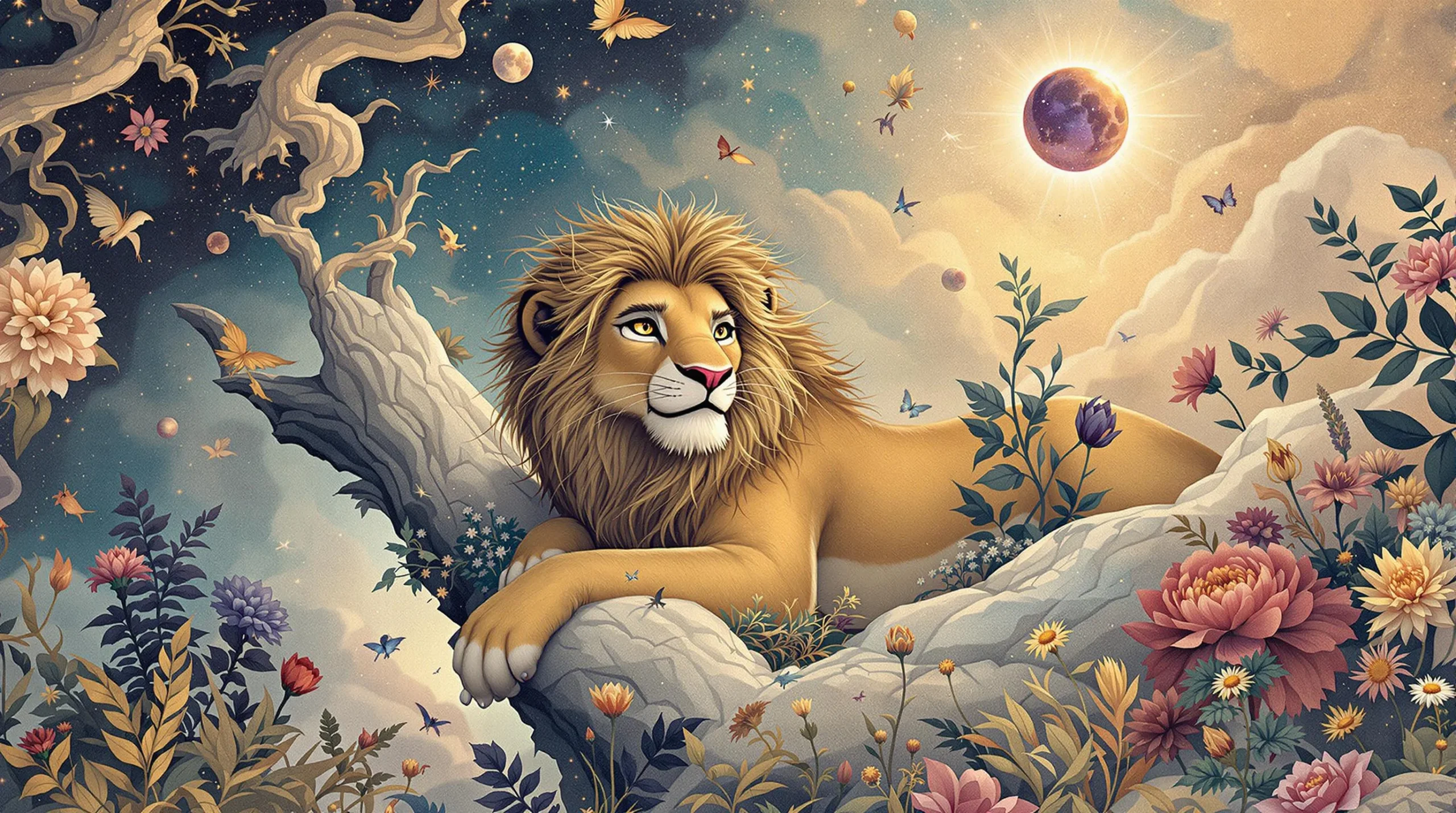


Simba

Archetype Meaning & Symbolism

Exiled, Royal, Playful, Guilty, Responsible, Heir, Reckless, Courageous, Restorative, Circle

  • The past can hurt. But the way I see it, you can either run from it or learn from it.

If Simba is part of your personal mythology, you may...

Believe

  • You may believe that a single, defining mistake has the power to condemn you to a life of exile, and that you are solely responsible for its fallout.
  • You may believe that while escapism and carefree living have their place as medicine for a wounded soul, they are not a cure.
  • You may believe that true adulthood is not a matter of age, but of accepting your rightful place in the world, no matter how reluctantly.

Fear

  • You may fear confronting the person or memory that represents your greatest failure or source of shame.
  • You may fear that even if you return to face your responsibilities, you will be inadequate to the task and will only make things worse.
  • You may fear disappointing the legacy of your ancestors or the potential that others have always seen in you.

Strength

  • You possess an incredible capacity for transformation, capable of rising from a period of apathy and hedonism to become a focused and inspiring leader.
  • You have the rare ability to build deep, loyal friendships in disparate worlds, connecting with both the carefree outcasts and the duty-bound traditionalists.
  • Your own journey from guilt to grace gives you a profound well of empathy for the mistakes of others.

Weakness

  • You have a powerful tendency toward avoidance, preferring to run from problems and difficult emotions rather than facing them head-on.
  • You are uniquely vulnerable to manipulation through guilt, as your own sense of culpability can be a lever used against you.
  • Your initial response to pressure or trauma may be a reckless immaturity that can alienate those you care about and exacerbate the crisis.

The Symbolism & Meaning of Simba

The Simba archetype is the cartography of the prodigal soul's return. It symbolizes the journey away from a perceived, unforgivable transgression and the eventual, difficult pilgrimage back to the scene of the crime. This is not about forgetting; it is about metabolizing guilt into responsibility. Within a personal mythos, Simba may represent a golden era of innocence shattered by a fall from grace, leading to a self-imposed exile in a 'jungle' of anonymity or hedonism. This wilderness is a crucial space: it is where the ego is dissolved, where status is meaningless, and where a different kind of survival is learned. The central symbolic act is the moment of looking into the water and seeing not your own reflection, but the face of your legacy, your potential, your ancestry. It is the universe holding up a mirror and reminding you: you are more than what you have become.

The archetype is also a profound exploration of the tension between individual freedom and communal duty. 'Hakuna Matata' is a seductive philosophy, a 'no worries' gospel that unburdens the self from the weight of the collective. To embody this archetype is to have lived, for a time, under this gospel. But the symbolism of the dying Pride Lands under Scar's rule is a stark reminder that abdication has consequences. A personal mythos shaped by Simba suggests that true self-actualization is not found in the splendid isolation of a 'problem-free philosophy,' but in finding one's irreplaceable role within the 'Circle of Life.' It posits that freedom is not the absence of responsibility, but the conscious and willing acceptance of the one responsibility that is uniquely yours.

Finally, the spectral appearance of Mufasa in the clouds speaks to the haunting nature of potential. This is the archetype of the 'heir,' one who is born with or into a legacy. This legacy may be familial, creative, or spiritual. The ghost is the voice of this legacy, the internal and external pressure to live up to a pre-written role. For some, this is a crushing weight. For the one with Simba in their mythos, it is a guiding star. It is the memory of who you were meant to be, a voice that cuts through the jungle's cacophony to say 'Remember.' It is the symbolism of a destiny that you can run from, but can never truly outrun.


Simba Relationships With Other Archetypes

The Ghost of the Father

The Simba’s journey is perpetually shadowed, or perhaps illuminated, by the Ghost of the Father. This presence is not merely the spectre of a dead king, but could be the very echo of legacy itself, a resonant hum in the bones of the prodigal child. It may manifest as a sudden, gut-wrenching memory, or the disembodied voice of conscience on the wind. This spectral figure could be seen as the ultimate tether to a destiny the Simba has tried to sever, a celestial compass whose needle always points toward home. It is the past made present, a watermark on the soul that no amount of hedonistic distraction can entirely fade, reminding the exile that one's name is not merely a sound, but a mantle, heavy with the dust of ancestors and the expectations of the future.

The Wasteland

The Simba often finds a strange, seductive home in the Wasteland. This archetype is not always a desiccated desert, but may be any place—or state of mind—that offers refuge from the sharp edges of memory and duty. It is the comfortable purgatory of “no worries,” a lush, unkempt garden of the self where potential is allowed to lie fallow, untroubled by the demands of a kingdom. Here, time may seem to flatten, and the weight of a lineage could feel like a half-forgotten dream. Yet, the Wasteland is a fragile sanctuary; its very peace is perhaps predicated on a kind of willed amnesia. The Simba’s residence there is always temporary, a becalmed sea where the ship of destiny drifts, waiting for the inevitable storm of purpose to tear through the quiet.

The Usurper

In the narrative of the Simba, the Usurper may function as a kind of cracked mirror, reflecting a twisted, grasping version of the power the true heir is meant to inherit with grace. The Usurper is perhaps the dissonant chord that throws the kingdom's harmony into chaos, the embodiment of a rot that begins not with an invading army, but in the intimate circle of the court. Their reign is what gives the Simba's exile its meaning and their return its moral urgency. This figure could be seen not just as an antagonist, but as a necessary crucible; it is the Usurper’s shadow that forces the Simba to finally grow into the light, transforming a runaway prince into a returning king by creating a wound in the world that only the rightful heir has the shape to heal.

Using Simba in Every Day Life

Confronting a Formative Failure

When paralyzed by a past mistake, a business decision that soured, a relationship that ended in regret, the Simba archetype offers a map. It suggests a period of retreat—the 'Hakuna Matata' phase—is not cowardice but a necessary, fallow season for the soul. It is permission to lick your wounds. But its ultimate use is in modeling the return: the act of looking at the spectral image of your failure not as a ghost to be fled, but as an ancestor whose wisdom, however painful, you must integrate to move forward.

Accepting Unwanted Responsibility

For those avoiding a mantle of leadership—in a family, a community, or a career—the Simba archetype is a powerful meditation. It reframes responsibility not as a burden to be borne, but as an ecosystem to be tended. You may be avoiding it because you feel inadequate, an imposter king. To use this archetype is to stand at the edge of your own 'Pride Lands,' survey the desolation your absence has caused, and realize that your presence, however flawed, is preferable to the chaos of the void. It is the choice to become a cause of order, rather than an effect of entropy.

Reconciling Two Selves

Many live with a dissonance between the person they are in private and the one they are in public; the carefree spirit and the dutiful scion. The Simba archetype provides a narrative for integrating these halves. It suggests your 'jungle' self, the one that feasts on grubs and sings off-key, is not an enemy to your 'royal' self. It is, in fact, the very part of you that holds the key to surviving the wilderness. Using this archetype means allowing both selves to inform each other: to rule with the joy you learned in exile, and to play with the wisdom you earned on the throne.

Simba is Known For

The Stampede

The primal scene of trauma and guilt, the event that triggers the hero's flight into exile and shapes his belief in his own culpability.

Hakuna Matata

A philosophy of radical presentism and escapism, representing a necessary but ultimately unsustainable period of healing through the rejection of past and future.

The Confrontation at Pride Rock

The climax of the hero's journey, where he returns to face his usurper, his past, and his destiny, thereby restoring balance to his world and himself.

How Simba Might Affect Your Personal Mythology

How Simba Might Affect Your Mythos

When Simba is a figure in your personal mythos, your life story may be written in the ink of exile and return. Your narrative is likely not a steady, linear ascent but a dramatic arc of fall and redemption. There was a 'before': a time of promise and belonging, a kingdom of sorts. Then, a cataclysm, a mistake, a great shame—the stampede—that sent you running. Your story includes a 'wilderness chapter,' a period where you lived under an assumed name, emotionally or literally, embracing a 'Hakuna Matata' ethos to numb the pain of what you left behind. This could be a decade in an unfulfilling career, a series of shallow relationships, or a geographical flight from home. Your personal myth is defined by this schism, this break in the timeline.

The turning point, the climax of your mythos, is the 'Nala moment'—an encounter, a crisis, or an inner awakening that forces you to look at the desolation you've allowed to fester in your absence. The rest of your story becomes about the difficult journey home, not to the past, but to the present responsibility you fled. Your mythos is not about being a perfect ruler from the start, but about becoming a worthy one through the very act of confronting your own wreckage. It is the story of someone who learns to rule their own inner kingdom only after having completely abandoned it.

How Simba Might Affect Your Sense of Self

Your view of yourself may be fundamentally split. On one hand, there is the exiled self: a being defined by a past mistake, saturated with a guilt so profound it feels like a core identity trait. You may believe, on some level, that you are a walking disaster, that your presence causes ruin, and that the kindest thing you can do for others is to keep your distance. This self-perception breeds a kind of imposter syndrome in reverse; you feel like an imposter when you are happy, because you believe you are fundamentally a creature of sorrow and shame.

On the other hand, there is a glimmer, a persistent whisper of a 'royal' self. Deep down, beneath the layers of self-recrimination, you may harbor a secret conviction of your own significance. It's the feeling that you were meant for more than this self-imposed exile in the jungle of mediocrity. This isn't arrogance; it is the faint memory of your own potential, the ghost of the person you were before the fall. Your journey of self-discovery is about reconciling these two halves: accepting the weight of the past without letting it extinguish the light of your inherent worth.

How Simba Might Affect Your Beliefs About The World

You may view the world as an intricate, deeply interconnected ecosystem, a great 'Circle of Life.' This is not an abstract ecological concept; it is a moral and ethical framework. You understand that actions—and crucially, inactions—have cascading consequences. You see that when someone neglects their post, a vacuum is created, and that vacuums are always filled, often by 'hyenas': chaos, opportunism, decay. This worldview imbues life with a profound sense of weight and meaning. It rejects the idea of a life without consequences.

This perspective could also foster a radical belief in redemption. The world is not a courtroom that delivers a final verdict, but a landscape that allows for a return journey. The past is not a destination you are condemned to, but a place you can learn from. Your worldview allows for seasons of life: there is a time for carefree wandering in the jungle, and there is a time for shouldering the burdens of Pride Rock. You believe that wastelands can become kingdoms again, that drought can be ended by the return of a rightful rainmaker, and that this is true for nations, for families, and for the human soul.

How Simba Might Affect Your Relationships

Relationships in your life may be sorted into two distinct territories: the Jungle and the Pride Lands. The 'Jungle' is populated by your 'Timon and Pumbaa' figures—friends who offer unconditional comfort, laughter, and a shared philosophy of avoiding the difficult stuff. These relationships are your safe harbor, built on the unspoken agreement not to poke at each other's wounds or demand too much. They are essential for survival in exile, but they may not be conducive to growth.

Then there are the 'Pride Lands' relationships, embodied by 'Nala.' These are the people who knew you 'before.' They see past your 'Hakuna Matata' facade to the royal potential beneath. Their love is not a soft place to land, but a challenge. They hold up a mirror and say 'Remember who you are.' These relationships are often more difficult and freighted with history and expectation. You may have a pattern of fleeing from this kind of connection, as it threatens the comfortable amnesia of your exile. The central relational challenge of your life is learning to integrate the easy joy of the jungle with the demanding, purposeful love of the Pride Lands.

How Simba Might Affect Your Role in Life

You may perceive your primary role in life as that of the 'Prodigal.' You are defined by what you have left behind. Whether it's a family business, a community expectation, or a creative calling, you feel its gravitational pull even as you run in the opposite direction. You may feel like a king in hiding, working a commoner's job, your royalty a secret self that feels both like a comfort and a curse. This creates a deep internal conflict: a simultaneous yearning for and terror of your own destiny.

Alternatively, you may have fully embraced the role of the 'Exile,' making it your entire identity. You are the wanderer, the one without roots, the person who champions a 'problem-free philosophy.' This role is a fortress built to protect you from the pain of your past and the pressure of your future. You might be the fun friend, the one who never gets tied down. But the Simba mythos suggests this is a temporary costume, not a permanent skin. There will come a time when the sky itself seems to call your name, and you will have to decide if you are merely an actor playing the part of the exile, or if you are ready to assume the role you were born to play.

Dream Interpretation of Simba

In a positive context, to dream of Simba—especially an adult Simba roaring atop Pride Rock or confidently walking the plains—is a potent symbol from your own subconscious. It may be a summons. It could signify that your own 'Hakuna Matata' phase is coming to its natural end and that you are now ready, whether you consciously admit it or not, to face a responsibility you have been avoiding. Seeing Mufasa's face in the clouds of your dream is an even more direct message: it is your own higher self, your own potential, reminding you of your true identity. This dream is an anointing, a sign of readiness and burgeoning courage.

In a negative context, a dream of the stampede, of being a small cub lost in a terrifying crush of bodies, speaks to a feeling of being overwhelmed by past trauma and guilt. You may feel utterly powerless, a victim of forces beyond your control, trapped in a replay of your worst moment. Dreaming of Simba cowering before Scar or the hyenas could represent your current relationship with your own inner critic or with external figures who diminish you. It is a dream of abdication, highlighting a fear that you are not, and never will be, strong enough to reclaim your own kingdom from the forces of chaos.

How Simba Archetype Might Affect Your Needs

How Simba Might Affect Your Physiological Needs

Physiologically, the Simba archetype may manifest as a life lived in two distinct phases of bodily experience. First, the 'Hakuna Matata' phase. This is the body in a state of relaxed hedonism. It prioritizes immediate pleasure and comfort: eating what tastes good ('slimy, yet satisfying'), sleeping in, avoiding strenuous exertion. It is a body at rest, a body in recovery. There may be a neglect of long-term health in favor of short-term contentment, a physiological expression of the 'no worries' philosophy.

Then comes the shift, the return. This may trigger a dramatic change in your relationship with your physical self. The body is no longer a hammock for the soul, but a vehicle for a mission. This could manifest as a sudden dedication to a fitness regimen, a more disciplined approach to diet, and a newfound appreciation for strength and endurance. You are, in effect, training for the battle to reclaim Pride Rock. The body becomes a tool to be sharpened, a physical representation of your renewed commitment and purpose.

How Simba Might Affect Your Ideas of Belonging

Your need for belonging may be a source of deep and persistent conflict. You might exist in a state of social limbo, caught between two worlds. With your 'jungle' friends, you may feel a sense of camaraderie, but it can feel conditional and shallow, predicated on a shared avoidance of depth. You may feel that if they knew who you 'really' were, or the gravity of what you left behind, they wouldn't accept you. You don't fully belong there because a core part of you is hidden.

Simultaneously, you may feel profoundly unworthy of belonging to your 'Pride Lands'—your family of origin, a high-achieving community, or any group that represents the life you fled. You see yourself as a disappointment, a pariah who has forfeited the right to be there. The journey of this archetype is the slow, painful realization that belonging is not a privilege to be earned, but a fact to be accepted. It is about returning not as a perfect hero, but as an integrated self, and discovering that your place was waiting for you all along. True belonging happens when you take your place, scars and all, back in the circle.

How Simba Might Affect Your Feelings of Safety

Your sense of safety may be paradoxically tied to the idea of running away. The 'jungle'—a new city, a different social circle, a life of anonymity—feels like the safest place in the world because it is a place where your past cannot find you. You may configure your life to avoid the 'Pride Lands,' the place of expectation, history, and potential confrontation. Safety is equated with being unseen, unknown, and unaccountable. You feel secure in smallness, in a life where the stakes are low and the ghosts of your past have no address to haunt.

The narrative arc of Simba, however, offers a crucial lesson on the nature of true safety. It suggests that this escapist security is an illusion. The threat you flee from (Scar and the hyenas) does not vanish; it grows stronger in your absence and devastates the very thing you were meant to protect. True, lasting safety, the archetype argues, is not found in hiding. It is created by facing the danger, establishing order, and defending the borders of your own kingdom. It is the security that comes from being the master of your domain, not a guest in a borrowed paradise.

How Simba Might Affect Your Views of Esteem

Your self-esteem may be anchored to a single, seismic event in your past. It is a fragile structure, built on the fault line of a great failure. You may operate from a deficit of worth, perpetually trying to pay back a debt of guilt that no one else is trying to collect. Success can feel fraudulent, and praise can feel like a misunderstanding, because your internal monologue is stuck on a loop, whispering 'If they only knew.' Your esteem is not based on your current actions, but on a past identity as 'the one who messed up.'

The path to rebuilding esteem, within the Simba framework, is not through self-help mantras but through responsive action. It begins with an external validation—a 'Nala' who reflects your true potential back to you, or a 'Mufasa's ghost' moment of clarity that reminds you of your inherent worth. Esteem is restored when you stop running from the past and instead learn from it. It's the moment of realizing you are not defined by the fall, but by the decision to get back up and climb. It is the acceptance that you are, indeed, more than what you have become.

Shadow of Simba

The shadow of Simba is the king who never returns. He is the man in his forties still living the 'Hakuna Matata' lifestyle, not as a joyful choice, but as a terrified refusal of maturity. He remains in the jungle of low stakes and easy pleasures, surrounding himself with friends who ask nothing of him and reflect back only his most charming, least challenging self. His potential, once a bright star, becomes a black hole, sucking the energy from his own life. He mistakes his cage of comfort for a kingdom of freedom, all while the real world, the world of consequence and meaning, turns to dust in his absence. This isn't a life of 'no worries'; it is a life of no growth, a slow spiritual death on a bed of palm fronds.

The other, more monstrous shadow is the Simba who returns not with wisdom, but with entitlement. He has not learned from his exile; he has only festered in it, his grief curdling into arrogance. He returns to Pride Rock not to restore the Circle of Life, but to place himself at its center. He becomes a petulant tyrant, demanding the fealty he believes is his birthright without doing the work to earn it. He scoffs at counsel, seeing it as a challenge to his authority. This shadow Simba has Mufasa's roar but none of his wisdom; he has Scar's selfishness but none of his strategic cunning. He is the ultimate failure of the archetype: the one who goes through the entire journey and learns absolutely nothing.

Pros & Cons of Simba in Your Mythology

Pros

  • Having run from responsibility, you understand its weight and value more profoundly than those who have never questioned it.
  • Your comeback story is a source of immense strength and can serve as a potent inspiration for others who feel lost in their own 'jungle.'
  • You have experienced life outside the 'palace walls,' giving you a humility and perspective that a born-and-bred ruler might lack.

Cons

  • You may lose years of your life to procrastination and self-pity, time that you can never get back.
  • Your flight from responsibility can cause real, tangible harm to the people and communities you leave behind.
  • The immense guilt you carry can become a self-fulfilling prophecy, leading you to make poor decisions out of a sense of unworthiness.