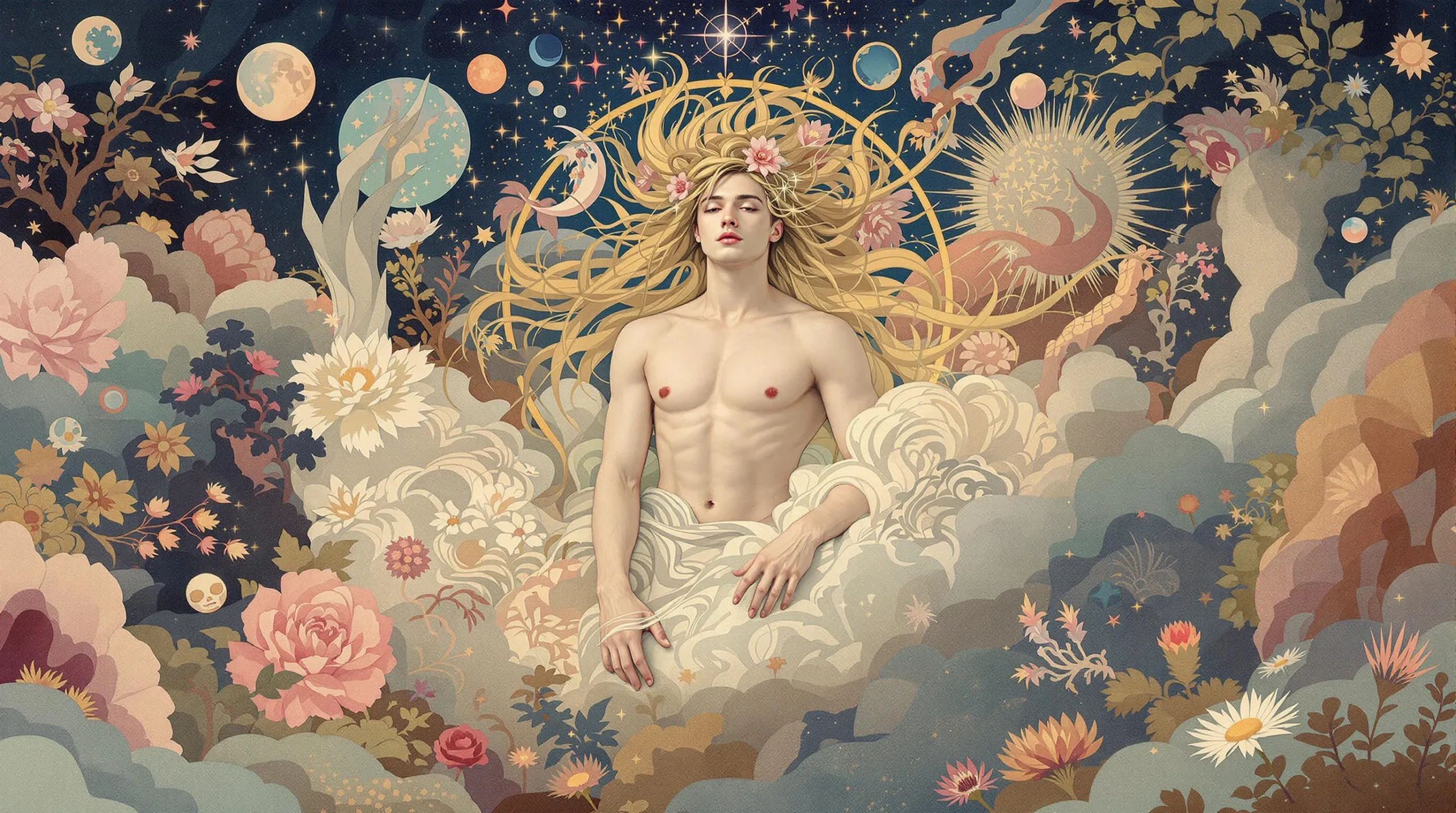


Silvanus

Archetype Meaning & Symbolism

Wild, ancient, guardian, liminal, rustic, feral, generative, solitary, boundary-keeper, unpredictable, gruff, paternal

  • Happy, too, is he who knows the rustic gods, Pan and old Silvanus and the sister Nymphs.

If Silvanus is part of your personal mythology, you may...

Believe

  • The most profound truths are found not in books or lecture halls, but in the silent wisdom of the uncultivated world.
  • Boundaries are living things, like hedgerows, that require tending and respect, not lifeless walls to be erected and forgotten.
  • Solitude is not a lack of company, but a form of sacred and necessary communion with the self and the cosmos.

Fear

  • The complete domestication of the soul, a future where every wild corner of the self has been paved over, sanitized, and made productive.
  • That the relentless expansion of civilization will leave no room for silence, mystery, or the untamed, both in the outer world and the inner landscape.
  • Being fundamentally and permanently misunderstood by those who live only in the tidy clearings of society, who mistake your wildness for malice or your solitude for sorrow.

Strength

  • A deep, quiet resilience rooted in self-knowledge, allowing you to weather personal crises with the steadfastness of an old oak in a storm.
  • The innate ability to establish and maintain healthy, living boundaries that protect your well-being without completely isolating you from others.
  • A profound sense of authenticity that makes you a grounding, trustworthy presence, unswayed by fads or social pressure.

Weakness

  • A tendency toward reclusive isolation, where protective solitude sours into a misanthropic refusal to engage with the human community.
  • A stubborn, almost reflexive resistance to necessary structure, collaboration, and the conventions of society, even when they are beneficial.
  • An impatience or gruff dismissal of the 'tame' world, which can alienate potential allies and close you off from joy, intimacy, and shared endeavor.

The Symbolism & Meaning of Silvanus

To find Silvanus in your personal mythology is to acknowledge the wild, untamed country that exists within your own soul. He is not a god of the manicured park, but of the deep woods, the tangled thicket, the land that has not yet been, and perhaps never should be, fully civilized. His presence suggests a reverence for what is primal, instinctual, and authentic in you. This archetype represents the part of the self that requires solitude to thrive, that feels more at home in the quiet hush of the trees than in the clamor of the marketplace. He is the guardian of your inner wilderness, the force that resists complete domestication and reminds you that your truest nature has roots running deeper than social conditioning.

In a modern context, Silvanus symbolizes the keeper of living boundaries. He challenges the idea of rigid, static walls, proposing instead the concept of a thriving edge, a liminal space that is both a barrier and a habitat. Your personal boundaries, under his influence, might become less about saying “no” and more about cultivating a personal ecosystem where you can flourish. He is the patron of the threshold, governing the sacred transition between your inner world and the outer, the private self and the public persona. He asks: what parts of yourself do you keep wild, and how do you protect that sacred ground?

The Silvanus archetype could also speak to a powerful, generative masculinity that is protective and rooted, rather than aggressive or dominant. He is the “old man of the woods,” embodying a wisdom that is ancient, earthen, and patient. He is often depicted carrying a cypress tree, a symbol of both death and eternal life, suggesting a comfort with the cycles of growth and decay. His energy is not that of the conquering hero, but of the steadfast guardian, the one who knows that true strength lies not in changing the landscape, but in understanding and preserving it.


Silvanus Relationships With Other Archetypes

The Hermit

The Hermit may enter the woods seeking escape, but what is discovered in the presence of Silvanus is rarely simple solitude. It is, perhaps, a more profound and demanding form of company. The forest does not offer a blank canvas for contemplation so much as it presents a mirror, its tangled undergrowth reflecting the unnavigated corridors of the self, its sudden clearings a stand-in for moments of stark and unsettling clarity. The relationship is less that of a tenant to a landlord and more that of an acolyte to a silent, ancient teacher. The Hermit might learn the patience of stone, the persistence of the root, and the unsettling truth that to be truly alone is to be utterly enmeshed in a web of life that has no particular need for you. The silence of Silvanus is not an absence, but a language of rustling leaves and cracking twigs, one that could strip away the ego until all that remains is a listening presence, as much a part of the landscape as any moss-covered rock.

The City

In the grand, ongoing myth of existence, the City stands as the geometric counter-argument to the wild, chaotic poetry of Silvanus. The City is an act of will, a declaration in stone and steel that straight lines and right angles can impose a lasting order upon the world. To the City, Silvanus may be perceived as a resource to be managed, a threat to be paved over, or a romanticized periphery to be viewed from a high-rise window. Yet, Silvanus seems to hold a longer view. It presses against the City’s edges not with malice, but with an indifferent, inexorable patience. It is the dandelion cracking the pavement, the vine scaling the brick wall, the quiet, persistent whisper that every grid is temporary. Their relationship could be seen as a slow, geological argument between human ambition and organic time, a tension between the constructed narrative of civilization and the amnesiac, cyclical story of growth and decay.

The Ruin

The Ruin is where the long quarrel between the City and Silvanus reaches a kind of melancholy truce. It is a shared space, a collaboration between human memory and natural forgetting. Here, Silvanus does not simply conquer; it re-contextualizes. The rigid skeleton of a cathedral or a factory is softened, given new flesh by ivy and new meaning by the birds that nest in its rafters. A ruin may suggest that the ultimate fate of human endeavor is not to be erased, but to become a trellis for a different kind of life. The relationship is one of sacred reclamation, where Silvanus acts as a slow, green archeologist, unearthing a deeper beauty in the decay of what was once proud and impervious. The Ruin becomes a monument not to failure, but to a poignant and inevitable synthesis—proof that what humanity builds is perhaps most beautiful at the precise moment it is being unbuilt.

Using Silvanus in Every Day Life

Navigating Career Transitions

When leaving one job for the unknown of another, you may invoke the spirit of Silvanus. He is the god of the boundary, the liminal space between the cultivated field and the untamed forest. Instead of viewing unemployment or a career shift as a void, you might see it as a fallow, wild space, a necessary wilderness between one phase of cultivation and the next. This perspective allows for exploration and unexpected growth, trusting that something new will take root in the unplowed soil of your professional life.

Establishing Personal Boundaries

Where some see boundaries as brick walls, the Silvanus mythos suggests they are more like living hedgerows or the edge of a forest: permeable, yet distinct. When dealing with an intrusive family member or a demanding colleague, you may not build a wall, but tend to your forest’s edge. This could mean letting in certain things (sunlight, rain, fruitful conversation) while keeping out others (invasive species, unwelcome demands). The boundary is not a dead barrier but a living, breathing ecosystem that defines your sacred personal space.

Overcoming Creative Blocks

The archetype of Silvanus can offer a potent remedy for the sterile paralysis of a creative block. He invites you to leave the tidy, cultivated garden of known ideas and venture into the woods of the subconscious. This might mean engaging in automatic writing, doodling without purpose, or simply taking a walk without a destination. The goal is not to find a pre-formed idea but to commune with the raw, untamed, and sometimes chaotic material from which all new things are born. Silvanus teaches that the most fertile ground is often the wildest.

Silvanus is Known For

Protector of Forests

Silvanus was revered as the spirit and guardian of the woods, particularly the wild, uncultivated groves that lay beyond the edges of Roman farms and cities. To cut down a sacred grove was to invite his wrath.

Guardian of Boundaries

He held a special duty to watch over the boundaries of property. Markers dedicated to him were placed at the edges of fields to ensure their integrity, making him a god of thresholds and the spaces in-between.

Friend to the Farmer

Despite his wild nature, Silvanus was also a patron of agriculture, especially in the initial, arduous work of clearing forests for cultivation. He represented the raw energy of nature that, when respected, could be channeled to support human endeavor.

How Silvanus Might Affect Your Personal Mythology

How Silvanus Might Affect Your Mythos

When Silvanus enters your personal narrative, your life story may cease to be a linear progression on a paved road. Instead, it becomes a map of forests and clearings. The plot of your life is no longer about constant, upward mobility but about cycles of cultivation and fallowness. Periods of retreat, solitude, or apparent non-productivity are reframed not as failures, but as essential seasons in the deep woods of the self, times for roots to deepen and resources to be gathered for the next period of growth. Your mythos becomes one of resilience, where the greatest trials are navigated not by force, but by knowing the terrain of your own inner wilderness.

The conflicts in your story may shift from external battles against villains to internal negotiations with your own wild nature. The central tension could be between the village and the forest: the call of community versus the need for solitude, the demands of civilization versus the pull of authenticity. Your personal epic might be about learning to walk the boundary between these two worlds, to be a bridge between the cultivated and the wild. Your role is not necessarily to tame the forest or abandon the village, but to be the one who can thrive in both, bringing the wisdom of the woods to the hearth of the community.

How Silvanus Might Affect Your Sense of Self

To see yourself through the lens of Silvanus is perhaps to accept and even cherish the untamable aspects of your character. You may find a quiet strength in your need for solitude, viewing it not as anti-social behavior but as a necessary communion with your core. Your self-image could be rooted in the metaphor of an old-growth forest: complex, resilient, layered, and possessing an inherent worth that is independent of external validation. You might feel a sense of being ancient, as if your soul has its own deep, gnarled roots connecting you to something timeless and essential.

This archetype could foster a profound sense of self-sufficiency. The approval you seek might come less from others and more from a deep, internal sense of being true to your own nature. You may feel a kinship with the outcast, the hermit, the artist, and anyone who lives by an internal compass. However, this could also lead to a certain gruffness or impatience with social artifice. The self becomes a landscape to be known and respected, not a project to be perfected or a product to be sold. You are the guardian of your own sacred grove.

How Silvanus Might Affect Your Beliefs About The World

With Silvanus as a guide, your worldview might become deeply ecological, suffused with a sense of the world as a living, breathing entity. Civilization might seem like a small, fragile clearing in a vast, ancient forest. This perspective could instill a skepticism toward narratives of endless progress and a deep respect for what is old, slow, and cyclical. You may see more wisdom in the decay of a fallen log, which nurses new life, than in the construction of another glass tower. The world is not a resource to be exploited, but a mystery to be revered.

This worldview may also prioritize the local, the tangible, and the rustic over the global, the abstract, and the polished. The health of a small patch of soil, the integrity of a local community, the preservation of a quiet space—these might seem far more important than grand, sweeping ideologies. You could develop an eye for the sacred in the mundane: the divinity in a weed pushing through pavement, the resilience in a gnarled tree, the profound peace of a silent wood. The world is not a problem to be solved, but a presence to be with.

How Silvanus Might Affect Your Relationships

In relationships, the Silvanus archetype may guide you toward connections that honor both intimacy and autonomy. You might view a partnership not as a merger of two people into one, but as two distinct trees growing side-by-side, their roots intertwined but their branches reaching for the light in their own unique ways. You likely require a great deal of personal space and may gravitate toward partners who are self-sufficient and understand that your need for solitude is not a rejection of them, but a requirement for your own well-being. Deep intimacy, for you, could be found in shared silence as much as in conversation.

You might be a fierce protector of your loved ones, guarding the sanctity of your shared life as Silvanus guards the borders of a farm. Yet, this protective instinct could sometimes manifest as possessiveness or an unwillingness to be flexible. You may struggle in relationships that demand constant social performance or a loss of individuality. The ideal relationship is a sanctuary, a sacred grove where both partners can be their most authentic, untamed selves without fear of judgment. It is a space where the wildness of each person is not just tolerated, but cherished.

How Silvanus Might Affect Your Role in Life

Your perceived role in life, colored by the Silvanus mythos, may be that of the guardian at the edge. You may not feel called to be the king in the castle or the merchant in the square, but the keeper of the gate, the tender of the threshold, the one who understands the importance of what lies beyond the walls. This could manifest as a career in conservation, therapy, art, or any field that involves protecting a sacred space, whether it be a literal ecosystem or the fragile wilderness of the human psyche. You are a protector of potential, of what is not yet or should never be fully categorized.

This role is often a solitary one. You might feel a sense of duty that isolates you, a responsibility to hold a space that others may not even recognize exists. You may be the person in a family or organization who advocates for slowing down, for considering the unseen consequences, for preserving integrity over expedience. Your purpose is not to lead the charge forward, but to ensure that in our rush to cultivate, we do not destroy the very wildness that nourishes us. You are the quiet, steady reminder of the forest that surrounds our small clearings.

Dream Interpretation of Silvanus

To dream of Silvanus in a positive context, such as being led by a kind, bark-skinned old man through a thriving forest or coming to rest in a sun-dappled, peaceful grove, may symbolize a healthy and integrated connection with your own authentic nature. It could suggest that you are successfully navigating a period of introspection and that you are in touch with your deep, instinctual wisdom. Such a dream can be a profound affirmation that your need for solitude and your unique path are valid and nourishing. It is a sign of being well-rooted, secure in your own skin, and at peace with your inner wilderness.

Conversely, a negative dream featuring this archetype—being chased by a menacing, feral figure through a dark wood, finding a forest clear-cut and barren, or being trapped behind an impassable wall of thorns—could point to a fractured relationship with your own wildness. It may indicate a fear of your own instincts, a sense that your personal boundaries have been violated, or a deep-seated anxiety about being isolated and disconnected from community. Such a dream could be a warning from your psyche that you have become too domesticated, losing touch with your vital, primal energy, or that your protective solitude has curdled into a fearful, misanthropic isolation.

How Silvanus Archetype Might Affect Your Needs

How Silvanus Might Affect Your Physiological Needs

When Silvanus is part of your mythos, your physiological needs may become deeply intertwined with the natural world. There could be a palpable, physical craving for the sensory input of wild places: the feeling of cool moss, the scent of damp earth and pine, the sound of wind in the leaves. This is not a mere preference but a felt need, as essential as nourishment. Your body might feel caged or agitated in sterile, indoor environments for extended periods, developing a restlessness that can only be soothed by direct contact with a living landscape.

The rhythms of your body might also align more closely with natural cycles. You may feel a pull toward seasonal eating, a sensitivity to the phases of the moon, and a deep need for your sleep patterns to follow the sun. Unstructured, natural movement—hiking on uneven terrain, climbing a tree, walking barefoot on grass—could feel more restorative than a structured gym workout. Your physical well-being is calibrated to the untamed world, and neglecting this connection can feel like a kind of starvation.

How Silvanus Might Affect Your Ideas of Belonging

Belonging, in the key of Silvanus, is not about fitting in with the crowd. It is a more primal, quieter affair. You might find your deepest sense of connection not in large parties or social networks, but in the company of a few trusted souls who understand the language of silence and respect the sanctity of solitude. Your tribe may be a small grove of individuals who, like you, are fiercely independent yet deeply loyal. Belonging is feeling at home in your own skin, even when you are alone.

Furthermore, your sense of belongingness might extend beyond the human realm. You could feel a profound kinship with a particular landscape, a specific forest, or with the animal and plant life around you. This connection can be more grounding and affirming than any human social club. It is the feeling of being part of a vast, ancient ecosystem. The risk, of course, is that this preference for the non-human can lead to a feeling of alienation from society, a sense that you do not truly belong anywhere in the civilized world.

How Silvanus Might Affect Your Feelings of Safety

For you, a sense of safety may not come from locks on the doors or a robust financial portfolio. Instead, it could be rooted in a profound self-reliance, the quiet confidence that you can navigate the metaphorical dark woods of life. Safety is adaptability. It is the knowledge that, should the cultivated fields of your life fail, you possess the inner resources and resilience to survive in the wilderness. This feeling of security comes from knowing your own nature and trusting your instincts to guide you through uncertainty.

Your home itself might need to feel like a safe grove, a sanctuary bordered by a protective threshold. Safety is less about keeping threats out and more about cultivating a space where your authentic self can rest without armor. However, this could also lead to a suspicion of external systems of authority or safety nets. You may feel that true security can only be built from within and through a direct, personal connection to your environment, making you wary of depending too heavily on the fragile structures of civilization.

How Silvanus Might Affect Your Views of Esteem

Esteem, for one who carries the Silvanus archetype, is not built upon accolades, promotions, or public recognition. It is the quiet, solid dignity of an ancient tree. Your self-worth may be derived from your authenticity, your integrity, and your resilience. It is the esteem that comes from knowing you have weathered storms, that your roots are deep, and that your existence is your own. You may value your ability to be self-sufficient and to live by your own code more than any external measure of success.

This creates a form of esteem that is remarkably stable and difficult to shake, as it is not dependent on the fickle opinions of others. You know your own worth because you have explored the territory of your own soul and found it to be solid ground. The danger is that this can shade into a stubborn pride, a refusal to accept help or to admit when the cultivated skills of others are needed. It is the esteem of the guardian who is so confident in his own strength that he forgets the value of the village.

Shadow of Silvanus

The shadow of Silvanus emerges when the guardian becomes a prisoner of his own grove. The healthy solitude of the forest-dweller can curdle into a bitter, fearful isolation. Here, the archetype is not a protector of wildness, but a hoarder of emptiness. The boundaries, once living hedgerows, become impenetrable thickets of thorns, keeping everything out, including light and nourishment. This shadow figure is the hermit who has forgotten why he sought solitude, becoming feral and hostile, suspicious of all connection and seeing threats in every attempt at intimacy. He is the embodiment of the phrase “cannot see the forest for the trees,” lost in the details of his own isolation.

Another manifestation of the shadow is an aggressive, Luddite-like rejection of all things cultivated or civilized. Instead of embodying the wisdom of the wild, this figure wields his “authenticity” as a weapon, expressing contempt for anyone who finds meaning or joy in society, artifice, or ambition. It is a wildness that becomes destructive rather than generative, a force that seeks to tear down the clearings rather than simply protect the forest. It is a brittle, defensive posture that fears engagement and mistakes stubbornness for strength, ultimately leading to a life that is not wild and free, but barren and lonely.

Pros & Cons of Silvanus in Your Mythology

Pros

  • You possess a strong and authentic sense of self, one that is not easily swayed by social pressure or external validation.
  • You have a deep capacity for self-reliance and the resilience to navigate difficult, unstructured, or fallow periods of life with grace and patience.
  • You are capable of experiencing a profound, almost mystical connection to the natural world, finding solace and wisdom in its rhythms.

Cons

  • You may struggle with teamwork, social integration, and the compromises necessary for life in a community or organization.
  • Your fierce independence and need for solitude can be perceived by others as aloofness, gruffness, or an outright rejection of intimacy.
  • You might actively neglect the “cultivated” aspects of a balanced life, such as career ambition, financial planning, or social networking, to your own detriment.