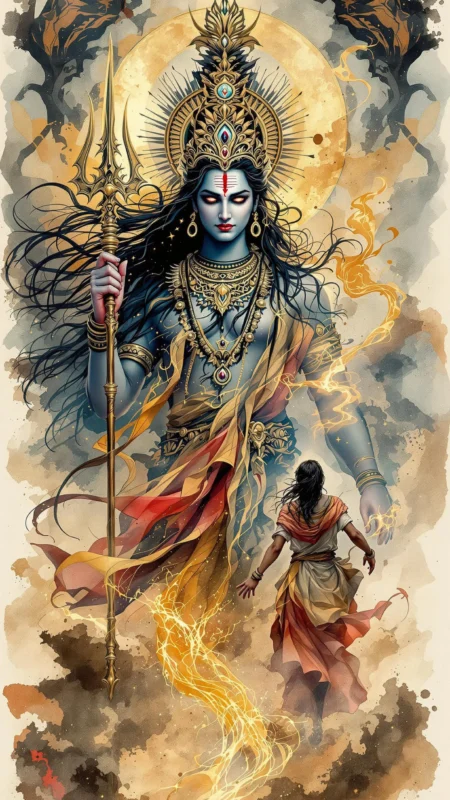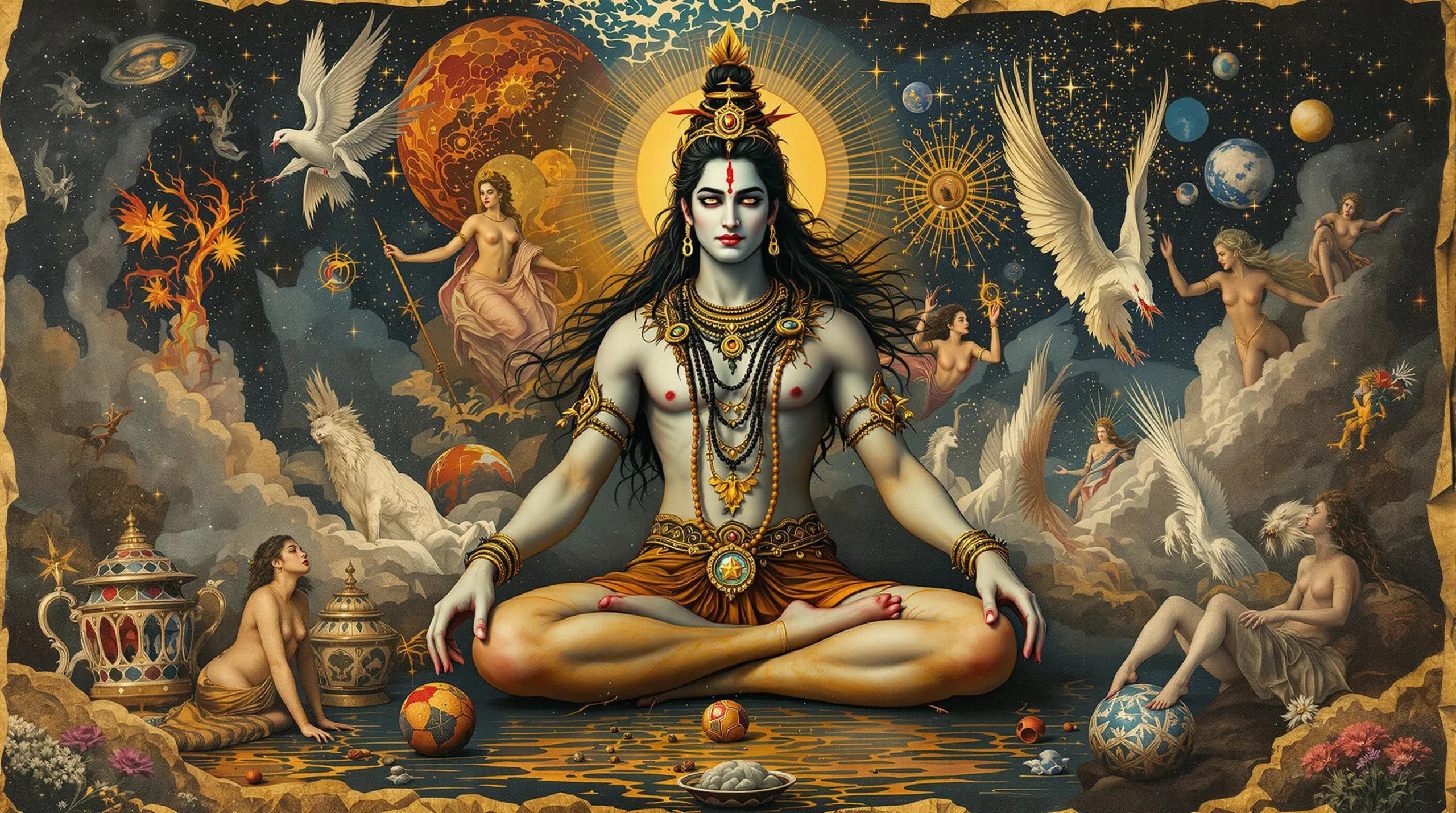


Shiva

Archetype Meaning & Symbolism

Destroyer, creator, ascetic, dancer, wild, meditative, paradoxical, fierce, compassionate, untamed

  • The universe is a drumbeat. To hear it, you must first become silent. To join the dance, you must be willing to fall.

If Shiva is part of your personal mythology, you may...

Believe

  • Endings are not failures; they are sacred acts of clearing space for the new to be born.
  • True power lies not in controlling the storm, but in becoming the calm eye at its center.
  • Stillness is not emptiness, but the plenum of all potential; the most potent action is born from profound silence.

Fear

  • The ultimate trap of stagnation, a comfortable life devoid of transformation.
  • That you will love something—a person, a creation—so much that you will be unable to let it go when its time for dissolution comes.
  • That the destructive impulse will overwhelm the creative one, leaving you with nothing but a wasteland of your own making.

Strength

  • A radical, fearless acceptance of impermanence and change.
  • A profound capacity for self-reinvention and rising from the ashes of your own life.
  • An unshakable inner peace that remains centered even in the midst of external chaos.

Weakness

  • A tendency to prematurely dismantle good situations out of a restless fear of attachment or comfort.
  • An emotional detachment that can be perceived by others as coldness, nihilism, or an inability to truly connect.
  • A difficulty engaging with the mundane but necessary work of maintenance, preservation, and long-term stability.

The Symbolism & Meaning of Shiva

To find the Shiva archetype active in your personal mythology is to find a home in paradox. He is the destroyer who is called Śhiva, the auspicious one. He is the ultimate ascetic, detached from the world, yet also the passionate lover. This isn't a contradiction to be solved, but a mystery to be inhabited. In a modern context, Shiva represents the terrifying but necessary force of creative destruction. He is the patron saint of the startup that renders an industry obsolete, the artist who shatters convention, the individual who must tear down a comfortable life to answer a deeper calling. He symbolizes the wisdom in letting go, the recognition that all forms—careers, relationships, identities, civilizations—are temporary constructs, waves in a cosmic ocean. He is the silent witness at the heart of the storm.

The symbols that adorn him become a grammar for this personal myth. The serpent around his neck is not a threat, but a mastered primal energy: desire and fear worn as an ornament. The crescent moon in his hair is a marker of time, a reminder that he is the master of its cycles, not its victim. The river Ganga flowing from his locks could be the taming of overwhelming emotional or creative force, channeled into a life-giving stream. His drum, the damaru, beats out the rhythm of creation itself, while the fire in his other hand represents the inevitable end of all that is created. To live with this archetype is to learn how to hold both the drum and the fire in the hands of your own life.

Ultimately, Shiva points to a reality beyond form. His ash-smeared body signifies the final truth of all matter: what remains after everything has been burned away. His meditative stillness is an invitation to find that which is unchanging within ourselves, the pure consciousness that observes the dance of life and death without being entangled. He suggests that true freedom isn't found in accumulating more, but in becoming so profoundly empty that the entire universe can rush in. He is the patron of the void, the god of the blank page, the silence from which the most beautiful music can be born.


Shiva Relationships With Other Archetypes

The Volcano

The relationship between Shiva and the Volcano is perhaps one of terrestrial embodiment, a geological dream of the divine. For ages, the volcano may sit as a silent, brooding mountain, a monument to stillness, its immense power held in a state of deep, magmatic meditation. This is the ascetic Shiva, withdrawn and self-contained. Yet, this quietude is merely a prelude. The eventual eruption is not an act of simple violence, but a profound expression of cosmic force—a destructive power that is simultaneously, primordially creative, birthing new islands from the sea, new earth from the planet’s fiery heart. The Volcano, in its cycle of slumber and cataclysm, could be seen as the earth’s own attempt to perform the Tandava, the slow, hot-blooded dance of dissolution and regeneration that echoes Shiva's own nature.

The Shoreline

One might view the Shiva archetype as the boundless, formless ocean—an abyss of pure potential, vast, deep, and ultimately indifferent. The Shoreline, then, emerges not as an antagonist but as a necessary partner in a cosmic dialectic. It is the principle of form, the gentle insistence of limitation, that gives the ocean its voice and its tangible power. Without the ragged line of the coast, a wave would have no place to break, its immense energy dissolving back into itself without sound or fury. The Shoreline may, in this sense, represent the manifest world, the sacred container that invites the formless to become present. It suggests, perhaps, that even the most transcendent power requires a worldly context—a relationship, a boundary, a love—to ground its dance and give its cycle of renewal a stage upon which to play out.

The Ruin

The Ruin is what remains in the quiet aftermath of the god’s passing. It is the sacred footprint left by the dance of destruction. The relationship here is not one of opposition, but of profound, echoing consequence. Where Shiva is the force that topples the cathedral or fells the empire, the Ruin is the lingering testament to that awesome power, a space that has been emptied to make way for contemplation. It is a monument to impermanence itself. Yet, it is never truly empty. In the way that wildflowers push through cracked flagstones and owls nest in a broken colonnade, the Ruin suggests that Shiva’s work is never an endpoint. It is, perhaps, a hallowed ground where one can witness the first, tender shoots of new life, proving that destruction is merely the tilling of the soil for what is to come.

Using Shiva in Every Day Life

Navigating Career Transitions:

To embody the Shiva archetype here is not to simply quit a job, but to perform a ritual burning of an old professional identity. It may involve consciously letting go of the accolades, the familiar jargon, the very shape of the self that fit that role. This act of dissolution, of accepting the void of 'what's next,' creates the sacred space required for an entirely new professional calling to emerge, one that is perhaps more authentic than the last.

Healing from a Breakup:

After a relationship ends, the tendency is to preserve memories, to cling to the ghost architecture of the shared life. The Shiva archetype invites a different path: a dance of destruction through the ruins. This could mean a cathartic clearing of objects, a willed forgetting of patterns, a transformation of shared spaces. It is the understanding that one cannot build a new temple for the self on a foundation still crowded with the monuments of a former union. The destruction is an act of love for the self that is yet to be born.

Confronting Creative Blocks:

When inspiration stagnates, the Shiva archetype suggests the block is not a lack of ideas, but an attachment to old ones. The solution, then, is a destructive act. It might mean deleting a half-finished manuscript, painting over a canvas, or dismantling a project. This is the Tandava dance in miniature: a fierce, energetic clearing of what has become stale and precious. From that cleared space, that zero point, something genuinely new has the permission to spark into existence.

Shiva is Known For

The Cosmic Dance (Tandava)

This is the famous, vigorous dance that is the source of the cycle of creation, preservation, and dissolution. It is not chaos for its own sake, but a rhythmic, purposeful energy that keeps the universe vital and moving, destroying weary forms to make way for new expressions of life.

The Third Eye

Located on his forehead, this eye of wisdom, when opened, burns away illusion, ego, and desire. It represents a state of higher consciousness beyond ordinary perception, a direct insight into the nature of reality that can be both terrifying and liberating in its clarifying power.

Asceticism and Meditation

Shiva is often depicted meditating motionlessly in the Himalayas, smeared with ash, detached from all worldly concerns. This represents the ultimate mastery over the self, the mind, and the senses, and the discovery of a profound, unshakable peace that lies within, independent of any external condition.

How Shiva Might Affect Your Personal Mythology

How Shiva Might Affect Your Mythos

When Shiva enters your personal narrative, the plot ceases to be a linear progression toward a happy ending. Your life story may no longer resemble a novel of steady development, but rather a collection of epic poems, each with its own dramatic climax and dissolution. The mythos becomes cyclical. Great fires, floods, and demolitions cease to be narrative tragedies and become crucial plot points: the necessary clearing of the set for the next act. You might see your past not as a foundation to be built upon, but as a series of skins you have shed, each one perfect for its time and necessarily discarded.

Your personal myth could be defined by its transformations. You might be the person who had three distinct careers, lived in wildly different places, and cultivated entirely separate selves, each a valid and complete chapter. The central theme of your story is not 'becoming' in the sense of accumulation, but 'being' in the sense of radical presence, followed by 'un-becoming' to allow for renewal. The heroism in your story lies not in slaying external dragons, but in having the courage to periodically turn the sword of discrimination on your own life, your own identity, and your most cherished creations, trusting that this destruction is a sacred act.

How Shiva Might Affect Your Sense of Self

Your sense of self may become profoundly fluid, less an object and more a process. If identity is a house, yours is a tent: easily dismantled, moved, and set up again in a new landscape. You might locate your 'self' not in your job title, your relationship status, or your achievements, but in your very capacity for change. This can be deeply liberating. You are not the sculpture; you are the raw marble and the chisel. This perspective might foster a deep, internal locus of control, a sense that even in total collapse, the core of you—the silent, witnessing consciousness—remains untouched.

This can also lead to a comfort with solitude that borders on the sublime. The ascetic aspect of Shiva suggests that the self is most truly found when all external distractions are stripped away. You might not fear loneliness, but actively seek it as a way to commune with your deepest nature. Your self-worth is not reflected back at you from the eyes of others, but discovered in the silent stillness of your own heart. This creates a self that is autonomous, self-contained, and perhaps a little intimidating to those who need constant external validation.

How Shiva Might Affect Your Beliefs About The World

To see through the Shiva archetype’s eye is to view the world as a grand, cosmic dance of creation and destruction, and to find it beautiful. You may see the headlines of collapse—economic, political, environmental—not as aberrations, but as the universe's rhythm made manifest. This is not a callous detachment, but a radical acceptance of the nature of reality. It is the wisdom of the forest floor, which knows that rot and decay are the very source of new life. You may find it difficult to invest in ideologies that promise permanence or utopia, seeing them as beautiful but naive attempts to freeze the river.

Your worldview may prioritize energy over form. You might be less interested in the specific structures of society and more interested in the creative and destructive energies flowing through them. You could develop a kind of cosmic patience, an understanding that even the most deeply entrenched systems will eventually crumble. This perspective fosters a deep appreciation for the ephemeral: the fleeting beauty of a sunset, the temporary intensity of a conversation, the brief lifespan of a flower. You know that their preciousness is inseparable from their impermanence.

How Shiva Might Affect Your Relationships

In relationships, the Shiva archetype could manifest as a profound, non-possessive love. You might love someone for who they are in this moment, with a full, implicit understanding that they will change, and that the relationship itself will change or end. This allows for a startling degree of freedom and authenticity within the connection. There is no need for pretense when permanence is not the goal. Relationships become sacred spaces for mutual transformation, and the end of a relationship, when it comes, may be seen not as a failure, but as a graduation, a completion of a particular dance.

However, this can create a palpable tension with conventional relationship models. The desire for stability, for predictable long-term commitment, for 'forever,' may feel alien or even threatening. You might be a deeply loving and passionate partner, but one who holds a part of themselves in reserve, a part that belongs only to the mountain peak of their own inner solitude. This can be perceived as aloofness or an inability to fully commit. You may form incredibly deep, soul-baring connections, yet struggle to participate in the day-to-day maintenance that long-term domestic partnership requires.

How Shiva Might Affect Your Role in Life

Your role in life may not be that of the builder, the maintainer, or the preserver. You might be the catalyst, the disruptor, the one who speaks the uncomfortable truth that clears the air. This could be literal: you might be an entrepreneur who upends an industry, a political activist, or a turnaround specialist. Or it could be more subtle: the friend who asks the hard question, the artist who breaks taboos, the family member who insists on dealing with the long-buried conflict. Your purpose is not to make people comfortable, but to wake them up.

This role is often a lonely one. You are the agent of change, and change is often resisted. People may be drawn to your energy and vision, but they may also fear it. You might feel that your job is to start the fire and then walk away, trusting that others will come to cook on its embers or warm their hands by its light. You may feel a deep responsibility to wield your destructive power with wisdom and compassion, understanding that you are not merely a wrecker, but a ground-clearer for a future you may not personally inhabit. Your legacy is not a monument, but a cleared space.

Dream Interpretation of Shiva

In a positive context, to dream of Shiva, his dance, or his symbols—a trident, a drum, a crescent moon—is a powerful omen of impending transformation. It may suggest that the psyche is ready to shed a major aspect of itself: a limiting belief, a painful past, an old identity. The dream could be an invitation from the deep self to embrace a necessary ending with courage and even joy. It might signal the unblocking of a massive well of creative energy, or the dawn of a profound spiritual insight. Seeing Shiva meditating could point to a newfound capacity for inner peace and detachment amidst external chaos. The dream affirms that the destruction you face or initiate is blessed, a sacred part of your growth.

In a negative light, a terrifying, wrathful, or out-of-control Shiva in a dream could symbolize a deep-seated fear of change. It may represent a part of your life that you know must end, but which you are clinging to desperately. The destructive force feels external and threatening because you have disowned it in yourself. Alternatively, it could signify that the archetype's energy is running rampant in your life: you are being reckless, nihilistic, or self-destructive. The dream is a warning that your impulse to tear down is not being balanced by consciousness or a creative vision, leading only to meaningless devastation, a scorched earth with no seeds planted for a new harvest.

How Shiva Archetype Might Affect Your Needs

How Shiva Might Affect Your Physiological Needs

When the Shiva archetype informs your being, your relationship with your body may become one of intense discipline and profound surrender. There could be a draw towards practices that push the body to its limits, not for the sake of ego, but to witness its resilience and impermanence. Fasting, long-form meditation, endurance sports, or intense yogic practices might feel like natural expressions: using the body as an alchemical vessel to burn through dross and access deeper states of consciousness. The body is not just a vehicle for living, but a laboratory for transformation.

Simultaneously, there might be a deep appreciation for the body's need for stillness and withdrawal. You may honor cycles of high energy with periods of deep rest, understanding that both are essential to the dance. Comfort with sensory quietude—the silence of a meditation hall, the emptiness of a landscape—could feel as nourishing as food. The physiological need becomes less about simple comfort and more about attunement: listening to the body's deeper rhythms and providing the extreme conditions, whether of intensity or serenity, that it needs to serve as a conduit for a larger energy.

How Shiva Might Affect Your Ideas of Belonging

The need for belonging may shift from the social to the cosmic. You might not find your tribe in a conventional community, with its shared norms and expectations. Instead, you could feel a profound sense of belonging with the universe itself, with the grand, impersonal cycle of life and death. Your people may be other outliers, fellow mystics, artists, and rebels who also feel more at home in the wilderness than in the village square. Connection is forged not through conformity, but in shared moments of raw, authentic truth.

This can be a lonely path. The feeling of being an outsider is a constant companion. You might struggle to fit into family gatherings, corporate cultures, or social clubs. The small talk and social rituals can feel hollow. Yet, this seeming isolation is paired with a paradoxical sense of universal connection. In deep meditation or a walk in a storm, you may feel more connected to the heart of existence than you ever could at a party. Belonging is not about being included, but about realizing you were never separate to begin with.

How Shiva Might Affect Your Feelings of Safety

Your need for safety may be radically redefined. Conventional security—a steady job, a mortgage, a robust savings account—could feel like a trap, a gilded cage that prevents necessary transformation. Safety is not found in building higher walls, but in knowing you can survive having no walls at all. It is an internal state, rooted in the unshakeable confidence that you can handle dissolution. You have faced the void and found not an abyss, but a wellspring of potential. This is the security of the master surfer, who finds safety not in avoiding the wave, but in their ability to ride it.

This can lead to a life that appears insecure or reckless to an outside observer. You might make choices that prioritize freedom and authenticity over stability and predictability. The feeling of safety comes from aligning with the cosmic flow, trusting that even if your world is destroyed, you have the inner resources to dance in the ruins and build anew. The ultimate safety is a deep, abiding peace with impermanence itself, a release from the fear of loss because you understand that nothing can be truly possessed in the first place.

How Shiva Might Affect Your Views of Esteem

Esteem, for you, may not be built on the praise of others or the accumulation of worldly success. It is forged in the crucible of self-confrontation. Your self-worth could be directly proportional to your courage: the courage to dismantle a life that no longer serves you, to speak a truth that will ostracize you, to sit with your own deepest fears without flinching. It is the esteem of the spiritual warrior, earned not in victory over others, but in mastery over oneself.

This means your self-esteem might be remarkably resilient to external validation or criticism. Since it is not derived from what you have or what you do, it cannot be easily taken away. It is the quiet pride of the ascetic who needs nothing, the unshakeable integrity of the dancer who moves to an inner rhythm. Your esteem comes from the knowledge that you are aligned with your deepest nature, and that you have the strength to destroy anything, even your own ego, that stands in the way of that alignment.

Shadow of Shiva

The shadow of Shiva is destruction untethered from creation. It is the nihilist who burns down the world not to clear ground for new growth, but for the sheer, cold pleasure of watching it turn to ash. This shadow manifests as a pattern of sabotaging relationships, careers, and projects just as they begin to flourish, mistaking this compulsive demolition for spiritual liberation. It is the cynical voice that whispers, 'It will all end anyway, so why bother building?' It is the anarchist of the soul, whose rebellion serves only chaos, not freedom.

This shadow can also appear as a life-negating asceticism. It is not the wise withdrawal of the meditating god, but the fearful retreat of a soul terrified of life’s messy, beautiful entanglement. It is a spiritual bypass, using a mask of detachment to avoid the hard work of love, vulnerability, and connection. This shadow Shiva builds a fortress of solitude and calls it enlightenment, starving the heart while claiming to transcend it. It is the ultimate quietism, a premature surrender to entropy that refuses to participate in the dance at all.

Pros & Cons of Shiva in Your Mythology

Pros

  • You may possess an immense resilience, able to navigate life's greatest upheavals with grace and even a sense of purpose.
  • You might have access to profound wells of creativity, as you are unafraid to destroy old forms to make way for the radically new.
  • You could cultivate a deep, unshakable sense of inner peace that is not dependent on external circumstances, praise, or success.

Cons

  • You may risk profound isolation, as your comfort with endings and your need for solitude can make it difficult to form lasting, stable bonds.
  • You might be perceived by others as chaotic, unreliable, or even cruel, as your drive to disrupt and transform can be frightening to those who value security.
  • You may struggle to find simple, consistent joy in the mundane, day-to-day aspects of life, always feeling the pull toward the next great dissolution.