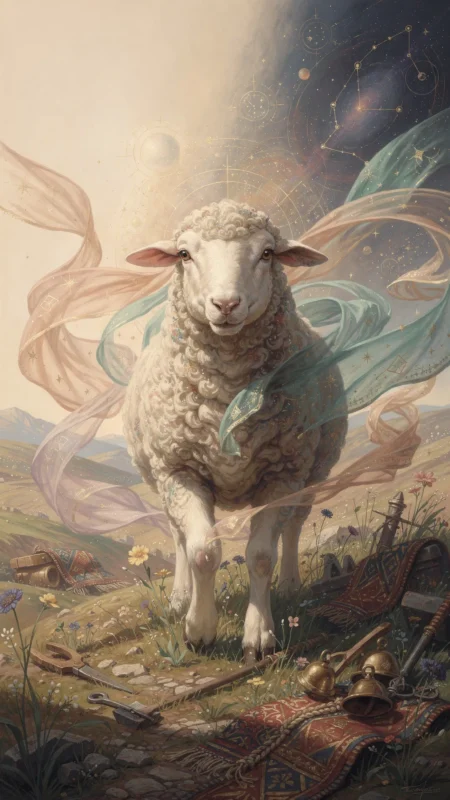
The Shepherd
The relationship between the Sheep and the Shepherd is perhaps the primal compact, a silent agreement between the vulnerable and the vigilant. The Shepherd’s call is not merely a sound but a resonant note in the very hollow of the Sheep’s being, a frequency that promises direction in a world of bewildering openness. This figure could be seen as a benevolent deity, a stern father, or simply a calculating farmer, and the Sheep may not possess the faculty or the inclination to distinguish between them. The crook, that question mark of wood and iron, might be a tool to rescue the fallen from a ravine, but it is also the instrument that hooks the neck and enforces the path. In the Shepherd, the Sheep finds a release from the terror of choice, trading a measure of its will for the promise of green pasture and the illusion of a world without wolves. It is a surrender so complete it may not even register as a loss, but rather as the finding of its proper and peaceful place.
The Wolf
The Wolf is not so much an enemy as a necessary shadow, the dark ink against which the Sheep’s white innocence is rendered visible. The relationship is one of primal, existential polarity; one is the embodiment of the collective, the other a shard of untamed solitude. But the Wolf’s threat may be the very mortar that binds the flock. The fear of its teeth is what huddles the many into a single, trembling body, transforming a loose affiliation of grazers into a community. Without the narrative of the Wolf—a story told in scent on the wind and in the sudden, electric tension of the herd—the Sheep’s life of placid consumption could lack all drama, all meaning. The Wolf is the chaos that gives form to the Sheep’s order, the wildness that makes its tameness a virtue, and perhaps, the unacknowledged author of its most cherished instinct: to stay together.
The Fence
With the Fence, the Sheep may have its most subtle and profound relationship. This is not a creature of will but a stark, unyielding principle. It is a tamed horizon, a line drawn against the terrifying poetry of the unknown. The Sheep might press against its familiar, weathered wood not with a desire to breach it, but with a need for reassurance, to feel the limits of its own safe world. The Fence could represent the comfort of dogma, the security of social convention, or the quiet relief of a life whose parameters are already set. It is both a prison and a sanctuary, and its true nature depends on a perspective the Sheep may never develop. To the world outside, it is a cage; but from the inside, it is perhaps the very architecture of peace, the silent promise that today will be much like yesterday, and tomorrow will be much the same.

 Believe
 Fear
Fear Strength
 Weakness