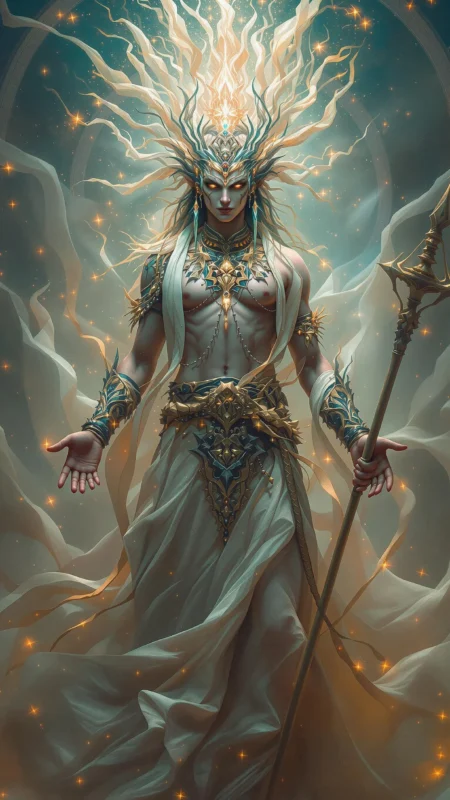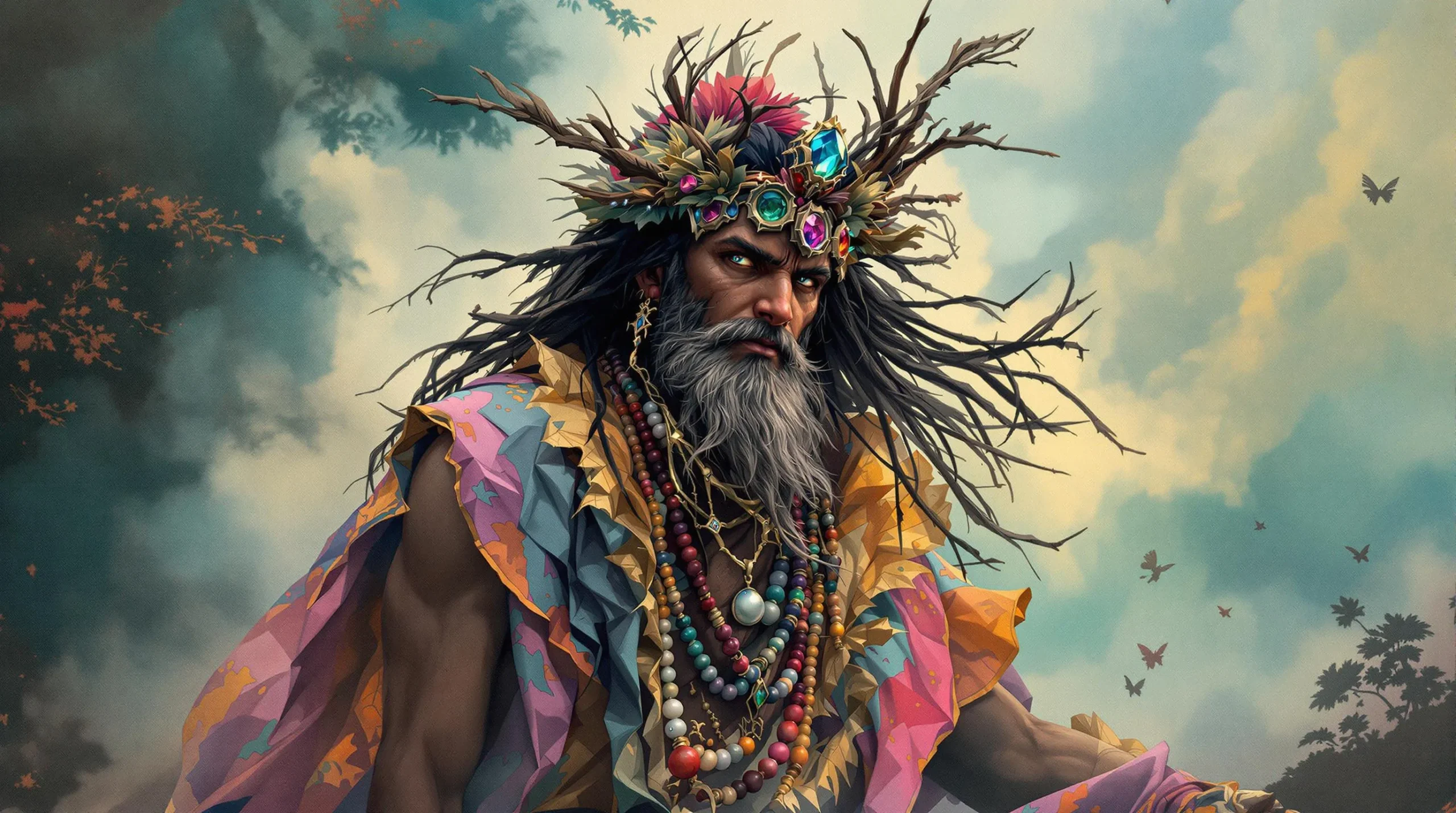


Shaman

Archetype Meaning & Symbolism

Liminal, Visionary, Healer, Eccentric, Grounded, Feral, Interpreter, Trickster, Solitary, Channel

  • The world you see is only the skin of the drum; learn to listen for the beat within.

If Shaman is part of your personal mythology, you may...

Believe

  • You may believe that everything, from a stone to a star, is imbued with consciousness and that the world is in constant communication with you, if you only learn how to listen.
  • You may believe that your deepest wounds are not liabilities but portals, sacred openings through which your greatest power and compassion can enter the world.
  • You may believe that there is a hidden order within chaos, and that the most challenging periods of life are not random punishments but deliberate initiations into a deeper level of wisdom.

Fear

  • You may hold a deep fear of losing your grounding, of your sensitivity tipping over into madness, and of being unable to distinguish the spirit world from the consensus reality.
  • You may fear that your insights and gifts will be misunderstood, dismissed, or even pathologized by a society that does not have a framework for what you experience, leading to persecution or profound isolation.
  • You may fear the very power that moves through you, worrying that it is too immense to handle, that it could harm you or others, or that the responsibility it entails is a burden you cannot carry.

Strength

  • Your greatest strength may be your profound intuition, the ability to perceive the hidden patterns, energetic dynamics, and underlying truths in any situation, person, or system.
  • You may possess an extraordinary resilience, having been tempered in the fires of personal crisis and emerged with a deep capacity to withstand and even thrive amidst chaos and transformation.
  • You may have a unique ability to hold sacred space for others, creating a container of non-judgmental presence that allows for profound healing, vulnerability, and catharsis in those around you.

Weakness

  • Your porous energetic boundaries may be a weakness, making you susceptible to taking on the pain, anxiety, and psychic debris of others, leading to burnout and confusion about what is yours and what is theirs.
  • You may have a tendency towards escapism, finding the mundane world so draining or painful that you prefer to dwell in the more exciting realms of spirit or imagination, neglecting practical responsibilities.
  • Your position as an outsider, while a source of unique perspective, can lead to chronic social isolation and a difficulty in forming relationships that can contain the totality of who you are.

The Symbolism & Meaning of Shaman

In the personal mythology of a contemporary life, the Shaman archetype often emerges not from choice but from necessity, a calling forged in the crucible of crisis. It may represent the part of you that survives a great illness, a shattering loss, or a profound disorientation, and returns with a new map of reality. This is the aspect of the psyche that refuses to accept a purely material explanation for existence, insisting on the presence of soul, of unseen connections, of a living, breathing cosmos. The Shaman symbolizes the power to find medicine in the poison, to see the wound not as a defect but as a doorway through which a deeper wisdom can enter. It is the courage to sit with chaos and listen for its hidden language.

This archetype speaks to a unique kind of knowing: an embodied, intuitive intelligence that resides in the bones and the blood, not just the intellect. For you, it could mean that your sensitivity is not a weakness but a finely tuned perceptual tool. It suggests that your strangeness, your inability to fit neatly into society’s boxes, is the very source of your power. The Shaman’s journey is one of dismemberment and remembering, of being taken apart by life and then reassembled into something more whole, more potent. It is the archetype of the masterful Kintsugi artist, who knows the gold used to mend the broken pot makes it more beautiful and valuable than it was before.

To have the Shaman in your personal mythos is to be tasked with bridging worlds: the world of spreadsheets and the world of synchronicity, the boardroom and the dreamscape, the mundane and the magical. You may be the one in your family or workplace who senses the unspoken emotional currents, who can diagnose the 'sickness' in a system that others ignore. This role asks you to trust what you perceive in the shadows, to honor the wisdom of dreams, and to find the sacred in the cracks of the ordinary. It is a path that demands both grounding in earthy reality and the courage to fly into the vastness of spirit.


Shaman Relationships With Other Archetypes

The Trickster

The Shaman and The Trickster are cousins of chaos, dancing on the edge of order. While the Shaman seeks to restore balance, The Trickster arrives to shatter it, revealing the absurdity and fragility of the structures the Shaman works within. For a person embodying the Shamanic path, The Trickster may appear as a disruptive event or a person who upends their carefully constructed spiritual worldview, forcing a necessary evolution. The Trickster's pranks prevent the Shaman from becoming too self-serious or dogmatic, reminding them that the universe is not only sacred but also profoundly playful and unpredictable. It is the coyote that steals the sacred rattle, forcing the Shaman to learn to make music with their own voice.

The Hermit

The Hermit is a kindred spirit, a fellow traveler in the landscapes of the interior world. Both archetypes understand the necessity of withdrawal and solitude. However, their purpose diverges. The Hermit withdraws for the purpose of self-knowledge, to tend to their own inner light. The Shaman withdraws to gather power, to commune with guides, and to find the healing needed for the community. The Hermit's cave is a destination; the Shaman's is a base camp from which they journey and to which they must return with a boon for the tribe. In one's life, the pull between these two may represent the tension between personal enlightenment and communal responsibility.

The Wounded Healer

The Wounded Healer is the Shaman in chrysalis. The journey of the Shaman often begins with a profound wound—a physical illness, a psychological crisis, or a spiritual emergency—that casts them out of ordinary life. It is through the process of navigating their own suffering that they acquire the empathy and knowledge to guide others. The wound is the initiation. It creates the opening through which power can flow. A person with the Shaman archetype in their mythos doesn't heal *despite* their wounds; they heal *through* them. Their scars become a testament to survival and a map for others lost in similar darkness.

Using Shaman in Every Day Life

Navigating a Career Crisis

When the map of a conventional career path dissolves into meaninglessness, the Shaman archetype may guide you not with a new map, but with a compass attuned to soul-work. It encourages a descent into the unknown: a period of fallow uncertainty where you might listen to the rhythms of your own energy, observing what truly nourishes you versus what society prescribes. This could manifest as leaving a corporate job to apprentice with an herbalist, or integrating mindfulness practices into a leadership role, transforming the 'what' of your work by radically changing the 'how'.

Healing Intergenerational Wounds

The Shaman understands that a family is a living system, with its own ghosts and unseen allegiances. When confronting familial conflict or inherited trauma, this archetype offers a perspective that transcends individual blame. It may compel you to become a pattern-breaker, to witness the unspoken pain carried by your ancestors and choose a different response. This isn't about grand confrontation, but perhaps about quiet rituals: lighting a candle for a forgotten relative, or consciously refusing to participate in a long-standing, toxic communication style, thereby healing the energetic web of the family line.

Overcoming a Creative Impasse

When faced with a blank canvas or a silent instrument, the Shaman archetype suggests that the source of creation lies not in the conscious mind but in the wilder territories of the psyche. This may mean engaging in practices that alter consciousness: not necessarily through substances, but perhaps through rhythmic dancing, fasting, or spending a night alone in nature. The goal is to bypass the internal critic and become a channel for what wants to be born, allowing images, melodies, or words to emerge from a place that feels both deeply personal and mysteriously universal.

Shaman is Known For

Journeying

This is the practice of intentionally entering an altered state of consciousness to travel to unseen realms. In a modern mythos, this may not be a literal flight but a deep dive into the subconscious through meditation, dreamwork, or intense creative focus to retrieve insight and forgotten parts of the self.

Healing

The Shaman is a conduit for restorative energy, seeking to bring a person or a system back into balance. This could be the friend who knows exactly what to say to soothe a psychic wound, the therapist who sees the root of a complex, or the artist whose work provides catharsis for a community.

Intermediary

A walker between worlds, the Shaman translates the wisdom of the spirit world—the unconscious, the mythic, the natural—into the language of the human world. They might find profound metaphors in the flight of a bird or see the symbolic story playing out in a corporate boardroom.

How Shaman Might Affect Your Personal Mythology

How Shaman Might Affect Your Mythos

When the Shaman enters your personal narrative, your life story may cease to be a linear progression and transform into a spiral, marked by cycles of descent, ordeal, and return. Major life challenges—illness, heartbreak, career collapse—are no longer seen as mere misfortunes but as initiatory crises, crucibles designed to burn away the non-essential and awaken a deeper purpose. Your mythos becomes a tale of 'soul-retrieval,' a continuous journey to reclaim lost parts of yourself from the underworld of trauma, conformity, and fear. You are the hero who travels not to slay the dragon, but to understand its language and learn what treasure it guards.

The narrative becomes populated with non-human guides: a recurring dream animal, a particular landscape that feels alive and communicative, a synchronicity so precise it feels like a wink from the cosmos. Your story is no longer yours alone; it is interwoven with the stories of your ancestors, the land you inhabit, and the archetypal currents that flow through the collective. You may see your personal struggles as a microcosm of a larger cultural or planetary healing that needs to happen, and your journey as one small but vital part of that great work.

How Shaman Might Affect Your Sense of Self

Integrating the Shaman archetype may radically alter your self-concept, shifting it from a solid, defined ego to something more fluid and porous. You might begin to see yourself less as a 'doer' and more as a 'channel' or a 'hollow bone,' a vessel through which insight, creativity, and healing energy can move. This can be both liberating and disconcerting. Your identity is no longer solely defined by your job title, relationships, or achievements, but by your connection to this deeper, wilder current of life. Eccentricities you once saw as flaws might be re-contextualized as essential parts of your toolkit.

This archetype may also foster a profound intimacy with your own shadows. Instead of banishing difficult emotions or painful memories, you may feel called to 'journey' to them, to meet them with curiosity and respect, and to listen for the wisdom they hold. This leads to a form of self-acceptance that is not passive, but radically active. It is the understanding that wholeness does not mean perfection, but rather the integration of all parts of your being: the light and the dark, the human and the mythic, the sane and the 'mad.'

How Shaman Might Affect Your Beliefs About The World

Your perception of the world may shift from seeing it as an inanimate collection of resources to a living, intelligent, and responsive field of consciousness. The line between the inner world of thought and the outer world of events becomes permeable. You might start to perceive meaning in coincidence, language in the weather, and personality in a landscape. This is the animistic worldview of the Shaman: the understanding that everything is alive and interconnected, and that communication is possible between all things.

This perspective could dismantle the illusion of separation. A problem in your community is not 'out there'; it is also 'in here,' a reflection of an imbalance within the collective psyche. Healing the environment becomes indistinguishable from healing oneself. This worldview fosters a deep sense of embeddedness and responsibility. It's a reality where a prayer is a form of psychic technology, an apology can heal an energetic rift, and the most powerful action one can take is to restore a small piece of the world—a relationship, a garden, one's own body—to a state of balance and wholeness.

How Shaman Might Affect Your Relationships

The Shaman archetype may profoundly deepen and complicate your relationships. You may find yourself drawn to a level of authenticity and soul-baring intimacy that can be unsettling for those accustomed to more superficial connections. You might become the unofficial 'seer' of your social circle, the one who perceives the unspoken dynamics, the hidden grief, or the latent potential in others. This can be a gift, allowing you to offer profound support, but it can also be a burden, as you may absorb the energetic 'static' of others if your own boundaries are not strong.

You may feel a sense of 'tribe' that transcends blood ties or social convenience, gravitating towards others who also walk a path of awareness and service, fellow 'walkers between worlds.' Relationships become less about mutual entertainment and more about mutual evolution. However, this can also lead to periods of intense loneliness, as the path of the Shaman is often a solitary one, and finding those who can truly meet you at your depth may be rare. You may have to learn the difference between being a healer for your loved ones and becoming an enabler of their refusal to do their own work.

How Shaman Might Affect Your Role in Life

This archetype may cast you in a role you did not consciously choose, one that carries a heavy, albeit meaningful, sense of responsibility. You may feel like a caretaker of the 'soul' of your family, your workplace, or your community. This isn't about formal leadership but about holding a certain energetic space, being the person who remembers the importance of ritual, tells the difficult truths, or advocates for a more humane and holistic approach. You might be the one who organizes a memorial for a laid-off colleague or who senses when the collective morale is 'sick' and needs tending.

The role can feel paradoxical. You might be central to the well-being of the group, yet always remain something of an outsider. Your perspective, drawn from the 'edge,' is valuable precisely because it is different from the consensus view, but this difference can also be isolating. Your life's work may not be a job but a calling, a sacred duty to mend the tears in the fabric of community and to remind others of the sacred dimension of life, a role that offers little in the way of conventional reward but immense soul-level satisfaction.

Dream Interpretation of Shaman

To dream of the Shaman, or of performing shamanic acts, in a positive context, is often a powerful call from the psyche to embrace your innate wisdom and healing abilities. It may signal that you are ready to move to a new level of self-awareness, to integrate fragmented parts of yourself, or to step into a role of greater service in your community. The dream could be an affirmation, validating your intuitive hunches or your unconventional path. It might offer a specific symbol—an animal, a tool, a song—as a gift of power, a resource to be brought back into your waking life to help you navigate a current challenge. It is an invitation to trust the unseen and your ability to navigate it.

In a negative context, a dream of a threatening or incompetent Shaman could be a warning from your subconscious. It may point to a dangerous inflation of the ego, where you are claiming spiritual authority without having done the necessary shadow work—the shadow Shaman or charlatan. Alternatively, it might signify a fear of your own power, a sense that the forces you are beginning to connect with are overwhelming and could lead to a loss of grounding or sanity. It could also represent a part of you that is engaging in 'spiritual bypassing,' using spiritual concepts to avoid dealing with difficult, messy human emotions and realities. The dream is a caution: ground yourself, check your motives, and respect the power you are touching.

How Shaman Archetype Might Affect Your Needs

How Shaman Might Affect Your Physiological Needs

When the Shaman archetype is active, your physiological needs may become deeply intertwined with ritual and connection to the natural world. The need for food might transform into a conscious practice of receiving life force, where you feel a palpable connection to the plants and animals that sustain you, making you sensitive to processed foods that feel 'dead' or energetically inert. Your body is not a machine but a sacred vessel, and you may feel a physiological pull to nourish it with intention, perhaps finding that certain herbs or whole foods have a noticeable effect not just on your physical health but on your mood and spiritual clarity.

Rest and sleep may also take on a shamanic dimension. The need for sleep is not just for physical repair but for 'journeying'—a time when the soul travels, processes information, and receives guidance. You might find that your body requires periods of profound quiet and darkness, not just nightly sleep, to recalibrate your sensitive nervous system. The cycles of the moon, the seasons, and even the time of day may have a more pronounced physiological effect on you, as your body attunes itself to the larger rhythms of the cosmos. Bodily sensations—a gut feeling, a prickling on the skin—are not random noise but a primary form of communication from the wider web of life.

How Shaman Might Affect Your Ideas of Belonging

The need for belongingness, through the lens of the Shaman, is a profound paradox. You may feel an oceanic sense of belonging to everything—the earth, the cosmos, all of humanity—while simultaneously feeling like an exile from every specific group you encounter. Your truest tribe might not be defined by shared background or interests, but by a shared way of seeing. You belong with the other listeners, the pattern-seers, the edge-walkers. Finding these individuals can be a lifelong quest, and the feeling of recognition when you do is a powerful homecoming.

Love and intimacy may be sought as sacred acts of soul-recognition. You might yearn for a partner who can meet you not just on the physical and emotional planes, but on the spiritual and mythic ones as well. This is a desire for a 'fellow traveler,' someone with whom you can explore the mysteries without fear of judgment. While this deep connection is the ultimate form of belonging, its rarity can create a profound sense of loneliness. You may have many loving relationships, but still feel that the core of your being, the part that communes with spirits and dreams, is seen by very few. Your task is to learn to belong to yourself and to the wild, invisible world first and foremost.

How Shaman Might Affect Your Feelings of Safety

Your sense of safety may undergo a profound redefinition. The conventional bulwarks of safety—a steady job, a locked door, a robust stock portfolio—might feel strangely inadequate. Instead, true safety may be found in your ability to read and harmonize with the underlying energetic realities of a situation. You feel safe not when you are insulated from the world, but when you are deeply attuned to it. This means developing a powerful intuition that alerts you to danger, be it a person with hidden intentions or a place with a history of sorrow. Your safety lies in your awareness.

However, this same sensitivity can make you feel profoundly unsafe in environments that others find normal. A fluorescent-lit office with a toxic emotional atmosphere, a crowded mall filled with anxiety, or a conversation rife with unspoken resentment might feel like a genuine physical threat to your system. Your need for safety, therefore, involves creating energetic as well as physical boundaries. It might mean learning techniques for psychic shielding, regularly clearing your energy field through practices like smudging or time in nature, and being fiercely selective about who and what you allow into your personal space. Safety is an active, ongoing practice of energetic hygiene.

How Shaman Might Affect Your Views of Esteem

Esteem, for one with an active Shaman archetype, is rarely derived from external validation or social status. Applause from an audience that doesn't understand the depth of your journey may feel hollow. Instead, your self-esteem is forged in the underworld. It is built from the successful navigation of your own dark nights of the soul, from the times you faced a terrifying truth and did not flinch, from the moments you retrieved a lost piece of your own soul. Your esteem is sourced from your effectiveness as a conduit: did the healing work? Did the insight land? Did the creative act feel true?

This creates a resilient but often invisible sense of self-worth. It is the quiet confidence of knowing you can sit in the fire of transformation—your own or another's—and hold your center. Esteem is tied directly to your integrity and your connection to 'source.' It grows every time you trust your intuition over the consensus, every time you honor a message from a dream, and every time you use your unique gifts in service to life. It is the esteem that comes not from being liked, but from being aligned with your soul's purpose.

Shadow of Shaman

The shadow of the Shaman manifests as the charlatan, the fraudulent guru. This is the individual who co-opts the language and aesthetics of spirituality for personal gain: power, wealth, or adoration. They may possess a genuine psychic gift but use it to manipulate and control rather than to heal and empower. The shadow Shaman fosters dependency in their followers, positioning themselves as the sole intermediary to the divine, a tollbooth on the road to enlightenment. They speak of wholeness while feeding on the brokenness of others, their charisma a mask for a deep internal void. This shadow aspect is a warning against spiritual materialism and the ego's cunning ability to turn even the most sacred tools into weapons of self-aggrandizement.

A different, more tragic shadow emerges when the Shaman is all wound and no healer. This is the individual who is permanently lost in the spirit world, ungrounded and unable to function in everyday reality. They may be addicted to ecstatic states, perpetually seeking transcendence to escape their unresolved trauma. They have journeyed to the underworld but have never completed the return. They have the map but cannot read it for themselves, let alone for others. This aspect of the shadow speaks to the profound danger of undertaking the shamanic journey without adequate integration, mentorship, and a deep, humble connection to the earth and the messy, beautiful reality of being human.

Pros & Cons of Shaman in Your Mythology

Pros

  • You may possess access to a wellspring of profound, non-linear wisdom that allows you to solve problems and see possibilities that are invisible to a purely rational mind.
  • You may live with a deep and abiding sense of purpose, feeling that your life, with all its strange turns and difficulties, is part of a meaningful and sacred story.
  • You may be a powerful catalyst for positive change, capable of facilitating deep healing and transformation for the individuals, communities, or systems you are a part of.

Cons

  • The path can be intensely lonely, as your experiences and perceptions may be difficult for others to understand, leaving you feeling like a permanent outsider.
  • You may be highly susceptible to psychological distress, burnout, and nervous-system overload due to your extreme sensitivity to the energetic and emotional states of others and the world at large.
  • You may be misunderstood, dismissed, or even feared by conventional society, which can create challenges in maintaining stable careers, family relationships, and a sense of belonging in the mainstream world.