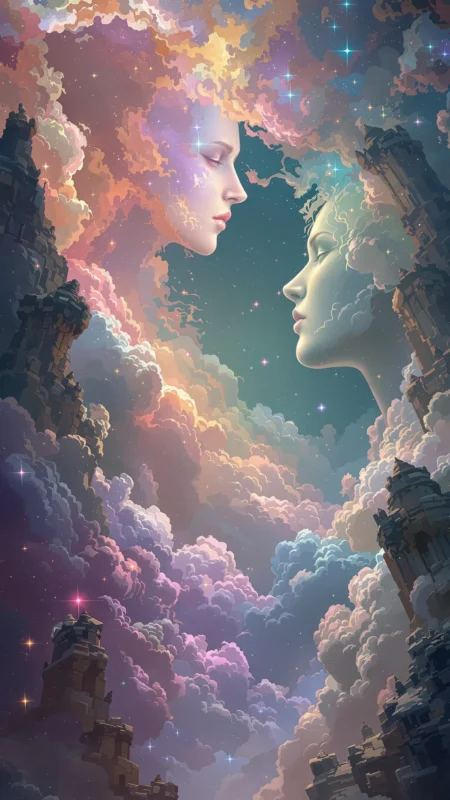


Shadow Realm

Archetype Meaning & Symbolism

Subconscious, repressed, potential, mysterious, feared, primal, intuitive, formless, deep, fertile

  • Come look where you dare not. All that you discard, I keep. It is the only soil from which true things can grow.

If Shadow Realm is part of your personal mythology, you may...

Believe

  • True wholeness is not about eliminating the darkness, but about integrating it into a more complete and complex light.

  • What we repress or deny in ourselves ultimately gains power over us, running our lives from the shadows.

  • The most profound creativity, wisdom, and compassion can only be found by courageously engaging with the uncomfortable, unknown, and rejected parts of the self.

Fear

  • That if you were to fully acknowledge the contents of your Shadow Realm, you would be consumed by them, losing control to your most destructive impulses.

  • That the darkness within you makes you fundamentally monstrous, flawed, or unlovable to others.

  • Becoming lost in endless, morbid introspection, unable to enjoy the simple, bright surfaces of life.

Strength

  • Profound psychological insight and a deep understanding of human nature, both in yourself and others.

  • Access to a deep wellspring of creativity, as you can draw from the full, uncensored spectrum of human experience and emotion.

  • A resilient and authentic sense of self, one that is not easily shattered by criticism or failure because it is built on radical self-acceptance.

Weakness

  • A tendency towards melancholy or cynicism, as you are perpetually aware of the darker undercurrents of life.

  • The risk of projecting your unacknowledged shadow traits onto other people, unfairly blaming them for the darkness you refuse to see in yourself.

  • You may struggle to act decisively or to enjoy simple pleasures, sometimes getting bogged down in the complex analysis of hidden motives and potential downsides.

The Symbolism & Meaning of Shadow Realm

In the personal mythos, the Shadow Realm is the unlit continent within. It is not merely a basement for our villainous impulses, but rather the fertile, chaotic soil from which our most authentic selves might grow. It represents the radical idea that wholeness is not achieved by purging our darkness, but by integrating it. This realm is the home of the unlived life, the selves we could have been had we made different choices, and they wander its corridors, waiting for an invitation to speak. To have this archetype as a central feature of your story is to be perpetually engaged in a dialogue with what is hidden, to believe that your most profound wisdom is whispered from the parts of you that you have been taught to silence.

The symbolism of this inner landscape is deeply personal and ever-shifting. For one, it may be a submerged city, holding the Atlantis of their childhood dreams and traumas. For another, it could be a tangled wood where feral, instinctual parts of the self live free from the strictures of civilized thought. The Shadow Realm challenges the modern obsession with transparency and curated perfection. It suggests that a life lived entirely in the light is a life of surfaces, lacking depth and resonance. Its presence in one’s mythology is a testament to the courage required to look away from the sun, to adjust one’s eyes to the gloom, and to find the unexpected beauty in the monochrome palette of the soul's twilight.

Ultimately, this realm symbolizes potentiality itself. It is the quantum field of the psyche, where everything you are not (yet) exists in a state of possibility. It is the source code of your personality, containing all the raw data that has been edited out of the final, public-facing program. Engaging with the Shadow Realm is an act of profound self-creation. It is the process of reclaiming raw material—the anger, the grief, the forbidden joy—and consciously choosing what to build with it. It is the understanding that the most magnificent statues are carved from the same dark, unformed stone that others simply discard.


Shadow Realm Relationships With Other Archetypes

The Sovereign:

The Sovereign who denies the existence of a Shadow Realm in their kingdom is a tyrant ruling over a brittle facade. Their true measure is their relationship with this unseen territory. A wise Sovereign knows the whispers in the alleys, the discontent in the taverns, the desperation behind closed doors. They understand that the kingdom's shadow—its poverty, its secrets, its corruption—is part of the whole. To integrate it is not to condone it, but to acknowledge it, to bring its truths into the light of the court. A Sovereign who can walk in their kingdom’s Shadow Realm without fear is one who cannot be easily deposed, for their power is rooted in the complete reality of their domain, not just the polished cobblestones of the main square.

The Inner Child:

Often, the Inner Child is a primary resident of the Shadow Realm, having been exiled there when its expressions of vulnerability, rage, or exuberant joy were deemed 'too much' for the adult world. It may not be a gleeful child, but a ghost, haunting the psyche with unmet needs and unhealed wounds. The journey into the Shadow Realm, then, becomes a rescue mission. The goal is to find this lost child, not to scold it or force it into the light, but to sit with it in the dark, to listen to its story, and to assure it that it is finally safe to feel what it feels. The integration of the Inner Child from this realm could be the source of renewed creativity, playfulness, and emotional authenticity.

The Explorer:

While The Explorer is often imagined scaling mountains or crossing oceans, their most perilous and rewarding journey may be the cartography of their own Shadow Realm. Here, the compass spins wildly, and the maps are written in the forgotten language of symbols and dreams. The Explorer in this context is a psychonaut, a brave adventurer of the interior. The monsters they face are not external beasts but their own disowned impulses. The treasures they discover are not gold, but shards of piercing self-knowledge. This relationship redefines adventure: the final frontier is not outward, but inward, and the most courageous act is to chart the darkness within oneself.

Using Shadow Realm in Every Day Life

Navigating Creative Stagnation

When the well of ideas runs dry, you might consciously decide to journey into your personal Shadow Realm. This is not an act of force, but of listening. It could involve automatic writing, dream journaling, or engaging with art that makes you uncomfortable. The goal is to retrieve the discarded fragments: the 'silly' idea, the 'shameful' desire, the 'irrational' image. These are the phosphorescent ores in the deep mine, capable of illuminating an entirely new creative path, one that feels dangerously, thrillingly authentic.

Understanding Compulsive Behavior

A recurring habit you wish to change, from procrastination to a specific social anxiety, could be viewed as a creature native to your Shadow Realm. Instead of fighting it on the surface, you may choose to understand its origins in the dark. Perhaps the procrastination monster guards a deep fear of failure. Perhaps the social anxiety is the ghost of a past humiliation. By metaphorically sitting with this creature and learning its story, you may not vanquish it, but integrate its energy, transforming a compulsion into a conscious choice or a source of self-knowledge.

Deepening Intimacy

In a relationship, when a conflict feels intractable, it may be that the issue resides in the shared Shadow Realm of the partnership. This is the space of unspoken fears, resentments, and assumptions. To enter it together requires immense trust. It could mean asking the questions you are both afraid to voice: 'What part of me do you secretly resent?' or 'What is the one truth we never speak?' This intentional descent can feel perilous, but it is often the only way to find the buried treasure of profound, resilient intimacy, forged in the acceptance of each other’s complete selves, shadows and all.

Shadow Realm is Known For

Repository of the Repressed

This realm is the vast, unseen archive of the psyche. It holds every impulse, memory, desire, and trait that has been deemed unacceptable, inconvenient, or dangerous by the conscious mind and the culture it inhabits. It is the silent curator of all that has been pushed away.

Source of Untapped Potential:

Within the darkness lies dormant power. The Shadow Realm may contain the courage you disowned for being 'reckless,' the artistic talent you dismissed as 'impractical,' or the raw ambition you were taught to suppress. It is the sleeping dragon guarding the hoard of your future capabilities.

The Landscape of Initiation:

Mythically, this is the underworld, the labyrinth, the dark forest. It is the place one must journey through to undergo a fundamental transformation. True growth, within this framework, is not an ascent into the light but a descent into darkness to retrieve a lost part of the soul, returning forever changed.

How Shadow Realm Might Affect Your Personal Mythology

How Shadow Realm Might Affect Your Mythos

When the Shadow Realm is a significant geography in your personal mythos, your life story ceases to be a linear progression towards success or enlightenment. Instead, it becomes a cyclical narrative of descent and return. The most pivotal moments, the true turning points, do not happen on the brightly lit stage of public life, but in the quiet, subterranean chambers of the self. Your mythos may be marked by periods of withdrawal, deep introspection, or even depression, which are not seen as failures but as necessary initiatory journeys. You are the hero who must periodically go into the underworld, not to slay a monster, but to consult an oracle, retrieve a lost artifact of your own soul, or simply to understand the roots of the world tree that is your life.

This archetype reframes your antagonists and obstacles. They may be less a series of external villains and more the personifications of your own unacknowledged shadows. A difficult boss might become the embodiment of your repressed ambition; a recurring pattern of failed relationships could be the work of a saboteur who lives in your psychic depths, terrified of intimacy. Your mythos, therefore, is not about conquering the world, but about achieving a state of inner diplomacy. The great quest is to create a truce, and eventually an alliance, between the conscious self and the vast, often frightening, populace of your own Shadow Realm.

How Shadow Realm Might Affect Your Sense of Self

Your perception of self may be one of profound, and at times burdensome, complexity. You might not identify with a simple, stable persona, but see yourself as a dynamic ecosystem of competing, often contradictory, forces. There is the self you present to the world, and then there is the vast, unseen reality of the self that lives in the shadow. This can foster a deep sense of humility, an awareness that you can never fully know your own motivations. It could also lead to a quiet confidence, one not born of arrogance, but of the self-knowledge that comes from having navigated your own difficult inner terrain. You have met your own monsters, and so you are less afraid of them.

This can also cultivate a state of perpetual self-inquiry. You might find it difficult to accept simple answers about who you are. Instead of saying 'I am a kind person,' you might think, 'I am a person who contains both immense kindness and its opposite, and I consciously choose which to act upon.' This creates a rich, nuanced, and highly responsible sense of self. It is the opposite of a fragile identity that shatters when a 'negative' trait is exposed. Your sense of self may be more like a kintsugi bowl, its integrity and beauty found not in its flawless perfection, but in the golden seams where it has been broken and consciously repaired.

How Shadow Realm Might Affect Your Beliefs About The World

Your worldview could be one that instinctively distrusts surfaces and searches for the hidden machinery beneath. You may see the world not as a collection of facts, but as a tapestry of narratives, with the most important threads being the ones that are invisible. Politics, social movements, and cultural trends are not taken at face value; you might always be asking, 'What is the shadow of this? What is being repressed or denied for this bright image to exist?' This perspective sees society itself as having a collective Shadow Realm, a repository of its historical crimes, its systemic injustices, and its unspoken anxieties. You may believe that a society, like a person, can only be healthy to the extent that it is willing to confront this collective shadow.

This can lead to a worldview that is less judgmental and more compassionate, albeit in a way that can look like cynicism to others. You may understand that the most outwardly virtuous people and institutions have deep shadows, and that those who are demonized often carry the projected shadows of the collective. This is a worldview of radical non-duality: light and dark are not warring opposites but inextricable partners in the dance of reality. Progress is not about eliminating darkness, but about integrating more and more of it into conscious awareness. The world is not a problem to be solved, but a mystery to be endlessly, and respectfully, explored.

How Shadow Realm Might Affect Your Relationships

In relationships, you may be drawn to depth and authenticity above all else. You might find superficial connections profoundly unsatisfying, as you are acutely aware of the unsaid and the unseen that exists between two people. Your friendships and partnerships could be spaces where both parties feel safe enough to reveal their shadow aspects without fear of rejection. You may be the person to whom others confess their secrets, not because you are a gossip, but because you project an aura of non-judgment, an implicit understanding that everyone has a Shadow Realm. You might believe that true love is not about finding a perfect person, but about having the courage to tend to the imperfect, sometimes frightening, garden of a shared inner world.

However, this focus on the shadow can also create challenges. You may be prone to projecting your own unacknowledged traits onto your partners, seeing in them the anger or neediness you deny in yourself. There could be a tendency to 'dig' for problems where none exist, to mistake simple quiet for hidden resentment. The challenge is to balance the awareness of depth with the ability to enjoy the simple, sunlit surfaces of a relationship: the easy laughter, the shared meal, the uncomplicated moment. The goal is to be a skilled navigator of the relational underworld, not a permanent resident.

How Shadow Realm Might Affect Your Role in Life

You may feel that your role in life is not to be a beacon of light, but a keeper of the dark. This does not mean you are a negative or destructive force; rather, you may be a guide, a therapist, an artist, a writer, or a trusted friend who helps others navigate their own Shadow Realms. Your purpose could be to hold space for the difficult, the uncomfortable, the grieving parts of the human experience that society often prefers to ignore. You are the one who is not afraid to sit with a friend in their sorrow without trying to 'fix' it, or the artist whose work gives voice to a collective, unspoken anxiety. You may see your role as that of a soul-retriever, one who journeys into the depths to bring back lost and vital parts of the human spirit.

This could also manifest as a role of a truth-teller or a bullshit-detector. Because you are so attuned to the hidden and the unsaid, you may be the one in a family or an organization who points out the 'emperor has no clothes.' This is not always a comfortable or popular role. It can be isolating to be the one who sees the shadow of a beloved leader or the denial at the heart of a company's mission statement. Yet, from the perspective of your personal mythos, this role is essential. You are a guardian of wholeness, and your work is to remind the world of the parts of itself it has chosen to forget.

Dream Interpretation of Shadow Realm

In a positive context, dreaming of the Shadow Realm—a cave, a dark ocean, a labyrinthine basement—may be an invitation from your psyche to engage with your untapped potential. The dream is not a threat, but a summons. Meeting a frightening figure in this realm could symbolize an opportunity to integrate a powerful, disowned part of yourself, like your anger or ambition. Finding a lost object or a hidden treasure in such a dream may signify the reclaiming of a forgotten talent or a crucial piece of self-knowledge. These dreams suggest you are ready for a new level of self-awareness and that the energy for your next stage of growth lies in the territory you have, until now, been afraid to explore.

In a negative context, a dream of the Shadow Realm can feel terrifying and overwhelming. Being chased by an unseen entity, getting lost in endless dark corridors, or drowning in murky water might indicate that your repressed contents are becoming volatile and are threatening to overwhelm your conscious control. Such a dream may be a warning sign that you are living too superficially and ignoring crucial psychological work. It could reflect a mounting anxiety, a trauma that needs to be addressed, or the consequences of profound inauthenticity in your waking life. The dream is a cry for help from the deepest part of yourself, urging you to turn and face what you have been running from.

How Shadow Realm Archetype Might Affect Your Needs

How Shadow Realm Might Affect Your Physiological Needs

When the Shadow Realm archetype is strong, your physiological needs may be seen as direct communiques from the body's deep intelligence. A sudden wave of exhaustion is not just a need for sleep, but a summons from the subconscious to cease conscious striving and enter a state of receptive darkness for repair and integration. You might interpret illness not merely as a mechanical failure, but as a somatic expression of a psychic truth that has been ignored. The body becomes a landscape, and its aches, pains, and cravings are the terrain's way of communicating. The need for food could be felt as a need to ground oneself, to literally incorporate the earth to balance a flight into mental abstraction.

This perspective fosters a deep, almost mystical connection to the body's rhythms. The digestive system could be seen as its own alchemical laboratory, transmuting the outer world into the inner self, a process mirrored in the psyche's digestion of experience. Rest, in this view, is a sacred act, a necessary descent. You might prioritize solitude and silence, understanding that the nervous system needs regular visits to a place of non-stimulation to process the vast data it absorbs. Your physical well-being becomes inextricably linked to your psychological willingness to honor the dark, quiet, and hidden phases of life.

How Shadow Realm Might Affect Your Ideas of Belonging

A sense of belonging might be elusive for you in conventional settings. You could feel like an outsider at cheerful, surface-level gatherings, acutely aware of the undercurrents of unspoken tension and buried feelings that others seem to ignore. Your tribe is not defined by shared interests, but by a shared willingness to be authentic. You may find your deepest sense of belonging with the artists, the mystics, the therapists, the recovering addicts—anyone who has made the journey into their own Shadow Realm and returned. Love, for you, is not just about mutual admiration, but about the mutual courage to witness and accept each other's complete, unedited selves.

This can lead to a few profound, incredibly deep connections rather than a wide circle of casual acquaintances. You might believe that intimacy is forged in the dark. It is the moment when a friend confesses a shameful secret and is met not with judgment but with a quiet 'me too.' It is the partner who can see your worst traits and love you not in spite of them, but because they understand those traits are part of a larger, complex whole. Belonging is the relief of taking off the mask and discovering you are still welcome. It's the quiet communion of fellow travelers who know the map of the underworld is written on the heart.

How Shadow Realm Might Affect Your Feelings of Safety

Your need for safety may be defined less by physical security and more by psychological integrity. True safety is not the absence of external threats, but the internal capacity to face your own darkness without being consumed by it. A high wall and a locked door may provide a thin illusion of security if you are still haunted by the unacknowledged 'monsters' within. Therefore, you might invest your energy in building psychological containers: strong therapeutic relationships, a disciplined creative practice, or a spiritual framework that allows you to engage with your shadow in a structured, non-destructive way. Safety is the courage to be vulnerable with yourself.

The greatest danger, from this perspective, is self-deception. The refusal to look at your own capacity for jealousy, rage, or cruelty is what gives those forces power over you. They become saboteurs who operate from the shadows. By contrast, bringing them into a contained, conscious space—acknowledging them without necessarily acting on them—is the ultimate safety measure. It's the difference between knowing there is a tiger in the house and letting it roam freely versus knowing it's there and keeping it in a very strong, well-maintained enclosure. You feel safest when you are most honest with yourself about the full spectrum of your own humanity.

How Shadow Realm Might Affect Your Views of Esteem

Your self-esteem may not be built on a foundation of achievements or external praise, but on the bedrock of self-acceptance. Esteem, in this framework, is the quiet pride that comes from having the courage to meet yourself. It is earned not by being flawless, but by taking responsibility for your flaws. Each time you acknowledge a shadow trait—your envy, your pettiness, your fear—without being destroyed by the admission, you build a more resilient sense of self. It is a rugged, weatherproof esteem that does not collapse in the face of criticism because you have likely already told yourself something far more incisive and true.

This can create a powerful independence from the opinions of others. When your self-worth is contingent on maintaining a 'good' or 'perfect' image, you are always in a state of anxiety. But when your esteem is rooted in your commitment to wholeness, you become free. You might derive a deep sense of dignity from your internal work. The 'victories' that build your esteem are private ones: choosing not to act on a petty impulse, admitting when you are wrong, or showing compassion for the part of yourself you like the least. Your esteem is the quiet, internal nod of respect you give yourself for showing up to the difficult, often thankless, work of becoming whole.

Shadow of Shadow Realm

When the Shadow Realm archetype falls into its own shadow, it becomes a prison rather than a place of potential. One might become a permanent resident of their own underworld, glorifying their pain and identifying completely with their wounds. This is the artist who believes they must suffer to create, the intellectual who luxuriates in nihilism, or the person who perpetually analyzes their trauma without ever moving towards healing. The descent becomes an end in itself. Instead of retrieving treasures from the deep, they simply collect more darkness, growing accustomed to the gloom until the light itself feels painful and offensive. Their insight curdles into a toxic cynicism that poisons every relationship and every possibility for joy.

The opposite shadow expression is a violent and complete denial of the realm's existence. This is the person committed to a life of relentless positivity, spiritual bypassing, and curated perfection. They live in a brightly lit, sterile house with no basement. But the repressed contents do not disappear; they seep through the floorboards. This person might be baffled by their sudden, explosive rages, their self-sabotaging behaviors, or the deep depression that descends like a fog on their 'perfect' life. Their unacknowledged shadow projects outward with immense force, leading them to see evil everywhere except within themselves, fueling rigid moral crusades and a profound lack of self-awareness. Their life, built on denial, is brittle and in constant danger of shattering.

Pros & Cons of Shadow Realm in Your Mythology

Pros

  • You possess the capacity for profound authenticity and self-awareness, leading to a life of integrity and meaning.

  • Your ability to navigate complexity and hold paradox makes you a wise counselor, a nuanced artist, and a deeply empathetic friend.

  • You have access to a rich inner world that provides a constant source of creativity, resilience, and personal growth.

Cons

  • The necessary work of shadow integration can be psychologically painful, lonely, and at times destabilizing.

  • You may be misunderstood or perceived as negative, morbid, or overly intense by those who prefer to live on the surface of life.

  • There is a constant risk of becoming lost in introspection or developing a cynical worldview that makes it difficult to trust or experience simple joy.