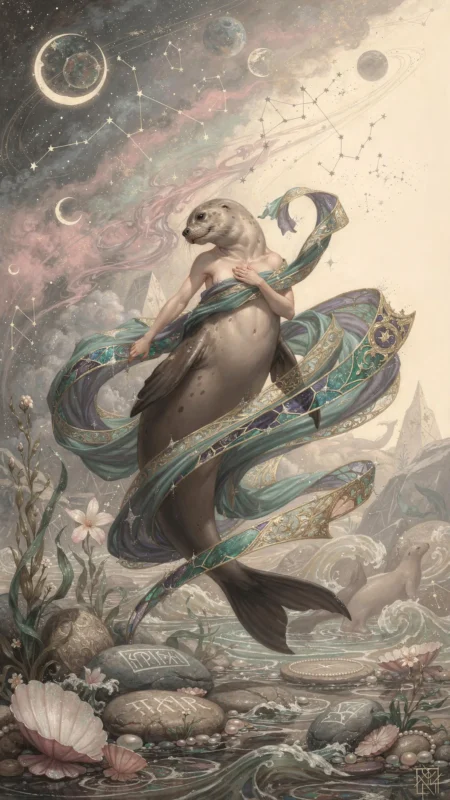
Selkie

Archetype Meaning & Symbolism

Dual, melancholic, longing, adaptable, mysterious, gentle, captive, wild, soulful, elusive

  • Do not mistake my love for the shore as a rejection of the sea: my heart learned its rhythm from the tides.

If Selkie is part of your personal mythology, you may...

Believe

  • You may believe that your soul has more than one true home, and that your life is a pilgrimage between them.
  • You may believe that the deepest love does not seek to possess, but to witness and protect the wildness in another.
  • You may believe that melancholy is not a sickness to be cured, but a sacred weather pattern of the soul, a sign of its depth.

Fear

  • You may fear losing the one thing that gives you access to your true self, whether it is your creativity, your solitude, or your connection to nature.
  • You may fear that you are incapable of ever feeling fully settled, that you are doomed to a life of perpetual longing.
  • You may fear that if you ever fully revealed your true, wild nature, the people you love would abandon you.

Strength

  • Your ability to navigate vastly different worlds and social contexts with grace and empathy is a profound strength.
  • You possess a rich, deep inner life that is a source of immense creativity, resilience, and wisdom.
  • You are capable of a unique kind of love: one that is both fiercely loyal and deeply respectful of freedom and individuality.

Weakness

  • You may be prone to a persistent melancholy or a feeling of being fundamentally out of place, no matter where you are.
  • You may struggle with commitment, always keeping one foot out the door, ready to return to the sea.
  • You may have a tendency to hide your true self, leading to feelings of loneliness even when surrounded by people.

The Symbolism & Meaning of Selkie

The Selkie in modern personal mythology is the patron saint of the divided soul, the archetype for anyone who lives with one foot in the mundane world and one in a world of deep, intuitive magic. It speaks to the tension between responsibility and wildness, domesticity and freedom. To have a Selkie mythos is to feel the constant tidal pull between what is expected of you and what your spirit yearns for. It is the story of profound adaptability, of making a home on a foreign shore, but it is also the story of a persistent, sacred melancholy, a homesickness for a part of oneself that has been misplaced, hidden, or surrendered.

The sealskin is perhaps the most potent symbol: it is your soul's truth, your irreducible essence, your wildness. It could be your art, your spirituality, your unconventional identity. In the myth, it is often stolen or hidden by another, representing how we may allow our truest selves to be contained or defined by relationships, jobs, or societal expectations. The quest of the Selkie soul is often the quest to reclaim this skin, to remember who you were before you were told who you should be. This isn't necessarily about leaving a life behind, but about integrating that skin into your daily existence, wearing your soul on the outside.

Ultimately, the Selkie symbolizes a heartbreaking choice and a deep form of integrity. It questions the nature of belonging. Is it better to be loved for the convenient version of yourself, or to be true to a self that may require you to stand apart? The Selkie myth suggests that true wholeness does not come from choosing the land or the sea, but from honoring the call of both. It is about learning to live with the beautiful ache of a dual nature, and understanding that this very division is the source of your unique depth, empathy, and grace.


Selkie Relationships With Other Archetypes

The Lighthouse

The Lighthouse may stand as the Selkie’s most poignant counterpart, a stoic pillar of human resolve planted firmly at the edge of her own dissolving world. It is, perhaps, a symbol of the very love that holds her on shore—a steady, unwavering beam that promises safety and guidance through terrestrial nights. Yet, this same light could be seen as a warden, its cyclical sweep a constant, painful reminder of the vast, dark liberty that lies just beyond the breakers. The Lighthouse speaks a language of stone and duty, of staying put, while the Selkie’s soul is fluent only in the shifting tongue of the tides. She might gaze at it from a window, seeing not a beacon of hope, but the lonely, unblinking eye of her own gilded cage, a permanent fixture on the coast of her captivity.

The Exiled Monarch

In the quiet melancholy of the Selkie, one might perceive the ghost of the Exiled Monarch. She is, after all, a creature of a different, more fluid kingdom, possessed of a birthright written in salt and foam. On land, stripped of her sealskin—her mantle of state, her very crown—she could be seen as royalty living in disguise amongst commoners, her noble bearing mistaken for mere sorrow or strangeness. Her longing for the sea is not simple homesickness; it is the deep, cellular ache of a sovereign separated from her throne and her people. The domestic world, with its predictable rituals and solid ground, may feel like a provincial court to which she has been banished, her true power and identity a whispered rumor only she can hear on the wind.

The Keeper of Secrets

The Selkie’s relationship with the Keeper of Secrets is one of profound, and perhaps unwilling, intimacy. She herself is the vessel of a secret so fundamental it bifurcates her very existence. Her silence is not emptiness, but a space crowded with the unsaid, an entire ocean of identity held back behind the dam of a human face. The one who finds and hides her sealskin becomes the external manifestation of this archetype—a jailer who holds the key not just to a physical object, but to the Selkie’s very soul. This dynamic creates a strange and terrible bond, a shared knowledge that isolates them both. The secret, then, could be understood as the true space she inhabits: a liminal territory of memory and longing, invisible to all but her, and the one who has locked the door.

Patterns of The Selkie Spirit Animal, Totem, or Archetype

Signs that the Selkie has surfaced in the waters of your personal mythology are often subtle, more like a shift in the tides of your inner life than a lightning strike. You might notice a recurring and inexplicable pull towards the coast, a yearning so physical it feels like a homing instinct. Synchronicities may appear: you might find sand dollars far from the shore, hear haunting sea shanties in unusual places, or find that stories of shapeshifters and enigmatic strangers resonate with a startling, personal clarity. Perhaps you have a history of relationships that fit the pattern of the myth: a deep, loving connection that nonetheless contains an element of captivity or of being fundamentally misunderstood, where your need for periodic, solitary retreat is a point of contention.

A significant indicator is a recurring feeling or theme in your own life. Do you feel you are living a double life? Not in a deceptive sense, but in having a competent, outward-facing persona and a secret, intensely private inner world that feels more real? This interior space might be where your creativity, your spirituality, and your true emotions reside. It is your metaphorical ocean. You may feel a deep empathy for the displaced, for refugees, for anyone caught between two worlds, because you recognize their plight as your own. If these patterns of feeling and event align in your life, the Selkie spirit animal may be making its presence known.

Look, too, at your dreams and creative expressions. Recurring dreams of swimming, of the ocean, of losing something vital, or of being torn between two families are strong signs. Notice what you create. Are your poems, paintings, or songs filled with themes of longing, of water, of transformation and return? The Selkie does not often announce itself with a roar. It appears as a soulful gaze from a passing stranger, a melody that makes you weep for a home you've never seen, or the sudden, overwhelming need to stand at the edge of a great body of water and simply breathe. It is a quiet, persistent, and deeply personal calling back to the soul.

Using Selkie in Every Day Life

Navigating Career and Passion:

You may find yourself in a stable, respectable job that provides security (the land), yet feel a profound, almost painful pull towards a creative or spiritual calling that feels less certain (the sea). The Selkie archetype teaches not to abandon one for the other, but to find ways to honor both. This could mean carving out non-negotiable time for your passion project, turning your office into a sanctuary of personal inspiration, or finding a career that allows you to metaphorically swim between the worlds of commerce and creativity.

In Intimate Relationships:

When a relationship feels both deeply loving and strangely confining, the Selkie mythos offers a lens. Your partner may be the gentle human who found your skin, loving you for who you are on land. The work is not to resent their love as a cage, but to teach them about your need for the sea. It's about communicating your requirement for solitude, for wildness, for a part of your life that is yours alone, assuring them that this private ocean is not a threat to the home you've built together, but the source of your magic.

Finding Your Place in the World:

If you feel a perpetual sense of not quite belonging, a homesickness for a place you can't name, the Selkie archetype provides a mythic framework for this feeling. It suggests your 'home' may not be a single geographical location but a state of being. You can cultivate 'home' by creating rituals that connect you to your deeper nature: regular visits to water, engaging in soulful music or art, or connecting with others who understand the feeling of being born of two worlds.

Selkie is Known For

The Stolen Skin

The central motif of a Selkie's sealskin being taken by a mortal, trapping them on land in human form. This skin represents their true nature, their freedom, and their connection to their authentic self.

A Divided Heart:

Known for their profound love for their human families, yet cursed with an inconsolable longing for the sea and their seal-kin, creating a life defined by a beautiful, tragic melancholy.

The Eventual Return:

Most tales end with the Selkie finding her skin and returning to the ocean, often leaving behind heartbroken loved ones. This return symbolizes the non-negotiable call of the soul to its true home, even at great personal cost.

How Selkie Might Affect Your Personal Mythology

How Selkie Might Affect Your Mythos

When the Selkie swims into your personal mythology, your life story ceases to be a linear progression and becomes a tale of tides, of comings and goings. Your narrative may be punctuated by periods of profound retreat into a private, interior world, followed by periods of intense engagement with community and family. These are not seen as contradictions but as the natural rhythm of your being. Past loves or lives are not chapters that are closed, but distant shores you still hear calling. The mythos becomes a sacred map, charting the moments the Selkie spirit animal surfaced: the time you left a perfectly good situation because your soul was suffocating, or the time you chose to stay, learning to build a tide pool of your own in a landlocked life.

Your personal myth becomes a quest for integration. The central conflict is not good versus evil, but land versus sea, convention versus instinct. You might frame your life's purpose as the search for your sealskin: that lost piece of creative passion, spiritual freedom, or raw authenticity you may have traded for security or love. Victories are not marked by external accolades but by moments of wholeness: when you speak your truth even if it estranges others, when you create art that channels your deep inner world, when you find a partner who doesn't want to hide your skin but learns to swim with you.

How Selkie Might Affect Your Sense of Self

To see yourself through the Selkie's eyes is to accept a fundamental duality within your nature. You may feel like a gracious host and a wild creature all at once. There's the self you present to the world: capable, loving, and grounded. Then there is the secret self, the one that dreams of the vast, cold, and silent deep. This can lead to a feeling of being perpetually misunderstood, as few are granted access to the oceanic depths of your soul. You might feel most yourself when near water, listening to haunting music, or lost in a creative flow, moments where the boundary between your two selves dissolves.

This self-perception fosters a deep, often melancholic, interiority. Your inner world is a vast kingdom, rich and complex. You may not feel a need for constant external validation because your sense of self is anchored in this hidden, authentic core. However, it can also lead to a sense of isolation. When the land-bound self is dominant for too long, a feeling of profound inauthenticity can set in, a spiritual malaise that can only be cured by a return, however brief, to your 'sea.' The core self feels more aligned with the Selkie spirit animal than with the terrestrial persona it has so expertly crafted.

How Selkie Might Affect Your Beliefs About The World

Your view of the world may be tinged with the Selkie's signature melancholy and empathy. You see the 'land'—the structures of society, the nine-to-five grind, the concrete jungles—as a temporary arrangement, a place of borrowed time. You may appreciate its comforts and beauties, but you are always aware of its limitations and the wilder world that laps at its edges. You may look at others and sense their own hidden seas, their own lost skins, fostering a deep compassion for the quiet compromises people make to belong.

This perspective could also create a certain detachment. You may view worldly ambitions, social hierarchies, and the pursuit of material wealth with a kind of gentle bewilderment. For the Selkie soul, true wealth is freedom, authenticity, and a connection to the profound. The world is not a place to be conquered but a coastline to be explored. You may believe that every system, every relationship, every city has a shoreline, a place where it meets something older, deeper, and more true, and that is where you feel most alive.

How Selkie Might Affect Your Relationships

In relationships, the Selkie archetype brings both a capacity for profound, almost mythic love and an inherent, painful tension. You may love your 'human' partner with a depth that is all-consuming, creating a family and a home that is a true sanctuary. You are a devoted partner and parent. Yet, there is always the call of the sea, the need for a part of your soul to remain untamed and sovereign. This can be misinterpreted by partners as distance, secrecy, or a lack of commitment, when it is, in fact, a precondition for your love.

The challenge is to find a partner who does not view your sealskin as a threat. A healthy relationship for a Selkie soul is not with someone who hides the skin to keep you, but with someone who loves you enough to help you find it when you have forgotten where you left it. It requires a delicate dance of intimacy and autonomy. You may find yourself drawn to partners who are themselves wanderers or possess a deep understanding of the soul's need for solitude. For you, the greatest act of love is not being held, but being allowed to swim away, knowing the shore will always welcome you home.

How Selkie Might Affect Your Role in Life

You may feel that your role in life is to be a bridge between worlds. In a family or community, you might be the keeper of dreams, the one who reminds others of the magic they have forgotten. In a workplace, you might be the intuitive voice in a sea of logic, the one who sees the emotional undercurrents beneath the spreadsheets. Your perceived role is rarely one of direct leadership in the traditional sense; you are not the king of the land. Instead, you are the shoreline whisperer, the counselor, the artist, the healer, who stands at the boundary and translates the language of the sea for those who can no longer hear it.

This can also be a heavy burden. You may feel a constant pressure to adapt, to wear the human form that is expected of you in your various roles: the responsible employee, the ever-present parent, the stable partner. This performance, while often masterful, can be exhausting. Your true role, as you feel it in your core, is simply to be yourself in all your dual-natured glory. The life-long task becomes less about fulfilling a specific role and more about creating a life where the Selkie does not have to pretend to be fully human, where she can move between her forms with grace and acceptance.

Dream Interpretation of Selkie

In a positive context, dreaming of the Selkie is a potent omen of integration and reclamation. To dream of swimming freely in the ocean as a seal signifies a deep connection to your intuition, your emotions, and your authentic self. You are in your power, comfortable in your own skin. If you find your lost sealskin in a dream, it may suggest you are on the verge of recovering a vital part of yourself: a creative talent, a spiritual path, or the courage to leave a situation that has confined you. A dream where a human lover willingly returns your skin is a powerful symbol of a relationship that supports your wholeness and freedom.

Conversely, a negative Selkie dream speaks of entrapment, loss, and longing. Dreaming that your skin is stolen, lost, or burned can reflect a profound fear of losing your identity to a relationship, a job, or social pressure. You may feel that your soul is being held captive. To dream of standing on a cliff, watching the seals play in the water below while you are stuck in human form, is the ultimate expression of the Selkie's ache: a deep separation from your own joy, wildness, and spirit. It may be a call from your subconscious to identify what, or who, is keeping you from your 'sea' and to begin the difficult journey of reclaiming your soul's right to be free.

How Selkie Archetype Might Affect Your Needs

How Selkie Might Affect Your Physiological Needs

From a mythological perspective, the physiological needs of a Selkie soul extend beyond simple food and shelter. There may be a palpable, physical need to be near water. A feeling of claustrophobia or a subtle, chronic exhaustion may set in when landlocked for too long. The air may feel thin, the sounds too sharp. This is the body remembering its other form. The need is not just for water, but for vast, open spaces that mirror the expanse of the ocean: wide skies, windswept fields, or even the anonymity of a bustling city, which can mimic the sea's immersive quality.

The body may crave sensory experiences that echo its marine home. The taste of salt, the feeling of cold water on the skin, the rhythmic, muffled sounds that one might hear underwater. When these needs are not met, a person with a Selkie mythos might experience a kind of spiritual dehydration, a physical manifestation of their soul's homesickness. They may find that things like float tanks, sensory deprivation, or even just long baths become not just luxuries, but essential maintenance for their well-being.

How Selkie Might Affect Your Ideas of Belonging

The need for belongingness is the central, aching heart of the Selkie mythos. It manifests as a dual loyalty that can never be fully resolved. You may experience a profound sense of love and connection with your 'land family,' be it your biological family, your chosen friends, or your community. You belong with them, and the bond is real and deep. You laugh with them, build a life with them, and would protect them fiercely. There is no question of your love for the shore.

And yet. There is another belonging, a pull toward another kin: the silent, sleek swimmers in the cold sea. This is a belonging of the soul, a resonance with a wilder, more ancient part of your nature. This may manifest as a feeling of being most 'at home' when alone, or with fellow artists, mystics, and misfits who also seem to hear a song others don't. This creates a permanent, low-level hum of homesickness, a feeling of being a loving exile everywhere. The quiet whisper of the Selkie spirit animal reminds them of a different kin, and the deepest desire is not to choose between these two families, but to somehow have them recognize each other across the waves.

How Selkie Might Affect Your Feelings of Safety

For the Selkie archetype, the concept of safety is deeply paradoxical. The human home, the family, the steady job—these provide physical safety and security, the very things a human being is conditioned to seek. Yet, for the Selkie soul, this 'safe' harbor can feel like the most dangerous place in the world, for it is where the soul-skin is most at risk of being lost or hidden away. The greatest threat is not physical harm, but the slow, comfortable death of the authentic self.

True safety, paradoxically, might be felt in the unpredictable, untamed 'sea.' This is the space of creative risk, of emotional vulnerability, of solitude. While objectively more 'dangerous'—it offers no guarantees, no shelter—it is the only place the Selkie soul can be whole and therefore truly safe in its own integrity. The ultimate safety measure is to always know where your sealskin is. It means guarding your connection to your core identity, your art, your wildness, with a fierce and loving vigilance, for without it, you are truly lost at sea, even when standing on dry land.

How Selkie Might Affect Your Views of Esteem

Esteem needs for the Selkie soul are a complex negotiation between external acceptance and internal authenticity. You may derive a portion of your self-worth from how well you perform your 'human' role. Accolades at work, the love of your family, your reputation in the community—these things matter, and they can build a solid sense of terrestrial esteem. You may take pride in your ability to adapt, to thrive on land, to be a good and loving person in a human context.

However, this esteem is fragile. True, unshakable self-worth comes only from the connection to your 'sea' self. It is rooted in your creative power, your intuitive wisdom, and your untamable spirit. Your esteem soars not when you get a promotion, but when you finish a poem that speaks your soul's truth. It blossoms not when someone praises your practicality, but when they acknowledge your wild, mystical side. The core of your esteem is tied directly to the fate of your sealskin. When it is hidden, your self-worth feels conditional. When you are wearing it, or at least know it is safe and accessible, your esteem is sovereign and needs no external validation.

Shadow of Selkie

When the Selkie archetype falls into shadow, it can manifest in two devastating extremes. The first is the 'absent heart.' This is the Selkie who mistakes the call of the sea for a license for emotional abandonment. They use their need for 'freedom' as a justification for being unreliable, unavailable, and cold. They may abruptly leave relationships and responsibilities, not as a sacred act of soul-reclamation, but as a flight from intimacy and accountability. The shadow of the Selkie spirit animal can manifest as a cold, abrupt departure, leaving a wake of bewildered, heartbroken people on the shore, convincing themselves this is the price of their authenticity.

The other shadow is the 'sunken skin.' This is the Selkie who, out of fear or a desperate need for acceptance, completely severs the connection to the sea. They burn their own sealskin. They become a martyr to domesticity and convention, suppressing their wildness, their art, their intuition, until they are a hollowed-out shell of their former selves. They may become bitter, resentful, and deeply depressed, projecting their self-betrayal onto those they chose to stay for. They haunt their own 'safe' home like a ghost, a walking embodiment of a soul that has drowned on dry land.

Pros & Cons of Selkie in Your Mythology

Pros

  • You have access to a profound depth of feeling and intuition that allows you to experience the world with extraordinary richness.
  • Your dual nature gives you a unique perspective, making you an excellent mediator, artist, or translator of ideas and emotions.
  • You understand the preciousness of both connection and solitude, and can cultivate both with intention and grace.

Cons

  • You may live with a persistent, low-grade sorrow or homesickness that others may not understand.
  • Your relationships can be complicated by your fundamental need for autonomy, which can clash with a partner's need for security.
  • Feeling like you're always playing a part or not quite fitting in can be exhausting and isolating.