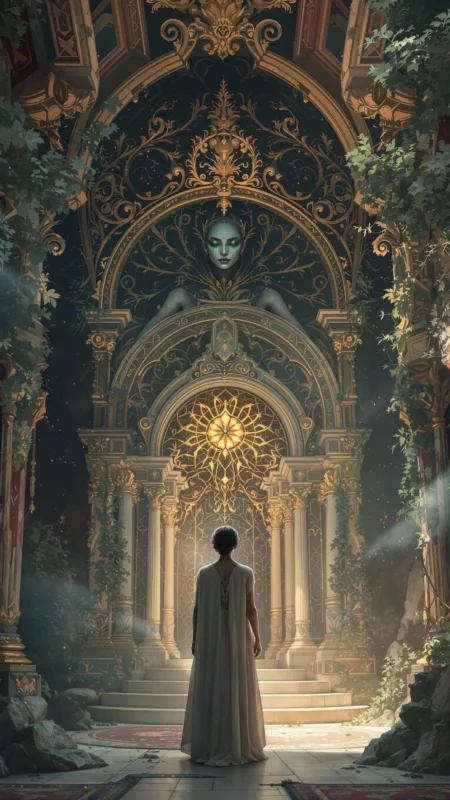


Sealed Crypt

Archetype Meaning & Symbolism

Inviolable, patient, forgotten, latent, potent, somber, ancestral, foundational, secretive, profound

  • What is buried is not gone, it merely waits for the right key or the right tremor. Do not rush the revelation.

If Sealed Crypt is part of your personal mythology, you may...

Believe

  • Some things are not meant to be known or shared by everyone; secrecy has its own sacredness.
  • The most powerful parts of a person are the ones they keep protected and hidden from the world.
  • Time does not heal all wounds, it merely entombs them, and the ghosts may still knock from inside.

Fear

  • Being exposed, 'figured out,' or emotionally naked before you are ready or have given consent.
  • That what is hidden inside you is monstrous, empty, or shameful, and that its revelation would lead to ruin.
  • Forgetting where you buried the key to your own best parts, leaving your own potential permanently inaccessible.

Strength

  • Profound self-possession and an inner life that cannot be easily swayed by external opinion.
  • The ability to keep secrets and be a trustworthy confidant, creating relationships of exceptional depth.
  • Patience and a long-term perspective, understanding that some things need to remain dormant to reach their full potential.

Weakness

  • An inability or unwillingness to be vulnerable, which can lead to emotional distance and profound loneliness.
  • A tendency toward stasis and procrastination, where potential remains forever buried and never actualized in the world.
  • A deep-seated fear of spontaneity and the unknown, preferring the controlled quiet of the tomb to the beautiful chaos of life.

The Symbolism & Meaning of Sealed Crypt

In a personal mythos, the Sealed Crypt may symbolize the vast, unlit corridors of the unconscious mind. It is the repository for all that has been experienced but not processed, all that has been forgotten but not erased. This is not a void but a library of silent stories, a museum of dormant emotions. To have this archetype is to feel the weight and presence of this inner structure, to know that who you are on the surface is merely the manicured lawn above a sprawling, subterranean architecture. Your intuitions may be echoes from its chambers, your sudden melancholies a draft from a crack in its foundation. The crypt insists that self-knowledge is an archaeological endeavor, a careful excavation of what lies beneath.

Furthermore, the Sealed Crypt can represent the power and burden of lineage. It is the place where ancestral gifts and generational traumas are stored. A talent for music you never pursued, a temper you cannot explain, a quiet grief that doesn't feel entirely your own: these may be the heirlooms and specters interred within your personal crypt. To engage with this archetype is to acknowledge that you are the current custodian of a history that began long before you. Your life might become a quest to understand what is inside: to identify which sealed chambers contain treasures you can bring into the light, and which hold sorrows that need to be mourned and sealed anew.

On a more immediate level, the Sealed Crypt is the patron saint of buried potential. It is the novel you started and put in a drawer, the language you learned the basics of and then abandoned, the profound love you felt but never acted upon. These are not failures; in the mythology of the crypt, they are sleeping energies, preserved and potent. The crypt whispers that it is never too late, that these things are not gone, merely waiting. It suggests a life path that is not linear but geological, with rich veins of possibility that can be rediscovered and mined at any time, often when you least expect it, transforming the narrative of your life in an instant.


Sealed Crypt Relationships With Other Archetypes

The Key

The relationship between the Sealed Crypt and The Key is the most fundamental. The Crypt is defined by its state of being locked, its potential held in stasis. The Key represents the catalyst for change, the specific and necessary element required for revelation. In a personal mythos, The Key is rarely a literal object. It could be a person whose presence unlocks a part of you that has been dormant for years. It might be a sudden insight, a line in a book, or a piece of music that opens a door to a flood of memory and emotion. The Crypt is passive, patient, and powerful in its inertia; The Key is active, specific, and powerful in its ability to initiate. The Crypt waits, and The Key arrives.

The Gardener

The Gardener archetype exists in stark contrast to the Sealed Crypt. The Gardener is all about the surface, about active cultivation, seasonal cycles, and visible growth. Life, for The Gardener, is a process of tending, weeding, and nurturing in the open sun. To The Gardener, the Sealed Crypt might appear as a stubborn stone in the field, a place of death and stagnation. To the Crypt, The Gardener's work may seem ephemeral and exposed. In a personal mythos, this tension could play out as a conflict between a life of external achievement and visible progress versus a life of deep, internal development. One is not better than the other, but the individual may feel torn between the urge to produce fruit and the need to preserve what is hidden deep within the earth.

The Earthquake

If The Key is the sanctioned entry, The Earthquake is the violation. The Earthquake is the force of chaotic, unscheduled, and often traumatic change that cracks the crypt open from the outside. It is the secret accidentally exposed, the repressed memory that surfaces violently during a crisis, the foundation of one's life cracking under pressure to reveal what was hidden beneath. While The Key represents intentional integration, The Earthquake signifies a premature or brutal revelation. It can be terrifying, forcing a confrontation with the crypt's contents before one is ready. Yet, sometimes, in a life that has become too static, too sealed, The Earthquake is the only force strong enough to break open a crypt that has become a prison, initiating a painful but necessary era of rebuilding.

Using Sealed Crypt in Every Day Life

Navigating Creative Blocks

A creative idea that feels incomplete need not be discarded. Instead, it can be ritually placed within your personal crypt. This isn't an act of failure, but of preservation. You are acknowledging its potential while recognizing the timing is not yet right. The crypt becomes a fertile darkness, a place where concepts can gestate, protected from the harsh light of judgment and the pressure to perform, waiting for the missing piece to arrive not by force, but by grace.

Processing Trauma

The Sealed Crypt may offer a way to conceptualize a painful past. It suggests that a memory does not have to be an open wound, constantly weeping into the present. Instead, it can be carefully, respectfully entombed. This is not repression, but containment. You acknowledge its existence and its weight, but you choose to build a structure around it, one with a single, guarded door. You become the keeper of the key, deciding if, when, and with whom you will enter that space, rather than having it burst into your consciousness unbidden.

Cultivating Patience

When undertaking a long-term transformation, whether a career change or a profound shift in character, the Sealed Crypt serves as a potent metaphor. The process is happening deep underground, in silence and darkness, invisible to the outside world. This view combats the modern demand for constant, visible progress. It allows you to trust the subterranean work, to understand that the most foundational changes are slow, quiet, and happen long before any shoots break the surface.

Sealed Crypt is Known For

Preservation

Its primary function is to halt time's decay, to keep something—an object, a memory, a power—in a state of perfect stasis. What is placed inside is protected from the corrosive elements of the outside world, held inviolate until it is one day reopened.

Secrecy

The Crypt is the ultimate confidant. It is built to hold what cannot be spoken, to contain the truths that are too powerful or too dangerous for the common light. It represents the parts of our stories that are for us alone, or for a trusted few who are granted the key.

Potential Energy

A Sealed Crypt is a vessel of immense potential. Its value lies not in what it is, but in what it holds. This creates a quiet tension, a silent hum of power. It might contain a treasure beyond imagining, a forgotten piece of wisdom, or a horror that was locked away for good reason. Until it is opened, it is pure possibility.

How Sealed Crypt Might Affect Your Personal Mythology

How Sealed Crypt Might Affect Your Mythos

When the Sealed Crypt is a central feature of your personal mythology, your life story may not be a linear progression but a tale of excavation. Your narrative is punctuated by the discovery or the opening of crypts. There is a 'before' and 'after': the time before you uncovered a hidden talent, the period after you finally understood a piece of your family history, the moment a long-held secret was revealed. Your mythos becomes one of hidden depths and latent destinies. You may feel that your true purpose is not something you build, but something you unearth. This creates a life story with an air of mystery and inevitability, as if you are slowly discovering a plot that was written long ago.

The presence of the crypt also frames your mythos as one of guardianship. You may see yourself as the keeper of a sacred space, whether that space contains a personal creative potential, a family legacy, or a profound truth you have discovered. Your life is not just about your own journey, but about protecting the integrity of what is stored within. This can imbue your story with a sense of quiet nobility and profound responsibility. The major conflicts in your narrative may revolve around protecting the crypt from violation, finding the right person to share the key with, or grappling with the decision of whether to leave something buried or bring it into the light of day.

How Sealed Crypt Might Affect Your Sense of Self

Your sense of self may be uniquely layered. You might perceive a distinct difference between your external persona—the self that navigates the world—and a deeper, more authentic self that resides in a protected inner space. This isn't necessarily a false or deceptive persona, but rather a necessary interface. Your core identity feels ancient, private, and potent, like a pharaoh's tomb untouched for millennia. This can lead to a powerful sense of self-possession; you are not easily defined or influenced by others because you know that your truest self is inaccessible to them, sealed away from public opinion. You are the sole curator of your own internal museum.

This can also foster a self-view that is fundamentally mysterious, even to you. You may feel that you do not fully know yourself, that there are sealed chambers within your own psyche yet to be explored. This perspective replaces the anxiety of 'finding yourself' with the patient curiosity of an archaeologist. You trust that who you are is already there, complete and contained. The journey is not one of invention but of discovery. This can lead to moments of profound self-revelation later in life, where you uncover strengths or desires you never knew you possessed, feeling less like you've changed and more like you've finally gained access to another room in your own house.

How Sealed Crypt Might Affect Your Beliefs About The World

Your worldview may be one of profound skepticism toward surfaces. You might inherently believe that the most important truths are hidden, that the stated meaning is never the real meaning, and that every person, institution, and landscape has a subterranean history that truly defines it. This makes you a natural psychologist, historian, and critic, always looking for the subtext, the buried motivation, the forgotten story. The world is not a stage, but an archaeological site. This can be a source of great insight, allowing you to perceive realities that others miss. You see the ancient riverbed beneath the modern highway, the childhood wound beneath the adult's bravado.

However, this perspective may also foster a certain melancholy or detachment. If the ultimate truth is always buried, then the present moment can feel thin, like a layer of dust over something more substantial. You may struggle to fully invest in the 'now,' seeing it as a temporary and distracting facade. This can lead to a worldview where realness is equated with the past, with what is hidden and preserved. Your philosophy may be one of conservation rather than innovation, of depth rather than breadth. You trust what has endured in darkness over what flourishes briefly in the light.

How Sealed Crypt Might Affect Your Relationships

In relationships, you may operate like a fortress with a single, heavily guarded gate. Casual connections might be difficult; small talk can feel like a desecration of the silence that guards your inner world. You do not give away access easily. Potential partners or friends must prove themselves worthy of the key. This means trust is paramount, earned over long periods of observation and consistency. You are watching to see if they are careful, if they respect boundaries, if they can sit with silence. For many, this can make you seem distant, aloof, or secretive.

For the few who are granted entry, however, the relationship can be one of profound and unshakable intimacy. To be invited into your crypt is to be shown the core of your being: the buried dreams, the preserved wounds, the secret treasures. This is a sacred act, and it forges a bond of incredible strength. You are a deeply loyal and trustworthy partner and friend, capable of holding the secrets of others with the same reverence you hold your own. The challenge is navigating the vast space between the stranger at the gate and the beloved confidant within; there is often little middle ground in your relational world.

How Sealed Crypt Might Affect Your Role in Life

Your perceived role in life might be that of the Guardian or the Conservator. You may feel a deep, often unspoken responsibility to protect something of value from the ravages of time and the carelessness of the world. This could be a family legacy, a creative tradition, a specific body of knowledge, or the vulnerable, nascent potential within another person. You are the one who keeps the old stories, who remembers the original intent, who shields the flame from the wind. This role is often quiet, requiring immense patience and integrity, and receives little external validation. Its rewards are internal: the knowledge that something precious remains safe because of your watchfulness.

Alternatively, you may see your role as the Archaeologist of your own soul. Your primary task in life is not to build a career or a family in the conventional sense, but to excavate your own depths. Your life is a long and careful dig site. Each relationship, each job, each crisis is a tool that might help you unearth another artifact, another shard of your true self. This can lead to a life path that seems unconventional or meandering to others, but for you, it has a deep, internal logic. Your purpose is not achievement, but revelation. You are here to map your own subterranean world.

Dream Interpretation of Sealed Crypt

In a positive context, dreaming of a Sealed Crypt can signify a readiness for a new level of self-discovery. If you discover a crypt and are able to enter it with ease, finding treasures, beautiful artifacts, or sleeping ancestors inside, it may suggest that you are successfully integrating a dormant part of your psyche. The dream could be affirming that a talent you have buried is ready to be unearthed, or that you have processed a past trauma to a point where its wisdom can be harvested without its pain. Finding the key to a crypt in a dream is a particularly potent symbol of having a breakthrough insight or achieving the maturity needed to confront your own depths.

In a negative context, a dream of a Sealed Crypt can be deeply unsettling. Being trapped inside a crypt, with the door sealed shut, can symbolize feelings of depression, hopelessness, or being imprisoned by your own past. It may reflect a state of psychological paralysis, where potential feels locked away and inaccessible. If the crypt is empty, it could speak to a fear of inner vacuity, a terror that beneath the surface, there is nothing of value. Dreaming of a crypt that holds something monstrous or that crumbles around you may represent the fear that your repressed contents are toxic and that confronting them will lead to your own destruction.

How Sealed Crypt Archetype Might Affect Your Needs

How Sealed Crypt Might Affect Your Physiological Needs

The Sealed Crypt archetype may translate into a physiological need for periods of profound sensory withdrawal. Your basic need for rest might extend beyond simple sleep into a need for true stasis: silence, darkness, and solitude. This is not laziness, but a deep-seated drive to conserve energy, as if your very life force is a finite resource stored within the crypt that must not be squandered on frivolous external activity. You might be the person who disappears for a weekend, not to do anything, but to simply 'be' in a quiet space, allowing your systems to settle and recharge in a way that is deeper than sleep.

Physically, this archetype can manifest as a kind of bodily containment. You might hold your body in a very controlled way, with tension in the jaw, shoulders, and hips, as if you are physically guarding your core. There can be a tendency toward a slower metabolism or a need to 'hibernate' in winter, feeling a palpable drop in energy and a desire to retreat. Your body might be sending a clear message: the work happening now is internal and subterranean, and it requires that the external machinery be powered down. Honoring this need is crucial for your physical well-being; ignoring it can lead to chronic fatigue or burnout.

How Sealed Crypt Might Affect Your Ideas of Belonging

Belongingness is not found in crowds. For the Sealed Crypt archetype, love and belonging are deeply intertwined with the act of selective revelation. You do not feel you belong until you can trust someone with a key to a part of your inner world. This makes the formation of close bonds a slow, deliberate, and sometimes arduous process. You may feel a profound sense of loneliness even when surrounded by people, because true connection is not about shared activity, but shared secrecy. You are seeking the fellow archaeologist who will treat the contents of your soul with reverence, not the tourist who just wants a quick look.

Once this bond is formed, it is one of incredible depth. To love someone, for you, might mean becoming the guardian of their crypt as they are the guardian of yours. This creates relationships of profound mutual trust and loyalty. You feel seen and loved not for your sunny exterior, but for the complex, shadowy, and precious contents of your interior. The challenge lies in risking that first act of revelation. The fear of showing someone a chamber of your crypt, only to have them recoil or misuse the knowledge, can be so great that it prevents you from ever experiencing the very belonging you crave.

How Sealed Crypt Might Affect Your Feelings of Safety

Your need for safety is likely defined by the concept of inviolability. Physical security is less about protection from overt attack and more about protection from intrusion. A locked door is a profound symbol for you. Your safety feels most assured when you are in a space where you cannot be seen, heard, or surprised. This could be a literal space, like a home with thick walls and few windows, or a psychological space, like a carefully curated private life. The ultimate threat is not violence, but exposure. The thought of your private journals being read, your secrets being revealed, or your solitude being interrupted can feel like a genuine threat to your existence.

This translates into a life where you build deliberate walls between your inner self and the world. Safety is found in compartmentalization. You might have separate friend groups, undisclosed hobbies, or parts of your life story you never share. These are not deceptions, but defensive structures, like the false passages in a pyramid designed to protect the central chamber. You feel secure when you know there is a part of you, a core reality, that no one can touch. The danger arises when these walls become so thick that they imprison you, cutting you off from the help and connection that are also essential for safety.

How Sealed Crypt Might Affect Your Views of Esteem

Your self-esteem may be a quiet, internal affair, tethered to the perceived value of what you keep hidden. If you believe your crypt contains a great treasure—a unique talent, a profound wisdom, a deep capacity for love—you may possess a calm and unshakable self-worth that is impervious to external praise or criticism. You have no need for validation because you are the guardian of something priceless. Your esteem comes from the knowledge of your own depth and potential, even if it is never shown to the world.

Conversely, your esteem can be incredibly fragile, built upon the fear of what your crypt might contain. If you suspect that what is sealed away is not a treasure but a horror—a deep inadequacy, a shameful past, an inner emptiness—then your life may become a frantic effort to keep the door bolted. Your self-esteem is then a defensive structure, reliant on no one ever finding out the 'truth' about you. In this case, praise feels fraudulent, as if they are complimenting the beautiful mausoleum without knowing it is empty or holds only dust.

Shadow of Sealed Crypt

When the shadow of the Sealed Crypt takes hold, it ceases to be a sanctuary and becomes a prison. The guardian becomes the prisoner. Here, potential is not preserved, but suffocated. The person becomes so identified with their secrets and their past that they cannot live in the present. They refuse to open the door to anyone or anything new, and their inner world becomes stagnant, airless, and toxic. It is the artist who never shows their work, the lover who never confesses their feelings, the person who clings to an old grievance like a precious treasure. They become a living monument to what might have been, their life a beautiful, tragic, and ultimately empty mausoleum.

Another shadow aspect emerges when the walls of the crypt crumble entirely. This can manifest as an inability to hold anything in, a kind of psychological incontinence. Secrets are spilled recklessly, deep emotions are displayed to strangers, and there are no boundaries between the inner self and the outer world. This person overshares not out of a desire for intimacy, but from a desperate, chaotic need to empty the crypt of its overwhelming contents. Lacking the structure of the crypt, they have no sense of self-possession, no sacred inner space, and are dangerously vulnerable to the manipulations and judgments of others. They are a ruin, open to all weathers, with their treasures and their ghosts scattered for all to see.

Pros & Cons of Sealed Crypt in Your Mythology

Pros

  • You possess a rich inner world and a capacity for deep self-reflection that others may lack.
  • You naturally maintain strong personal boundaries, preserving your energy and autonomy.
  • You cultivate an aura of mystique and depth that can be powerfully alluring and intriguing to others.

Cons

  • Your preference for privacy can easily tip into isolation, making it difficult to form and maintain close relationships.
  • Your greatest strengths and talents may remain latent and unfulfilled, buried within the crypt forever.
  • You may have a tendency to become stuck in the past or in a state of inaction, resisting necessary growth and change.