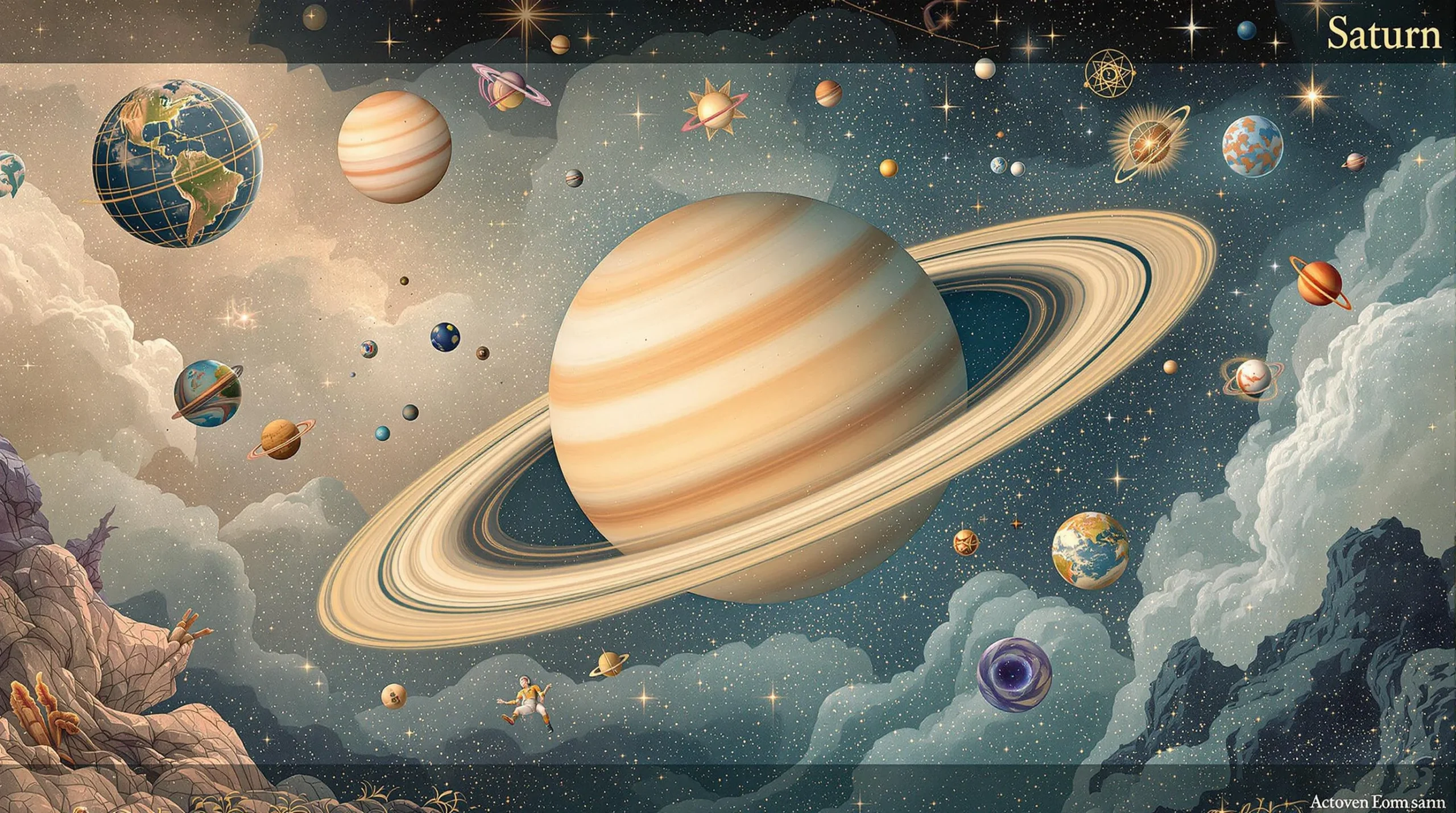


Saturn

Archetype Meaning & Symbolism

Structured, disciplined, authoritative, melancholic, wise, karmic, responsible, patient, solitary, foundational

  • All things are the food of time.

If Saturn is part of your personal mythology, you may...

Believe

  • You may believe that suffering and hardship are not obstacles to be avoided, but the primary instruments of character and wisdom.

  • You may believe that true freedom is not the absence of limits, but the mastery of a chosen discipline, a liberation found within form.

  • You may believe that time is the ultimate arbiter of truth and justice, patiently settling all accounts and revealing the quality of all work.

Fear

  • You may hold a deep-seated fear of running out of time, of reaching the end of your life with your great work unfinished and your potential unfulfilled.

  • You may fear that the foundations of your life—your career, your relationships, your very self—are secretly flawed and destined for an inevitable, catastrophic collapse.

  • You may fear being exposed as incompetent or irresponsible, a failure in the duties you hold most sacred.

Strength

  • Your patience is geological; you have an innate ability to play the long game, understanding that the greatest achievements require time.

  • Your discipline is your superpower, allowing for a capacity for sustained, focused effort that can wear down any obstacle.

  • You possess a profound sense of responsibility and integrity, making you a pillar of reliability in a fluctuating world.

Weakness

  • You may have a tendency toward rigidity and pessimism, a resistance to change that can cause you to miss vital opportunities for growth.

  • Your inner critic can be merciless, leading to bouts of melancholy, anxiety, or a paralysis born from a fear of not being perfect.

  • You may find it difficult to express warmth, joy, and spontaneity, which can lead to a sense of emotional isolation from others.

The Symbolism & Meaning of Saturn

In the personal mythos, Saturn arrives as the celestial architect, the sober god who reminds us that dreams, no matter how luminous, require scaffolding to touch the sky. He is the archetype of structure, time, and the beautiful, terrible finality of consequence. He represents the skeletal system of our lives: the unseen framework of discipline, responsibility, and commitment that gives our fleshy ambitions form and the strength to stand. To dance with Saturn is to learn the rhythm of clocks and calendars, not as masters, but as partners. It is to understand that the harvest only comes after the tilling, the planting, and the patient tending through long, unglamorous seasons. He is the gravity of the real, pulling our loftiest aspirations down to earth, not to crush them, but to give them roots.

Saturn also governs the territory of limits. He draws the boundary lines on the map of the self, showing us where we end and the world begins. This is not a punishment but a definition. In a culture that often prizes limitless expansion and boundless optimism, Saturn’s wisdom is in the sacred power of 'no,' the clarity of a finite container. He is the mountain that teaches the river how to flow, the shoreline that gives the ocean its voice. Within a personal mythology, he may represent the necessary losses, the melancholic goodbyes, and the hard-won wisdom that only emerges when we accept that we cannot be everything, do everything, or have everything. This acceptance is not defeat: it is the beginning of true mastery within a chosen domain.

Ultimately, Saturn symbolizes the process of maturation itself. He is the force that transforms us from the mythic child, living in the Golden Age of blissful ignorance, into the sovereign of our own small kingdom. This journey involves confronting the Cronus within: the fear that our own creations will supplant us, the urge to consume our potential before it can challenge us. To integrate Saturn is to make peace with time, to become its student rather than its victim. It is to build a legacy, not of marble monuments, but of character. A structure forged in the fires of trial, cooled by patience, and solid enough to offer shelter to others. He is the god of earned wisdom, the patron saint of late bloomers and old souls.


Saturn Relationships With Other Archetypes

The Seed

Saturn and the Seed may seem to exist in opposition—one the embodiment of time’s unyielding pressure, the other a vessel of silent, coiled potential. Yet, their relationship is perhaps less an antagonism than a profound, necessary symbiosis. Saturn provides the very conditions for the Seed’s eventual triumph: the cold, confining darkness of the earth, the slow drip of seasons, the immense weight that forces the nascent life to gather its strength. It is Saturn’s slow, grinding patience that teaches the Seed how to endure, how to draw sustenance from limitation. Without this period of intense, quiet struggle under Saturn’s gaze, a seed’s potential could remain a mere suggestion, a fragile dream. The shell might never crack, the first root might never risk its tender search for what lies beyond. Saturn, then, is not the jailer of the Seed, but its silent, demanding midwife, understanding that true growth is not a sudden explosion of light, but a strength forged in the patient, formidable dark.

The River

The River, in its essence, is a force of constant movement, a liquid narrative seeking the path of least resistance on its journey to the sea. Saturn, in contrast, is the bedrock, the canyon wall, the unmoving obstacle. Their encounter could be seen as a fundamental conflict between freedom and constraint. Yet, it may be that the River only truly discovers its power and identity through its long negotiation with Saturn. Without the discipline of banks, a river is merely a flood, a formless spill of energy dissipating across a landscape. Saturn provides the geological grammar that gives the water its voice—a focused, directed current capable of carving canyons and nourishing civilizations. The River, in turn, slowly and relentlessly wears away at Saturn’s stony facade, polishing its edges and revealing its strata, a testament that even the most rigid structures are subject to the tender erosions of time and persistence. Theirs is the dance of form and energy, where one gives shape and purpose, and the other offers a lesson in yielding transformation.

The Child

In the figure of the Child, Saturn perhaps confronts its most intimate and terrifying mirror. The Child is pure futurity, a canvas of unwritten possibilities, while Saturn is the immense gravity of the past, of lessons learned, and of finality. This relationship is steeped in a primal anxiety—the fear of obsolescence, the specter of being overthrown by the very life one has fostered. Saturn may thus manifest as the stern taskmaster, imposing rules and limitations that feel, to the Child, like a form of consumption, a devouring of its freedom. But this containment could also be a kind of desperate architecture, an attempt to build a vessel strong enough to hold the chaotic, boundless energy of new life. In the Child’s gaze, Saturn may see a judgment on its own calcified certainties; in Saturn’s shadow, the Child might first learn the weight of consequence and the slow, arduous work of building a world that can last. It is a dialogue of profound, and often painful, necessity, where the future must somehow learn to carry the past without being crushed by it.

Using Saturn in Every Day Life

Facing a Major Life Project

When confronted by a task that feels like a mountain, Saturn offers not a shortcut but a blueprint for the quarry. It asks you to become the stonemason of your own ambition. You may begin to map the terrain, not with grand, sweeping gestures, but by identifying the very first stone to cut. Saturn’s influence is in the quiet, consistent tap of the chisel, the daily ritual that, over seasons, carves a path. It transforms overwhelming scale into a sequence of manageable, concrete actions: a testament to the idea that empires are built not in a day, but one deliberate, well-placed stone at a time.

Navigating a Period of Limitation

During times of constraint, whether financial, physical, or creative, the Saturn archetype invites a meditation on the beauty of boundaries. Like the famous rings, these limitations are not necessarily a cage but perhaps a defining orbit. This period could become a crucible for ingenuity, forcing you to work with the essential, to distill your efforts to their most potent form. You might discover a profound strength not in what you have, but in what you can achieve without. It is the poet finding freedom in the sonnet, the painter in the small canvas: a mastery born from necessity.

Establishing Personal Authority

To embody Saturn is to claim the quiet authority that comes from self-knowledge and integrity. This is not the loud command of a tyrant but the gravitational pull of a planet. When setting boundaries with others or building self-respect, the Saturnine path is one of consistency. Your 'no' becomes a mountain, immovable not because of anger, but because it is rooted in the bedrock of your values. Your 'yes' becomes a solemn vow. This archetype could teach that true authority is an internal structure, a well-tended architecture of the soul that requires no external validation.

Saturn is Known For

The Golden Age

Saturn's reign over Latium was mythologized by Roman poets as the 'Saturnia regna,' a primordial era of effortless abundance, innocence, and peace, before labor, law, or war were known to humanity.

Devouring His Children

In his Greek aspect as Cronus, he is infamous for swallowing his divine children—Hestia, Demeter, Hera, Hades, and Poseidon—immediately after their birth, fearing a prophecy that one of them would overthrow him.

The Titanomachy

The ten-year war between the old guard of Titans, led by Cronus, and the new generation of Olympians, led by his son Zeus (Jupiter), who ultimately defeated and imprisoned his father, ending his cosmic rule.

How Saturn Might Affect Your Personal Mythology

How Saturn Might Affect Your Mythos

When Saturn holds the pen, the personal mythos becomes less a dashing epic and more a patient, geological saga. The narrative arc may not be one of meteoric rises and dramatic reversals, but of slow, tectonic shifts. Your story might be one of apprenticeship, a long period spent in the wilderness of learning, honing a craft until mastery is undeniable. The core theme is often one of earned sovereignty: the protagonist does not stumble upon a crown but forges it, piece by piece, from the raw material of their own limitations and failures. The great challenges in this mythos are not external dragons but internal tests of endurance, integrity, and patience.

This narrative structure might prioritize depth over breadth. Instead of a hero who wanders the wide world, the Saturn-touched mythos may feature a protagonist who digs deep, exploring a single mine until it yields diamonds. The story celebrates the profound beauty of commitment, whether to a place, a person, a practice, or a principle. It’s a mythos that finds its climax not in a single, explosive moment of victory, but in the quiet satisfaction of a completed structure: a finished novel, a well-raised family, a life built on a foundation of kept promises. The legend is not about what you were given, but what you painstakingly built with the time you had.

How Saturn Might Affect Your Sense of Self

With Saturn as a guide, your perception of self may be inextricably linked to your competence and what you have built. You might see yourself as an old soul, someone who has always understood the weight of things, even as a child. There can be a deep, abiding sense of responsibility that is both a source of strength and a heavy cloak. You may not seek to be liked so much as to be respected for your integrity and reliability. Your self-worth could be measured by a stern internal auditor, one who values duty over desire and results over intentions. This can forge a character of immense fortitude and self-reliance.

However, this internal architect can also become a harsh critic. You might perceive your flaws as structural defects that threaten the entire edifice of your being. A fear of inadequacy can haunt you, a quiet dread that you are an imposter, that your foundations are merely sand. This can lead to a state of perpetual self-improvement that leaves little room for grace or spontaneity. The self becomes a project to be managed, a fortress to be maintained, which can sometimes feel profoundly lonely, as if you are the sole watchman on a very high, very cold wall.

How Saturn Might Affect Your Beliefs About The World

A Saturnine worldview is one etched with the laws of cause and effect, time, and consequence. You may see the world not as a magical stage for miracles but as a vast, intricate clockwork, where every gear turn, however small, has a necessary and predictable result. There is a deep appreciation for history, tradition, and the enduring power of institutions. You might look at a skyscraper and see not just steel and glass, but the decades of engineering, labor, and economic principles that allowed it to exist. This perspective is fundamentally realist, acknowledging the harshness of reality and the necessity of effort.

This view might foster a certain skepticism towards revolutionary fervor or quick-fix solutions. You may believe that true change is evolutionary, not revolutionary, unfolding over generations. It’s a perspective that respects entropy: the tendency of things to decay without constant maintenance. Therefore, the world is not something to be conquered, but something to be carefully tended. This can lead to a profound sense of stewardship, but it can also verge on pessimism, a feeling that the forces of time and decay will inevitably win, and our greatest duty is simply to slow their advance.

How Saturn Might Affect Your Relationships

In the realm of relationships, Saturn seeks endurance and form. Connections are not fleeting bursts of light but slow-growing trees, cultivated for the strength of their roots. You may approach partnerships, both romantic and platonic, with a solemnity that can be mistaken for coldness. What you truly seek is structure: clearly defined commitments, mutual responsibilities, and the security of a shared future. You might be the person who remembers anniversaries not as a sentimental gesture, but as marking another year of a jointly constructed reality. Loyalty is your highest currency.

This can make you an incredibly reliable and devoted partner, the bedrock upon which others build their lives. Yet, the Saturnine influence can also erect walls where bridges should be. A fear of vulnerability might lead to emotional distance, a preference for showing love through practical acts of service rather than words of affection. There may be a tendency to place heavy expectations on yourself and others, creating standards that are difficult to meet. The challenge is to allow for the wild, chaotic, and unstructured aspects of love, to understand that not every connection needs to be a fortress built to last eternity.

How Saturn Might Affect Your Role in Life

If Saturn shapes your mythos, you may feel a powerful call to a role of authority, structure, and stewardship. You are the builder, the judge, the teacher, the elder, the keeper of the gate. This role is less about personal glory and more about a profound sense of duty to uphold a standard, preserve a tradition, or create a lasting framework for others. Whether as a parent, a manager, or a mentor, you might feel compelled to provide the very stability you yourself crave. Your purpose is found in creating order from chaos, in being the fixed point around which others can orient themselves.

This sense of role can bestow a great deal of dignity and purpose. You are the one others turn to when things fall apart. However, this mantle of responsibility can feel immensely heavy. You might struggle to abdicate control, to trust in the abilities of others, or to simply rest. There can be a loneliness to being the perpetual grown-up in the room. The mythic task becomes learning to balance the crown of responsibility with the freedom to be human, to be flawed, and to understand that even the most solid structures must sometimes allow for the wildness of new growth.

Dream Interpretation of Saturn

To dream of Saturn in a positive light is to dream of structure and harvest. You might see images of well-tended fields, solid architecture, intricate clockwork functioning perfectly, or yourself as a venerable elder offering wise counsel. Such dreams may signify that a period of hard work is paying off, that you are achieving a new level of mastery and maturity. It could be an affirmation from your subconscious that the foundations you are laying in your waking life are sound. The feeling is one of sober satisfaction, of earned peace. It is the quiet hum of a well-built reality.

When Saturn appears as a negative force in a dream, it embodies the crushing weight of time, fear, and limitation. You might dream of being trapped in a crumbling building, pursued by a grim, shadowy figure with a scythe, or watching a clock’s hands spin furiously as you race against an impossible deadline. These dreams could reflect feelings of being imprisoned by your responsibilities, overwhelmed by depression, or terrified of aging and failure. It is the nightmare of the flawed foundation, the anxiety that all your efforts will amount to nothing but dust.

How Saturn Archetype Might Affect Your Needs

How Saturn Might Affect Your Physiological Needs

From the perspective of your personal mythos, Saturn’s influence on your physiological needs manifests as a deep-seated drive for order and discipline. Your narrative about your body may be one of stewardship; it is not a vessel for fleeting pleasures but a complex system requiring careful maintenance. This can lead to highly structured routines: regimented meal times, consistent sleep schedules, and exercise programs that are followed with unwavering consistency. The goal is not aesthetic perfection but functional resilience, the creation of a physical foundation strong enough to withstand the pressures of time and labor.

This disciplined approach can build a robust and reliable physical self, a body that serves as a dependable tool for your life's work. However, this same impulse can become rigid, making it difficult to adapt to changes or to listen to the body's intuitive needs for rest or spontaneity. The mythos can become one of control, where any deviation from the plan feels like a structural failure. The body might be treated more like a machine to be optimized than a living organism to be nurtured, potentially missing its subtle signals in the pursuit of a flawless regimen.

How Saturn Might Affect Your Ideas of Belonging

When Saturn shapes the need for belonging, love and connection are seen as structures to be built, not states to be fallen into. Your mythos of relationship is one of long-term investment and shared responsibility. You may find your sense of belonging not in large, amorphous social circles, but in small, well-defined groups with a clear purpose and history: a tight-knit family, a professional guild, a lifelong friendship pact. Acceptance is earned through loyalty, reliability, and demonstrating your commitment over time.

This leads to relationships of incredible depth and endurance. The bonds you forge are resilient, capable of weathering immense storms. However, this approach can make it difficult to form new connections, as you may subconsciously subject potential friends or partners to a lengthy, arduous vetting process. Spontaneity and casual affection might be viewed with suspicion. There's a risk of feeling isolated, of standing within your beautifully constructed relationship fortress and wondering why more people don't come to visit, not realizing the drawbridge is almost always up.

How Saturn Might Affect Your Feelings of Safety

Saturn’s impact on the need for safety is profound, translating into a powerful urge for tangible, lasting security. The personal mythos here is a story of building a fortress against the chaos of fortune. This isn't about hiding from the world, but about creating a stable base from which to engage with it. It materializes as a focus on career stability, the slow accumulation of financial reserves, meticulous retirement planning, and owning a home. Every act is a brick laid in the wall of security, a provision stored for the inevitable winter.

This drive creates a life of impressive stability and foresight, making you a pillar of security for yourself and your loved ones. You are rarely caught unprepared. The shadow side of this, however, is a persistent, low-grade anxiety about the future. The focus on what could go wrong can overshadow the enjoyment of the present. Risk becomes an enemy to be vanquished, which may close you off from opportunities that require a leap of faith. The fortress, designed to keep danger out, can easily become a comfortable prison.

How Saturn Might Affect Your Views of Esteem

For the Saturn-influenced individual, esteem is not a feeling but a verdict, delivered by a stern inner judge. Self-worth is derived almost exclusively from competence, achievement, and integrity. The mythos of your value is written in the ink of your accomplishments and the solidity of your word. You seek respect, not adoration. Esteem comes from the quiet, internal knowledge that you are a master of your craft, that you met your obligations, and that the work you produced was of the highest quality. It is the pride of the artisan in a perfectly joined corner.

This internal compass can be a source of immense strength, making you immune to fleeting trends and baseless criticism. Your self-esteem is built on a foundation of tangible proof. Yet, this equation of worth with performance is perilous. A failure in work can feel like a failure in being. There is little room for grace, and the inability to meet your own impossibly high standards can trigger deep feelings of shame and worthlessness. The mythic challenge is to build a definition of self that can stand even when your external structures falter.

Shadow of Saturn

The shadow of Saturn manifests as tyranny, either turned inward or outward. When projected onto the world, it is the spirit of the rigid authoritarian, the petty bureaucrat, the fearful patriarch who devours his children’s potential. This is Cronus in his darkest aspect. This shadow uses rules not to create order but to stifle life, punishing creativity and enforcing conformity out of a terror of the unknown. It is the belief that one's own structures are the only valid ones, and all else is chaos to be controlled or destroyed. It builds prisons and calls them safe houses.

When this shadow is turned inward, it becomes a crushing nihilism. It is the voice that whispers that all effort is futile, all structures are doomed to decay, and time is nothing but a slow, grinding mill that turns all ambition to dust. This is not the sober realism of Saturn, but a bleak, depressive state where responsibility becomes an unbearable weight and discipline collapses into lethargy. It is the feeling of being old before one’s time, ossified and trapped in a world devoid of hope. The architect gives up the blueprint and simply sits among the ruins, waiting for the end.

Pros & Cons of Saturn in Your Mythology

Pros

  • The Saturn archetype grants you the ability to build enduring legacies, whether they are tangible works, strong families, or a character of unimpeachable integrity.

  • You provide a bedrock of stability, order, and reliability, making you a source of profound security for yourself and those you care for.

  • It cultivates a deep, quiet wisdom and a powerful sense of self-respect, born not from ego but from the genuine experience of overcoming profound challenges through your own effort.

Cons

  • An excess of Saturnine energy can lead to emotional coldness, an inability to express vulnerability, and a profound sense of loneliness and isolation.

  • The intense fear of failure and imperfection associated with this archetype can stifle creativity, inhibit necessary risk-taking, and lead to analysis paralysis.

  • It can foster a rigid, dogmatic, and pessimistic outlook on life, causing you to become resistant to change and blind to the joy and spontaneity of the present moment.