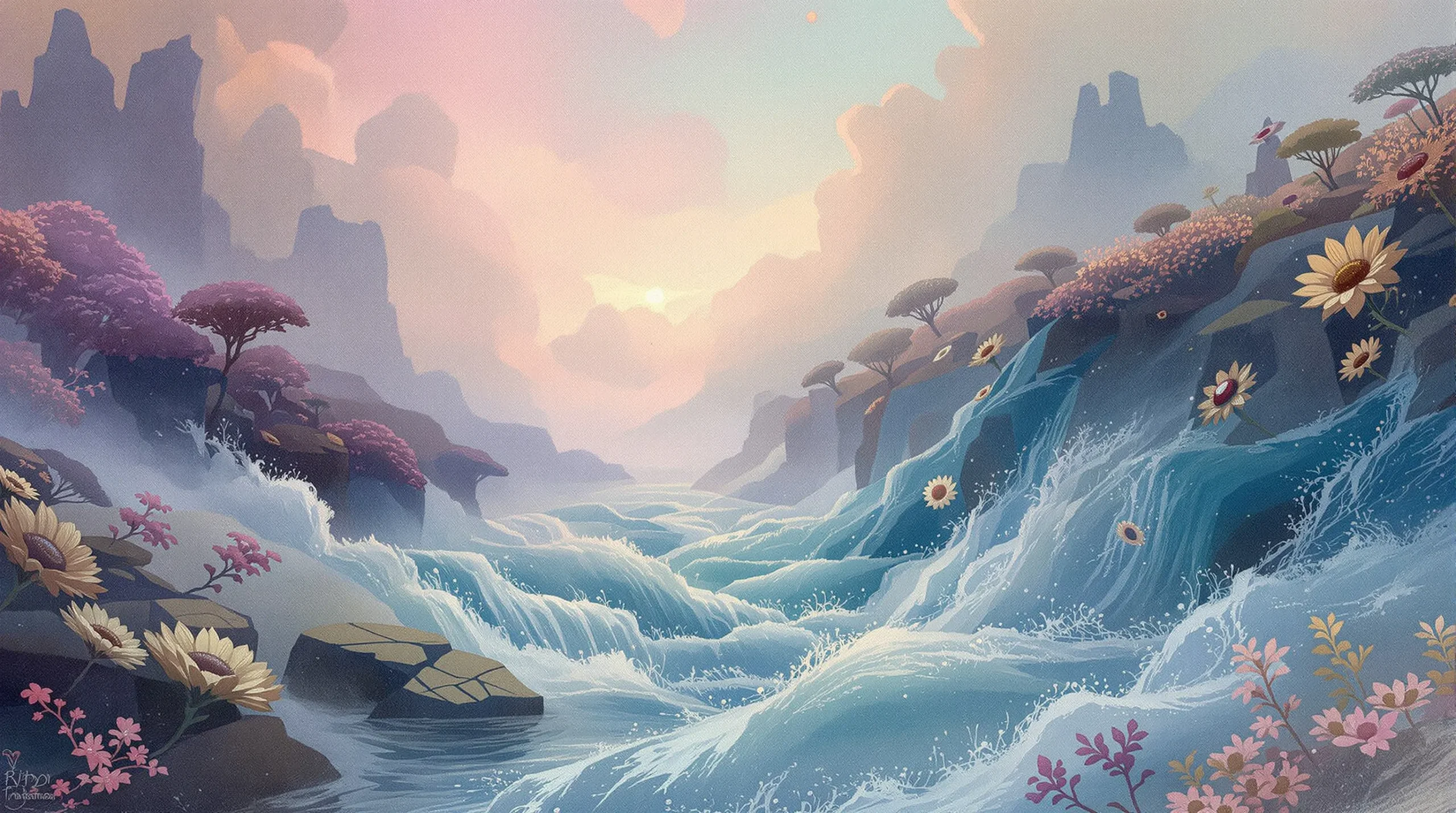


River

Archetype Meaning & Symbolism

Flowing, relentless, adaptable, carving, nourishing, destructive, ancient, meandering, purifying, boundary-defying, reflective

  • Do not mistake my yielding for weakness. I have shaped canyons with my patience.

If River is part of your personal mythology, you may...

Believe

  • The obstacle is the path; resistance is what carves the way forward.
  • The path of least resistance is not laziness, but the highest form of strategic wisdom.
  • True strength is not about being immovable, but about being unstoppable.

Fear

  • Stagnation: becoming a fetid, motionless pool, cut off from the source of life.
  • Being dammed: having one's natural flow, purpose, or expression blocked by external forces or internal inhibitions.
  • Drying up: a loss of passion, vitality, and creative energy, leaving an empty channel where life used to be.

Strength

  • Resilience: the ability to absorb shocks, navigate obstacles, and find a new path when the old one is blocked.
  • Adaptability: a profound capacity to change form to suit the environment, to be gentle in one moment and powerful in the next.
  • Patience: a deep, intuitive understanding that great change is accomplished not through force, but through persistent, unrelenting application of gentle pressure over time.

Weakness

  • Lack of direction: without clear banks, the tendency to spread too thin, becoming a marshy, ineffective swamp with no clear purpose.
  • Emotional erosion: a tendency to wear down others or oneself through relentless emotional expression or constant change, leaving relationships depleted.
  • Passivity: mistaking the path of least resistance for a lack of agency, allowing the currents of circumstance to dictate one's entire life without asserting any direction.

The Symbolism & Meaning of River

The River is, perhaps foremost, a symbol of time's relentless passage. It flows in one direction, an irreversible current pulling the present out of the future and into the past. In your personal mythology, to align with the River is to make a certain peace with this inevitability. It is to understand your life not as a series of static photographs but as a single, long exposure. Events are not destinations but points along the bank, and your story is the water moving past them. This archetype invites you to release the illusion of control, to cease swimming against the current of what is, and instead to learn the art of navigating the flow you have been given.

This archetype also speaks profoundly to the nature of boundaries. A river is a boundary: it separates two sides of a valley, two ecosystems, even two nations. Yet it is a living, permeable boundary that connects more than it divides, carrying silt from the mountains to nourish the delta. For the individual, this may symbolize the fluid nature of identity. The banks of the self are real, they give you direction, but they are not impervious. You are constantly shaped by what flows into you from others, and you in turn shape the landscapes you move through. The River archetype questions the notion of a fixed, isolated self, suggesting instead a self that is a conduit, a meeting place of currents.

Finally, the River is a powerful metaphor for purification and renewal. The phrase “you cannot step into the same river twice” points to its constant state of becoming. It carries away debris, its movement aerates and cleanses, its floods deposit fertile soil for new growth. When this archetype is active in your mythos, you might find a deep capacity for letting go. Grudges, old identities, and past pains are not held onto but are allowed to be carried downstream. It is the belief in emotional metabolism: the constant process of taking in experience, absorbing what is nourishing, and releasing the rest back into the great flow.


River Relationships With Other Archetypes

The Mountain:

The River and The Mountain exist in a timeless, dynamic tension. The Mountain stands for permanence, stillness, and unwavering identity, while the River represents change, movement, and adaptation. The River is born from The Mountain's heights and spends its existence wearing The Mountain down. In a personal mythos, this relationship might represent the interplay between one's core, unchangeable self (The Mountain) and the ever-evolving narrative of one's life (The River), a dance of erosion and resistance that shapes the landscape of the soul.

The Bridge:

The Bridge is an archetype of connection and transition, one that owes its existence to the challenge posed by the River. Where the River represents a natural boundary or a divide, The Bridge is the human-made, intentional act of crossing it. For an individual, the River could symbolize a difficult life passage or a psychological barrier, while The Bridge archetype represents the tools, relationships, or conscious choices they build to overcome that separation and integrate disparate parts of their life.

The Vessel:

The Vessel, be it a simple raft or a mighty ship, represents the self that navigates the currents of life, which is the River. The River provides the path and the power, but The Vessel determines the journey's quality through its own resilience, direction, and purpose. One might have a strong life current (a powerful destiny or circumstance), but without a well-built Vessel (a strong sense of self, skills, or support), one is merely tossed about. The two archetypes together explore the relationship between fate and free will.

Using River in Every Day Life

Navigating Career Transitions:

When your professional life feels dammed up, the River archetype could suggest a path of least resistance. Instead of forcing a promotion or clinging to a stagnant role, you might meander, exploring adjacent opportunities or even a complete change of industry, trusting that the current of your skills and passions will eventually carve a new, more fulfilling channel.

Healing from Emotional Trauma:

The River teaches that grief, like water, must move. To embody this archetype is to allow sorrow to flow through you rather than pooling into a stagnant swamp of resentment. It could mean creating rituals of release, seeking the confluence of community for support, and understanding that the constant movement, even if turbulent, is a form of purification.

Creative Block:

For the artist, the River offers a metaphor for overcoming creative inertia. It may suggest that inspiration isn't a single flood, but a constant, subtle current. This could involve shifting from grand projects to a daily practice, a small "trickle" of effort that, over time, gathers momentum and erodes the most stubborn creative obstacles, eventually becoming a powerful force.

River is Known For

The Journey, Not the Destination

A river has a source and a mouth, but its essence is the continuous movement between them. It is known for its perpetual journey, a symbol for life's unfolding process and the futility of fixating on a final endpoint.

Carving the Landscape

Through relentless, patient erosion, a river shapes the very earth it travels through. It is known for its power to create canyons, valleys, and deltas, a testament to the transformative force of persistent, gentle pressure.

A Source of Life and Danger

Rivers are cradles of civilization, providing water, sustenance, and transport. Yet, they are also capable of devastating floods. This duality, its capacity to both nurture and destroy, is a core aspect of its identity.

How River Might Affect Your Personal Mythology

How River Might Affect Your Mythos

When the River flows through your personal mythos, your life story may cease to be a sequence of discrete chapters and become a single, fluid narrative. The emphasis shifts from the peaks of achievement and the valleys of despair to the quality of the current that connects them all. Your mythos is not about where you ended up, but how you traveled: the tributaries of curiosity you explored, the patient way you navigated the oxbows of confusion, the force with which you broke through obstacles. This perspective frames your story as a journey with its own internal logic and momentum, relieving you of the burden of judging each moment in isolation.

The River archetype could also imbue your personal mythos with a sense of the epic, a connection to source and sea. Your individual life story may feel like a single tributary originating from a vast, mysterious source: your ancestry, your culture, the collective unconscious. And it flows toward an equally vast mouth, a return to the oceanic oneness of existence. This reframes personal struggles and triumphs not as isolated events, but as part of a grand water cycle of being, a story that began long before you and will continue long after you.

How River Might Affect Your Sense of Self

An identity shaped by the River archetype is, by its nature, fluid. You may see yourself less as a fixed object, a statue to be perfected and preserved, and more as a process. This could foster a profound resilience, an ability to adapt your shape to fit the containers of circumstance without losing your essential nature. The pressure to maintain a consistent persona from one decade to the next might dissolve, replaced by a curiosity about who you are becoming. The self is not a noun, but a verb: a continuous act of flowing.

Furthermore, you might perceive your own agency differently. Power is not seen as the ability to exert sudden, brute force, but as the capacity for persistent, gentle influence. Your sense of self-worth may be tied to your endurance, your ability to wear away at a problem over years, to shape your environment through quiet, relentless presence. This cultivates a deep patience with your own growth, understanding that the most profound changes in the landscape of the self are carved over immense stretches of time.

How River Might Affect Your Beliefs About The World

To see the world through the lens of the River is to see it as a vast, interconnected watershed. No event is isolated. A political decision upstream has social and economic consequences downstream. A personal kindness ripples out in unpredictable ways. This perspective could foster a holistic, systems-based understanding of reality, where problems are not seen as localized failures but as imbalances in a larger flow. It is a worldview that demands ecological thinking, not just about nature, but about societies, families, and the psyche.

This archetype may also cultivate a deep acceptance of impermanence as the fundamental state of reality. The world is not a fixed stage but a dynamic, ever-changing process. Floods and droughts are not aberrations; they are part of the cycle. This worldview could lead to a kind of pragmatic mysticism, a trust in the process even when it is chaotic or destructive. It replaces the desire for static security with a confidence in one's ability to navigate the currents of change, finding stability in motion itself.

How River Might Affect Your Relationships

In relationships, the River archetype suggests a dynamic of confluence. You might see partners, friends, and family not as possessions or fixed points of support, but as other rivers merging with your own. Each confluence changes the character of your flow, adding new volume, speed, or sediments. Some relationships are like brief, turbulent rapids; others are long, slow meanders. This view honors the co-creative nature of connection, where both parties are continuously shaping and being shaped by the shared journey.

Boundaries in these relationships might be understood as riverbanks: essential for providing direction and preventing a diffuse, aimless swamp, but also naturally permeable and subject to change over time. A healthy relationship has banks strong enough to contain the flow, but soft enough to allow for growth and shifting course. This archetype encourages a flexible approach to commitment and intimacy, one that values both the integrity of each individual current and the beautiful, complex patterns they create by flowing together.

How River Might Affect Your Role in Life

Your perceived role in life, be it in family or career, may shift from a static position to a dynamic function. You are not a 'manager' but a conduit for your team's energy and ideas. You are not a 'parent' but a channel through which love, guidance, and resources flow to your child. This perspective emphasizes your role as a facilitator of a process larger than yourself. It can relieve the ego's burden of ownership and control, reframing your purpose as one of stewardship: to maintain the health of the channel and ensure the flow is clear and strong.

This focus on function over title could also lead to a more adaptive professional or social life. Instead of identifying with a single job title, you might identify with the current of your skills and passions, which can flow into various channels throughout your life. Your role is not defined by the name on your office door but by the effect your presence has on the systems you move through. It is an identity based on the verb of your contribution rather than the noun of your position.

Dream Interpretation of River

In a positive context, a dream of the River may symbolize a harmonious alignment with the flow of your life. To see a clear, sparkling river moving with purpose could reflect emotional clarity, creative vitality, and a sense of being on the right path. Swimming easily with the current might suggest that you are successfully navigating your circumstances with grace. Successfully crossing a river, perhaps on a sturdy bridge or in a boat, could signify a triumphant passage through a major life transition, having overcome the obstacles it presented.

A river in a dream can also carry a warning. A dark, muddy, or turbulent river might represent overwhelming emotions, a state of confusion, or a life that feels out of control. To be drowning or swept away by the current could indicate feelings of powerlessness in the face of external pressures or internal turmoil. Dreaming of a dam, a blockage, or a dried-up riverbed may be one of the most potent symbols: it could point to creative stagnation, emotional repression, or a profound loss of life force and purpose. It is the psyche's call to find the source again, to break down what is holding you back.

How River Archetype Might Affect Your Needs

How River Might Affect Your Physiological Needs

When the River is part of your personal myth, your relationship with your body's most basic needs may become a sacred practice. The need for water, for instance, is not just a biological imperative but a ritual of purification and flow. You may feel that drinking a glass of water is a way of replenishing your inner current, of washing away physical and energetic debris. Illness might be interpreted as a blockage or stagnation in the body’s internal waterways, prompting a focus on circulation, hydration, and cleansing to restore health.

This archetype could also foster a deep connection to the rhythms of the body. The circulation of blood, the ebb and flow of breath, the tidal pulls of hormones: all may be seen as expressions of an inner river system. Practices that enhance this flow, such as cardiovascular exercise, dance, or breathwork, could feel less like chores and more like acts of devotion to the current of life moving through the physical self. The body is not a static machine but a living, flowing ecosystem.

How River Might Affect Your Ideas of Belonging

Belonging, through the lens of the River, is not about being rooted in one place but about being part of a larger flow. A sense of connection comes from joining a current bigger than yourself: a community, a social movement, a shared tradition. Love and intimacy may be seen as a confluence, a merging of two life streams that creates a new, more powerful river. The goal is not possession or static unity, but a shared journey, a harmonization of currents moving toward a common sea.

This perspective might also challenge conventional ideas of belonging. A river is, in a sense, a perpetual traveler, belonging to the entire watershed rather than any single location. You may feel a greater sense of belonging to the journey of life itself than to a specific town or tribe. Love could be expressed as the act of supporting another's flow, clearing their path of debris, and celebrating their momentum, even if their current eventually carries them in a different direction. It is a belonging based on flow, not fixity.

How River Might Affect Your Feelings of Safety

For one who identifies with the River, safety is not found in walls or fortifications but in momentum. The most secure state is to be in motion, able to adapt and move around or through obstacles. This might manifest as a life strategy focused on flexibility and resourcefulness over the accumulation of static assets. Safety is having a diverse skillset that can be applied in many environments, or an emotional resilience that allows you to get back into the current after being thrown onto the bank. It is the security of water, which cannot be broken or permanently contained.

However, this archetype also brings a keen awareness of hidden dangers. Safety means respecting the river's power. It involves understanding undercurrents, the potential for flash floods, the dangers lurking beneath a calm surface. In life, this translates to a healthy capacity to perceive the hidden dynamics in social situations or the unstated risks in a business venture. You may develop an intuitive sense for what lies beneath the surface, recognizing that true safety lies not in ignoring danger, but in understanding its nature and navigating it wisely.

How River Might Affect Your Views of Esteem

Self-esteem rooted in the River archetype is derived from persistence, not from singular victories. The river's glory is not in any single wave but in its relentless, patient journey that carves canyons from stone. Your self-worth, then, may be tied to your own endurance, your quiet dignity in the face of erosion, your ability to keep moving forward no matter the obstacle. It is the profound confidence of water: soft enough to yield, but powerful enough to wear down mountains. This fosters an esteem that is resilient to failure, as any single setback is just a bend in the river, not its final destination.

Adaptability itself becomes a core source of pride. The ability to be gentle or forceful, shallow or deep, swift or placid as the situation requires is a mark of mastery. Your esteem may not come from having a rigid, unchanging character, but from having a fluid, responsive one. You respect yourself for your capacity to fit new containers, to navigate unfamiliar terrain, and to absorb change without losing your fundamental direction. Your value is in your dynamic nature, not in a static state of perfection.

Shadow of River

The shadow of the River emerges as a destructive, uncontrolled flood. This is change for its own sake, a restless inability to commit, eroding all stability in one's life and the lives of others. It becomes a torrent of unchecked emotion, overwhelming reason and drowning healthy boundaries. This shadow aspect might manifest as a person who creates chaos wherever they go, justifying their relational wreckage as "going with the flow," when in fact they are a flash flood, leaving a trail of debris and heartache without accountability. They use fluidity as an excuse for unreliability, and their relentless movement becomes a flight from intimacy and responsibility.

The opposite shadow is stagnation. The River becomes a dammed, stagnant pool, choked with algae and decay. This could be a person who fears change so profoundly that they cut themselves off from life's current, refusing new experiences, and allowing their skills and relationships to atrophy. They may cling to past grievances and old narratives, creating a toxic inner environment. This is depression as a dry riverbed, a landscape of potential and past vitality now barren and lifeless, haunted by the memory of a flow that no longer exists.

Pros & Cons of River in Your Mythology

Pros

  • A natural ability to navigate life's changes with grace and flexibility.
  • A deep well of patience and persistence that allows for the achievement of long-term goals.
  • An intuitive understanding of complex systems and the interconnectedness of life.

Cons

  • A potential for emotional instability or being easily overwhelmed by circumstance.
  • Difficulty establishing firm boundaries or maintaining a stable sense of self.
  • A tendency to avoid direct confrontation, preferring to wear down obstacles rather than face them head-on, which can be inefficient or passive-aggressive.