The Tickbird
On the vast, armored landscape of the Rhinoceros's back, the Tickbird may appear as a skittish afterthought, a nervous courtier to an indifferent king. Yet, this relationship could be a kind of chattering covenant, a necessary alliance between blunt force and nuanced perception. The Rhinoceros, in its magnificent, earth-shaking progress, is perhaps blind to the smaller, burrowing worries of the world—the parasites of doubt, the whispers of distant threats. The Tickbird, in turn, subsists on these very anxieties, its sharp eyes and sharper beak providing a service of irritating precision. It is the critic whose insights are tolerated for their utility, the voice of pragmatic detail that the great, charging soul cannot afford to ignore. This pairing suggests that even the most self-contained power may rely on an external conscience, a fragile truce between the grand, singular path and the vital, peripheral truths it would otherwise trample underfoot.
The Savanna
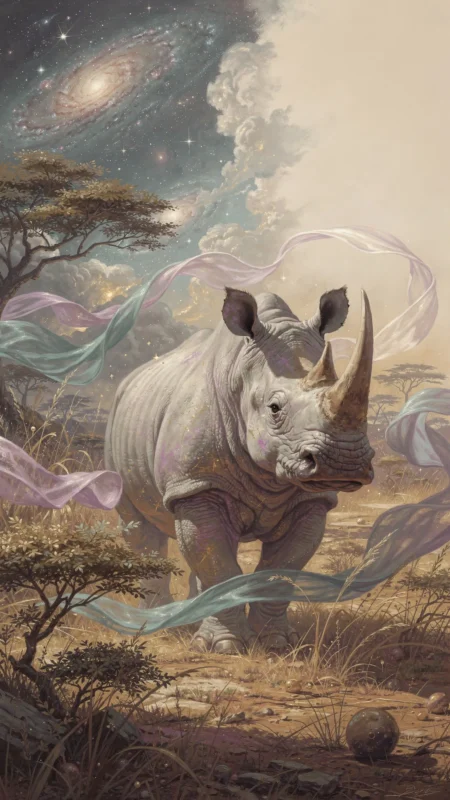
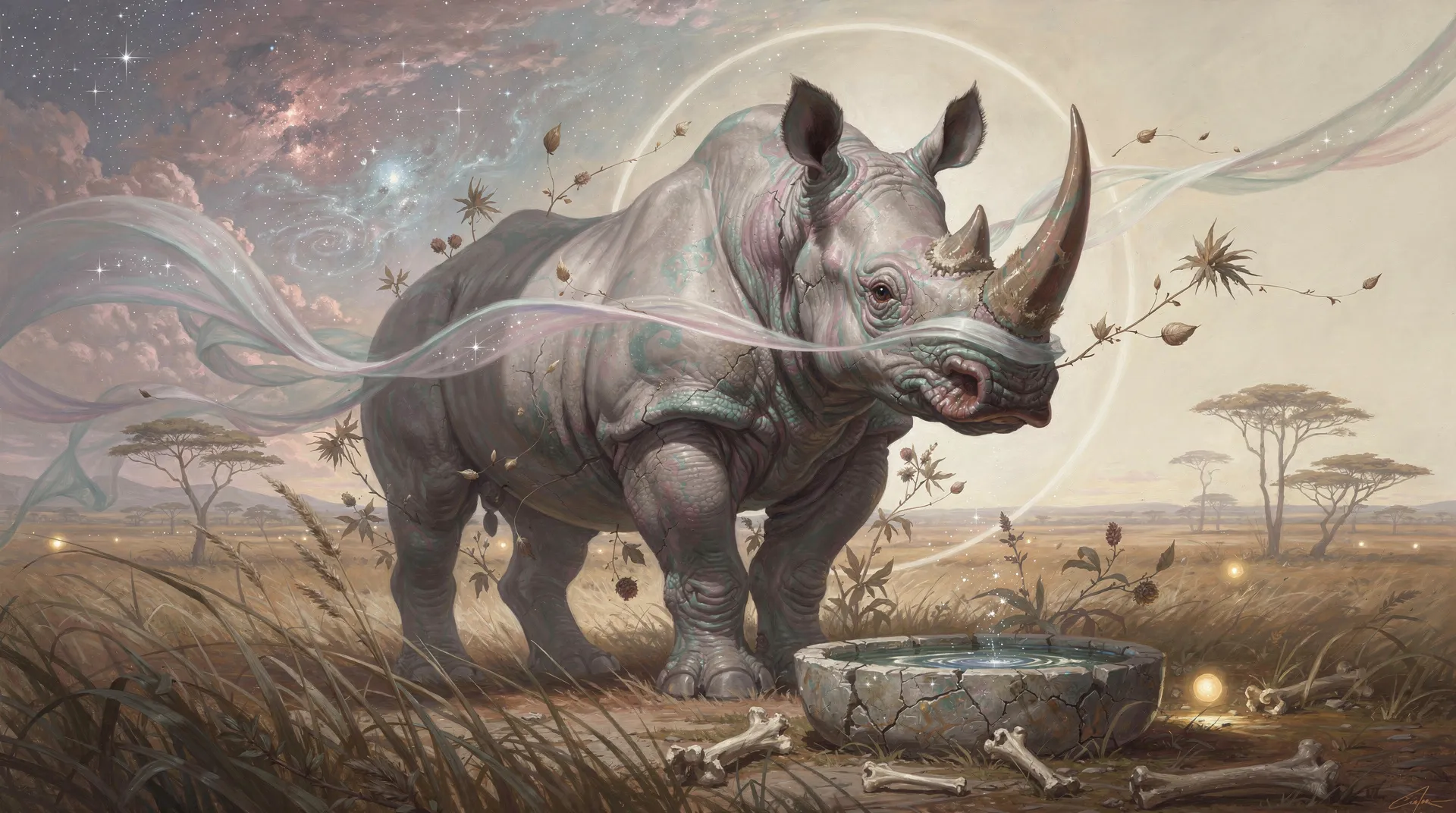
The Savanna is not merely a stage for the Rhinoceros, but its co-author, the silent, sprawling partner in its creation. Its vast, sun-bleached emptiness may be what necessitates the creature's myopic focus; to truly comprehend the horizon in its entirety could be to be paralyzed by it. The Savanna is the grand, indifferent canvas upon which the Rhinoceros’s dusty, singular trail is etched—a testament to a will imposed upon a world of profound passivity. It is the silence that amplifies the thud of its footfalls, the heat that forges its impervious hide. Perhaps the Savanna represents the overwhelming scale of a life's project or the market's stark indifference, a context that demands a narrow, powerful, and almost brutal dedication to carve out a space for oneself. The Rhinoceros does not conquer the Savanna so much as it endures it, its very form a response to the quiet, crushing challenge of immensity.
The Fog
When the world dissolves into a soft, grey ambiguity, the Rhinoceros may encounter its most profound adversary: the Fog. An archetype of pure, forward momentum finds itself adrift in a realm without landmarks, its power rendered directionless. The Fog could symbolize those seasons of existential doubt, the crisis of purpose that can stall even the most resolute spirit. The creature's great horn, normally an instrument of decisive, piercing action, becomes a tentative probe into an unknown that yields no resistance and offers no clarity. It is in this relationship that the Rhinoceros’s reliance on raw instinct over sight is most severely tested. Here, the titan of the tangible is humbled, a lonely, lumbering shape navigating a world that has lost its hard edges, its absolute certainties, suggesting that the greatest threat to a charging force is not a barrier, but the utter loss of a path.

 Believe
 Fear
Fear Strength
 Weakness