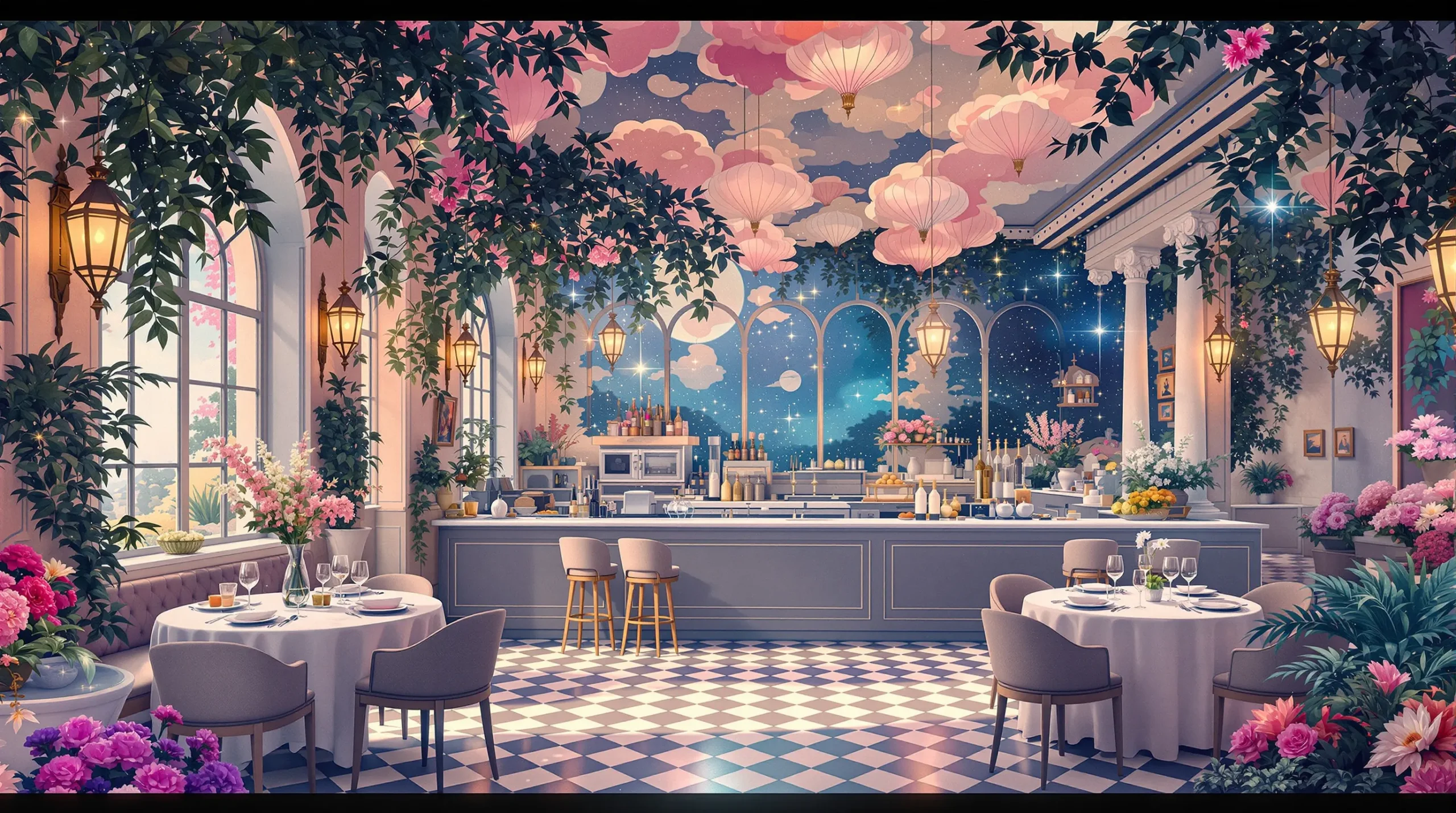


Restaurant

Archetype Meaning & Symbolism

Communal, transactional, nourishing, performative, structured, fleeting, sensory, hierarchical, predictable, comforting

  • The menu is not the meal. It is a map of hungers you have not yet named. Choose wisely, for every order is a world.

If Restaurant is part of your personal mythology, you may...

Believe

  • Life offers a menu of possible experiences, and personal growth lies in developing a more refined palate.

    The best way to build community is to reserve a table and break bread together.

    Every interaction is a kind of transaction, and it is important to understand the terms of the exchange.

Fear

  • That your needs will not be met, or that what you truly hunger for is not on the menu.

    Being presented with a bill that you are unable to pay, symbolizing a broader failure to meet obligations.

    The deep loneliness of being a single diner in a room full of laughing, connected people.

Strength

  • A masterful ability to navigate diverse social situations by understanding their unspoken rules and roles.

    A deep appreciation for craft, presentation, and the creation of curated experiences for yourself and others.

    The capacity to make decisive choices from a limited set of options, trusting your own taste and intuition.

Weakness

  • A tendency to view relationships through a transactional or consumerist lens.

    A discomfort with unstructured, chaotic, or 'messy' situations that don't come with a clear menu.

    A potential over-reliance on external validation and commercialized experiences for a sense of belonging and self-worth.

The Symbolism & Meaning of Restaurant

In the personal mythos, the Restaurant may represent a third space, a realm that is neither the private sanctuary of Home nor the chaotic wilderness of the World. It is a curated, semi-public stage where we perform versions of ourselves. Here, we are customers, patrons, critics: roles defined by the act of choosing and consuming. The Restaurant could symbolize a desire for experiences that are crafted for us, a longing for a world where our needs are anticipated and met, for a price. It is the place we go when the labor of our own kitchen feels too heavy, seeking not just food, but to be cared for in a structured, predictable way.

This archetype also speaks to the nature of choice within a system. The menu, no matter how extensive, is always finite. One's mythology might be shaped by this reality: life offers a vast but ultimately limited set of options. Personal freedom, then, is not about having infinite possibilities but about developing the 'palate' to choose wisely from what is available. The Restaurant teaches that taste is a form of identity. What we order—what experiences, relationships, and beliefs we consume—says something fundamental about who we are, or at least who we are performing as in that moment.

Furthermore, the Restaurant is a microcosm of society. It contains hierarchies (chef, server, busboy, customer), economies, and unspoken social codes. To have the Restaurant archetype active in your mythology could mean you are acutely aware of these structures. You may see life as a series of social contracts and exchanges. It could foster a deep appreciation for craft, service, and the complex machinery of human cooperation that allows such a space to exist, a place where strangers gather to fulfill one of life's most basic, and most profound, rituals.


Restaurant Relationships With Other Archetypes

The Home

The Restaurant exists in a dynamic tension with the Home. While both offer nourishment, Home's is ideally unconditional, born of love and duty, messy and beautifully imperfect. The Restaurant's nourishment is transactional, polished, and performative. It is a refuge from the emotional complexities of the Home kitchen, offering a fantasy of effortless sustenance. If Home is where you must be yourself, the Restaurant is where you can be anyone you choose to be, for as long as you can pay the bill.

The Marketplace

The Restaurant is a specialized boutique within the grand Bazaar of the Marketplace. The Marketplace offers raw ingredients, potential, the chaotic promise of everything. The Restaurant takes those raw goods and transforms them through craft and fire, selling not just a product, but a finished, curated experience. For a person whose mythos includes the Restaurant, the raw potential of the Marketplace may feel overwhelming; they might prefer a world that has already been interpreted, plated, and presented for their convenience and delight.

The Stage

Every restaurant is a theater. There is a front-of-house and a back-of-house, a cast of characters playing their roles, and an audience (the diners) who are also part of the performance. The relationship is symbiotic. The diner performs the role of the gracious or demanding patron; the server performs the role of the attentive guide. For someone with this archetype, life may feel like a series of scenes set in different locations, with costumes, scripts, and prescribed interactions. Authentic connection might be confused with a flawless performance.

Using Restaurant in Every Day Life

Navigating Social Choices

When faced with a complex social situation, you might frame it as entering a specific kind of restaurant. A formal business negotiation is a Michelin-starred establishment with a strict tasting menu: the rules are set, the roles are clear, and performance is key. A casual get-together with old friends is the beloved neighborhood diner: the menu is familiar, comfort is the goal, and you know exactly what to order. This allows you to adjust your behavior, expectations, and 'performance' to suit the unspoken rules of the space.

Cultivating New Relationships

To deepen a new friendship or romance, you could consciously use the archetype to create a shared experience. Instead of defaulting to the same 'safe' option, you might choose a restaurant that represents a desired quality: a chaotic, lively tapas bar to encourage spontaneity and sharing, or a quiet, intimate bistro to foster deep conversation. The restaurant itself becomes a third party in the relationship, a container that shapes the nature of the time spent together and builds a memory tied to a specific taste and place.

Making Life Decisions

When contemplating a major life change, like a career shift or a move, you could approach it as studying a menu in a foreign country. You don't recognize all the ingredients, you can't be certain you'll like the outcome, and there's a risk involved. The act of choosing becomes a practice in trusting your intuition, your 'palate' for life. It encourages you to ask: am I ordering what I think I *should* have, or am I ordering the dish that truly calls to my deepest hunger, regardless of how unfamiliar it seems?

Restaurant is Known For

The Menu

A symbol of both possibility and constraint. The menu presents a curated world of choices, defining the boundaries of the experience. It is a pact between the provider and the consumer, a declaration of what is possible within this specific time and place. To choose from it is to exercise agency.

The Table

The sacred space of communion and separation. It is where stories are exchanged, deals are struck, and bonds are forged over the ritual of a shared meal. A single table can be an island of intimacy in a sea of strangers, a temporary territory where a private world is built in a public space.

The Transaction

The fundamental exchange of value that underpins the entire experience. This is not merely financial. It is an exchange of service for gratitude, of craft for appreciation, of ambiance for presence. It acknowledges that this comfort, this nourishment, is conditional and requires a reciprocal act.

How Restaurant Might Affect Your Personal Mythology

How Restaurant Might Affect Your Mythos

When the Restaurant archetype shapes a personal mythos, one's life story may be perceived not as a journey or a battle, but as a long series of meals. Significant moments are marked by where they ate, what was ordered, who sat across the table. The narrative arc might be a quest for the perfect dish: the one experience, job, or relationship that will finally satisfy a deep, ineffable hunger. The protagonist of this mythos is a connoisseur of life, a seeker of taste and refinement, and perhaps a critic of all that is served to them. Their character development could be charted by the evolution of their palate, moving from the simple comforts of a diner to the complex, challenging flavors of haute cuisine.

This mythos may also be profoundly episodic. Each visit to a 'restaurant'—each new job, city, or social circle—is a self-contained scene with a clear beginning (being seated), middle (the meal), and end (paying the bill). This can create a sense of life as a collection of distinct experiences rather than a single, flowing narrative. The challenge for the individual is to find the common thread, the recurring flavors and themes that link these disparate meals into a cohesive story. Otherwise, their mythos risks becoming a scrapbook of menus from places they've been, rather than the epic tale of the person who dined there.

How Restaurant Might Affect Your Sense of Self

An individual influenced by the Restaurant archetype may view the self as something to be curated and presented, much like a dish. The self is not a fixed entity but a collection of tastes, preferences, and experiences that are chosen and assembled. Identity could feel like a menu from which one selects traits: 'tonight I will be sophisticated,' 'tonight I will be adventurous.' This can lead to a fluid and adaptable persona, but also a potential disconnect from an authentic, core self that exists independent of its 'presentation' to others.

Furthermore, the sense of self might be tied to the role one plays within the restaurant drama. One might identify as the 'Patron,' whose worth is defined by their ability to choose, consume, and pay. Or they could see themselves as the 'Chef,' a creator who finds meaning in nourishing others, but perhaps remains unseen. They might also resonate with the 'Server,' the ultimate intermediary, facilitating experiences for others while navigating their own needs. The self becomes defined by its function within a system of service and consumption.

How Restaurant Might Affect Your Beliefs About The World

A worldview colored by the Restaurant archetype might see society as a grand, sprawling establishment with endless dining rooms. In this view, everything has a price, and every experience is a service being rendered. It can foster a sophisticated, albeit cynical, understanding of social dynamics, recognizing the hidden transactions and performances that structure our interactions. The world isn't a place of random chaos or divine will, but a system of menus, reservations, and bills. Justice might be seen as everyone getting what they 'ordered,' and inequality as some people having access to better tables and more extensive menus.

This perspective may also cultivate an appreciation for order and craft. The world could appear as a place of immense potential for well-designed experiences. It fosters a belief that with enough care, attention, and resources, any situation can be transformed into a pleasant and nourishing one. It's a worldview that values ambiance, presentation, and the skill it takes to turn raw reality into something palatable. However, it may struggle with things that cannot be ordered, controlled, or reviewed on a five-star scale: wild nature, untamed emotions, unconditional love.

How Restaurant Might Affect Your Relationships

Relationships may be framed as a series of shared meals. The first date is a risky new restaurant, a marriage is a comfortable booth at a favorite spot, and a friendship could be the easy rhythm of a weekly coffee shop meeting. This can bring a beautiful sense of ritual and deliberate presence to connections. Each shared table is an opportunity to connect, a conscious choice to set aside time and break bread. The act of deciding where to eat together becomes a metaphor for negotiating the direction of the relationship itself.

Conversely, this archetype could introduce a consumerist lens to relationships. One might unconsciously 'review' partners and friends based on the 'service' they provide or the 'experience' they offer. A difficult patch in a relationship might be viewed as a 'bad meal,' leading to a desire to simply leave and find a 'better restaurant' rather than working through the issue with the 'chef.' It risks seeing people as items on a menu, chosen to satisfy a temporary hunger, rather than as fellow diners sharing a long and sometimes unpredictable feast.

How Restaurant Might Affect Your Role in Life

One's perceived role in life could be heavily influenced by the cast of characters in a restaurant. You may feel your purpose is to be the 'Host,' creating welcoming spaces where others can connect and feel at ease. Your role is to set the table for life's important moments, making sure everyone feels they belong. This is a role of facilitation, of creating the container for the experiences of others, finding satisfaction in their satisfaction.

Alternatively, you might feel you are destined to be the 'Critic,' the one whose role is to observe, evaluate, and pass judgment. Your purpose is to uphold standards, to distinguish the exquisite from the mediocre. This is a role of discernment and taste-making, but it can also be an isolating one, placing you outside the shared experience you are judging. There's also the role of the perpetual 'Diner,' who sees their purpose as sampling as much of life's menu as possible, a connoisseur of consumption whose life is defined by a relentless pursuit of the next new flavor.

Dream Interpretation of Restaurant

In a positive context, dreaming of a restaurant may symbolize abundance, choice, and social nourishment. A dream of being seated at a beautiful table with a rich menu could suggest that a period of new opportunities and rewarding choices is on the horizon. If you are dining with loved ones, it might reflect a feeling of deep connection and community in your waking life. Being served a delicious meal could represent a sense of being cared for and your needs being met. It is an affirmation that you are worthy of sustenance and pleasure.

In a negative light, a restaurant in a dream could manifest anxieties about social performance, scarcity, and unmet needs. Dreaming of a restaurant with no food, a confusing menu, or terrible service might point to feelings of frustration and a lack of viable options in your life. Being alone in a crowded restaurant could symbolize loneliness and alienation. A dream where you cannot pay the bill is a classic anxiety dream, perhaps representing a fear of being exposed as inadequate or unable to meet your obligations. A dirty or chaotic kitchen could suggest a deep unease about what is going on 'behind the scenes' in a situation or relationship.

How Restaurant Archetype Might Affect Your Needs

How Restaurant Might Affect Your Physiological Needs

The Restaurant archetype takes the physiological need for food and elevates, or complicates, it into an aesthetic and social ritual. If this archetype is strong in your mythos, you may find that simple sustenance is rarely enough. The *how* and *where* of eating become as crucial as the *what*. This could lead to a highly refined palate and a deep appreciation for the art of cuisine, turning a basic need into a source of profound pleasure and intellectual engagement. Your body may feel more nourished by a beautifully prepared meal in a calming environment than by a more nutritious meal eaten hastily under fluorescent lights.

However, this can also create a disconnect from the body's simple signals of hunger and satiety. The need for food may become entangled with the need for a specific *experience*, leading one to ignore hunger until the 'perfect' dining opportunity arises. It might also foster a dependence on external sources for nourishment, potentially diminishing one's own ability or desire to cook—the fundamental act of feeding oneself. The body's needs become outsourced, dependent on a system of commerce and service rather than personal skill and intuition.

How Restaurant Might Affect Your Ideas of Belonging

The Restaurant can be a potent engine of belonging. Being a 'regular' at an establishment, where your name is known and your usual order is remembered, provides a powerful, almost tribal sense of inclusion. It's a chosen community, a place outside of home and work where you are recognized and have a place. Sharing a meal with friends or family at a table creates an island of intimacy, a temporary 'us' in a room full of 'them.' This archetype provides a clear, structured method for forging and maintaining social bonds through the ancient ritual of breaking bread.

Yet, it can also be a source of profound alienation. The image of the single diner in a bustling restaurant is a classic trope of loneliness for a reason. It highlights one's solitude against a backdrop of communion. The archetype can also foster a conditional and performative sense of belonging. You belong as long as you can afford the meal and play the part. It can create social anxiety around being at the 'right' restaurant, with the 'right' people, turning the pursuit of connection into a competition for status rather than a search for genuine intimacy.

How Restaurant Might Affect Your Feelings of Safety

For many, the Restaurant represents a predictable and controlled environment, a bastion of safety. The rules are clear, the roles are defined, and there is a tacit agreement that for the duration of the meal, you are a guest to be cared for. This can provide a powerful sense of security, a temporary reprieve from a chaotic world where you are responsible for your own well-being. The menu itself is a form of safety: a promise of what is to come, reducing the anxiety of the unknown. To have this archetype is to seek out and create these pockets of reliable order.

The shadow side of this safety is its transactional nature. The care and security are conditional upon your ability to pay and your adherence to social norms. This safety is not a right, but a service purchased. This can instill a background hum of anxiety: the fear of the bill, of being 'cut off,' of making a social misstep that results in your expulsion from the safe space. It may also lead to a distrust of safety that isn't contractual, a skepticism toward unconditional care because the dominant model in one's mythos is one of explicit exchange.

How Restaurant Might Affect Your Views of Esteem

Esteem needs can be readily met within the Restaurant framework. The simple act of being waited on—of having your choices honored and your needs attended to—can be a powerful affirmation of self-worth. It says, 'for this moment, you are important.' Developing a sophisticated palate and being seen as a person of 'good taste' can also be a significant source of esteem, a way of demonstrating cultural capital and refinement. Being able to host others, to 'treat' them to a fine meal, positions you as a provider and a person of means, directly boosting feelings of competence and social standing.

However, this reliance on external validation can make esteem fragile. Its foundation is built on your capacity as a consumer or your performance within a specific social role. A declined credit card, a clumsy social error, or being snubbed for a reservation can feel like a devastating blow to one's core identity. It may also lead to a comparative and competitive mindset, where self-worth is measured by the exclusivity of the restaurants one can access or the perceived quality of one's choices, trapping a person in a cycle of seeking validation through consumption.

Shadow of Restaurant

The shadow of the Restaurant emerges when consumption replaces connection. It is the pursuit of status over sustenance, where the goal is not to be nourished but to be seen in the right place, ordering the right thing. This shadow turns the sacred act of eating into a competitive sport. It manifests as the ghost kitchen: a placeless, faceless transaction devoid of ambiance or human interaction, delivering a product with maximum efficiency and minimal soul. It is the belief that anything can be ordered on demand—experiences, comforts, even relationships—and that everything can, and should, be rated, reviewed, and algorithmically optimized, stripping the world of its mystery and texture.

The other, darker shadow is the one that exists behind the kitchen doors. It is the willful ignorance of the labor, the stress, and the often-exploitative hierarchies that make the serene dining room experience possible. It is enjoying the meal without a thought for the hands that prepared it. In a personal mythos, this shadow can manifest as a sense of entitlement, a belief that one's comfort should be produced by an invisible, tireless machine. It creates a profound disconnect between the pleasure of consumption and the reality of production, fostering a self-concept that is dangerously detached from the interdependent web of human effort that sustains it.

Pros & Cons of Restaurant in Your Mythology

Pros

  • It provides a reliable, structured container for social interaction, making it easier to connect with others.

    It fosters an appreciation for craft, ritual, and the sensory pleasures of a well-made experience.

    It offers a clear model for understanding choice, transaction, and the performance of social roles.

Cons

  • It can lead to a transactional view of relationships, valuing them for the 'experience' they provide.

    It may create a dependency on external, commercialized spaces for feelings of comfort and belonging.

    It risks fostering anxiety around status, choice, and social performance, masking authenticity.