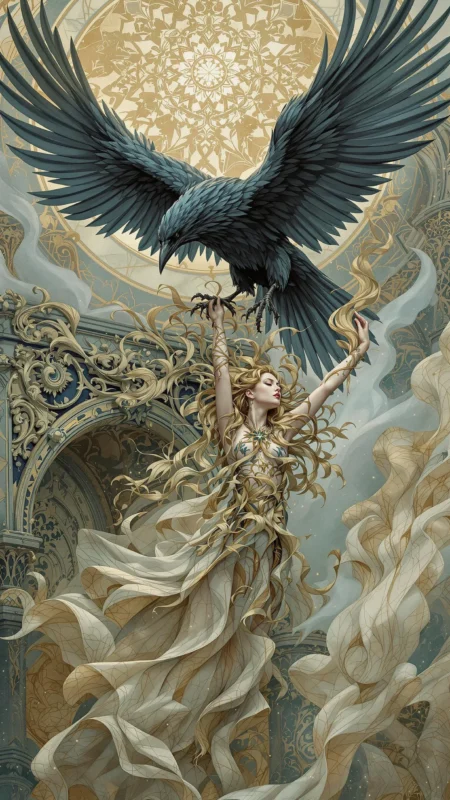
Raven

Archetype Meaning & Symbolism

Intelligent, prophetic, trickster, mysterious, messenger, adaptable, creative, solitary, keeper, liminal

  • I placed the stars in the sky, one by one, after I stole them from the old man who kept them in a box. Creation is often a kind of theft.

If Raven is part of your personal mythology, you may...

Believe

  • You may believe that the void is not empty, but is the source of all potential, and that darkness is a canvas, not a threat.
  • You may believe that secrets are a form of currency, and that true power lies not in what is said, but in what is understood without being spoken.
  • You may believe that humor and trickery are sacred tools, capable of disarming tyrants and revealing truths that sober analysis cannot touch.

Fear

  • You may fear that your intentions will be misunderstood, that your role as a messenger of difficult truths will cause you to be seen as malevolent or ominous.
  • You may fear that your own cleverness is a cage, isolating you from simple, heartfelt connection and trapping you in a world of analysis and strategy.
  • You may fear silence: not the quiet of the void which you love, but the silence that follows when you have spoken a truth so profound or so painful that it leaves everyone, including yourself, speechless.

Strength

  • Your strength is your perspective, an ability to see the interconnectedness of things and the hidden patterns in the chaos, allowing you to navigate complexity with grace.
  • You possess a formidable creative intelligence, a knack for fashioning brilliant, unorthodox solutions from the scraps and shadows that others have discarded.
  • You have a profound resilience, an inner core that is not shattered by darkness or crisis, but is instead sharpened and illuminated by it.

Weakness

  • Your love of secrets and strategy can curdle into manipulation, using your insight to control others rather than to liberate them.
  • You may have a tendency toward intellectual arrogance or emotional aloofness, keeping others at a distance with your wit and appearing cold or inaccessible.
  • You might have a penchant for mischief that crosses the line into disruption, stirring up drama for the sake of the intellectual stimulation it provides, regardless of the emotional cost.

The Symbolism & Meaning of Raven

The Raven does not represent the darkness, but rather the intelligence that thrives within it. It is the flash of insight in the deep of night, the voice that speaks when all else is silent. In personal mythology, the Raven's presence suggests a life story that does not shy away from the void. It embraces the unknown as a place of infinite potential, a blank page upon which a new world can be spoken into existence. To have the Raven as a guide is to understand that magic is not a departure from reality, but a deeper perception of it: seeing the intricate patterns in chaos, hearing the messages carried on the wind, knowing that even the most desolate landscape holds the promise of a clever solution.

This archetype is the patron of the liminal, the threshold-dweller. It speaks to a comfort with paradox: the creator who is also a thief, the messenger of light who is cloaked in shadow, the solitary creature who is a master of communication. For an individual, this may manifest as a life lived in the 'in-between': the artist who is also a scientist, the spiritual leader with a trickster’s sense of humor, the hermit who profoundly shapes their community. The Raven mythos sanctifies ambiguity, suggesting that the most profound truths are not simple declarations but complex, iridescent things that shimmer differently depending on the light.

Furthermore, the Raven symbolizes the transformative power of intelligence and wit. Where others see brute force, the Raven sees a lock to be picked. It is the archetype of the survivor who outsmarts their circumstance, the innovator who fashions a tool from scraps, the storyteller who reframes a tragedy into a lesson. When this bird casts its shadow over your personal myth, it may be a call to rely not on what you have, but on what you know. It champions the mind as the ultimate survival tool, capable of stealing fire from the gods and rearranging the stars in the sky.


Raven Relationships With Other Archetypes

The Scarecrow

In the silent pantomime of the harvested field, The Raven and The Scarecrow may engage in a curious dialogue. The Scarecrow, a hollow sovereign of straw and cast-off garments, is an effigy of human authority, a gesture meant to ward off the very mystery the Raven embodies. Yet the Raven, a chattering, black-feathered skeptic, could see through this ruse, recognizing not a threat but a lonely monument to a fear it does not feel. It perches upon the Scarecrow’s outstretched arm, a living, breathing intellect upon a hollow man, and their relationship becomes a tableau of irony: the persistent, wild truth of nature resting comfortably upon the manufactured, static symbol of its own suppression. It is perhaps a commentary on how true intelligence, that of the trickster and the survivor, is never fooled by the empty uniforms of power.

The Scholar

The relationship between The Raven and The Scholar seems to be one of a perilous and vital transaction. The Raven, a creature of omen and esoteric flight, may carry a shard of obsidian truth in its beak—a message from the liminal spaces, a forgotten word, a premonition. The Scholar, cloistered within the quiet austerity of the archive, yearns for precisely this kind of untamed knowledge, the piece that will not fit neatly upon the shelf. The Raven, then, could be seen as a living, breathing grimoire, offering a wisdom that is both profound and corrupting. It delivers a thought that cannot be un-thought, a memory that cannot be un-remembered. The Scholar may seek the bird’s gnosis, but the exchange is never simple; it is the wild, chaotic poem entering the structured library, and one of them must, in some way, be irrevocably changed.

The Lighthouse

One might say the Raven exists in a state of perpetual negotiation with The Lighthouse. The Lighthouse is a stoic pillar of certainty, a cyclopean eye casting its methodical, sweeping blade of light against the formless dark. It represents reason, safety, a singular, navigable truth in a sea of chaos. The Raven, however, is a creature of that very chaos, a fragment of the velvet night given wings and a voice. It does not flee the beam but rather dances at its periphery, existing comfortably in the momentary shadows between its passes. The relationship, then, is not one of antagonism but of definition. The light of the tower only has meaning because of the profound darkness the Raven inhabits, and the Raven’s mystery is made all the more stark by the brief, piercing clarity that seeks, and always fails, to fully contain it.

Using Raven in Every Day Life

Navigating a Career Transition

When faced with the disorienting void of unemployment or a career crossroads, the Raven archetype encourages seeing this emptiness not as a failure but as a necessary vacuum. It prompts you to become a scavenger of possibilities, picking up glinting bits of opportunity others might overlook: a forgotten skill, a tangential interest, a networking connection that seems obscure. Your path forward may not be linear but a clever, patched-together flight plan only you could devise.

Solving a Creative Block

A blank page or an unsolved problem may feel like a dead end. The Raven suggests a trickster's approach. Instead of confronting the problem head-on, you might steal its power by inverting it, telling the story backwards, or introducing a chaotic, seemingly random element just to see what happens. The solution could be found not in logic, but in a playful act of creative sabotage that breaks the stalemate and lets the light in.

Confronting a Difficult Truth

When a painful truth about a relationship or a personal failing surfaces, the instinct is often to look away. The Raven, as a messenger from the shadowlands, advises you to stare back into its dark eye. It may guide you to deliver a necessary, sharp-pecked truth, or to accept one with stark clarity. This is not about cruelty, but about the profound magic of bringing what is hidden into the light, knowing that only then can true transformation begin.

Raven is Known For

The Trickster Creator

In many First Nations mythologies of the Pacific Northwest, Raven is a central figure who, through cunning, theft, and trickery, brings fundamental elements like the sun, moon, stars, water, and fire to humankind. His actions are not always benevolent in motive, yet they result in the creation of the world as we know it.

Messenger Between Worlds

Across cultures, the Raven is seen as a liminal creature, at home in the space between life and death, the conscious and the unconscious. Its appearance could be an omen, a message from the gods, or a psycho-pomp guiding souls, comfortable in the twilight realms that others fear.

Keeper of Secrets

With its deep intelligence and connection to the mysterious, the Raven is often depicted as a keeper of hidden knowledge. To align with the Raven is to be entrusted with secrets, to understand the power of what is left unsaid, and to be a guardian of profound, sometimes dangerous, truths.

How Raven Might Affect Your Personal Mythology

How Raven Might Affect Your Mythos

When the Raven becomes a central figure in your personal mythos, your life story may cease to be a linear progression and become, instead, a series of brilliant, opportunistic flights. Your narrative is no longer about following a pre-ordained path but about creating one from the ether. Major life events, especially crises, might be reframed as moments where you, like the mythological bird, stole something essential from the darkness: wisdom from loss, opportunity from chaos, a new identity from the ashes of an old one. Your mythos could be one of the clever survivor, the catalyst, the one who saw the glimmer of light in the tightly-shut box and devised a way to release it for everyone.

Your personal history may also be characterized by a dance with the void. Periods of emptiness, confusion, or being an outsider are not chapters of failure but sacred pauses, the deep, silent inhale before a new creation. You might see yourself as a messenger in your own story, carrying vital information from one part of your life to another, or from your inner world to your outer community. The plot of your life might seem episodic and unpredictable to others, but you perceive the hidden thread: a continuous quest for knowledge, a pattern of transforming the very rules of the game you are playing.

How Raven Might Affect Your Sense of Self

To see oneself through the Raven’s eye is to accept, and perhaps even cherish, a profound sense of complexity. You may see yourself as a composite of light and shadow, and you cease to strive for a simple, sanitized version of your being. This archetype fosters an identity that is fluid, adaptable, and comfortable on the periphery. You might not feel the need to be the center of attention, preferring the role of the keen observer who understands the deeper dynamics at play. Self-worth is not tied to conventional success but to your own cleverness, your insight, your ability to navigate the labyrinth of your own psyche.

There may also be a cultivated sense of being a keeper of secrets, both your own and others. This doesn't necessarily imply duplicity, but a deep respect for the power of knowledge and the sanctity of what is hidden. You might see yourself as a bridge, a person who can translate difficult concepts or connect disparate worlds of thought. Your identity is not static; it is a trickster's mask, capable of shifting to meet the needs of the moment while the essential, intelligent self remains constant beneath. You may be the person who speaks the uncomfortable truth, not out of malice, but from a mythic sense of duty to the clarity that only truth can bring.

How Raven Might Affect Your Beliefs About The World

A world-view informed by the Raven is one where the cosmos is fundamentally mysterious and intelligent. It is not a machine to be figured out, but a story to be read, full of symbols, omens, and hidden meanings. Coincidence is rarely just coincidence; it is the universe winking, leaving a breadcrumb trail of shiny objects for the observant to follow. This perspective finds magic in the mundane and sees the fabric of reality as thin in places, allowing messages to pass through from other realms of understanding, whether you call them the subconscious, the collective unconscious, or the spirit world.

This outlook also tends to be skeptical of simple binaries: good and evil, success and failure, sacred and profane. The Raven's world is painted in shades of iridescent black, where a 'good' outcome can arise from a 'bad' action, and creation can be an act of theft. It fosters a perspective that values cunning over force, and wisdom over dogma. The world is not a battlefield to be conquered but a puzzle to be solved, a poem to be interpreted. It is a place where the most powerful act can be a quiet observation, a clever word, or the courageous decision to fly into the storm.

How Raven Might Affect Your Relationships

In relationships, the Raven archetype may foster a deep intolerance for the superficial. You may seek out connections that are transformative, profound, and unafraid of exploring the shadows. These are not always comfortable partnerships. They may be characterized by a playful testing of boundaries, a trickster-like humor that pokes at insecurities to reveal deeper truths, and an intense intellectual rapport. You might be drawn to fellow 'ravens': other solitary, intelligent souls who understand the language of silence and subtext.

The shadow side of this in relationships is a potential for aloofness or manipulation. A Raven's love can feel conditional upon a partner's intellectual curiosity or willingness to 'go deep.' There may be a tendency to hold back, to keep secrets as a form of power, or to create drama as a way of testing the relationship's mettle. True connection requires not just the sharing of secrets, but a vulnerability that the self-sufficient Raven can find challenging. Learning to trust another with the keys to your own inner puzzles, without tricks or tests, might be a central life lesson.

How Raven Might Affect Your Role in Life

Your perceived role in life may shift from that of a participant to that of a catalyst or a messenger. You might not feel called to build the institution, but to be the one who provides the spark of insight that makes its creation possible. This could manifest as the consultant who solves the impossible problem, the artist whose work changes the conversation, or the friend who delivers the hard truth that sets another free. It is a role that often exists on the margins, observing the patterns of the community from a slight distance.

You might also feel your role is to be a guardian of the liminal spaces. This could be literal, like working in fields that deal with death, birth, or major life transitions. Or it could be metaphorical, being the person in a family or organization who holds the 'unspoken stuff,' who remembers the history, and who can see the future implications of present actions. It is a role that carries the weight of knowledge and the responsibility of its use: when to speak the secret and when to hold it, when to stir the pot and when to let things be.

Dream Interpretation of Raven

In a positive context, a dream of a Raven could be a powerful affirmation from your subconscious. It may arrive as a messenger, signifying that you are about to receive a crucial piece of insight or information that will change your course. The dream could be a call to embrace your own intelligence and creativity to solve a waking-life problem. Seeing a Raven create something, like steal the sun or arrange stars, could symbolize your own immense creative potential waiting to be unleashed. It is a sign to trust your intuition, to look for the magic in a seemingly mundane situation, and to prepare for a profound transformation.

Conversely, a Raven in a dream can carry a more challenging message. A flock of menacing ravens, known as an 'unkindness' or 'conspiracy,' could represent a fear of social judgment or a feeling of being conspired against by hidden forces, or even parts of yourself. A silent, staring Raven might be the embodiment of a shadow aspect or a difficult truth you are refusing to acknowledge. If the Raven steals something precious from you in the dream, it could signify a fear of loss or a warning that your own cleverness is becoming a form of self-sabotage, tricking you out of something you truly value. It asks you to look at where you might be too cynical, too manipulative, or too isolated.

How Raven Archetype Might Affect Your Needs

How Raven Might Affect Your Physiological Needs

The Raven, in one’s personal mythology, can reshape the approach to basic physiological needs, turning survival into an art form. It is the archetype of resourcefulness, not abundance. The need for food, water, and shelter is met not by hoarding, but by a keen and ever-watchful intelligence. This may translate into a life of elegant minimalism, a profound sense of 'enoughness,' or an uncanny ability to find sustenance and comfort in unexpected places. You might be the person who can make a gourmet meal from scraps, find shelter in a storm, or live comfortably with less because your security is rooted in your wit, not your possessions. Your body is not a thing to be pampered, but a clever tool to be kept sharp and ready.

The relationship with the physical self could also be one of keen observation. The Raven knows its own instrument. This may foster a deep attunement to your body's signals: the subtle shifts in energy, the quiet language of hunger or fatigue. Health is maintained through awareness and adaptation, not rigid protocols. There may be a fascination with the body’s mysteries, its ability to heal and transform. This is not a pursuit of brute strength, but of a lean, efficient, and highly perceptive physical presence in the world.

How Raven Might Affect Your Ideas of Belonging

The Raven is a solitary creature, yet it is also part of a 'conspiracy.' This paradox defines the need for belongingness within its mythos. You may not seek belonging in a large, undifferentiated crowd, but in a small, select group of intelligent, like-minded individuals. Your 'flock' is a conspiracy of souls who understand your language of metaphor and shadow, who appreciate your wit, and who are not afraid of your intensity. Love and friendship may be rare but incredibly profound, built on a foundation of intellectual respect and shared secrets.

Alternatively, a sense of belonging may be found not with people, but with ideas, mysteries, or a specific landscape. You might feel more at home in a library, a laboratory, or a wild, windswept place than in a bustling party. Belonging is a state of resonance, of feeling understood by the very fabric of your environment. There is a danger of this turning into a noble isolation, where the standards for connection are so high that they are rarely met. The central challenge becomes allowing others into your solitary world, sharing your perch without fearing that it will break.

How Raven Might Affect Your Feelings of Safety

Safety, under the Raven's influence, is not a function of walls, weapons, or wealth. Safety is a function of perspective. The Raven finds its security in seeing the whole board, in perching high enough to observe the patterns below. In a personal mythos, this may translate to a life strategy that prioritizes awareness, knowledge, and foresight over physical fortification. You might feel safest when you understand a situation deeply, not when you are merely protected from it. This can lead to a career in strategy, research, or investigation—roles that require seeing what others miss.

This need for safety through knowledge may also create a deep-seated aversion to being deceived or kept in the dark. The greatest threat is not the visible danger, but the hidden one. Consequently, you may develop a piercing ability to see through pretense and a low tolerance for secrets being kept from you. The Raven’s safety comes from its ability to fly away, to remain uncaptured. Psychologically, this means cultivating an inner freedom and a mental agility that allows you to escape any conceptual or emotional trap, ensuring that your core self remains sovereign and secure, regardless of external chaos.

How Raven Might Affect Your Views of Esteem

Esteem, for one who identifies with the Raven, is rarely derived from public acclaim or conventional markers of success. It is the quiet, internal satisfaction of having solved the puzzle. Self-worth is built on moments of profound insight, on the successful application of wit and cunning, on being the one who knew what was coming. It is the esteem of the strategist, the poet, the magician: a confidence rooted in a mastery of the unseen forces of a situation. You may take deep pride in your independence and your ability to thrive where others would falter.

This can also be a fragile kind of esteem, as it is tied to being 'in the know.' A moment of being outsmarted, deceived, or proven wrong can feel like a devastating blow, not just to one's ego, but to one's very identity. The esteem need, therefore, involves a maturation of the archetype: moving from the pride of the young, clever trickster to the quiet wisdom of the old raven, who understands that true knowledge includes knowing the limits of one's own perception. The highest form of esteem becomes the ability to say 'I don't know,' recognizing that as the gateway to an even deeper mystery.

Shadow of Raven

When the Raven archetype falls into shadow, the clever messenger becomes the master manipulator. The playful trickster hardens into the cruel con artist, using its profound insight not for creation or revelation, but for purely selfish gain. This shadow Raven hoards knowledge, weaponizing secrets to maintain power and control over others. It isolates them with cynicism and sows discord with carefully placed whispers. The love of the void becomes a belief in nihilism, a conviction that because nothing is permanent, nothing matters. The world is no longer a puzzle to be solved, but a game to be won at any cost, and other people are merely pawns on the board.

An excess of the Raven's energy can lead to a state of profound isolation, trapped in an ivory tower of one's own intellect. You may become so adept at seeing the hidden motives and flaws in everything that you can no longer experience simple joy or trust. A lack of this energy, conversely, can lead to a feeling of being a perpetual victim of circumstance, unable to see the patterns or devise a clever way out of difficulty. The shadow appears when the Raven forgets its purpose: that the light is stolen not to be hoarded in the dark, but to be shared with the world.

Pros & Cons of Raven in Your Mythology

Pros

  • You have access to a deep well of creativity and intuition, allowing you to see opportunities and solutions that are invisible to most.
  • You possess an extraordinary ability to navigate crises and transformations, finding meaning and strength in the very experiences that break others.
  • You cultivate a resilient and self-sufficient mind, finding security in your own awareness rather than in external circumstances.

Cons

  • Your mysterious or aloof nature can lead to social isolation, as others may find you intimidating, ominous, or difficult to know.
  • You may be burdened by the knowledge you carry, seeing uncomfortable truths about people and situations that you cannot unsee or easily share.
  • There is a constant temptation to use your intelligence for manipulation or to retreat into a cynical worldview, cutting you off from genuine vulnerability and connection.