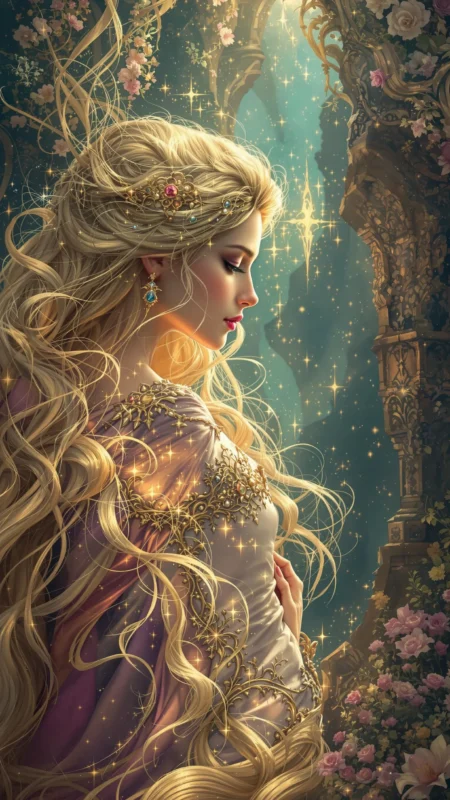


Rapunzel

Archetype Meaning & Symbolism

sheltered, creative, resourceful, naive, yearning, resilient, trusting, isolated, hopeful, captive

  • I've been looking out of a window for eighteen years, dreaming about what I might feel like when those lights rise in the sky. What if it's not everything I dreamed it would be?

If Rapunzel is part of your personal mythology, you may...

Believe

  • You may believe that your true life has not yet begun, and you are in a period of waiting for a specific event or person to set it in motion.
  • You may believe that your greatest talent or gift is also your greatest vulnerability, something to be protected and hidden away lest it be exploited by others.
  • You may believe that the 'real world' is a place of intense, magical experiences, and that a life of safety is a life half-lived.

Fear

  • You may fear that the world outside your comfort zone is too complex and dangerous for you to navigate successfully.
  • You may fear that if you reveal your true, authentic self, you will be rejected, controlled, or misunderstood.
  • You may fear that your dreams are illusions, and that if you finally reach for them, they will dissolve into disappointment, proving less magical than the longing itself.

Strength

  • You possess a rich and vibrant inner world, capable of sustaining you through periods of isolation and external quiet.
  • You are profoundly resourceful, able to turn your limitations into tools and find creative solutions with the materials at hand.
  • You have a capacity for deep, unjaded wonder and can appreciate the beauty and novelty of experiences that others take for granted.

Weakness

  • You may be prone to passivity, waiting for external circumstances to change rather than initiating action yourself.
  • You may be excessively naive and trusting, making you vulnerable to manipulation or deception.
  • You may have a tendency to idealize people or experiences, setting yourself up for disappointment when reality does not match your dreams.

The Symbolism & Meaning of Rapunzel

The Rapunzel archetype speaks to a particular kind of modern condition: the curated isolation. Her tower is no longer a brick-and-mortar prison so much as a perfectly tailored echo chamber, a career that offers security but not fulfillment, or a worldview inherited and unexamined. She is the patron saint of the gifted but unrealized, the one whose immense potential is paradoxically the very reason for her confinement. Her long, magical hair may be a literal talent, a profound intellect, or a deep well of empathy that others wish to possess or control. To have Rapunzel in one’s personal mythology is to be acutely aware of a vast, unseen world and to feel the constant, low hum of a life waiting to be lived just beyond the windowpane.

Her story is not simply about waiting for a rescuer; it is about the dawning awareness that the means of escape are intrinsically part of the self. The hair must be let down. This act is a radical vulnerability, an offering of one's most precious and controlled asset to the unknown. The 'prince' who climbs it may not be a person, but an idea, an opportunity, a piece of art, or a moment of shattering insight that proves the tower is not the entire world. This archetype, therefore, charts the journey from passive dreaming to active participation, from seeing the 'floating lights' of life from a distance to finally walking among them.

The narrative is also a potent exploration of naivete and resilience. Rapunzel is thrust into a world for which she has no vocabulary, no armor. Every experience is primary, unfiltered. This could lead to perilous missteps, but it also allows for a purity of experience, an unjaded wonder that the world-weary have long since lost. Her mythos suggests that true strength isn't about being prepared for everything, but about having the inner resources, the creative ingenuity, to adapt and survive when the predictable safety of the tower is gone forever. It is the courage to be a beginner, even when you are possessed of a master’s gift.


Rapunzel Relationships With Other Archetypes

The Tower

The relationship between Rapunzel and the Tower may be the most intimate of all, a bond not of love but of shared, silent existence. The Tower is more than a prison; it is perhaps a second skin, a calcified womb that continues to hold her long after she has outgrown it. It offers a perverse form of safety, the profound stillness of a world without variables. In this, the Tower could be seen as a metaphor for the self-imposed limitations we build from our own fears, the elegant but airless architecture of a life unlived. She gives its cold stone a purpose, a lonely soul to echo in its halls, and in return, it gives her the entire universe, contained within a single, unblinking window. To leave it is not merely to escape, but to shed a part of oneself, to step out of a defining frame and face the terrifying canvas of an open sky.

The Witch

The Witch and Rapunzel are locked in a strange, gravitational pull, a dance of possession and potential. The Witch may not be an external monster so much as a shadow cast by a brilliant light, the personification of a love so fiercely protective it becomes a cage. She is the gardener who, fearing blight and insects, keeps the rare orchid in a bell jar, suffocating it with the very purity of her intentions. This archetype could represent the voice of tradition, of family, or of one's own inner critic that insists the world is too coarse for our delicate genius. Her power is not in spells but in the quiet, constant curation of reality, pruning away every possibility until only one, safe, sterile branch remains. Theirs is a relationship of loving tyranny, a bond that mistakes preservation for life.

The Prince

The Prince is perhaps less a person and more a disruption, the first note of a foreign music piercing a lifetime of silence. His arrival is a fundamental challenge to the hermetically sealed world of the Tower. He may be an idea, a poem, a new way of seeing that proves another reality is possible. He is the scent of rain on a dusty road, carried to one who has only ever known filtered water. The relationship, then, is not one of romance but of awakening. The Prince doesn't simply offer a ladder; he awakens the desire to climb, making the familiar comfort of the Tower suddenly, irrevocably unbearable. He is the catalyst, the external proof that the self is not a fixed point but a vessel, capable of journeying beyond the horizon it once mistook for the edge of the world.

Using Rapunzel in Every Day Life

Navigating a Career Change:

When the familiar walls of a long-held career feel more like a prison than a fortress, the Rapunzel archetype offers a map. It suggests that your accumulated experience, the long braid of your skills, is not a reason to stay but the very tool for your escape. You might use this a long-cultivated talent in a new way, letting it down into a different industry to see who, or what, climbs up.

Healing from Overprotective Relationships:

For those emerging from the shadow of a controlling parent, partner, or ideology, Rapunzel's story is a profound allegory. The tower is not stone but a construct of someone else's fear, disguised as love. Embracing this mythos is to acknowledge the safety of the tower was an illusion and to begin the painstaking work of learning the world on your own terms, trusting your own footing on the unfamiliar ground below.

Embracing a Latent Talent:

Perhaps a creative gift, a scholarly passion, or a unique skill has been kept private, a secret mural painted on the inside of your life. The Rapunzel narrative could embolden you to finally reveal it. It frames this unveiling not as a bid for approval but as a necessary act of self-realization, a way to let down your hair and connect your inner world with the outer one, inviting collaboration and new perspectives.

Rapunzel is Known For

The Tower

A symbol of isolation, but also of safety and a world unto itself. It may represent a gilded cage, a childhood home, a limiting belief system, or an intellectual silo.

The Hair

An extraordinary, almost supernatural gift that is both the reason for the confinement and the eventual key to freedom. It represents untapped potential, lineage, creativity, and a tangible connection to the self.

The Escape

The pivotal moment of descent or liberation, initiated by an external catalyst but ultimately requiring the protagonist’s own courage and resourcefulness. It is the crossing of a threshold into the unknown.

How Rapunzel Might Affect Your Personal Mythology

How Rapunzel Might Affect Your Mythos

When Rapunzel takes up residence in your personal mythos, your life story may cleave into a distinct 'before' and 'after': the time in the tower, and the time after the escape. The 'before' is often characterized by a sense of waiting, of life lived at a remove, viewed through a single window. It might be a period of intense internal development, of honing a craft in secret, of building a rich inner world that compensates for the lack of external stimuli. Your narrative may frame this period not as wasted time, but as a necessary incubation, a long, slow weaving of the very rope that will eventually secure your freedom.

The 'after' is the story of the descent. Your personal mythos becomes a chronicle of brave, often clumsy, firsts. It is a story of discovering the world is both more beautiful and more dangerous than you ever dreamed. This part of your narrative might be filled with characters who represent different facets of the world you were denied: the cynical thief, the steadfast friend, the faceless crowd. The central conflict of your mythos shifts from 'how do I get out?' to 'who am I, out here?' It is a story about the reclamation of your own power, learning that your greatest gift is not something to be hidden away, but your primary way of engaging with the universe.

How Rapunzel Might Affect Your Sense of Self

To see oneself through the Rapunzel lens is to perhaps feel a fundamental duality. On one hand, there is an awareness of a unique and powerful gift, a 'golden hair' that sets you apart. This could be an artistic talent, a sharp intellect, or a profound capacity for love. It is the source of your deepest sense of self. On the other hand, you may perceive this very gift as a vulnerability, the thing that makes others want to control or possess you, the reason you feel the need to remain 'in the tower,' safe and hidden. Your self-concept may be that of a secret waiting to be told.

You may view yourself as fundamentally naive or unworldly, even if you are intellectually sophisticated. There's a part of you that may feel perpetually younger than your years, as if you missed a crucial period of social or emotional development. This can lead to a charming innocence, but also a deep-seated fear of being deceived or overwhelmed. Self-worth might be intrinsically tied to your 'hair,' your special talent, and the journey is to learn that your value is not contingent on this gift, but on the courage you show in learning to use it for your own liberation.

How Rapunzel Might Affect Your Beliefs About The World

A worldview informed by the Rapunzel archetype may be one of sharp contrasts between safety and freedom, the known and the unknown. The world inside the tower is predictable, controlled, and comprehensible. The world outside is a chaotic, vibrant, and ultimately unknowable expanse. You might possess a deep-seated belief that safety is a form of imprisonment, and that true life, with all its attendant risks, only begins when one abandons the guarantee of security. There is often a profound romanticism about the 'real world,' a belief that out there, life is more vivid, more meaningful.

This perspective could also foster a certain suspicion of institutions or figures that offer total security, viewing them as potential 'Gothels' who seek to isolate you for their own benefit. There may be a belief that true knowledge is experiential, not theoretical. You can read about the sun, but you don't know it until you feel its warmth on your skin for the first time. This might lead to a worldview that prizes firsthand experience, authentic encounters, and the courage to be vulnerable over polished expertise or inherited wisdom. The world is not a map to be studied, but a landscape to be traversed, barefoot and wide-eyed.

How Rapunzel Might Affect Your Relationships

In relationships, the Rapunzel archetype can manifest as a powerful yearning for a connection that feels like a rescue. You may be drawn to partners who seem to represent the world outside your tower: people who are adventurous, worldly, and perhaps a little dangerous. There's a risk of idealizing a partner as a 'prince' who holds the key to your happiness, placing the burden of your liberation onto them rather than yourself. The initial stages of a relationship can feel like a revelation, a dazzling introduction to a life you only dreamed of.

However, this mythos also brings a profound challenge: learning to relate to others as an equal, not as a captive being freed. You may struggle with a dynamic of dependency or feel that your own naivete makes you unequal to your partner. The journey is to move from letting down your hair for someone else to climb up, to climbing down yourself to meet them on solid ground. This means cultivating relationships based not on shared escape, but on shared exploration. It also means confronting the 'Gothel' dynamic: learning to recognize and sever ties with those who love you for your gifts but fear your freedom.

How Rapunzel Might Affect Your Role in Life

If Rapunzel shapes your personal mythology, you may perceive your role in life as that of the 'hidden gem' or the 'latent potential.' You might feel that your true purpose is something you are still preparing for, a grand debut that has not yet occurred. This can create a sense of being on the cusp of your own life, perpetually standing at the proscenium arch but never taking the stage. Your role feels passive: to cultivate your gifts in private, to wait, to watch. It's a role defined by potential rather than action, which can be both a comfort and a source of profound frustration.

Embracing the full arc of the archetype means transforming this role from captive to adventurer. Your purpose shifts from protecting your gift to using it. You may feel your role is to be a catalyst for others who are trapped in their own towers, using your own story of escape to show them it's possible. Or, your role might be that of the eternal student of the world, making up for lost time by soaking in experiences with an uncommon intensity. It is a shift from being the object of the story, the girl in the tower, to being the protagonist of your own journey, the hero who navigates the dark forest and finds her own way.

Dream Interpretation of Rapunzel

To dream of Rapunzel in a positive context is often a dream of imminent breakthrough. You might be the one in the tower, looking out at a beautiful, beckoning world, which suggests your subconscious is acknowledging a deep-seated yearning for change and is ready to embrace it. If you see her long hair unfurling, it could symbolize that a solution to a long-standing problem is within your grasp, derived from your own innate talents. A dream of successfully climbing down the hair or meeting the 'prince' could signify that you are integrating a new, vital part of yourself or are ready to enter a new, more authentic phase of life.

In a negative context, a Rapunzel dream can signal feelings of profound stagnation and entrapment. The tower may feel menacing, with no windows. The hair could be tangled, cut short, or feel impossibly heavy, symbolizing a creative block or the sense that your gifts are a burden. You might dream of the witch, Gothel, guarding you, which could represent a domineering figure in your life or, more likely, your own inner critic and fear-based beliefs that keep you locked away. A dream of falling from the hair or getting lost in the wilderness after escaping may point to a fear that you are not equipped to handle the freedom you seek.

How Rapunzel Archetype Might Affect Your Needs

How Rapunzel Might Affect Your Physiological Needs

From a mythological perspective, the Rapunzel archetype may connect your physiological needs to a state of suspended animation. Within the tower, all needs are met, but in a sterile, controlled way. Food appears, but it is not foraged or hunted. The body is kept safe, but it is not tested or strengthened. This can translate to a life where you may ensure you have the bare necessities, but without any joy or sensory engagement. You eat to live, rather than living to eat. Your physiological world might feel muted, lacking the vibrant, chaotic energy of true somatic experience.

The escape from the tower represents a physiological awakening. Suddenly, hunger is real and urgent. The body feels the ache of walking long distances, the sting of cold, the simple pleasure of sun on the skin. Embracing this mythos could mean you feel a deep need to connect with your body in a more primal way: through intense exercise, immersion in nature, or a more mindful and sensual approach to food. It is about reclaiming the body not just as something to be preserved, but as the primary vehicle through which life is experienced.

How Rapunzel Might Affect Your Ideas of Belonging

Within the tower, the need for belonging is tragically simple: it is entirely invested in a single, controlling figure, the witch Gothel. This can create a pattern in your life of seeking an all-consuming bond with one person, a friend or partner, making them the sole arbiter of your social world. The love is real, perhaps, but it is a love contingent on your isolation. You belong, but only within the confines of a cage built for two. This can lead to a profound fear of social groups and a belief that you are incapable of navigating more complex relational dynamics.

Emerging from the tower is a terrifying and exhilarating exercise in finding true belonging. It requires moving past the intense, singular bond and learning to forge connections with a wider community. For a Rapunzel mythos, the journey toward belonging is about discovering you can be loved for your authentic self, not for the gift you provide or the captive you are. It is about finding your 'kingdom,' a place where your unique light is not seen as a threat or a prize, but as a welcome addition to the collective glow. It is learning that true belonging doesn't require you to stay in one place.

How Rapunzel Might Affect Your Feelings of Safety

The Rapunzel archetype presents a paradox of safety. The tower is the epitome of physical security: no predators, no accidents, no unforeseen threats. For someone influenced by this myth, the need for safety can be paramount, leading to a life that is highly structured, predictable, and risk-averse. You may build your own 'towers' through routines, insulated social circles, and careers that promise stability above all else. This safety, however, is juxtaposed with a profound psychological peril: the danger of a life unlived, of stagnation.

Leaving the tower is a deliberate rejection of this form of safety in favor of a different kind: the security that comes from self-reliance and resilience. The world outside is objectively less safe, filled with thorns and thieves. Yet, navigating it builds an inner fortitude that the tower could never provide. Your need for safety may transform from a need for external walls to a need for internal tools. You might seek to feel safe not because nothing can hurt you, but because you trust in your ability to heal, to adapt, and to overcome whatever challenges you face.

How Rapunzel Might Affect Your Views of Esteem

Esteem, in the world of the tower, is entirely external and conditional. Rapunzel's value is in her magical hair; her sense of worth is derived from her keeper's need for it. This may translate into a personal myth where your esteem is perilously tied to a single attribute: your intelligence, your beauty, your artistic skill, or your utility to others. You may feel worthy only when this specific trait is being praised or utilized. This leads to a fragile self-esteem, constantly in need of validation from an outside source, a 'Gothel' who tells you that you are special.

The development of esteem, for a Rapunzel archetype, is the process of internalizing that worth. It is the realization that your value is inherent and not dependent on your 'hair.' True esteem begins to build not when the prince admires the hair, but when you use it to orchestrate your own escape. It is fortified with every step taken in the unfamiliar world, every problem solved with your own ingenuity. Esteem becomes a measure of your courage and resilience, not your innate gifts. It is the quiet confidence that even if your hair were cut off, even if you were cast into the desert, you would find a way to survive and thrive.

Shadow of Rapunzel

The shadow of Rapunzel manifests as a pathological refusal to leave the tower. This is the Rapunzel who hears the call of the world and bolts the window shut, reinforcing the walls. She may convince herself that her isolation is a sign of superiority, that the world outside is base and unworthy of her. This shadow turns resourcefulness into stagnation, and the tower transforms from a prison into a self-imposed fortress of contempt. She may use her 'hair' not for connection, but as a way to occasionally sample the world without ever committing to it, pulling up visitors only to dismiss them, her isolation feeding a growing narcissism. Here, potential is not just unrealized: it is weaponized as a justification for inaction.

Another shadow aspect arises after the escape. This is the Rapunzel who cannot let go of her own naivete, who weaponizes it to demand constant rescue. She refuses to learn the ways of the world, maintaining a state of perpetual helplessness to ensure others will always take care of her. She may cling to a 'rescuer' with suffocating dependency, recreating the tower dynamic in every relationship. Her story ceases to be about her own journey and becomes entirely about the person who 'freed' her. In this dark reflection, the haircut doesn't signify liberation but a loss of identity, leaving her feeling powerless and eternally victimized by the world she once yearned for.

Pros & Cons of Rapunzel in Your Mythology

Pros

  • You have a deep well of creativity and self-reliance forged in solitude.
  • You approach the world with a sense of wonder and curiosity that can lead to profound and beautiful experiences.
  • Your story is one of dramatic and inspiring transformation, giving you a powerful narrative of liberation and self-actualization.

Cons

  • You may struggle with a sense of belatedness, feeling that you are always trying to catch up to your peers in life experience.
  • A tendency towards isolation and passivity can lead to missed opportunities and a life lived at a remove from the world.
  • You are susceptible to unhealthy relationship dynamics, either seeking a rescuer or becoming entangled with controlling figures who replicate your initial confinement.