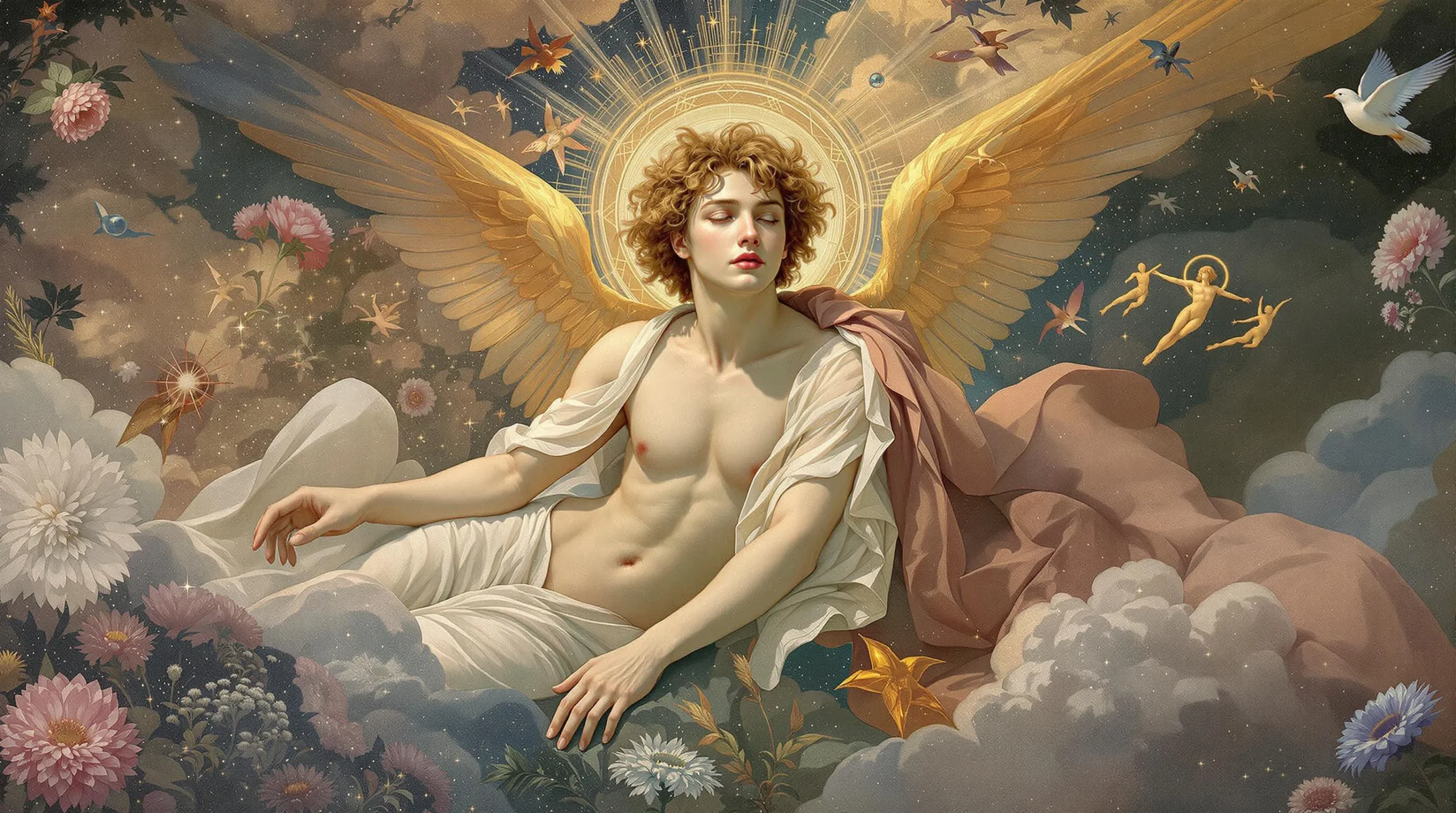


Raphael

Archetype Meaning & Symbolism

Healer, guide, companion, restorative, insightful, serendipitous, gentle, binding, clarifying, discreet

  • I am Raphael, one of the seven holy angels, which present the prayers of the saints, and which go in and out before the glory of the Holy One.

If Raphael is part of your personal mythology, you may...

Believe

  • That every illness, whether of the body or spirit, contains the hidden seed of its own cure.
  • That the universe operates on a principle of benevolent synchronicity, and there are no true accidents.
  • That the most profound guidance often comes in disguise, through the voice of a stranger or the quiet whisper of intuition.

Fear

  • A deep, existential loneliness: the terror that you are truly alone and the universe is indifferent to your suffering.
  • That some wounds are too profound to be mended, that you are irrevocably broken.
  • Misinterpreting the signs and taking the wrong path, becoming hopelessly and permanently lost.

Strength

  • A powerful intuition for finding the right solution, person, or resource at the exact right time.
  • A profound and reassuring sense of calm in the face of illness, chaos, or adversity.
  • An innate talent for compassionate listening, making you a natural confidant and guide for others.

Weakness

  • A tendency toward passivity, waiting for a sign or for help to arrive instead of taking necessary action.
  • An inclination to spiritually bypass practical problems, applying metaphysical solutions where mundane ones are required.
  • An aversion to direct conflict, sometimes prioritizing surface-level harmony over addressing the root cause of an issue.

The Symbolism & Meaning of Raphael

In the architecture of a personal myth, Raphael represents the principle of serendipitous healing. He is not the thunderous intervention of a sky god but the quiet arrival of the right person at the right time, the unexpected discovery of a solution you weren't looking for. He is the patron saint of happy accidents and benevolent coincidences, suggesting that the universe has a subtle, restorative intelligence. His presence in one's life story whispers that the cure for the wound is often found in the journey away from it, that the fish that could harm you also holds the key to your father’s sight. He symbolizes a trust in the process, a faith that the path itself will provide the means for its own completion.

Raphael may also symbolize the healing power of knowledge and clear sight. His most famous miracle is restoring Tobit's vision, a potent metaphor for lifting cataracts of ignorance or despair. To have Raphael in your mythos could mean you are someone who seeks clarity, who helps others see a situation in a new light. You might value the kind of wisdom that isn’t abstract but practical, applicable, and ultimately, freeing. This is the wisdom of the traveler who learns the customs of a new land, the physician who understands the properties of herbs, the companion who knows the right thing to say to dispel fear. It is a grounded, embodied intelligence.

Furthermore, the archetype carries the theme of disguise and revelation. Raphael walks with Tobias as a mortal man, his divine nature hidden until the journey’s end. This suggests that help and holiness may not always be recognizable. The catalyst for your healing may be a seemingly ordinary person, a mundane event, or a quiet insight. It encourages a worldview where the sacred is woven into the profane, where angels might wear the faces of strangers. This archetype challenges you to look past appearances and recognize the potential for grace in the everyday, to understand that the greatest guides are often those who walk beside you, not those who float above.


Raphael Relationships With Other Archetypes

The Wanderer

The relationship between The Raphael and The Wanderer is perhaps that of an unseen current to a lone vessel at sea. The Raphael archetype does not manifest as a lighthouse, a stark and unambiguous beacon against the dark. Instead, its influence may be found in the subtle shift of the wind that fills a sail long becalmed, or the chance meeting in a dusty tavern that reveals not a map, but the name of a mountain pass previously unheard of. This is not the loud, declarative guidance of a god, but the quiet conspiracy of grace and circumstance. The Wanderer, in their restless search for a place or a self, may never know the name of the force that nudged them, attributing their salvation to luck or their own rekindled intuition. It could be that The Raphael operates as a kind of divine cartographer, not drawing the path, but gently terraforming the landscape of possibility just enough for the Wanderer’s feet to find their way toward a home they did not even know they were seeking.

The Skeptic

With The Skeptic, The Raphael may engage in a dance as delicate and paradoxical as light itself. The Skeptic, a collector of empirical data and a builder of logical fortresses, demands proof that The Raphael, by its very nature, cannot provide. The Raphael's influence could be mistaken for a statistical anomaly, a rounding error in the grand calculation of a life, or the simple, maddening luck that defies a well-reasoned hypothesis. A Raphael’s healing touch might be rationalized as a placebo effect; its gentle guidance, a bout of confirmation bias. Yet, this archetype’s work may persist, like a single, sustained musical note resonating just below the threshold of hearing. It doesn’t shatter The Skeptic’s worldview, but perhaps introduces a hairline fracture, a sliver of unexplainable grace through which a new kind of light, however faint, might eventually enter. The relationship is not one of conversion, but of a quiet, persistent presence that plants a seed of mystery in the most ardently cultivated soil of reason.

The Mender of Broken Things

The Mender of Broken Things and The Raphael could be seen as partners in the quiet art of restoration, one working with the tangible world and the other with its invisible seams. The Mender is the one who patiently glues the fragments of a shattered heirloom, while The Raphael is perhaps the ambient peace in the room that stills the Mender's hand, ensuring the pieces align perfectly. They are collaborators in a sacred craft. Where the Mender splints the broken wing of a bird, The Raphael may address the shock and the fear, that silent trauma that can keep a creature grounded long after its bones have knit. Their relationship might be akin to the Japanese art of kintsugi; the Mender provides the lacquer and the physical labor to join the shards, but The Raphael provides the gold, the ineffable element of grace that does not hide the breaks but illuminates them, suggesting that an object, or a soul, can become more beautiful and profound for having been broken.

Using Raphael in Every Day Life

Navigating Illness

When facing a health crisis, the Raphael mythos reframes the experience from a purely biological failure into a pilgrimage. You might find yourself paying attention not just to medical advice but to the serendipitous wisdom offered by a stranger, the sudden insight gleaned from a book, or the healing power of a specific place. The illness becomes a journey with its own hidden map, and you are not a victim but a traveler seeking the remedy that the journey itself provides.

Mending a Broken Connection

In the aftermath of a painful argument or estrangement, you may call upon the Raphael archetype to act as a quiet guide. Instead of forcing a resolution, you might wait for the opportune moment, the 'kairos' time, to speak. The goal is not to win the argument but to heal the rift. The archetype encourages finding the precise words, not of justification, but of restoration, like a balm applied to a wound, allowing a natural, unforced reconciliation to occur.

Making a Life-Altering Decision

When at a crossroads, perhaps a career change or a move to a new city, the Raphael within you resists frantic pro-and-con lists. Instead, you may embark on a small journey, a walk in an unfamiliar neighborhood or a drive with no destination. This is an act of faith in the archetype's principle: that movement reveals the path. The answer may not come as a lightning bolt but as a quiet feeling of 'rightness', a chance encounter, or a sign that confirms the direction in which your soul is already leaning.

Raphael is Known For

The Divine Physician

Raphael's primary identity is that of the healer. His name itself means "God Heals," and his most famous acts involve restoring sight and providing remedies, signifying the mending of both physical and spiritual afflictions.

The Guide for Travelers

In the Book of Tobit, Raphael, disguised as a human, guides the young Tobias on a long and perilous journey. He symbolizes the benevolent companion, the secret helper who ensures safe passage through unknown territories.

The Binder of Demons

He is known for binding the demon Asmodeus, who had plagued Sarah, Tobias's eventual wife. This represents the power to neutralize destructive inner forces, to tame the personal demons that prevent love and wholeness.

How Raphael Might Affect Your Personal Mythology

How Raphael Might Affect Your Mythos

When Raphael is a cornerstone of your personal mythology, your life story may cease to be a narrative of conquest and become one of pilgrimage. Hardships are not obstacles to be bulldozed but detours that hold secret instructions. A lost job, a broken heart, a period of confusion: these are not narrative failures. They are the challenging terrain through which the pilgrim must pass, and the Raphael principle insists that this very terrain holds the key to your restoration. Your mythos is likely patterned with moments of synchronicity, of meeting the exact person you needed to meet, of finding a solution in the most unlikely of places, as if an invisible hand were subtly arranging the props on your life's stage.

The very structure of your story may shift. Instead of a linear progression towards a goal, it might resemble a spiral, circling back to old wounds not to reopen them, but to apply a new, more potent medicine found along the way. Your narrative is less about what you achieved and more about what you healed. The protagonists of your personal myth are not just heroes and villains, but guides, fellow travelers, and patients. The central tension may not be 'will I succeed?' but 'will I see?', 'will I be made whole?' It is a gentler, more mysterious plot, one that finds its resolution not in a final victory, but in a quiet, luminous moment of grace.

How Raphael Might Affect Your Sense of Self

To view yourself through the lens of Raphael is to see the self not as a fortress to be defended, but as a traveler on a sacred journey. You may perceive your own intuition as a divine guide, a quiet companion whispering directions at every fork in the road. There could be a fundamental belief in your own resilience, an innate sense that even when you are broken, you contain the capacity for wholeness. This archetype fosters a gentle inner voice, one that offers compassion rather than judgment when you stumble. You are not a flawed product to be fixed, but a landscape to be understood, with hidden springs and restorative herbs awaiting discovery.

This perspective might also engender a certain humility. If Raphael, the mighty archangel, walks in disguise, then your own true self may also be masked, even from you. Your greatest strengths might be hidden in your quietest qualities. Your purpose may not be to announce yourself with trumpets, but to fulfill your role with subtle efficacy. Self-esteem, in this context, is not tied to external validation but to the private knowledge of your own journey, to the demons you have bound and the sight you have restored, both in yourself and for others. It is the quiet confidence of the healer who knows their craft.

How Raphael Might Affect Your Beliefs About The World

With Raphael as a guide, your worldview may be tinted with a shade of enchantment. You could see the world not as a random, chaotic battlefield, but as a place of hidden remedies and benevolent connections. It fosters an almost radical optimism, not a denial of suffering, but a faith in the existence of its corresponding cure. You might find yourself less cynical, more open to the possibility of grace in unexpected places. A chance encounter on a subway platform, a book falling open to a resonant page, a sudden feeling of peace in a time of turmoil: these may not be dismissed as mere coincidence but are perhaps seen as whispers from the guiding intelligence of the cosmos.

This worldview re-enchants the mundane. A journey is not just a movement from A to B; it is an opportunity for revelation. A conversation is not just an exchange of information; it could be a divine appointment. This perspective encourages a posture of attentive curiosity towards life. You are always watching, listening for the subtle clues, the synchronicities, the quiet epiphanies. The world becomes a living text, full of symbols waiting to be read, and you are a traveler learning its language, trusting that even the most convoluted sentence will ultimately lead to a profound and healing truth.

How Raphael Might Affect Your Relationships

In the realm of relationships, the Raphael archetype positions you as the companion, the confidant, the quiet healer. You may find that people are drawn to you in times of trouble, not because you offer easy answers, but because you offer a calming presence, an ability to listen and help them see their own path more clearly. Your friendships might be marked by a sense of shared pilgrimage, a feeling that you are walking together for a reason. Love, in this mythos, is not an acquisition but a serendipitous meeting of two travelers who agree to share the road, to help heal each other’s wounds from past journeys.

You might approach conflict with a healer’s touch. The goal is not to win, but to restore harmony, to find the 'medicine' that can mend the tear in the fabric of the connection. This can lead to deep, resilient relationships built on mutual care and understanding. You may value discretion and gentleness, preferring to guide a friend toward an insight rather than imposing your own. Your relationships are not static arrangements but living, breathing journeys, each with its own perils, its own discoveries, and its own potential for grace.

How Raphael Might Affect Your Role in Life

Your perceived role in the world may shift from one of actor to one of agent, a subtle but profound difference. You are not necessarily the hero at the center of the drama, but perhaps the indispensable guide who ensures the hero reaches their destination. This is the role of the physician, the therapist, the wise mentor, the trusted friend. It is a role defined by its utility and compassion rather than its visibility. You might feel your purpose is to facilitate, to connect, to clear the way, to heal the rift so that something new can be born. There is a deep satisfaction in this, a sense of being an essential part of a larger, benevolent design.

This role is often played in disguise. You may not receive public acclaim for your contributions. Your greatest work might be a quiet word that changes a person's life, a piece of advice that sets someone on a new path, an act of compassion that goes unnoticed by all but the recipient. Your power is subtle, like Raphael’s. It lies not in commanding armies but in binding a single demon, not in building kingdoms but in guiding one traveler safely home. Your sense of purpose comes from this quiet, effective, and profoundly necessary work of restoration.

Dream Interpretation of Raphael

In a positive dream context, the appearance of Raphael, or his symbols like a traveler's staff or a fish, may be a powerful message of reassurance. It could suggest that a process of healing, whether physical, emotional, or spiritual, is underway, even if its effects are not yet visible in your waking life. The dream might be affirming a recent decision, indicating that you are on the 'right path.' Seeing Raphael guide you or someone else could point to the presence of a real-life mentor or your own emerging capacity to guide others. It is an archetypal nod of approval, a sign that you are aligned with a restorative and benevolent force.

Conversely, a dream where Raphael is wounded, absent, or ignored could signal a profound disconnect from your own healing potential or inner guidance. It might reflect a feeling of being lost, abandoned, or stuck in a state of unresolved pain. Perhaps you are ignoring your intuition or refusing help that is being offered. A dream of binding a demon that fails, or of trying to heal a wound that keeps bleeding, could point to a shadow aspect of the archetype: a fear that your problems are insurmountable or that the universe is, in fact, indifferent. Such a dream may be a call to consciously address what needs healing, to seek out a guide, or to listen more closely to the whispers you have been dismissing.

How Raphael Archetype Might Affect Your Needs

How Raphael Might Affect Your Physiological Needs

When the Raphael archetype informs your mythos, physiological needs are imbued with a sense of the sacred. The body is the pilgrim's vessel, the temple that must be maintained for the journey. This is not about ascetic denial, but about mindful care. Food is not just fuel; it is medicine. You might be drawn to herbal remedies, to understanding the healing properties of what you consume, to seeing a meal as an act of restoration. The act of eating could become a ritual of gratitude for the sustenance provided by the earth.

Rest, too, takes on a new dimension. Sleep is not merely a biological necessity but a journey into the dreaming lands where guidance can be found. Periods of quiet and inactivity are not seen as wasted time but as essential for integration and recovery. There is a deep listening to the body’s signals: fatigue is a call for sanctuary, pain is a message to be deciphered, and wellness is a state of harmonious alignment between the physical and the spiritual. The body is your first and most intimate companion on the path.

How Raphael Might Affect Your Ideas of Belonging

Belongingness, for one guided by Raphael, is found not in static tribes but in the caravan of fellow travelers. You may feel a deep kinship with other seekers, with those who are also on a journey of healing and discovery, regardless of their background. Love and friendship are often perceived as fated encounters, divine appointments where two paths intersect for a reason. There is a sense that the people in your life have been brought to you to teach, to learn from, to heal, and to be healed by.

This creates a sense of belonging that is both profound and portable. You are at home wherever you find a fellow soul on the path. Intimacy is built on the shared vulnerability of the journey, on the willingness to be a companion through difficult passages. Love is not about possessing another, but about walking beside them, offering the balm of your presence. It's a belongingness of purpose and resonance, a quiet recognition of another who speaks the same secret language of the soul.

How Raphael Might Affect Your Feelings of Safety

Safety, within the Raphael mythos, is less about locks on the doors and more about being on the correct path. True security is an internal state, a form of spiritual alignment. The belief is that if you are where you are meant to be, doing what you are meant to do, a certain kind of protection surrounds you. This does not mean an immunity to harm, but a faith that even harm can be integrated into the journey and ultimately serve a healing purpose. The fear of the unknown, a primary source of anxiety for many, is tempered by a trust in the guide, whether internal or external.

The world may still be a dangerous place, but you navigate it like a seasoned traveler rather than a terrified shut-in. You learn to read the signs, to trust your gut feelings about people and places, to know when to proceed and when to take shelter. Safety is found in wisdom, awareness, and flow, not in rigid control. It is the security of the pilgrim who trusts the road will provide, who knows that even in the darkest woods, there is a path, and a companion who knows the way.

How Raphael Might Affect Your Views of Esteem

Esteem needs, under Raphael's influence, are met through the act of restoration. Your self-worth is not derived from competition or accumulation, but from your capacity to be a conduit for healing. You may feel a deep sense of value when you successfully guide a friend through a crisis, when you find the perfect remedy for a personal ailment, or when you restore harmony to a discordant situation. It is the esteem of the skilled artisan, the quiet pride of the physician whose patient recovers. This is not the ego's need for applause, but the soul's satisfaction in being useful and effective in a meaningful way.

Furthermore, self-esteem is bolstered by your own resilience. Navigating a personal dark night of the soul and emerging whole on the other side becomes a source of profound strength. Each healed wound becomes a medal of honor, a testament to your faith in the journey. Esteem is built on a foundation of self-compassion, the ability to be a gentle guide to yourself. It is the quiet confidence that comes from knowing you can walk through fire and not only survive, but learn the secrets of the flames.

Shadow of Raphael

The shadow of Raphael can manifest as a form of toxic positivity, a refusal to engage with the messy, painful reality of suffering. This is the individual who offers platitudes instead of presence, who uses the language of healing to dismiss or invalidate another's pain. They become a 'spiritual bypasser,' insisting that everything happens for a reason, leaving the wounded feeling unseen and unheard. The shadow guide doesn't heal; he silences. He may also appear as a subtle manipulator, feigning wisdom and compassion to create dependency, offering a 'cure' that only he can provide, thus binding others to him rather than liberating them.

On the other extreme, the shadow emerges as a profound cynicism and refusal of grace. This is the wounded traveler who insists on walking alone, suspicious of all help. They see every potential guide as a deceiver, every offer of comfort as a trap. Having lost faith in the journey, they reject the very possibility of healing. They mistake their isolation for strength and their bitterness for wisdom. This shadow turns Raphael’s gentle guidance into a paranoid narrative of betrayal, transforming the world from an enchanted place of healing into a perilous landscape of illusions with no safe harbor.

Pros & Cons of Raphael in Your Mythology

Pros

  • You possess a deep well of resilience, viewing setbacks not as failures but as part of a larger, meaningful journey toward wholeness.
  • You naturally become a source of comfort and wise counsel for others, fostering deep and significant relationships.
  • Your life may feel rich with meaning and magic, as you perceive benevolent patterns and synchronicities where others see only chaos.

Cons

  • You may be perceived as naive or Pollyannaish by those with more pragmatic or cynical worldviews.
  • There is a risk of becoming drained by constantly being in the role of the healer, attracting an excess of 'wounded birds.'
  • You might neglect mundane responsibilities or practical planning, placing too much faith in things simply 'working out' on their own.