 Believe
 Fear
Fear Strength
 Weakness
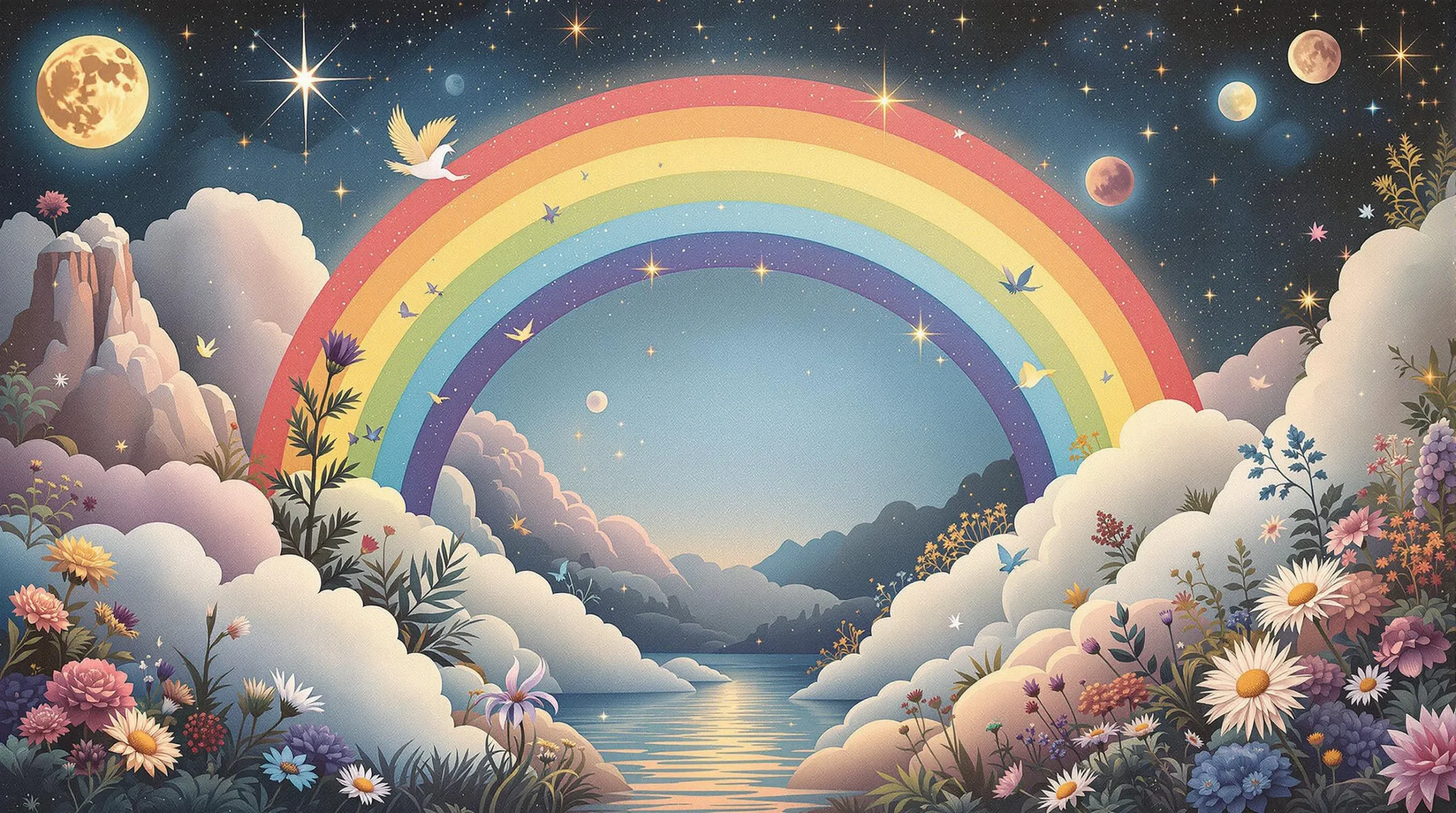
To find the Rainbow in your personal mythology is to understand life as a series of covenants. It is a promise, not of a life without storms, but of the beauty that is only possible because of them. The Rainbow is not a destination, but a phenomenon: a specific alignment of light and water, sun and tears. This archetype suggests a life lived in appreciation of transient, perfect moments, rather than a striving for a permanent state of happiness. The meaning is not in arriving at the pot of gold, a myth of material gain, but in the witnessing of the arc itself: a momentary, breathtaking bridge between the weeping earth and the illuminating heavens. It symbolizes an integration, a wholeness that is not static but happens in a flash of insight.
The Rainbow is the ultimate symbol of inclusive harmony. It holds the entire spectrum, giving each color its own space, its own truth, without demanding they blend into a single, homogenous hue. For a personal mythos, this may translate into a radical acceptance of the self’s multiplicity. You can be serene and angry, spiritual and carnal, hopeful and grieving, all at once. The Rainbow archetype gives you permission to contain these multitudes not as contradictions to be resolved, but as essential colors that create the spectacular whole of you. It is a symbol of profound psychological and spiritual tolerance, first for oneself, and then for the world.
Its ephemeral nature is central to its meaning. The Rainbow is beautiful precisely because it cannot last. It teaches that the most profound experiences are often fleeting, and that their value is not diminished by their impermanence. In a culture that prizes permanence, ownership, and constant states, the Rainbow is a quiet rebellion. It suggests a way of being that finds wealth in moments, not monuments. It whispers that your life story might not be a solid, linear road, but a series of luminous, weather-dependent arches that appear, awe, and vanish, each one leaving you changed and ready for the next storm.