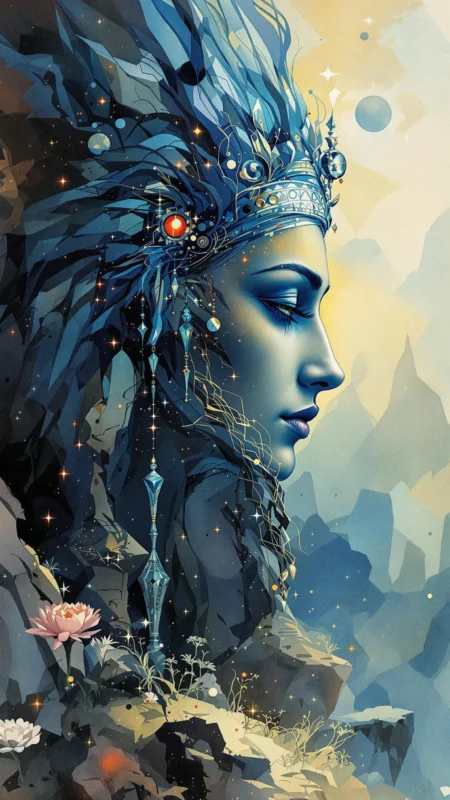
Ra

Archetype Meaning & Symbolism

Sovereign, Creative, Illuminating, Authoritative, Cyclical, Generative, Unwavering, Blinding, Majestic, Central

  • Each dawn is not a promise, but a decree. Live by the light you are given, for the darkness is not an end, but a passage.

If Ra is part of your personal mythology, you may...

Believe

  • I am the primary creator of my own reality, and my consciousness is the tool I use to shape it.
  • There is a fundamental, cyclical order to the universe, and my purpose is to align with it and express it in my own life.
  • Every day, every moment, is a new genesis, an opportunity to bring light, life, and order from the chaos of potential.

Fear

  • Irrelevance. To be forgotten, to have my light go out, to become a dead star in an empty sky.
  • Chaos. The loss of control, the dissolution of the order I have created, the triumph of meaninglessness.
  • Burnout. The terror that my inner fire will be extinguished, that my creative source will dry up, leaving me powerless and empty.

Strength

  • A powerful and unwavering creative vision, coupled with the immense energy required to bring that vision into being.
  • Natural authority and a magnetic charisma that inspires others to follow, creating cohesive and energized groups.
  • A profound resilience rooted in the deep, instinctual belief that every night is followed by a dawn, making comebacks feel inevitable.

Weakness

  • A tendency toward autocratic rule, believing your vision is the only one that matters, thus stifling collaboration and dissent.
  • An ego so powerful it can inadvertently scorch those who get too close, creating loneliness and alienating loved ones.
  • A deep-seated fear of failure, which is perceived not as a learning experience but as a form of personal annihilation or cosmic defeat.

The Symbolism & Meaning of Ra

To have Ra as a fixture in one's personal pantheon is to be in conversation with the very engine of creation. This is not the gentle, nurturing light of a bedside lamp: it is the hydrogen fusion furnace of the sun itself, a force of uncompromising generation. Its symbolism today may speak to the founder, the artist, the individual who feels a deep, internal imperative to bring something new into existence. This archetype suggests that your consciousness is a kind of light, and where you direct it, a world takes shape. Your focus is not merely attention: it is a life-giving, order-bestowing ray that can either cultivate a garden or scorch a desert. The presence of Ra may imply a life narrative centered on the burden and glory of being a source.

The daily journey of the solar barque becomes a potent metaphor for psychic resilience. To internalize this myth is to understand that periods of darkness, invisibility, and struggle are not aberrations but essential parts of the creative cycle. The passage through the underworld is where the self is truly tested and renewed, where it battles its own formless chaos to rise again. Ra’s meaning in a modern context is a profound counter-narrative to the cult of perpetual success. It suggests that true power lies not in avoiding the night, but in knowing how to navigate it, trusting that your own internal sun will, without fail, rise again in the morning.

Furthermore, Ra symbolizes an unquestionable, central authority. In your personal mythology, this could manifest as a powerful sense of self-sovereignty. You may not look outside for validation or permission, but inward, to the core of your own being, for the right to create, to lead, and to define your reality. This is the archetype of the individual as a cosmic center, the point around which a family, a company, or a creative project orbits. It is a mythos of profound responsibility, for the health and order of your entire solar system depend on the consistency and quality of your light.


Ra Relationships With Other Archetypes

The Serpent of the Underworld

The Ra may find its most profound, if adversarial, relationship with the Serpent of the Underworld. This is not a simple dance of good and evil, but perhaps the cosmic tension that gives form to existence itself. The Serpent is the unmaking, the cold and silent chaos that swallows the sun at the end of each day, threatening to keep it in its abyssal coils forever. Ra’s nightly journey is thus a necessary pilgrimage into the heart of its own negation. Without this recurring descent, the dawn might lose its quality of miracle, becoming mere routine. The Serpent, then, could be seen as the dark, velvety backdrop against which the diamond of consciousness is thrown, its existence a constant, terrifying reminder that all order is a temporary victory, a story told in the brief, warm pause between two eternities of silence.

The Horizon

One could argue that Ra's most intimate partner is the Horizon, that liminal stage for its daily birth and death. The Horizon is a paradox: a line that is always visible but never reached, a perpetual promise and a constant farewell. It is here that Ra emerges, a nascent thought blushing into a full-throated declaration of being, and it is here that it bleeds out in a final, poignant spectacle of color before surrendering to the night. This relationship may speak to the bittersweet nature of all great arcs. The Horizon is the threshold, the cosmic doorway that lends solemnity to Ra’s passage, framing its glory and its vulnerability with equal grace. It is the silent witness that understands, perhaps better than any other, that every majestic arrival already contains the seed of its departure.

The Scarab Beetle

In the humble Scarab Beetle, the Ra archetype finds a terrestrial mirror, a reflection of its grand celestial labor in the gritty particulars of the earth. The beetle, with its tireless rolling of a dung ball, seems to perform a sacred parody of the sun's journey across the heavens. This relationship could suggest a profound connection between divine will and mundane, persistent effort. The Scarab is the working-class hero to Ra’s sovereign, proving that the force of creation is not solely a top-down decree but also a ground-up, iterative act of will. It may whisper a truth about the nature of power: that the great, radiant sphere of influence is often propelled not by a single, magnificent gesture, but by a million small, unnoticed, and determined pushes forward.

Using Ra in Every Day Life

Navigating Creative Stagnation

When a project stalls, the mythos of Ra suggests viewing the block not as failure, but as the sun's necessary descent into the underworld. This period is for unseen battles, for grappling with the chaos serpent Apep in the depths of the psyche. Your task is not to force the light, but to navigate the darkness with courage, trusting that this journey is what allows the sun, and your project, to be reborn with the dawn, renewed and victorious.

Assuming Leadership

When called to lead, you may draw upon Ra's authority, which is rooted not in force, but in being the undeniable source of life and order. Your leadership could be a gravitational pull, creating a system where others find their own orbits and purposes. The goal is not to command, but to illuminate the path, to be the predictable, life-giving center that allows the entire enterprise to thrive, to turn its face toward your vision as a flower to the sun.

Establishing a Meaningful Routine

If life feels chaotic, the Ra archetype offers the solar barque as a model for your days. Your morning coffee is the emergence at dawn, your work is the journey across the sky, and your evening rituals are the passage into the regenerative dark. Structuring your day as a sacred, cyclical journey may infuse mundane tasks with cosmic significance, transforming routine into a ritual of personal creation and renewal.

Ra is Known For

The Solar Barque

Ra's celestial vessel in which he sailed across the heavens by day, bringing light to the world, and through the perilous underworld at night, defeating chaos to be reborn at dawn. This journey symbolizes the perpetual cycle of life, death, and rebirth.

The Creator God

In many myths, Ra is the self-created deity who brought forth all life from the primordial waters of Nun. He is the original source, the prime mover whose thoughts and words manifested the gods, humanity, and the ordered cosmos itself.

The Eye of Ra

A potent and often independent feminine counterpart, personified by goddesses like Sekhmet or Hathor. It acted as Ra's protector but could also unleash immense destruction, representing the dual nature of the sun's power to both nurture and scorch.

How Ra Might Affect Your Personal Mythology

How Ra Might Affect Your Mythos

When Ra captains your personal mythology, your life story ceases to be a linear progression and becomes a series of glorious, cyclical journeys. Each project, each relationship, each era of your life may be framed as a voyage across the sky: a hopeful dawn, a brilliant zenith of influence, and a necessary descent into darkness for renewal. Your narrative may be punctuated not by external events, but by your own acts of creation. You are the protagonist who speaks a world into existence. Failures are not endings but cosmic battles with the serpent of chaos in the underworld, moments of peril that make the subsequent dawn, your comeback, all the more heroic.

Your mythos may also be one of profound, sometimes isolating, centrality. You could be the sun king around whom other characters in your story revolve. Your story is the main plot; theirs are the subplots, dependent on your light. This can shape a narrative of a great founder or a lonely god, a figure who gives life to all but perhaps feels no one can truly withstand their fire or understand the burden of being the source. Your life's work becomes the creation of a stable, ordered cosmos, and the central dramatic tension is your struggle to maintain that order against the ever-present threat of chaos, both internal and external.

How Ra Might Affect Your Sense of Self

Your self-concept, illuminated by Ra, may be one of inherent power and generative potential. You might not see yourself as a product of your environment, but as the creator of it. There could be a fundamental identification with the role of 'the source': the source of ideas, of energy, of warmth, of structure. This can foster a robust sense of confidence and purpose. You may feel you contain a core of inexhaustible energy, a personal sun that fuels your ambitions and your very being. The self is not something to be discovered, but something to be emanated, to be projected onto the canvas of the world.

This same light, however, casts a long shadow on the self. The identification with Ra can cultivate a deep-seated fear of obscurity. Your sense of self-worth might become perilously tethered to your output, your visibility, your influence. If the light flickers, through burnout or failure, the self may feel annihilated. There can be an internal pressure to always be 'on', to shine brightly for the benefit of those in your orbit, leaving little room for vulnerability, doubt, or the simple need to be unobserved. The private self may feel like a hidden, nocturnal underworld, a place of retreat that is necessary but also fraught with the fear that the sun may not rise again.

How Ra Might Affect Your Beliefs About The World

With Ra as your lens, the world may appear not as a series of random, chaotic events, but as a cosmos, a place of profound and elegant order. You might perceive a universal rhythm, a grand cycle of creation and dissolution playing out on every scale, from the arc of civilizations to the life of a houseplant. This worldview is fundamentally optimistic, not in a naive sense, but in its deep trust in the inevitability of dawn. No matter how dark the night, the principle of light and life is seen as the universe's baseline state, its ultimate victor. You may look for the pattern, the structure, the central organizing principle in any situation.

This perspective also defines a clear moral and metaphysical landscape. Light is equated with consciousness, clarity, truth, and order. Darkness represents ignorance, chaos, secrecy, and formlessness. Your orientation to the world may be an active, creative one: a divine mandate to extend the kingdom of light, to bring order where there is chaos, to illuminate what is hidden, and to build systems that are as reliable and life-giving as the sun's daily journey. The world is not something that happens to you; it is a primordial sea of potential awaiting the command of a creator to take form.

How Ra Might Affect Your Relationships

In relationships, you may unconsciously assume the role of the sun. You are the source of warmth, energy, and plans, the gravitational center that holds your social 'solar system' together. People may be drawn to your radiance, your confidence, and your generative spirit. You might express love by providing for others, by illuminating their potential, by creating a stable and predictable environment for them to thrive. Your relationships could be defined by this dynamic of giving and sustaining, and you may find deep satisfaction in seeing your loved ones flourish in the climate you create.

However, the sun can also scorch. This central role may create an imbalance, where others feel they exist only in your orbit, their own light dimmed by your brilliance. There is a danger of becoming a benevolent dictator in your relationships, so certain of your own vision that you fail to see your partner or friend as a sun in their own right. Intimacy may be a challenge, as others might revere you from a distance but feel unable to get close without being burned by your intensity or your need for control. True partnership may require the difficult lesson of acknowledging other stars, other sources of light, in your personal heaven.

How Ra Might Affect Your Role in Life

The archetype of Ra may propel you toward roles of ultimate authority and creation. You are not meant to be a functionary in a system, but the creator of the system itself. This can manifest as the drive to be a founder, an entrepreneur, a director, an architect, a patriarch or matriarch: any role that involves establishing an ordered world from a singular vision. Your professional or familial role is not just a job or a duty; it is a calling, a cosmic function. You may feel a profound responsibility to be the prime mover, the one who provides the energy and direction for the entire collective.

This perceived role is one of constant, generative output. You may feel that if you stop creating, stop shining, the world you have built will collapse into chaos. This creates immense pressure to be perpetually strong, visionary, and decisive. There's little room for collaboration with equals; the role is more akin to a pharaoh with his council of advisors. You might define your life's purpose by the legacy you build, the institutions you found, and the order you bestow. Your role is to be the fixed point of light in a changing world, a heavy crown to wear, but one you may feel you were born to.

Dream Interpretation of Ra

In a dream, the appearance of Ra or a brilliant, life-giving sun may be a powerful omen of affirmation from the deep psyche. It could signal the dawning of a new era in your life, the successful birth of a long-gestating creative project, or a moment of supreme clarity and self-realization. To be visited by Ra in a positive context is to have your personal power and authority confirmed. The dream may be telling you that you are on the right path, that your inner light is strong, and that you have the power to manifest your vision. It is a dream of pure potential, of creation, and of being in alignment with your own central mythos.

Conversely, a dream of a dying or black sun, of being scorched by its rays, or of a wrathful, terrifying Ra figure, points to the archetype's shadow. This could be a stark warning about burnout, a sign that your vital energies are depleted from the constant pressure to shine. It might also reflect a tyrannical ego, an awareness that your ambition is scorching the people and projects you claim to nurture. Such a dream could also symbolize a terrifying loss of meaning, the fear that your creative source is drying up, or that the order you have imposed on your world is collapsing. It is a call to descend into your own underworld, not for renewal, but to confront the destructive aspects of your own power.

How Ra Archetype Might Affect Your Needs

How Ra Might Affect Your Physiological Needs

The Ra archetype anchors your personal mythos in the most fundamental physiological need: the sun's energy that sustains all life. This could manifest as a profound, almost primal, need for literal light and warmth. You may find your mood, energy, and very sense of well-being are inextricably linked to the weather, the season, and the brightness of your immediate environment. A dark, cluttered, or cold space might feel physically oppressive, a threat to your vitality. You might actively seek out sun-drenched rooms, warm climates, and vibrant, energetic atmospheres as a non-negotiable requirement for your physical thriving.

This need extends beyond the literal. Your body may crave a 'physiological' diet of inspiration, of vibrant ideas, and of energetic exchange. Stagnation, boredom, and lack of creative stimulus could feel like a kind of starvation. Just as the sun is a ball of ceaseless energy, you might feel a deep physical need for motion, for projects that require a high output of energy, and for a life that feels active and generative. Rest is not idleness, but the sun's journey through the underworld: a deliberate, purposeful recharge in preparation for the next burst of creative, life-giving activity.

How Ra Might Affect Your Ideas of Belonging

Belongingness, for a soul aligned with Ra, is a complex negotiation between the center and the periphery. You may feel you belong at the heart of any group: the family, the company, the circle of friends. Your sense of connection is forged through being the source of warmth, identity, and gravity that holds the collective together. Love may be expressed and received through acts of sustenance and creation, by providing a climate in which others can grow. You belong by being essential, by being the indispensable center of your chosen cosmos.

This centrality, however, can be the source of a profound loneliness. You may be revered but not truly known, loved for the light you give off rather than the fiery, complex core of your being. True intimacy might feel elusive, as others may be hesitant to approach the full intensity of your being, or you may be hesitant to let them. The need for belonging could manifest as a desire to create your own tribe, your own pantheon of 'gods,' a solar system of people who understand and reflect your light. Connection is found not by fitting in, but by creating a space where others can fit in around you.

How Ra Might Affect Your Feelings of Safety

Within the Ra mythos, safety is synonymous with order and illumination. Your need for security may be met by creating a world where everything is known, categorized, and predictable, mirroring the sun's reliable daily journey. A sense of safety could come from having a clear plan, a defined structure for your life, and the power to 'shine a light' into any dark corner of uncertainty. Ambiguity, secrets, and chaos are the ultimate threats, as they represent the formless void that existed before creation, the realm of the chaos serpent Apep. Safety is control, not in a neurotic sense, but in a cosmic one: the security of being the lawgiver in your own kingdom.

This means that you might seek to secure your world by becoming the ultimate authority within it. Safety is not a fortress to hide in, but a territory to command. You may feel most secure when you are the one in charge, the one with the vision, the one who dispels the darkness of ignorance or doubt with the force of your certainty. Threats are neutralized not by avoidance, but by illumination, by exposing them to the light of your consciousness and imposing your order upon them. Security, therefore, is an active, ongoing process of creation and maintenance, a daily battle to keep the forces of chaos at bay.

How Ra Might Affect Your Views of Esteem

Esteem needs are directly and powerfully fueled by the act of creation and the exercise of authority. Your self-worth may be inextricably tied to what you have brought into being. You might measure your value by the success of your projects, the coherence of the world you've built, and the influence you wield. Esteem is not derived from being liked, but from being recognized as a potent, generative force. Praise for your work is not just flattery; it is a necessary acknowledgment of your very essence, an affirmation of your divine function as a creator.

This makes your self-esteem both incredibly robust and incredibly vulnerable. It can be as powerful as the sun when you are in a flow state, successfully manifesting your vision and leading with clarity. In these moments, your self-regard is nearly unshakable. However, a significant failure, a creative block, or a challenge to your authority can feel like a direct assault on your core identity. Esteem is not built on a quiet sense of inner value, but on the visible, external evidence of your power. Therefore, you may be driven by a relentless need to prove your worth through constant creation and sovereign action.

Shadow of Ra

The shadow of Ra is the tyrant sun, the blazing star that brings not life but drought and desolation. When this archetype's shadow takes hold, the benevolent creator becomes a despotic ruler. Authority hardens into authoritarianism. The need for recognition becomes a demand for worship. This shadow self believes it is the only source of light and truth in the universe, and it will seek to extinguish any other flame that dares to burn brightly. It surrounds itself not with collaborators but with sycophants, punishing dissent and innovation that does not originate from its own mind. This is the leader who micromanages, the parent who cannot let their child grow up, the artist who cannot handle critique, all driven by a mortal terror of being usurped or rendered irrelevant.

Another facet of the shadow is the dying sun, the black star. This is what happens when the relentless pressure to create and to shine leads to a catastrophic burnout. When the light flickers, the Ra shadow doesn't just rest; it collapses into a state of profound nihilism and depression. If one’s identity is wholly invested in being the source, the absence of that power feels like total annihilation. This can lead to a bitter, resentful state, lashing out at the vitality and light in others. It is the fallen king who would rather see the entire kingdom turn to ash than see it thrive under a new sun. The shadow is found in the extremes: the blinding, destructive fire or the cold, life-denying void.

Pros & Cons of Ra in Your Mythology

Pros

  • You may possess an almost limitless well of creative energy and a clear vision for bringing new things into the world.
  • You are a natural leader, capable of inspiring deep loyalty and motivating others toward a common goal with your warmth and certainty.
  • Your core belief in renewal and rebirth can provide immense psychological resilience, allowing you to weather periods of difficulty with unshakeable optimism.

Cons

  • Your central, powerful role can lead to a profound sense of loneliness, as others may see you as a figurehead rather than a person to connect with.
  • You may be highly susceptible to burnout, driven by an internal and external pressure to be constantly 'on' and generative.
  • A potential for an overbearing ego and a need for control can damage relationships, stifling the growth and autonomy of those around you.