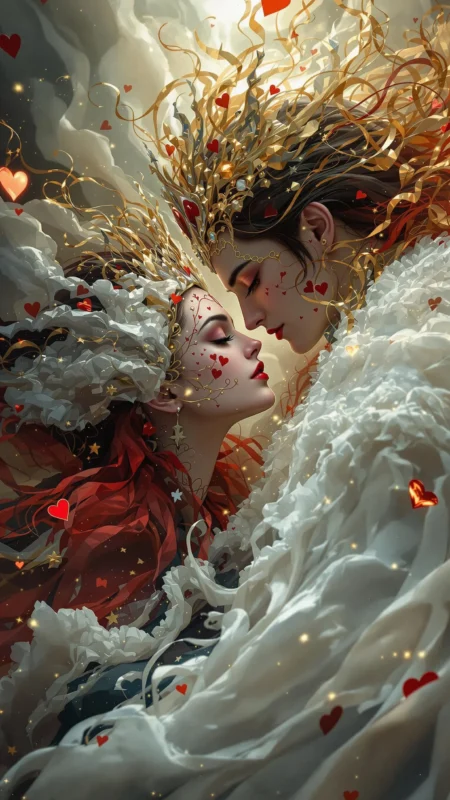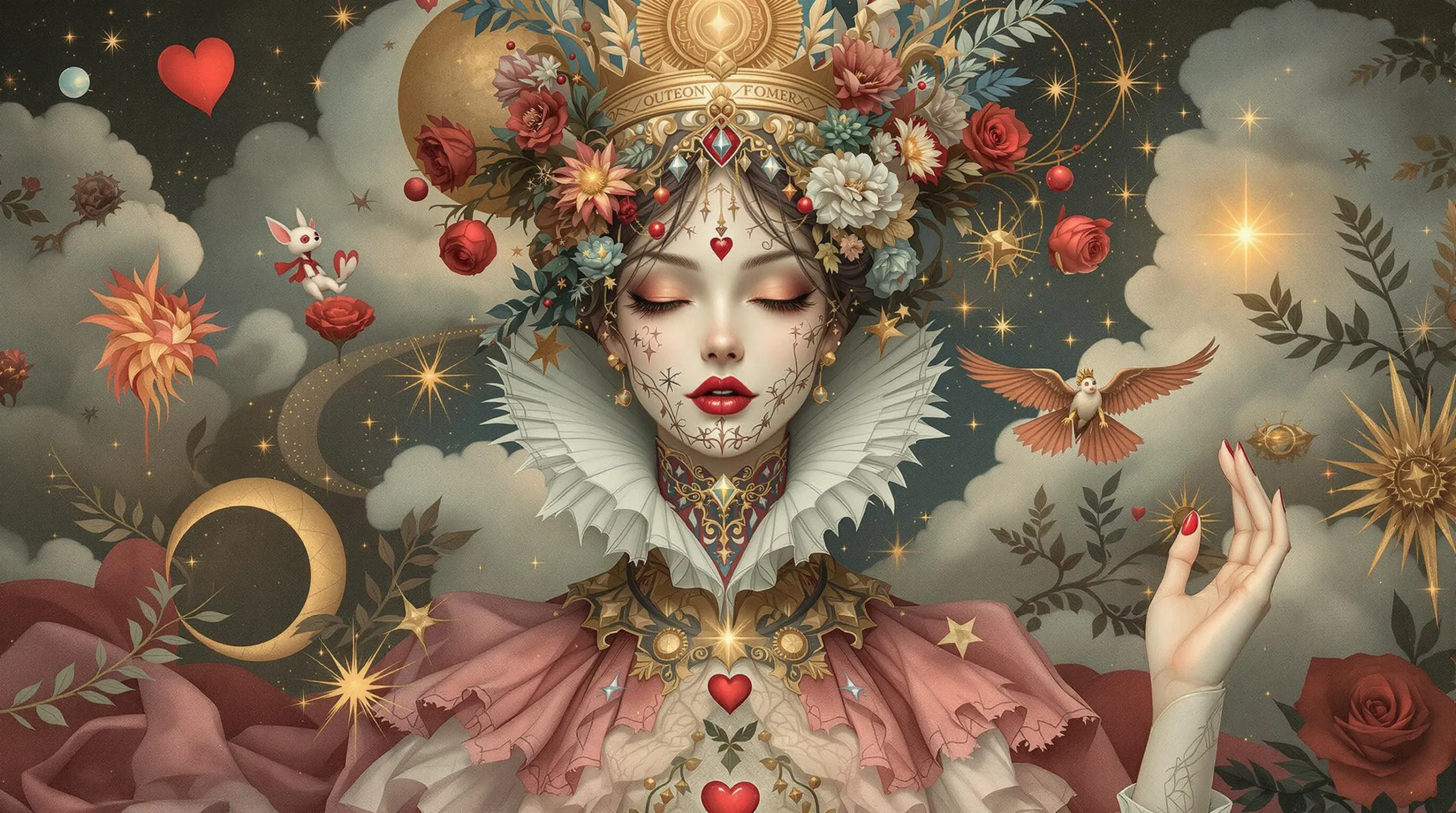


Queen of Hearts

Archetype Meaning & Symbolism

Tyrannical, passionate, impulsive, imperious, dramatic, volatile, regal, demanding, emotional, insecure

  • Off with their heads!

If Queen of Hearts is part of your personal mythology, you may...

Believe

  • My feelings are not suggestions; they are facts. If I feel wronged, it is because I have been wronged, and immediate justice is required.
  • Order, even arbitrary and nonsensical order, is always preferable to chaos. My rules create a world I can understand and control.
  • To show vulnerability is to invite attack. Power, and the performance of power, is the only true form of safety.

Fear

  • Losing control. The slightest sign of dissent or unpredictability feels like the beginning of a coup that threatens your entire world.
  • Being seen as ridiculous, small, or powerless. Your rage is a magnificent costume for a deep, gnawing terror of irrelevance.
  • Betrayal. You may live with a constant, low-grade paranoia that those closest to you are secretly disloyal, plotting to steal your tarts or your throne.

Strength

  • Decisiveness. You are capable of making swift, powerful decisions that cut through confusion and paralysis, making you a potent catalyst for action.
  • An unforgettable presence. Your dramatic flair and powerful emotional energy can be captivating, allowing you to command a room and inspire a strange, compelling form of loyalty.
  • Unyielding boundaries. You possess an unparalleled ability to identify and excise toxic elements from your life with the clean, final precision of a guillotine.

Weakness

  • A lack of nuance. You tend to see the world in a binary of black and white, loyal and traitorous, making it immensely difficult to navigate the subtle gray areas of human relationships.
  • Emotional volatility. Your temper can be a destructive force, a sudden storm that damages relationships, your reputation, and your own sense of peace.
  • An inability to receive feedback. Because criticism is perceived as an act of rebellion, it is nearly impossible for you to learn from your mistakes or to grow through the insights of others.

The Symbolism & Meaning of Queen of Hearts

The Queen of Hearts is the sovereignty of pure, unchecked emotion. She is the Id given a crown and a scepter. In personal mythology, she does not symbolize love, as her suit might suggest, but the heart as the biological engine of raw feeling: rage, joy, panic, and pride, all unchaperoned by the mind. To have her in your mythos is to contend with a powerful internal force that believes its feelings are not merely valid, they are law. She represents the terrifying allure of acting on every impulse, of making the internal weather the external climate, and the inherent danger of a passion that has no governor, no counsel, save for its own thunderous beat.

Her reign is also a masterclass in the performance of power. Her regality is costume, her court a stage, her fury a kind of weather she summons to prove she can. For the individual, this may point to the ways we construct our own authority, the masks of confidence we don a fragile ego underneath. The Queen of Hearts mythos could explore the gap between the powerful figure you project and the insecure ruler within, terrified of being seen as a fraud. She is a reminder that the loudest authority is often the most brittle, a fortress of dictates built on a foundation of fear.

This archetype is a study in arbitrary rules and the illusion of control. Wonderland operates on a fluid, dreamlike logic, yet the Queen imposes a rigid, nonsensical order upon it. To have her as a guide is perhaps to recognize a personal tendency to invent strict, unassailable rules for a world that refuses to comply. This might manifest as a need to control every variable in one's life, from social interactions to career paths, creating a personal kingdom with laws that only make sense to the monarch. It is a desperate attempt to build a logical castle on illogical ground, a project that can only lead to frustration and isolation.


Queen of Hearts Relationships With Other Archetypes

The Joker

In the rigid, crimson-soaked court of the heart, the Joker may be the only figure who cannot be brought to heel. He is, perhaps, the anarchic whisper against the Queen’s thunderous decrees, a crack in the porcelain face of her authority. While she rules a kingdom of feeling, a realm where passion is law, the Joker operates from a space of sublime absurdity, a logic so bent it cannot be broken. Their relationship could be seen as a tense, eternal dance between emotional tyranny and intellectual sabotage. He is the wild card that makes a mockery of her suit, the jester whose jokes are laced with the kind of truth that can topple a throne. The Queen’s fury toward him may stem from this essential impotence; he is the one variable her heart cannot calculate, the one subject who refuses to be painted red.

The Rose Garden

The Rose Garden is not merely a place, but a carefully constructed projection of the Queen's psyche. It could be understood as a fragile paradise built on a ruthless decree, a testament to a love so possessive it must remake the world in its own image. Every manicured hedge and blood-red petal may represent a feeling, a memory, or a demand, pruned and cultivated into an acceptable, beautiful shape. The infamous white roses, then, are not just horticultural errors; they are flaws in the self, imperfections that must be violently corrected, painted over with a facade of passion. The garden is her canvas and her cage, a space that offers the illusion of tranquil beauty while humming with the constant, anxious threat of the axe, a symbol of how the most ardent love can demand an impossible, and therefore cruel, perfection.

The Executioner

The Executioner may be less a person and more a function, the chilling, physical punctuation at the end of the Queen’s emotional sentence. He is the body’s tremor after a shriek, the cold steel that serves the hot heart. Their relationship is not one of collusion but of consequence; the Queen provides the fleeting, furious "why," and the Executioner provides the irreversible "how," a blade that falls without reflection or remorse. He could be seen as the ultimate instrument of a world ruled by mood, the terrifying means by which a passing temper is made absolute and final. In him, the Queen's abstract rage finds its concrete, devastating form, transforming a volatile feeling into a stark and silent fact.

Using Queen of Hearts in Every Day Life

Navigating Emotional Outbursts

When you feel the tell-tale surge of royal rage, a fury demanding immediate and disproportionate justice for a minor slight, you may pause. You can ask: is this a measured response, or is the Queen demanding a head? This allows you to witness the archetype’s impulse without being ruled by it, transforming a potential decree of war into a moment of self-inquiry. It becomes a tool not for suppression, but for understanding the source of the storm.

Creative Leadership

In a project stalled by indecision, the Queen of Hearts archetype can be a powerful catalyst. You might channel her decisiveness, not her cruelty. You can make the bold, executive choice that cuts through the noise. It’s about embracing the theatricality of leadership: making a grand pronouncement, taking a definitive stance, and imbuing the moment with a sense of irreversible momentum, turning a stagnant meeting into a court in session, ready for a verdict.

Setting Final Boundaries

There are relationships and situations that are not merely flawed, but toxic. The Queen offers a stark metaphor for the final, non-negotiable exit. When all attempts at repair have failed, you may invoke her absolute power to declare a situation over. It is not a negotiation: it is a severing. You are not just closing a door; you are removing the door from the castle wall, an act of self-preservation as brutal and necessary as a royal decree.

Queen of Hearts is Known For

Her Decree

The infamous, impulsive command, “Off with their heads!” which serves as her all-purpose solution to any problem, annoyance, or contradiction. It represents the ultimate expression of arbitrary power.

The Croquet Match

A surreal and chaotic game played with live flamingos for mallets and rolled-up hedgehogs for balls. It symbolizes the Queen’s nonsensical rule and her use of living beings as mere tools for her own amusement and whim.

The Trial of the Knave of Hearts

A court proceeding that is a mockery of justice, where the Queen demands a sentence before a verdict is even considered. This highlights her belief that her emotional conviction is more important than evidence, process, or fairness.

How Queen of Hearts Might Affect Your Personal Mythology

How Queen of Hearts Might Affect Your Mythos

When the Queen of Hearts marches into your personal mythos, your life story may cease to be a journey of discovery and become a narrative of sovereignty. Your protagonist, you, is not a wanderer but a monarch, and the central plot may revolve around the establishment and defense of your personal kingdom. Life events are not accidents or lessons; they are edicts, rebellions, and matters of state. Your myth might be a cautionary tale about a ruler's temper, or it could be a heroic saga about learning to wield immense passion with wisdom, transforming from a tyrant into a just sovereign.

The narrative rhythm of your life might adopt her staccato decrees. Your story could be punctuated by dramatic turning points rather than gradual shifts. There are moments of “cutting someone off,” grand pronouncements that change the direction of your career or relationships, and high-stakes emotional confrontations that feel like battles for the soul of the kingdom. You may see your life not as a gentle, flowing river, but as a series of sharp, decisive acts: a timeline marked by reigns, edicts, and the occasional, necessary coup d'état.

How Queen of Hearts Might Affect Your Sense of Self

To see oneself through the Queen's eyes is to view the self as a monarch by divine right. There may be a deep-seated belief that your emotional reality is the only reality that matters, and the world should arrange itself accordingly. This can foster a potent, unshakable sense of self-possession, an internal certainty that can be magnetic. However, this self-concept is also exceptionally brittle. If your feelings are law, then any disagreement or dissent from others is not just a difference of opinion; it is treason, a direct assault on the legitimacy of your very being, which can cause the self to shatter into rage.

Conversely, the Queen of Hearts can be internalized as the ultimate inner critic, a tyrant on the throne of your psyche. In this dynamic, you are not the Queen; you are her terrified subject. Every mistake you make is met with an internal shriek of “Off with your head!” This creates a state of constant performance anxiety, a fear of your own fallibility. The quest for self-development becomes a political thriller: a secret plot to appease, outwit, or ultimately dethrone the screaming monarch within who demands an impossible, inhuman perfection.

How Queen of Hearts Might Affect Your Beliefs About The World

With the Queen as your lens, the world may flatten into a chessboard, a stark landscape of red and white, friend and foe. Nuance is a frivolous luxury. People, institutions, and ideas are judged swiftly and sorted into one of two categories: loyal to your reign or worthy of condemnation. This worldview is not concerned with understanding complexity; it is concerned with establishing order. The world becomes a court to be managed, a territory to be ruled, where the primary objective is to enforce your own vision and quell any form of dissent that threatens the monolithic structure of your reality.

This perspective can also breed a profound and radical cynicism toward all external authority. If you perceive that all power structures are, at their core, as arbitrary, self-serving, and nonsensical as the Queen's court, then no government, corporation, or social institution can be seen as legitimate. You might view all rules as a game, all leaders as performers. This could lead to a rebellious, anti-authoritarian streak, a refusal to play by anyone's rules but your own, or it may curdle into a deep disillusionment, a belief that the entire world is a poorly managed, chaotic kingdom with no just ruler to be found.

How Queen of Hearts Might Affect Your Relationships

In relationships, the Queen of Hearts archetype may compel you to establish a monarchy rather than a partnership. You are the sovereign; others are members of your court. Love, affection, and attention are not freely exchanged but are granted as royal favors, conditional upon loyalty, adoration, and adherence to your unspoken rules. Displease the crown, and you risk banishment. This can create relationships of incredible intensity and high drama, but they are built on the unstable ground of power dynamics, not the bedrock of mutual respect and vulnerability.

The central emotional currency in your relationships could be loyalty, and the central fear, betrayal. Like the Queen, obsessed with who stole her tarts, you may find yourself perpetually testing the people you love, engineering small dramas to see who will stand by you, demanding proofs of allegiance. This makes true intimacy a near impossibility. A court is built on a performance of loyalty born from fear or ambition; a genuine connection requires a trust that the Queen's frantic, insecure heart cannot afford to grant. The throne, therefore, can be the loneliest place in the world.

How Queen of Hearts Might Affect Your Role in Life

Your perceived role in life, in any context, may be that of the ultimate authority. Whether in a family, a friend group, or a workplace, you may feel an inexorable pull towards the throne. This is not necessarily a desire for the practical burdens of leadership, but a need for the status of the final arbiter. Your role is to set the emotional tone, to pass judgment, and to be the undisputed center of gravity around which all others orbit. You provide the rules, the drama, and the law. You are not a player in the game; you are the game's capricious master.

This role, however, can feel less like a privilege and more like a prison. The crown is heavy, the performance of power exhausting. You might feel a relentless pressure to project an aura of absolute certainty and unshakeable command, even, and especially, when you feel lost, frightened, or insecure. Your role forbids you from asking for directions or admitting fault. You become trapped in a caricature of strength, a living symbol who is not permitted the messy, contradictory, and vulnerable experience of being simply human.

Dream Interpretation of Queen of Hearts

To dream of the Queen of Hearts in a positive context, where you are the Queen or are allied with her, could symbolize a powerful integration of your own authority and decisiveness. It may be a sign from your subconscious that you are ready to wield your power effectively in your waking life. Perhaps it is time to make a final, clean break from a person or situation that has been draining you, to issue a personal “off with their head” decree to a limiting belief or a toxic dynamic. The dream affirms your right to rule your own life with conviction.

A dream in which you are judged, condemned, or pursued by a terrifying Queen of Hearts often points to a confrontation with your own unmanaged emotions or a tyrannical inner critic. She may be the personification of your own explosive anger, your knee-jerk judgments, or your impatience that is wreaking havoc on your relationships and inner peace. The dream is a warning from the deep: your inner kingdom is in a state of terror, ruled by a despot. It is a call to revolution, to find a more just and compassionate way to govern yourself.

How Queen of Hearts Archetype Might Affect Your Needs

How Queen of Hearts Might Affect Your Physiological Needs

When the Queen of Hearts governs the mythos of your physiological needs, the body’s whispers become royal decrees demanding immediate satisfaction. Hunger is not a gentle signal but a crisis of state; thirst is an intolerable affront. The need for food might be met not with what is nourishing but with what is decadent, a feast befitting a monarch. Shelter is not merely for safety but for status: it must be a castle, a space that projects power and isolates the ruler from the unruly mess of the world, a place where one’s control is absolute.

This can also create a dangerous disconnect from the body’s own wisdom. Sleep might be viewed as a surrender, a lapse in vigilance, and therefore be resisted until exhaustion triggers an emotional collapse. Bodily functions become subjects to be commanded, not partners to be consulted. Rest is weakness; pain is rebellion. This worldview can lead to a cycle of ignoring subtle needs until they become full-blown emergencies, treating one's own physical self with the same impatience and lack of curiosity the Queen affords her hedgehog croquet balls.

How Queen of Hearts Might Affect Your Ideas of Belonging

For the Queen of Hearts, belonging is not a matter of mutual acceptance but of unilateral command. You do not seek to fit in; you seek to rule. Love and intimacy are filtered through the lens of a monarch and her court. Friendships and partnerships may be structured around fealty, with you as the emotional sun and others as planets in your orbit. You create belonging by establishing a kingdom and inviting subjects to live within its walls, under your laws. The price of admission is loyalty; the penalty for breaking it is exile.

This framework almost guarantees a profound and inescapable loneliness. The Queen is surrounded by faces, but she is intimate with none. True belonging requires vulnerability, the admission that one needs others, which the Queen perceives as a fatal weakness. The deep human need for love becomes warped into a desperate need for obedience and adoration. You may have a court full of people, but you are alone on the throne, because a relationship with a subject can never be a relationship with an equal.

How Queen of Hearts Might Affect Your Feelings of Safety

Safety, in the Queen of Hearts’ kingdom, is synonymous with absolute control. To feel safe, you may feel a need to dominate your environment, ensuring that every element is subject to your will. Financial security is not just a buffer; it is a treasury, a hoard of resources that demonstrates power and discourages rebellion. Employment is a throne, a position of authority from which to issue commands. Any threat to this control—a challenge at work, a market downturn, a crack in the foundation—is not a problem to be solved but an act of war, an existential threat to the entire kingdom.

This need for control extends to one’s health and well-being. Illness is an insurrection of the cells, an enemy to be vanquished swiftly and violently, rather than a condition to be understood and managed. Personal security means building walls, not bridges. The mythos fosters a belief that safety is achieved by eliminating all variables, punishing all threats, and establishing a sterile, predictable domain. The tragic irony is that this relentless pursuit of absolute safety often creates a life of high stress, paranoia, and isolation, which is profoundly unsafe for the soul.

How Queen of Hearts Might Affect Your Views of Esteem

Esteem, in this personal mythology, is a ravenous hunger that must be fed by external validation. It is not a quiet, internal sense of worth, but a loud, public coronation that must be constantly re-enacted. Respect is not earned through character but demanded by status. Self-esteem is therefore incredibly fragile, built upon the shifting sands of others’ fear and flattery. A minor slight, a perceived lack of deference, or a moment of being ignored can trigger a catastrophic collapse, because it challenges the very foundation of your right to rule.

Strength is narrowly defined as the power to impose your will, to win every argument, to never back down. The strength of admitting a mistake, the strength of compromise, the strength of quiet resilience—these are seen as forms of defeat. Esteem is therefore maintained through escalating displays of dominance. You must be the loudest voice, the final word. This creates a vicious cycle: the more you demand respect, the less you behave in a respectable manner, further starving you of the genuine admiration you crave.

Shadow of Queen of Hearts

When the shadow of the Queen of Hearts takes the throne, it manifests as a petty tyrant ruling a small and miserable kingdom. This is the part of you that screeches at a barista for the wrong kind of milk, that digitally 'beheads' a friend for a political post, that turns a simple domestic disagreement into a screaming proclamation of betrayal. This shadow self is not powerful but pathetic, its rage a sign of its profound powerlessness in the wider world. It creates a court of one, surrounded by the ghosts of banished friends and lovers, perpetually polishing a tarnished crown in a silent, empty room.

When this archetype's energy is deeply repressed, its opposite shadow emerges: the terrified, silent subject. You become a courtier in everyone else's kingdom, pathologically afraid of your own anger and assertiveness. You paint the roses red, not out of malice, but out of a desperate fear of displeasing whichever queen rules your current environment. You silence your own needs, swallow your own opinions, and live in constant, low-grade dread of a 'beheading' for some unknown infraction. You trade your own sovereignty for the illusion of safety, becoming a faceless playing card in someone else's deck.

Pros & Cons of Queen of Hearts in Your Mythology

Pros

  • You are a powerful agent of change, unafraid to tear down stagnant, unjust, or inefficient systems with decisive action.
  • You possess a theatrical and potent charisma, a gravitational pull that can rally people to a cause and make you a memorable, if feared, leader.
  • Your fierce defense of your own sovereignty serves as a powerful model for others on how to claim their own authority and set non-negotiable boundaries.

Cons

  • Your leadership style often creates a culture of fear, stifling the honesty, creativity, and morale of those you work or live with.
  • Your emotional impulsiveness can lead you to burn bridges with startling speed, making decisions in the heat of the moment that cause irreparable damage.
  • You are at high risk of profound loneliness, as your constant demand for loyalty and your intolerance for dissent make authentic, reciprocal relationships nearly impossible to sustain.