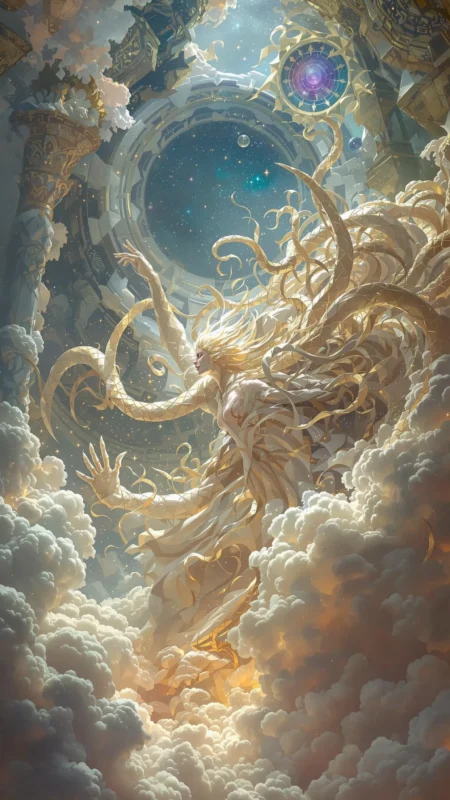


Portunus

Archetype Meaning & Symbolism

Liminal, Protective, Transitional, Guardian, Opportunistic, Two-faced, Domestic, Ancient, Fortuitous, Secure

  • I hold the key not to where you have been, but to where you might go; turn it with purpose, for the harbor awaits only those who dare to sail.

If Portunus is part of your personal mythology, you may...

Believe

  • You may believe that every ending is simply the locking of one door, which creates the space to find the key for the next.
  • You may believe that true freedom is not the absence of walls, but the power to control your own gates.
  • You may believe that the most sacred moments in life happen on the threshold, in the pause between leaving and arriving.

Fear

  • You may fear being trapped, either inside a situation you cannot leave or outside a place you desperately want to enter.
  • You may fear losing your keys, a symbolic terror of losing control, agency, and the very means of securing your life.
  • You may fear chaos and unpredictability, the metaphorical storm that could breach your harbor walls and destroy your sense of safety.

Strength

  • You possess an uncanny ability to navigate major life transitions, seeing them as manageable processes rather than terrifying upheavals.
  • You have a gift for creating environments of profound safety and security, making you a sanctuary for others.
  • You maintain exceptionally healthy boundaries, founded on a deep sense of self-respect and personal authority.

Weakness

  • You may have a deep aversion to spontaneity, preferring planned and controlled changes, which can cause you to miss out on unexpected opportunities.
  • You might be perceived as overly guarded or controlling, making it difficult for others to get close to you without passing a series of 'tests.'
  • You can become rigid or dogmatic about 'the right way' to do things, especially when it comes to beginnings and endings.

The Symbolism & Meaning of Portunus

To find Portunus in your personal mythology is to understand your life as a series of sacred thresholds. He is the quiet god of the hinge, the turning point. Unlike the grand, sweeping narratives of war or creation, the myth of Portunus is intimate, concerned with the profound magic of the mundane: the closing of a door, the arrival in a safe port, the turning of a key. He symbolizes the immense power vested in moments of transition. He suggests that the most significant acts are not the journeys themselves, but the decisions to begin and end them. His presence asks you to consider every doorway, whether to a new job, a new relationship, or a new phase of self, as a place of divine potential, requiring intention, respect, and the right key.

His symbolism is twofold, much like the god Janus with whom he is often associated. He looks both backward and forward. He is the guardian who secures the past, allowing it to be a foundation rather than a prison. By locking the door on what has been, you are not negating it; you are honoring its completion. At the same time, he holds the key to the future, representing opportunity, hope, and the courage to cross into the unknown. He is the god of auspicious moments, the patron of the calculated risk, the belief that with the right key, at the right time, a whole new world can be opened. He governs the liminal space, the 'in-between' where all things are possible.

In a modern context, Portunus is the patron saint of boundaries. He is the permission to say who and what may enter your life. He is the strength to close the door on draining energies, on past versions of yourself, on relationships that no longer offer safe harbor. He embodies the idea that security is not a passive state but an active practice of curation. Your life is your home, your harbor, and Portunus reminds you that you are the sole keeper of its keys. You decide who gets a spare, who must knock, and who is not permitted entry at all.


Portunus Relationships With Other Archetypes

The Key

The relationship between the Portunus and The Key is one of fraught, etymological potential. The Portunus, in its chitinous armor, could be seen as the living embodiment of a lock, a guardian of some deep, internal sanctum. The Key, then, is not merely an object but a proposition—an offer of intimacy, a promise of being truly seen beyond the defensive carapace. This relationship may be one of deep ambivalence for the Portunus. The Key represents a profound vulnerability, the potential for an outsider to turn the tumblers of one's soul, but it also, perhaps, offers the only true relief from the lonely weight of perpetual self-guardianship. The Key is a test: is the fear of being trespassed greater than the hope of being entered?

The Tide

The Portunus's relationship with The Tide is less a partnership and more a form of cosmic acquiescence. The Tide is the inexorable pull of circumstance, the great, sighing rhythm of gain and loss to which the creature is eternally bound. It dictates when the Portunus may venture forth to scavenge the boneyard of the low-water mark and when it must retreat to the blue-green silence of its submerged world. In this, The Tide might be understood as a metaphor for the larger, impersonal forces that shape a life—the economy, cultural shifts, the simple passage of time. The Portunus does not challenge this force; instead, it has learned the profound wisdom of yielding, of scuttling with the current, finding its agency not in opposition but in a deep, instinctual alignment with the inevitable.

The Lighthouse

To the Portunus, The Lighthouse could be perceived as a kind of dispassionate god, a solitary, cyclopean eye sweeping over its tidal kingdom. Both are guardians of the threshold, yet their natures are entirely opposed. Where the Portunus is all scuttling, immanent, and earthbound defense, The Lighthouse is transcendent, stationary, and remote. Its beam may offer a kind of cold comfort, a predictable geometry laid over the chaotic dark, but it provides no warmth, no company. This relationship, then, may speak to the feeling of being observed by a principle or power one can never truly know—be it society, history, or a distant, silent divinity. The Lighthouse is a constant, lonely witness to the crab's small dramas, its light touching the shell for a moment before sweeping on, forever concerned with the larger horizon.

Using Portunus in Every Day Life

Navigating a Career Change

To leave a job under the aegis of Portunus is not to burn a bridge but to consciously lock a door behind you. You may perform a small ritual: writing down what the old job gave you and what it took, then folding the paper and placing it in a box, turning a key to lock it. This act isn't one of bitterness, but of sanctifying a conclusion. The new opportunity is a separate door, and Portunus asks that you approach it not with the baggage of the last room, but with the clean, singular purpose of the key you now hold for the future.

Moving to a New Home

When you move, the first turn of the key in the new lock is a prayer to Portunus. He is the god of the threshold, the one who transforms a mere structure into a safe harbor. You might anoint the doorway with oil or salt, a quiet acknowledgment that this is no longer just a point of entry, but a membrane between your private world and the public one. In this mythos, you are not just acquiring property; you are establishing a port, a personal sanctuary where you and yours can find safe mooring after weathering the storms of the day.

Ending a Relationship

Closing the chapter of a relationship with Portunus as a guide is an act of profound self-preservation. It is the understanding that some doors must be locked for our own protection. This archetype encourages you to see the conclusion not as a failure, but as a necessary securing of your emotional port. You may visualize turning a key on the memories, not to erase them, but to contain them, to stop them from drifting into the present. This allows you to set sail again, not as a refugee from a shipwreck, but as a captain embarking from a harbor that is now, and forever, part of your past.

Portunus is Known For

Guardian of Keys and Doors

As the divine locksmith, he presides over all points of transition

the door to a home, the gate of a city, and the metaphorical passages of a human life. He ensures that what is meant to be kept in remains secure and what is meant to enter may do so auspiciously.

Protector of Harbors

Portunus was the patron of ports and harbors, the safe haven for ships returning from the sea. He represented the profound relief of arrival, the moment of transition from the chaotic, dangerous waters to the stability and security of land.

The Portunalia

An ancient Roman festival celebrated on August 17th in his honor. On this day, keys, the symbols of his power, were traditionally thrown into a fire for purification and good fortune, a ritualistic entrusting of one's security and future opportunities to the god's care.

How Portunus Might Affect Your Personal Mythology

How Portunus Might Affect Your Mythos

When Portunus anchors your personal mythos, your life story ceases to be a linear road and becomes, instead, an intricate building with many rooms and corridors. Your narrative is marked not by the miles traveled, but by the doors opened and closed. Major life events are 'key moments' in the most literal sense: the moment you got the key to your first apartment, the metaphorical key to a new career path, or the painful turning of a lock on a part of your life you had to leave behind. Your personal epic is one of gaining and sometimes losing the keys to different parts of your own castle.

This mythos shapes you as the protagonist who is a 'Gatekeeper' or a 'Harbormaster' of your own destiny. You might see your past not as a ghost that haunts you, but as a series of locked rooms you can choose to revisit or keep sealed. Your future is not a terrifying void but an unopened door filled with potential. Your personal legend is less about conquering external dragons and more about the internal wisdom of knowing which doors to unlock, which to bar, and which to simply leave ajar, awaiting a welcome guest. The central conflict of your story may often be the search for a lost key or the struggle to find the courage to cross a new threshold.

How Portunus Might Affect Your Sense of Self

To see yourself through the lens of Portunus is to understand your identity as both fluid and secure. You are a being of transitions. You may feel a dual nature within: one part of you deeply connected to the past, the home, and the known, while another part is perpetually looking forward, eager for the next opening, the next arrival. This might create an internal sense of being always 'on the threshold,' comfortable in the space between what was and what will be. You may not define yourself by a single state of being, but by your capacity to move between states with intention.

This archetype could instill a profound sense of personal authority and responsibility. If you hold the keys, you are the one in control of access to your innermost self. This fosters a strong sense of sovereignty. You may see your personal boundaries not as walls to keep others out, but as well-tended gates that open for the right reasons. This perspective cultivates a quiet confidence, the calm of the harbormaster who knows his port is secure. You are the one who grants entry, and that power, when wielded wisely, is the bedrock of your self-respect.

How Portunus Might Affect Your Beliefs About The World

Your worldview, colored by Portunus, is one of structure, opportunity, and managed flow. The world is not a chaotic, borderless expanse; it is a grand architecture of entrances and exits. You may see systems, societies, and even life itself as a series of gates. Some are open to all, some require a specific 'key'—like knowledge, wealth, or connection—and some are firmly locked. This doesn't necessarily lead to cynicism, but to a strategic understanding of how the world works. You believe in the power of finding the right key rather than trying to break down the door.

This perspective fosters a belief in auspicious timing and preparedness. Random chance plays a smaller role in your cosmology; opportunity is a door that opens, and you must be ready to walk through it. You might have a deep appreciation for infrastructure, for rules that create safe passage, and for traditions that mark transitions. You see the hidden poetry in customs like a housewarming party or a graduation ceremony: they are all rituals honoring Portunus, celebrating the successful navigation of a threshold. The world is a place of endless potential, if only one knows how to work the locks.

How Portunus Might Affect Your Relationships

In relationships, you may operate as the 'harbor.' You value security, loyalty, and the feeling of two people creating a safe space together against the outside world. A committed relationship, for you, is like a well-protected port where both partners can moor their ships, confident in their shared safety. The process of letting someone into your life is deliberate, a gradual bestowing of keys: the key to your home, to your secrets, to your future. You may be cautious at first, a careful guardian of your own gate.

This can also mean you have very strong ideas about relational boundaries. You are the one who locks the door on arguments, creating a clear end to conflict. You might struggle with ambiguity or with partners who are emotionally transient, who seem to have one foot always out the door. For you, belonging is about being fully 'inside.' The most profound declarations of love may not be passionate outbursts, but quiet, steady acts of creating a shared home, a mutual sanctuary. You provide a sense of arrival for others, a feeling that with you, they have finally come home.

How Portunus Might Affect Your Role in Life

You may feel that your role in life, your vocation, is to be a facilitator of transitions for others. You are the person who holds the space for new beginnings and dignified endings. This could manifest in a career as a therapist, a life coach, a midwife, or a funeral director. It could be the real estate agent handing over the keys to a new life, or the teacher welcoming students on the first day of school. In any field, you are drawn to the 'doorway' moments, the points of critical passage.

Within your family or community, you might be the unofficial 'harbormaster.' You are the one people turn to when they are in crisis, seeking a safe port in a storm. You provide stability, wise counsel, and a sense of security. Your role is not to solve their problems, but to offer them a temporary haven where they can rest, repair, and prepare for their next voyage. You are the keeper of the hearth, the guardian of the gate, the one who ensures that the circle of your community remains a safe and welcoming place.

Dream Interpretation of Portunus

In a positive dream context, Portunus may appear as a kind, bearded figure offering you a key, or you might simply dream of finding a beautiful, ornate key. This dream is a powerful omen of opportunity and agency. It suggests you currently possess the means to unlock a new phase of your life, solve a vexing problem, or gain access to a desired state of being. Dreaming of a calm, welcoming harbor signifies the imminent arrival of peace, success, or emotional security after a period of turmoil. The dream is an affirmation: you are on the right path, and a safe conclusion is within reach.

In a negative context, the dream might involve a lost key, a key that breaks in the lock, or a door that refuses to open no matter how you try. This can symbolize feelings of powerlessness, of being locked out of your own future, or of a missed opportunity that now haunts you. Dreaming of being trapped in a room or a house points to a feeling of stagnation, of being unable to leave a situation or a past self behind. A stormy, dangerous harbor in a dream may reflect a fear of commitment, a lack of a secure base in your life, or a warning that what you perceive as a safe haven is actually treacherous.

How Portunus Archetype Might Affect Your Needs

How Portunus Might Affect Your Physiological Needs

The mythology of Portunus speaks directly to the foundational need for shelter. Your personal mythos may elevate the act of securing your home to a nightly ritual of profound comfort. The click of the deadbolt is not just a sound; it is an incantation, a ward against the chaos of the world. This can foster a deep physiological sense of calm when you are within your own space. You may feel a palpable release of tension when you cross your threshold, as your body registers that it has reached its designated safe harbor, a place where it can truly rest and recuperate.

This connection to a safe port can also influence how you care for your body. Your body itself might be viewed as the primary 'house' you inhabit, with its own gates and thresholds. You may be more conscious than most about what you allow to enter it—the food you eat, the substances you consume. The need for a secure physical port could also translate into a highly structured daily routine, especially around sleep. Your bedroom becomes a sanctum, the final, most protected harbor where your physical self can be truly vulnerable and recharge for the next day's voyage out into the world.

How Portunus Might Affect Your Ideas of Belonging

The need for love and belonging, under the influence of Portunus, is intrinsically tied to the concepts of 'insider' and 'outsider.' You feel you belong when you have been formally welcomed across a threshold and accepted into the inner sanctum of a family, a group of friends, or a partner's heart. Belonging is the feeling of being given a key. It is a state of mutual trust where you no longer have to knock to be let in. This makes you fiercely loyal to your chosen 'insiders.'

Consequently, you may be the one who defines the boundaries of your social circles. You are the host of the party, the organizer of the family reunion, the one who brings people together within a defined space. Love, for you, is the act of creating a shared harbor. You show affection by making someone feel safe, welcome, and 'at home' with you. The deepest sense of belongingness comes from the quiet, shared understanding that you are both inside the same safe harbor, with the door securely closed to the rest of the world.

How Portunus Might Affect Your Feelings of Safety

Your need for safety, as informed by Portunus, is proactive and architectural. You believe safety is built, not hoped for. This extends beyond physical locks on doors into the realms of financial and emotional security. You may be the person who diligently builds a 'rainy day fund,' seeing it not as a pile of money, but as the strong walls of a harbor that can withstand economic storms. Insurance policies, retirement plans, and legal contracts are, in your mythos, the keys and locks that secure your future against uncertainty.

Emotionally, the effect is a deep-seated need for clear boundaries. You create safety by managing access to your inner world. You are likely uncomfortable with unpredictable people or situations where the 'rules of entry' are unclear. This can make you an incredibly reliable and trustworthy figure, as your own need for security makes you a stable presence for others. However, it also means that sudden, uncontrolled disruptions to your safety net—a betrayal of trust, a sudden financial loss—can feel like a catastrophic failure of your most sacred duty: keeping the port safe.

How Portunus Might Affect Your Views of Esteem

Your esteem needs are fulfilled by demonstrating competence as a guardian and a navigator of transitions. Self-worth comes from being the master of your own domain, holding the keys to your own life. You earn your own respect by successfully managing your boundaries, by making wise choices about what you allow into your life, and by navigating major changes with foresight and grace. Every time you successfully begin a new chapter or securely close an old one, your esteem grows. You are the reliable captain of your own ship, and you are proud of your well-kept harbor.

Respect from others is earned in a similar fashion. People look up to you for your stability, your trustworthiness, and your ability to create safe spaces. You gain status by being the person others turn to when they are at a crossroads, the one who can offer a steady hand or a safe place to rest. Your reputation is that of a person who is 'all there,' self-contained and secure. Esteem is not about flashiness or external accolades; it is the quiet, solid respect accorded to the harbormaster who keeps the port running smoothly and safely for all.

Shadow of Portunus

The shadow of Portunus manifests as the paranoid jailer. When this archetype is distorted by fear, the guardian of the gate becomes a prisoner within his own walls. This is the person who refuses all new opportunities, who sees every outsider as a threat, and who locks every door to the point of complete isolation. Their life stagnates, the rooms of their experience gathering dust, because the fear of what might enter has overwhelmed the hope of a welcome guest. They have built their harbor walls so high that no ship, not even their own, can get in or out. It is a self-imposed exile born from an overdose of the need for security.

Conversely, the other shadow expression is the keeper of a harbor with no gates at all. This is the individual with no boundaries, whose doors are always wide open to any influence, positive or negative. They are unable to secure their own emotional or physical space, leading to a life of chaos, depletion, and a feeling of being perpetually adrift. They cannot commit to a person, a place, or a path because they cannot bring themselves to close any other doors. They have so many keys they can't find the right one for any lock, and so they remain in the transient and vulnerable space of the entryway, belonging nowhere and safe nowhere.

Pros & Cons of Portunus in Your Mythology

Pros

  • You navigate life's inevitable changes with a rare and calming grace, viewing them as opportunities for intentional growth.
  • You act as a stabilizing force for those around you, offering a reliable sense of security and sanctuary in a chaotic world.
  • You approach your life with a powerful sense of agency and purpose, knowing you hold the keys to your own becoming.

Cons

  • Your need for control can make you resistant to necessary but unplanned changes, creating significant internal stress.
  • Others may find your strong boundaries to be off-putting or cold, misinterpreting your self-preservation as rejection.
  • You may place so much importance on the 'right' way to transition that you become overly ritualistic and lose sight of the journey itself.