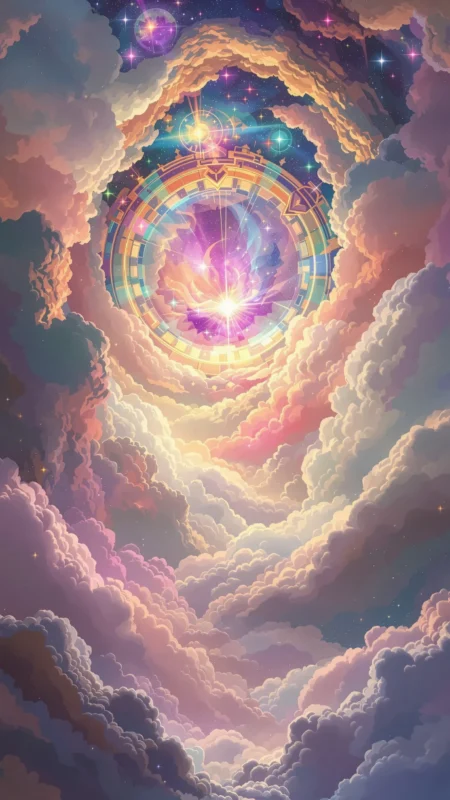


Portal

Archetype Meaning & Symbolism

Transitional, liminal, mysterious, promising, dangerous, permeable, inviting, sudden, cyclical, hidden

  • What you call an exit, another calls an entrance. The view depends entirely on which side you are standing.

If Portal is part of your personal mythology, you may...

Believe

  • Every ending is an illusion; it is merely a threshold to a new beginning.

    The self is not a fixed point but a journey through a series of different realities.

    The most important skill in life is learning to recognize the right door at the right time and having the courage to walk through it.

Fear

  • That you will become permanently stuck in the liminal space between worlds, a ghost belonging nowhere.

    Choosing the wrong portal and finding that the passage is irreversible, trapping you in a lesser story.

    That what lies on the other side of every door is ultimately just another empty room.

Strength

  • An unparalleled resilience and adaptability in the face of life’s major upheavals.

    A visionary ability to see potential, opportunity, and paths forward where others only see dead ends.

    A talent for helping others through their own significant life transitions, acting as a calm and knowing guide.

Weakness

  • A chronic restlessness and a potential inability to commit, always wondering if a better reality exists through another door.

    A tendency to romanticize the “next thing” to the point of devaluing the present moment and the people in it.

    Difficulty establishing a stable sense of identity, which can lead to feeling ungrounded and misunderstood by others.

The Symbolism & Meaning of Portal

In personal mythology, the Portal is the architecture of change. It suggests that transformation is not always a gradual, organic process, but can be a sudden, definitive crossing. Your life may be marked not by a slow arc of growth but by a series of distinct “before” and “after” epochs, each inaugurated by stepping through a specific doorway: a move to a new city, a diagnosis, the birth of a child, the reading of a single, life-altering book. These events become sacred sites in your memory, thresholds that, once crossed, forever changed the landscape of your inner world. This archetype invites you to see your own capacity for profound change as a series of gates waiting for the right key or the right moment of courage.

The Portal also speaks to the permeability of reality. If it is central to your mythos, you may hold a quiet conviction that what seems solid and fixed is, in fact, porous. You may look for the seams in the everyday, the thin places where another possibility might shine through. This could manifest as a fascination with quantum physics, alternate histories, spirituality, or even just the uncanny feeling that the person you could have been is living a life parallel to your own. The world is not a static stage but a dynamic set with hidden doors and shifting walls, and your purpose might be to find and navigate these passages.

Furthermore, the Portal archetype suggests that not all doors are for you. Part of its wisdom lies in discernment: knowing which thresholds to cross and which to pass by. Some portals may lead to distraction, to lesser versions of your own story. Others may be traps, promising escape but delivering only a different kind of confinement. To have the Portal in your mythology is to be in a constant, subtle dialogue with possibility, learning to feel which openings resonate with your deepest narrative and which are merely echoes from someone else’s tale.


Portal Relationships With Other Archetypes

The Guardian

The Guardian stands sentinel at the threshold, the necessary challenge before the passage. In a personal mythos, this relationship is the internal struggle before any great change. The Guardian is your own fear, your self-doubt, the societal expectations that tell you to stay put. The Portal remains impassive, but it cannot be accessed until the Guardian is satisfied, defeated, or understood. This archetype teaches that to cross a threshold, you must first confront what is guarding it within yourself.

The Key

The Key is what makes the Portal accessible. It is not brute force, but a specific piece of knowledge, an emotional breakthrough, a moment of grace, or the right person's love. The Portal’s relationship with the Key is one of elegant synergy. A locked Portal may represent a problem you cannot solve or a change you are not ready for. The search for the Key becomes the quest itself, and the moment it turns in the lock is the instant of transformation, the culmination of the journey that makes the passage through the Portal possible.

The Wanderer

The Wanderer is the seeker of Portals. This archetype is perpetually unsatisfied with a single reality and is driven to experience the multitude of worlds accessible through various thresholds. The Portal is the Wanderer's destination and point of departure. Their relationship is symbiotic: the Wanderer gives the Portal purpose by choosing to cross it, and the Portal gives the Wanderer their identity and path. In a personal narrative, this pairing could create a life of constant movement, exploration, and reinvention, defined by the search for the next horizon.

Using Portal in Every Day Life

Navigating a Career Shift

When leaving a long-held profession, one might frame the moment not as a failure or an end, but as consciously stepping through a portal. The skills and identity of the old job are not lost, but are the very things you carry through the doorway. This perspective shifts the focus from what is being left to what new landscape is being entered, transforming anxiety into anticipation for the unknown terrain of a new professional self.

Healing from a Relationship's End

The final conversation, the signing of papers, the return of a key: these are not just painful moments, but the archway of a portal. Recognizing them as such allows one to honor the passage. You might perform a small ritual to mark the crossing, acknowledging that the person who steps through is fundamentally different from the one who entered the relationship. It is an initiation into a new era of your own mythology, a solo chapter with its own distinct atmosphere.

Embracing a Spiritual Awakening

A sudden insight, a profound moment of synchronicity, or a deep meditative state can act as an unexpected portal. Instead of dismissing it as a fluke, one might treat it as a genuine crossing into a different way of seeing. This allows the integration of the experience into one's life story. It becomes the moment the veil thinned, the instant the world revealed a hidden dimension, fundamentally altering your map of reality from that point forward.

Portal is Known For

Transition

The Portal is the literal and metaphorical embodiment of passage. It is the mechanism by which a hero leaves the ordinary world, a soul enters the afterlife, or a mind accesses a new state of consciousness.

The Unknown

A Portal's defining characteristic is the mystery of what lies beyond it. It represents both the promise of a new world and the terror of a potential void, forcing a confrontation with uncertainty and a leap of faith.

Liminality

The Portal itself is a liminal space, a threshold that is neither here nor there. To be in the Portal is to be in-between states of being, a moment of pure potential where the old self has been shed but the new one has not yet formed.

How Portal Might Affect Your Personal Mythology

How Portal Might Affect Your Mythos

When the Portal is a cornerstone of your personal mythos, your life story ceases to be a linear road and becomes, instead, a series of interconnected rooms, each with its own climate, rules, and cast of characters. The major plot points are not battles won or mountains climbed, but the quiet, decisive moments of stepping from one room into the next. Your narrative is defined by these transitions. There is the “you” who existed before you moved to Paris, and the “you” after; the person you were before the loss, and the one forged in its wake. These versions of you do not erase each other, but coexist like portraits in a gallery, each marking a world you once inhabited.

This mythos is less concerned with a final destination and more with the art of the passage itself. The climax of any given chapter is the moment of stepping through the threshold. The narrative tension comes from the search for the next portal, the fear of what lies on the other side, and the courage required to leave a familiar world behind. Your story becomes a testament to adaptability and the radical belief that one can be reborn multiple times within a single lifetime, that identity is not a monolith but a travelogue of the selves you have been.

How Portal Might Affect Your Sense of Self

A self-image informed by the Portal is one of profound fluidity. You may not see yourself as a static entity, but as a perpetual traveler passing through different states of being. This can be liberating. You are not defined by your past mistakes or even your past successes; they belong to a self from a previous room. Your core identity might be located not in your personality or accomplishments, but in your capacity to change. You are the one who dares to cross the threshold, the one who adapts to the new light on the other side.

This can also cultivate a sense of detachment. If the self is always in transition, it can be difficult to feel fully present or grounded in any one identity. There may be a quiet melancholy, a feeling of being a visitor even in your own life. You might observe yourself with a kind of anthropological curiosity, watching this current version with the knowledge that it, too, is temporary. The challenge is to inhabit each self fully, to love the world on this side of the door, even while knowing that another passage may be just ahead.

How Portal Might Affect Your Beliefs About The World

To view the world through the lens of the Portal is to see it as a place of infinite, shimmering possibility. Reality is not a fixed, monolithic structure, but a permeable membrane between countless potential states. You might believe that a shift in perspective is, in a very real sense, a shift to another world. A conversation can be a portal; a piece of art can be a portal; a moment of intense grief or joy can tear open the fabric of the ordinary and show you something else entirely. This worldview is magical, but it is also demanding, as it implies that we are constantly co-creating our reality with the thresholds we choose to notice and cross.

This perspective may also lead to a deep skepticism of absolutes. Dogma, rigid ideologies, and claims of a single, objective truth may seem naive. If there are countless rooms, how can the rules of one apply to all? Your worldview might be characterized by a radical openness, a willingness to entertain contradictory ideas, and a belief that any system of thought is just one possible landscape. You might see the conflicts of the world as the result of people mistaking their room for the whole house, forgetting the existence of the doors that connect them all.

How Portal Might Affect Your Relationships

Relationships may be perceived as powerful portals in themselves. To truly know another person is to be granted access to their world, to step through the portal of their personality and see reality from a new vantage point. Consequently, the beginning of a significant relationship is a monumental transition, a crossing into a new territory that will irrevocably change you. You might choose partners who represent a world you wish to enter: a world of intellectual rigor, emotional vulnerability, or wild adventure. The relationship is the vehicle for that journey.

The end of a relationship is also a portal, a forced passage out of a shared world and back into the wilderness of the self. This can make breakups particularly disorienting, as it is not just a person you are losing, but a reality. You may also play the role of a portal for others. People may be drawn to you when they are on the cusp of change, sensing that you can help them cross a threshold within themselves. This is a profound gift, but it carries the risk of being seen as a means to an end, a doorway people pass through on their way to somewhere else.

How Portal Might Affect Your Role in Life

Your perceived role in life might be that of a psychopomp, a guide of souls, though not in a literal, mythological sense. You are the one who helps others navigate transitions. You may be the friend who is called after a devastating breakup, the therapist who guides a client through trauma, the artist whose work opens up new ways of seeing, or the manager who helps an employee transition to a new role. Your function is to stand at the threshold with others, holding a lantern and reminding them of their own courage.

This can lead to a sense of being essential but peripheral. You may facilitate great change but not be the direct protagonist of the resulting story. Your place is the liminal space: the doorway, the bridge, the crossroads. This role can be deeply fulfilling, but it may also create a longing to be the destination for once, not just the passage. The challenge is to find the profound meaning in being a catalyst, to understand that the architecture of the door is just as important as the hero who walks through it.

Dream Interpretation of Portal

In a positive context, dreaming of a Portal—an open door radiating light, a shimmering waterfall, a path appearing in a forest—could signify a readiness for change and the emergence of a new opportunity. It may suggest your subconscious is aligned with a conscious desire for growth, signaling that the time is right to take a leap of faith. The nature of the portal can offer clues: a sturdy, ancient door might point to a change rooted in ancestral wisdom, while a futuristic, technological portal might suggest an innovation in your career or thinking. Stepping through it willingly in a dream is a powerful symbol of self-acceptance and courage.

Conversely, a negative dream about a Portal can manifest as a door that slams shut, a bricked-up archway, or a terrifying vortex. This might reflect a feeling of being trapped, a missed opportunity that haunts you, or a deep-seated fear of the unknown. Dreaming of being pushed through a portal against your will could symbolize a change being forced upon you that you feel unprepared for. A portal that leads to a place identical to the one you left might suggest you are engaging in escapism, merely repeating old patterns in new settings rather than achieving genuine transformation.

How Portal Archetype Might Affect Your Needs

How Portal Might Affect Your Physiological Needs

From a mythological standpoint, the body itself is the primary portal. Birth is the dramatic entrance into this world, and death is the final, mysterious exit. If the Portal archetype is strong in you, you may have a heightened awareness of your body's own transitional states. Puberty, pregnancy, menopause, illness, and aging are not just biological processes; they are profound, mythic passages. Each one is a threshold that changes your relationship with your physical self and the world. You may feel that your body is a sacred vessel, a temporary dwelling whose various doors of perception and experience must be honored.

This can lead to a deep practice of embodiment. You might view eating not just as fueling, but as taking the outer world into your inner world. Breath could be seen as a constant, subtle portal between the self and the cosmos. Sickness might be interpreted as the body demanding a crossing into a new state of awareness or a different way of living. Your physiological needs are not just maintenance; they are rituals that affirm your presence on this side of the veil, while acknowledging the body’s ultimate role as a temporary gateway.

How Portal Might Affect Your Ideas of Belonging

Belonging may be a fluid and often elusive feeling. If home is a static concept, you may never quite feel you have one. Your sense of connection is not tied to a place, a nation, or even a continuous community, but to the state of passage itself. You may find your tribe among fellow travelers, seekers, and expatriates—others who understand the feeling of being perpetually in-between. True intimacy might be found in moments of shared transition, with people you meet on the proverbial road.

This can lead to a profound sense of belonging to the journey, rather than the destination. You feel at home in airports, in new cities, in the first chapter of a book. But it can also engender a deep loneliness, a yearning to arrive somewhere and finally unpack. The love you seek may be from someone who does not try to nail you down, but who recognizes you as a fellow doorway, a passage to another world, and is content to stand with you on the threshold, admiring both views.

How Portal Might Affect Your Feelings of Safety

For one who identifies with the Portal, safety is a paradoxical concept. The ultimate danger is not risk, but stagnation. Being trapped in a situation, a belief system, or a relationship long after it has ceased to serve your story feels like a kind of death. Therefore, safety is not found in building high walls, but in knowing there is always a door. The ability to transition, to escape, to reinvent—that is the source of security. Your safety lies in your adaptability and the belief that you can handle whatever lies on the other side of the next threshold.

However, the portal itself is the most unsafe place to be. The threshold is a point of maximum vulnerability, a space of no-man's-land where you belong neither to the world you left nor the one you are entering. In this liminal state, you are exposed, unformed, and at the mercy of the unknown. True safety, then, is the courage to endure this temporary state of dissolution. It is a deep, internal trust that even if you fall apart in the passage, you will reassemble on the other side, changed but whole.

How Portal Might Affect Your Views of Esteem

Self-esteem may be sourced not from what you have built, but from what you have survived. Your worth is measured by your resilience, your courage to close doors behind you, and your faith in opening new ones. You might take quiet pride in the collection of selves you have been, seeing them as badges of honor that testify to your capacity for radical reinvention. Your esteem is built on the foundation of your adaptability, your ability to walk into a new world and learn its language.

Conversely, your esteem can be fragile, highly dependent on forward momentum. A period of stagnation or the inability to find or open a necessary portal can trigger a crisis of self-worth. If your value is tied to your ability to transition, then feeling stuck can feel like a fundamental failure of your very being. You might feel worthless if you are not in the process of becoming something else, leading to a desperate search for any exit, even an unhealthy one, just to feel the motion of passage again.

Shadow of Portal

The shadow of the Portal manifests as compulsive escapism. Life's necessary challenges are not met with courage but are dodged by jumping through the nearest exit. Relationships, jobs, and commitments are abandoned at the first sign of difficulty, not as a genuine transformation but as a flight from responsibility. The person becomes a collection of beginnings without middles or ends, their life a series of hallways and abandoned rooms. The Portal, in this sense, is not a tool for growth but an addiction to the novelty of arrival, endlessly seeking a perfect world that never materializes because the self remains unchanged.

The other, equally potent shadow is paralysis. It is the curse of the person standing before a necessary door, frozen by the infinite possibilities and risks. They spend their life analyzing the doorway, polishing the knob, and reading maps of the other side, but never find the courage to simply step through. This fear of making the wrong choice becomes a choice in itself: the choice of stagnation. The Portal becomes a monument to a life unlived, a constant, silent rebuke, a reminder of the vast, unexplored country of the self that was forfeited for the illusion of safety.

Pros & Cons of Portal in Your Mythology

Pros

  • Your life is dynamic, rich with diverse experiences, and rarely boring.

    You possess a deep wisdom about the nature of change, making you a source of comfort and guidance for others.

    You are unafraid of starting over, giving you a sense of freedom that few people ever experience.

Cons

  • You may struggle with a sense of groundlessness and a persistent feeling of being an outsider.

    The constant change can be exhausting for both you and those who care about you, leading to unstable relationships.

    You might sacrifice genuine depth in one area of life for the breadth of experiencing many.