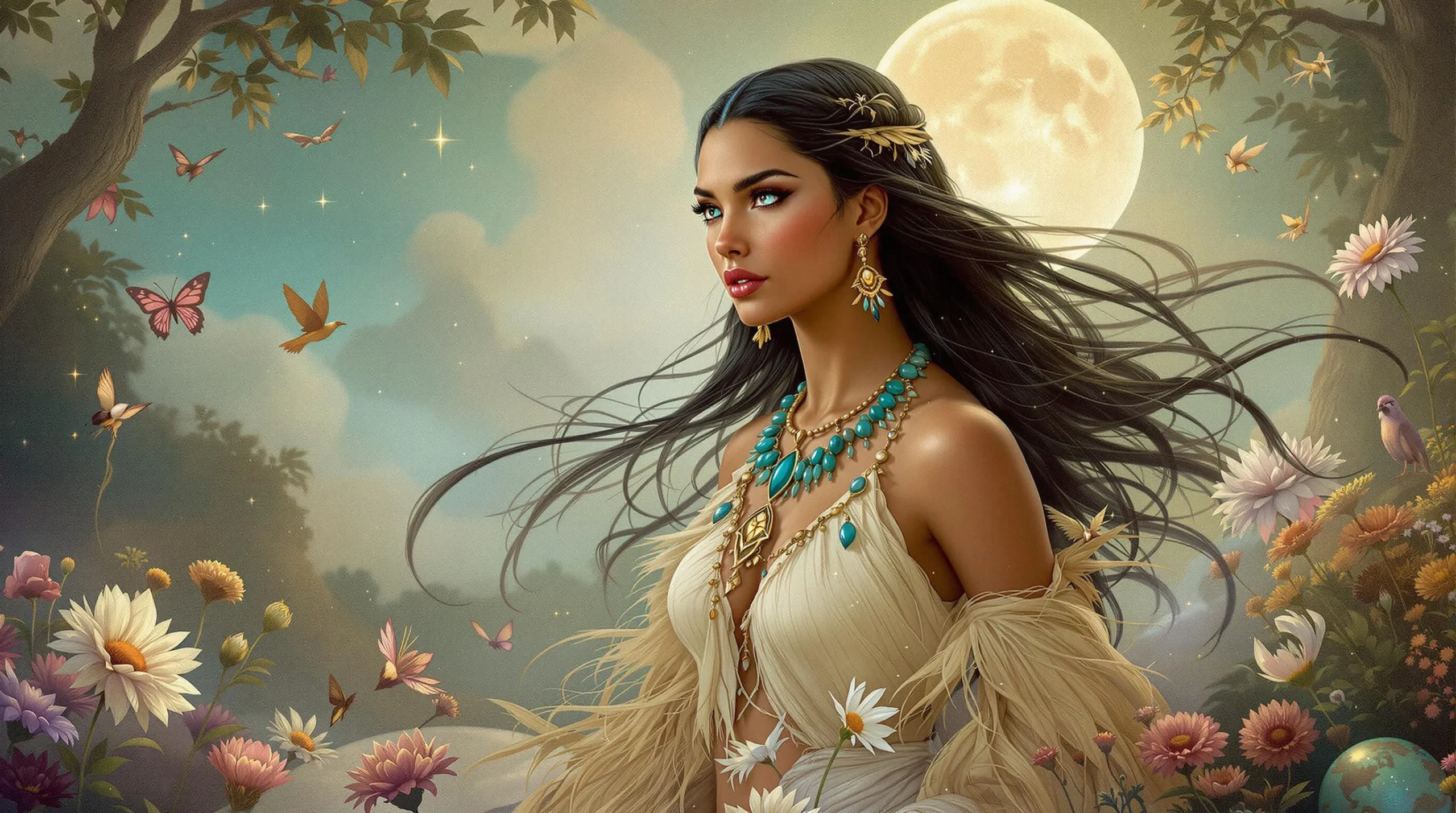


Pocahontas

Archetype Meaning & Symbolism

Diplomatic, Spirited, Intuitive, Bridge-builder, Rebellious, Empathic, Curious, Sacrificial, Naive, Nature-attuned

  • Listen with your heart, you will understand.

If Pocahontas is part of your personal mythology, you may...

Believe

  • You may believe that the most profound truths are not spoken, but are felt intuitively and communicated through empathy, bypassing the limitations of language.
  • You may believe that the natural world is not a backdrop for human drama but an active, sentient participant, offering wisdom to those who attune themselves to its rhythms.
  • You may believe that your ultimate allegiance is not to a tribe or a nation, but to a personal code of conscience that values peace and understanding above all else.

Fear

  • You may fear that in your attempt to bridge two worlds, you will ultimately be rejected by both, left in a state of permanent, lonely exile.
  • You may fear that your idealism is a form of profound naivete, and that your faith in the goodness of others will lead to your own betrayal or the destruction of what you seek to protect.
  • You may fear that by absorbing so much of another's culture or perspective, you will lose the core of your own identity, becoming a hollow echo rather than a distinct voice.

Strength

  • Your capacity for deep, radical empathy allows you to see the shared humanity beneath the surface of conflict, making you an exceptional mediator and peacemaker.
  • You possess the immense courage to defy the conventions and expectations of your own people when your conscience demands it, staying true to your own moral north.
  • You have an intuitive connection to the unseen world, an ability to draw strength and guidance from nature and from the subtle currents of emotion that flow between people.

Weakness

  • Your noble idealism can shade into naivete, causing you to misjudge the intentions of others and place your trust where it is not warranted.
  • You have a tendency toward self-sacrifice, often placing the needs of the group or the goal of harmony above your own well-being and happiness.
  • You may be plagued by a chronic sense of not belonging, a feeling of being an outsider in every room, which can lead to profound loneliness and isolation.

The Symbolism & Meaning of Pocahontas

The Pocahontas archetype, as filtered through the prism of modern storytelling, emerges as a potent symbol of the liminal space. She is the shoreline, belonging to both land and sea but wholly neither. In personal mythology, she may represent the soul’s capacity to hold opposing truths in a single, gracious embrace: tradition and progress, the tribe and the individual, the familiar world and the tantalizing, terrifying unknown. Her story is not simply one of peace, but of the immense personal cost of being the peacemaker. She is the living embodiment of the question: what must be sacrificed to create something new? Her meaning, therefore, is tied up in the beautiful, painful alchemy of cultural and personal transformation.

Her symbolism is also deeply entwined with the concept of an innate, pre-civilized wisdom. She suggests a way of knowing that precedes logic, a listening that occurs with the heart, not just the ears. She is the voice that whispers of a world where everything is alive, where every rock and tree and creature has a spirit. To have her in one's personal mythos is to feel a pull toward this animistic worldview, to suspect that the truest things are not spoken in boardrooms or codified in laws, but are felt in the currents of a river or the turning of a season. This makes her a powerful figure for an age grappling with ecological crisis and a sense of profound disconnection.

The very tension between the historical Pocahontas and her fictionalized, archetypal counterpart adds another layer of meaning. It highlights our tendency to romanticize the 'noble savage' or the 'perfect mediator,' smoothing over the jagged edges of history for a more palatable narrative. To wrestle with this archetype is to wrestle with this tendency in oneself. It forces a confrontation with the ways we might idealize others or situations, projecting a simplistic purity onto complex realities. She becomes a symbol not just of bridging worlds, but of the inherent dangers and temptations of that very act.


Pocahontas Relationships With Other Archetypes

The Foreign Shore

Her relationship with the Foreign Shore may be one of a perilous and profound reflection. Like a still river mirroring a ship it has never seen, she could hold the image of the newcomer within herself without yet being disturbed by its wake. This other world, with its sharp angles of iron and its loud, declarative tongue, perhaps represents a question she did not know she was asking. The connection is not one of simple opposition, but of a dangerous, magnetic curiosity—the kind a hand feels when hovering over a flame. It is a dialogue conducted across a vast and silent water, where every gesture is magnified and every motive is a shadow, a dance between the possibility of a shared horizon and the threat of a tidal wave that could remake her entire landscape.

The Whispering Grove

With the Whispering Grove, her bond is perhaps less a relationship and more a state of being, a kind of cellular knowledge. She does not simply walk through the forest; she is the forest's way of perceiving itself. The rustle of leaves may be her native syntax, the current of the river her own circulatory system. This archetype is the ancient, rooted consciousness from which she draws her grace and her unnerving calm. It is the silent elder that taught her how to listen not to words, but to the growth of things, to the intention behind the silence. In the face of a new and clamorous world, the Grove is her anchor, a profound, living library whose wisdom allows her to see the foreign ship not as an ending, but merely as a new and peculiar seed landing upon old, old soil.

The Echoing Chasm

Perhaps her most intimate and lonely dialogue is with the Echoing Chasm itself—the very space she is destined to span. She is the bridge, and so her primary relationship could be with the terrifying emptiness below. The chasm is the silence between two languages, the misunderstanding between two peoples, the vast and unwritten treaty she must embody. To be the peacemaker is to exist within the tension, to become the echo that proves two opposing cliffs can, in fact, communicate. This relationship is not with a person or a place, but with a condition of separation. Her actions and her very soul are the sound sent into the void, and her hope is that what returns is not a distorted cry, but a recognizable, if forever altered, answer.

Using Pocahontas in Every Day Life

Navigating Family Conflicts

During a heated holiday dinner where political divides feel like canyon walls, the Pocahontas mythos may guide you not to win the argument, but to translate the underlying fears and hopes of each side. You might become the quiet center of the storm, asking questions that reveal the shared humanity beneath the rhetoric, seeking the narrow path to understanding rather than the broad road to victory.

Choosing an Unconventional Career

When family pressure mounts to follow a stable, prescribed career path, your inner Pocahontas might compel you to listen for the riverbend. This could manifest as leaving a lucrative law track to pursue environmental conservation, or abandoning a corporate ladder to start a small business that aligns with your soul’s purpose, trusting an internal compass over the provided maps.

Healing a Disconnection from Nature

In a life lived under fluorescent lights and mediated by screens, this archetype could be a call back to the wild. It might inspire you to find a language in the rustling of leaves, to see a story in the flow of a stream, or to simply walk barefoot on the earth. It is a way of remembering that wisdom does not only reside in books or data, but is whispered in the living world.

Pocahontas is Known For

Bridge Between Worlds

She is perhaps most famously known as the intermediary, the figure who stands astride the chasm separating two hostile cultures, attempting to translate not just words, but hearts.

Defiance for Peace

Her definitive act is one of rebellion against the drumbeat of war, a dramatic intervention where she chooses a radical empathy over tribal loyalty to avert bloodshed.

Voice of Nature

She represents a profound communion with the natural world, conversing with the wind and river as if they were kin, and drawing her wisdom from the earth itself.

How Pocahontas Might Affect Your Personal Mythology

How Pocahontas Might Affect Your Mythos

When the Pocahontas archetype shapes your personal mythos, your life story may become a narrative of translation. You are the one who stands between warring factions, whether in your family, your workplace, or your community, tasked with the delicate art of helping each side hear the other. Your myth is not one of conquest but of connection. Major life events may be framed as journeys into a 'new world': a dramatic career change, a move to a foreign country, a relationship with someone from a vastly different background. These are not mere changes of scenery; they are quests to understand a foreign way of being and, in doing so, to expand the boundaries of your own soul.

Your narrative arc might also be defined by a pivotal act of defiance against your 'tribe.' Your personal legend could hinge on a moment where you broke with the expectations of your family or culture to follow a higher, internal law. This act is often one of sacrifice, where personal comfort or belonging is traded for moral integrity or the possibility of a greater peace. The central theme of your mythos becomes the journey away from the safety of the known toward the uncertain promise of a more integrated, compassionate world. You are, in essence, always 'just around the riverbend,' perpetually seeking what lies beyond the horizon of accepted wisdom.

How Pocahontas Might Affect Your Sense of Self

Your view of self may be inextricably linked to your role as a bridge. You might see your identity not as a fixed point, but as a fluid, mediatory force. Your self-worth could be derived from your ability to empathize, to understand, and to create harmony where there was discord. This can foster a profound sense of purpose, a feeling that your presence serves a vital, healing function in the world. You might perceive yourself as possessing a unique form of wisdom, one that is intuitive, nature-based, and emotionally intelligent, setting you apart from those who operate purely on logic or ambition.

Conversely, this self-concept can be a heavy mantle. You may feel that you don't truly belong anywhere, that you are a permanent ambassador without a home country. The self can feel thin, stretched between opposing worlds, defined more by its relationship to others than by an intrinsic core. There may be a persistent feeling of being misunderstood by all sides, of being a curiosity to one group and a traitor to another. The self becomes a vessel for peace, but in the process, may forget its own needs, its own anger, and its own simple desire to just be, without the constant work of translation.

How Pocahontas Might Affect Your Beliefs About The World

With this archetype coloring your perception, the world may cease to be a collection of objects and become a web of living subjects. A forest is not timber; it is a council of elders. A river is not a resource; it is a storyteller. This worldview is fundamentally animistic, imbued with a sense of spirit and interconnectedness. You may view conflict not as a zero-sum game of winners and losers, but as a symptom of misunderstanding, a failure to listen. The world is a place of profound, hidden wisdom, and the correct posture toward it is one of reverent attention.

This perspective could also foster a deep skepticism of 'progress' when it comes at the cost of this enchanted worldview. You may see modern, industrialized society as loud, brutish, and spiritually impoverished, deaf to the subtle music of the earth. Your worldview might be tinged with a tragic sense, a sorrow for a world that has forgotten how to listen with its heart. You might find yourself at odds with prevailing cultural narratives of acquisition and dominance, instead championing a philosophy of symbiosis and respect for all forms of life, seeing a value in things that cannot be measured or sold.

How Pocahontas Might Affect Your Relationships

In relationships, you may be drawn to the 'other.' The familiar and the similar might offer comfort, but the Pocahontas mythos compels you toward the stranger, the one whose world is different from your own. These relationships, whether romantic or platonic, are often transformative, forcing you to learn new languages of love and being. You likely approach connection with a radical empathy, striving to understand your partner’s world from the inside out. You might be the keeper of peace in your relationships, the one who smooths over disagreements and tirelessly works toward mutual understanding.

This very strength, however, can create its own challenges. Your deep empathy may blur into a lack of boundaries, making you susceptible to partners who take more than they give. You may feel an immense pressure to be the 'wise one' or the 'healer' in the relationship, suppressing your own needs and frustrations for the sake of harmony. There is also the persistent risk of idealization: you might fall in love not with a person, but with the idea of their 'otherness,' only to be disappointed by the complex, flawed human being you eventually discover. Your relationships are deep and meaningful, but they may rarely be simple.

How Pocahontas Might Affect Your Role in Life

Your perceived role in any social structure, from the family to the nation, may be that of the diplomat. You are the one who instinctively steps into the breach, who volunteers for the difficult conversation, who sees a path to reconciliation when others see only war. This is not just a preference; it might feel like a calling, a sacred responsibility. You may believe your purpose is to be a conduit for a more compassionate way of being, to advocate for the voiceless and to remind the powerful of the humanity of their adversaries.

This archetype also contains the role of the conscientious objector. You are the one who must, at times, defy the will of your own group. When the collective beats the drum of war, prejudice, or greed, your role is to stand apart and say no. This is the role of the heretic who is loyal to a deeper truth. It is a lonely role, often leading to ostracism or being branded a traitor. Your purpose is not to maintain the status quo, but to challenge it from within, guided by an unwavering internal compass, even if it means standing entirely alone.

Dream Interpretation of Pocahontas

To dream of the Pocahontas archetype in a positive light is often to receive a message of integration and heart-centered wisdom. If she appears to guide you across a rushing river or to quiet two snarling beasts, it may suggest that you have the innate capacity to navigate a current emotional conflict or to reconcile warring aspects of your own psyche. Seeing her paint with the colors of the wind could be an invitation from your subconscious to break free from rigid, black-and-white thinking and embrace a more fluid, creative, and holistic perspective on a problem in your waking life. She comes as an affirmation of your intuition.

In a negative context, a dream of Pocahontas could be a warning against a perilous naivete. If she appears lost between two warring armies, unable to be heard, or if she willingly walks into a gilded cage, it may reflect a feeling of powerlessness or a fear that your peacemaking efforts are being exploited. Dreaming of her being swept away by a storm or fading into the landscape could symbolize a loss of self, a sense that in trying to be a bridge for others, your own identity is eroding. It is a cautionary signal from the deep self to examine where your idealism may be blinding you to danger or causing you to sacrifice too much.

How Pocahontas Archetype Might Affect Your Needs

How Pocahontas Might Affect Your Physiological Needs

From the standpoint of personal mythology, the satisfaction of physiological needs becomes a spiritual practice. Hunger is not simply sated; it is an occasion to connect with the earth’s bounty. You may find yourself drawn to whole, natural foods, to gardening, or to foraging, seeing food as a direct communion with the living world. The need for nourishment is tied to the nourishment of the planet, and a fast-food meal might feel like a violation of this sacred contract. Physical activity becomes less about exercise and more about a conversation with the landscape: running is a way to borrow the speed of the deer, swimming a way to understand the wisdom of the river.

Shelter, too, is redefined. A home is not just a box for living in; it is a place that must be in harmony with its surroundings. This could manifest as a preference for natural building materials, large windows, or a living space that seamlessly blends the indoors and outdoors. You may feel a physiological restlessness or dis-ease in sterile, artificial environments, a sense of being cut off from a vital life source. Your body’s well-being is perceived as being directly dependent on the health and vitality of the ecosystem you inhabit. Clean air, pure water, and direct contact with the earth are not amenities; they are essential nutrients.

How Pocahontas Might Affect Your Ideas of Belonging

The need for love and belonging is the central, aching heart of the Pocahontas mythos. There is, on one hand, a profound sense of belonging to a place, a people, a tradition. It is a rootedness in the earth, in the stories of the ancestors, that provides a deep sense of identity. This is the 'village' from which you come, the source of your initial strength and worldview. It is a love that is as natural and essential as breathing.

Yet, the core narrative demands that you step outside this primary belonging to form a connection with the 'other.' It is in this act that the agony and ecstasy of the archetype reside. You may find a profound, soul-altering love with someone from a different world, but this love often comes at the price of your original belonging. You might find yourself perpetually caught between two shores, not quite native to your new world, and no longer fully at home in your old one. Belonging ceases to be a place or a group, and becomes a state you must create within yourself and in the fragile, beautiful connections you forge in the liminal spaces.

How Pocahontas Might Affect Your Feelings of Safety

Within this mythos, safety is a function of relationship, not fortification. True security is not found behind high walls or in the accumulation of power, but in the radical act of turning a potential enemy into a friend. Your approach to safety may be rooted in preventative diplomacy, in the belief that understanding and empathy are the most effective shields. You might instinctively de-escalate conflict, seeking to address the root causes of aggression rather than simply meeting force with force. Safety is the delicate web of community and mutual respect you weave around yourself.

This orientation, however, carries a significant vulnerability. The belief that all conflict stems from misunderstanding can be a dangerous blind spot in the face of genuine malice. Your impulse to trust, to see the best in others, may be interpreted as weakness and exploited. The archetype’s vulnerability is its faith in the power of the open heart. While this can be a revolutionary force for good, it can also lead to personal harm when confronted with those who do not share the same lexicon of peace. Safety, then, becomes a precarious balance between open-heartedness and discerning wisdom.

How Pocahontas Might Affect Your Views of Esteem

Esteem, for one who carries this archetype, is not built on external accolades or material success. It is forged in the quiet crucible of moral integrity. Your self-respect is directly tied to your ability to listen to your inner voice and to act in accordance with it, especially when it is difficult. You earn your own esteem by being the person who speaks for peace when others call for war, who shows compassion to the outcast, who chooses the hard, right path over the easy, wrong one. Respect from others is valued, but only when it is earned through wisdom and courage, not through conformity.

This can, however, lead to a fragile or conditional esteem. Your self-worth might become dependent on being the 'good one,' the 'wise mediator,' the 'savior.' This creates immense pressure to be perfect, to never falter in your role as the moral compass. A failure to prevent a conflict, or a moment of selfish anger, can feel like a catastrophic blow to your identity. The challenge is to build an esteem that allows for human flaw, one that is based not on successfully saving the world, but on the courage to keep trying, and the grace to forgive yourself when you fail.

Shadow of Pocahontas

When the Pocahontas archetype falls into shadow, the bridge-builder becomes the self-eraser. The noble act of understanding another culture curdles into a romanticized betrayal of one's own. This shadow figure fetishizes the 'other,' whether it's a person, a culture, or an ideology, believing it to be the source of salvation. She will gladly abandon her heritage, not for a higher peace, but for the approval and acceptance of the perceived 'superior' or 'more exciting' world. The shadow of Pocahontas is the 'Stockholm Syndrome' of the soul, where one falls in love with the very forces that threaten to consume one's identity. She doesn't build a bridge; she burns her own village down to be closer to the fort.

Another facet of the shadow is a kind of spiritual arrogance. The connection to nature and intuitive wisdom becomes a cudgel with which to judge others. This shadow archetype looks upon the 'civilized' world with a smug pity, seeing others as spiritually bankrupt savages for their inability to 'paint with all the colors of the wind.' The role of mediator is twisted into one of manipulation, using emotional intelligence not to heal, but to control. She becomes the gatekeeper of a 'deeper truth,' doling out condescension disguised as wisdom, her peace-loving exterior masking a profound contempt for those who do not share her enlightened perspective.

Pros & Cons of Pocahontas in Your Mythology

Pros

  • You possess a rare and valuable gift for creating harmony and fostering deep understanding between people with conflicting views.
  • You experience the world with a sense of wonder and connection, finding guidance, beauty, and meaning in the natural environment.
  • Your life is guided by a strong sense of purpose and integrity, providing you with the courage to forge a path that is authentically your own.

Cons

  • You may be vulnerable to manipulation and betrayal due to a tendency to see the best in everyone, even when evidence suggests otherwise.
  • You risk emotional burnout and the erosion of your own identity by habitually prioritizing the needs and harmony of others over yourself.
  • You may carry a persistent feeling of loneliness and alienation, never feeling fully understood or at home in any single group or culture.