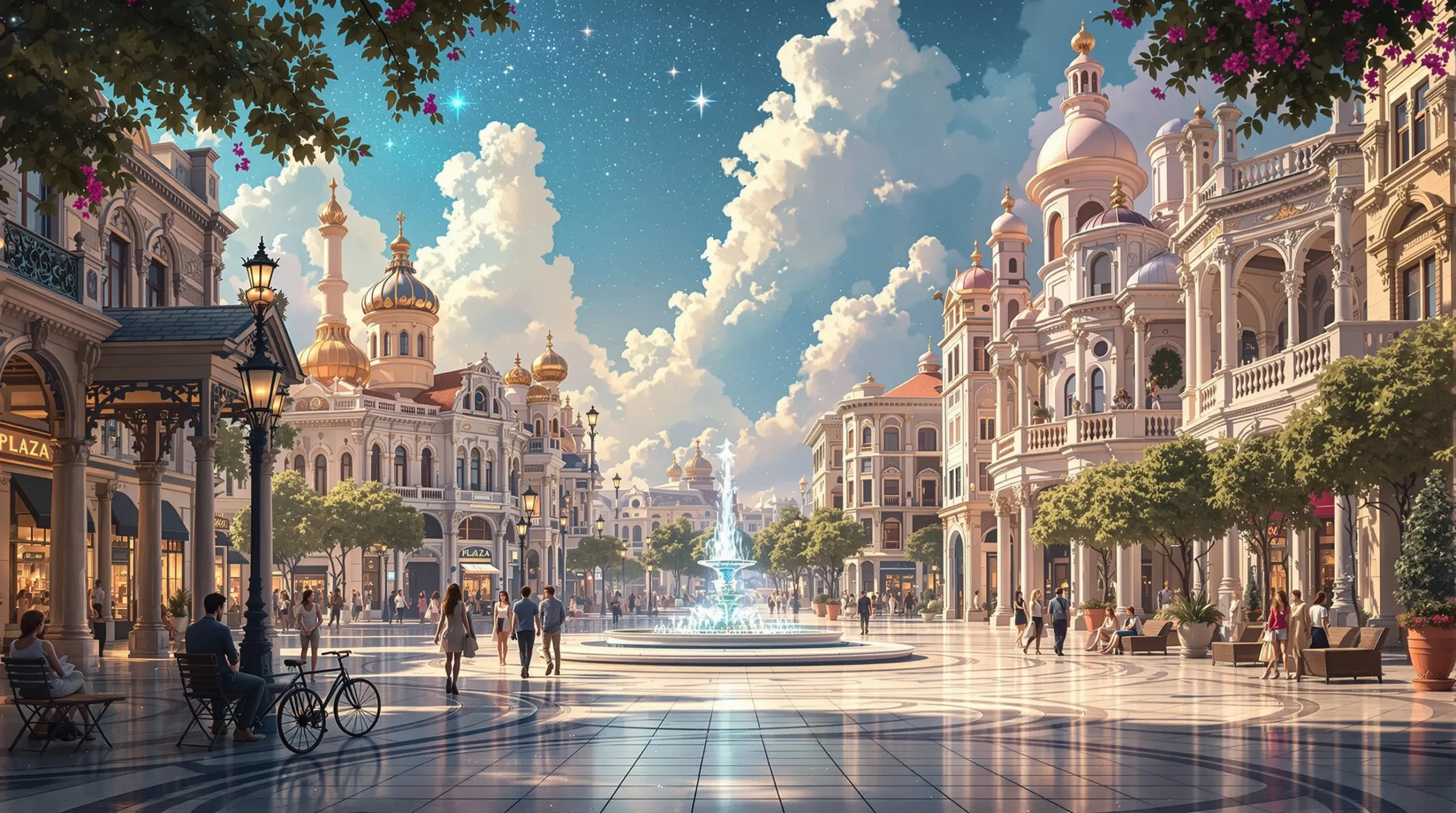


Plaza

Archetype Meaning & Symbolism

Open, public, intersecting, communal, exposed, central, chaotic, structured, performative, connective

  • Stand in my center. Here, all paths converge, and every direction is a beginning.

If Plaza is part of your personal mythology, you may...

Believe

  • You may believe that what is not seen does not truly exist; that ideas, love, and identity must be made public to be made real.

  • You may believe that the self is a fluid performance, shaped and defined by the context of the community and the gaze of the other.

  • You may believe that society is a project we are all building together, and that public space is sacred ground for this work.

Fear

  • You may fear public humiliation above all else, the moment when the crowd turns, and you are cast out from the circle of belonging.

  • You may fear invisibility, the chilling realization that you could disappear from the public square and no one would notice or care.

  • You may fear the loss of civic order, the moment when the structured Plaza descends into the chaos of a lawless, unpredictable mob.

Strength

  • You likely possess a natural sociability and an intuitive grasp of group dynamics, making you an adept networker and community builder.

  • You may have a high degree of civic-mindedness and a genuine desire to contribute to the well-being of the collective.

  • You might be comfortable in the spotlight, able to communicate your ideas clearly and persuasively to a public audience.

Weakness

  • You might neglect your inner life, becoming so focused on your public persona that you lose touch with your authentic, private self.

  • You may have a deep-seated need for external validation, leaving your self-esteem vulnerable to the whims of public opinion.

  • You may struggle with genuine, one-on-one intimacy, preferring the safety and breadth of the crowd to the vulnerability and depth of a private bond.

The Symbolism & Meaning of Plaza

In personal mythology, the Plaza is the theater of the self. It represents the part of you that is public, the face you present to the world, and the arena where your identity is tested and affirmed by the collective gaze. To have a strong Plaza archetype suggests that your life story may be inextricably linked with public events, social movements, or community life. It is the place where your internal monologue must become dialogue, where private conviction is hammered into public persona on the anvil of social interaction. This is not about celebrity, but about the fundamental human need to be seen and to participate in the life of the tribe.

The Plaza is also a potent symbol of civilization itself: a structured, open space carved out of the wilderness of private impulse. Its geometric lines, fountains, and monuments may symbolize your own attempts to bring order to the chaos of experience, to create a central, organizing principle in your life. It is a space of rules, both spoken and unspoken. Yet, its very openness makes it a container for the unpredictable. It is the place of the peaceful protest and the violent riot, symbolizing that the civic order you construct is always vulnerable to the raw, untamable energy of the collective.

On a deeper level, the Plaza could be the landscape of fate in your inner world. It represents those moments of profound openness to the universe, where any person you meet or any direction you turn could change the course of your life. It is the crossroads archetype writ large, a vast nexus of possibilities. If the Plaza is central to your mythos, you may believe less in a single, predetermined destiny and more in a life shaped by serendipity, by the spontaneous chemical reactions that occur only when different elements are brought together in an open, shared space.


Plaza Relationships With Other Archetypes

The Forest

The Forest is the Plaza's antithesis: it is wild where the Plaza is structured, hidden where the Plaza is exposed, and primal where the Plaza is civic. A journey in one's mythos might be from the Forest to the Plaza, representing a movement from deep, solitary introspection to public expression. One might get lost in the Forest to find a hidden truth about the self, but that truth is only made real when it is brought into the sunlight of the Plaza and tested against the reality of others. Their relationship is the dance between the inner and outer worlds.

The Hearth

The Hearth is the intimate fire of private life, of family and chosen kin. The Plaza is the vast, impersonal space of the public. If the Hearth is your sanctuary, the Plaza is your forum. A life guided by both may be a constant negotiation between the needs of the few you love and your duties to the many you serve or live among. The Hearth provides the warmth and strength needed to endure the exposure of the Plaza, while the Plaza offers a connection to the wider world that prevents the Hearth from becoming insular and stagnant.

The Messenger

The Messenger needs the Plaza to fulfill their function. This archetype, which carries news, ideas, and calls to action, finds its audience in the open square. The Plaza is the platform and the amplifier for the Messenger's words. Without the gathering place, a message is just a whisper in the wind. In a personal mythos, this relationship might symbolize the need to find the right venue for your ideas. You may carry a powerful message, but its impact depends entirely on your ability to find and command the stage of the public square.

Using Plaza in Every Day Life

Navigating Career Changes

When faced with a professional crossroads, you might envision your career as a vast plaza. Instead of seeing a linear path, you see a central space from which countless streets—new opportunities—radiate. You could use this archetype to practice being visible: updating public profiles, attending industry gatherings, and sharing your ideas openly, treating the job search not as a private hunt but as a public declaration of your readiness for what’s next.

Overcoming Social Anxiety

For those who fear the crowd, the Plaza archetype can be a tool for gradual engagement. You may begin by picturing yourself on the periphery, sitting at a café under an arcade, simply observing the flow of life without pressure to participate. From this safe vantage point, you can study the patterns, the rhythms of interaction. The goal is not to conquer the Plaza but to find your comfortable place within it, recognizing that even the observer is a vital part of the public tapestry.

Finding Creative Inspiration

When inspiration runs dry, you could mentally visit your inner Plaza. This is the space to people-watch the psyche, to witness the convergence of disparate ideas, memories, and emotions. By sitting in this open forum, you invite chance encounters between concepts. A snippet of overheard conversation becomes a line of dialogue, the pattern of pigeons scattering becomes a new visual motif, and the convergence of strangers becomes the seed of a story about fate.

Plaza is Known For

Public Gathering

It is the designated heart for civic life, the stage for festivals, markets, revolutions, and memorials. It is where a city's collective joy and grief are given space to be expressed.

Architectural Centerpiece

The Plaza is often the focal point of urban design, a deliberate void around which a city's most important buildings—cathedrals, courthouses, libraries—are arranged, defining the community's values through its structures.

A Place of Intersection

This is the space of chance and confluence, where strangers' paths cross for a fleeting moment. It's a physical manifestation of the network of society, a place where a thousand different stories run parallel and sometimes collide.

How Plaza Might Affect Your Personal Mythology

How Plaza Might Affect Your Mythos

If the Plaza is a key landscape in your personal mythology, your life story may be written in public ink. Major turning points might not be quiet, solitary epiphanies but moments of public action or recognition: a speech you gave, a protest you joined, a chance encounter in a crowd that altered your path. Your narrative is less a hero’s solitary journey into the cave and more the story of a citizen, a performer, or a connector whose identity is forged in the crucible of the collective. Your legend is not about what you did alone, but how you moved with, and were moved by, the currents of your community.

Your mythos could also be that of the observer, the flâneur of your own existence. You may be cast not as the main actor on the stage, but as the one who sits at the edge, chronicling the drama of the human condition. Meaning, for you, is found in the tapestry of interconnected lives you witness. Your story is not a single thread but an appreciation of the entire, complex weave. You are the keeper of the city's stories, the one who understands that the soul of a place is found in its public heart.

How Plaza Might Affect Your Sense of Self

You may perceive your self as an entity that is fundamentally social, co-created in the space between you and others. Your sense of identity might feel most solid and real when you are engaged in public life, whether through your work, your community, or your social network. The feeling of being “yourself” could be directly linked to the act of participation, of being a recognized face in the crowd. This is not necessarily a performance of ego, but perhaps a profound understanding that the self is relational and comes alive through witness.

Alternatively, the Plaza's influence might instill a sense of perpetual exposure, a feeling that you are always on display. This could lead to a highly curated public persona, a carefully constructed mask designed to manage perceptions and protect a more vulnerable inner self. You may struggle to distinguish between your authentic self and the role you play in the public square. This can create a deep internal division, a split between the person you are in private and the statue of yourself you’ve erected in the Plaza.

How Plaza Might Affect Your Beliefs About The World

Your worldview may be foundationally communal, centered on the belief that significance is created through collective action and public discourse. You might see society as a living organism whose health depends on the vitality of its shared spaces. For you, truth is not a private revelation but a consensus hammered out in the forum of public opinion, and progress is measured by the freedom and vibrancy of the city square. You might believe that the most important aspects of human experience are those that are shared.

Seen through the Plaza lens, the world could also appear as a relentless and often overwhelming performance. You may be acutely sensitive to the tides of public opinion, the power structures that choreograph public life, and the inherent theatricality of politics and culture. This can lead to a cynical perspective, viewing all public acts as self-interested performance. Or, it could foster a deep appreciation for the courage it takes to stand in the open and speak a personal truth, knowing the crowd can be both an embrace and a mob.

How Plaza Might Affect Your Relationships

Your relationships may be defined by their public context. You might thrive on partnerships that are visible and integrated into a wider social network; the ideal partner is someone who can stand beside you confidently in the public square. Connections are often forged in group settings, through shared causes, or professional circles. The act of “going public” with a relationship could be a deeply significant milestone, an affirmation of the bond's legitimacy and strength in the eyes of the community.

The potential pitfall is a difficulty in cultivating true, unobserved intimacy. You may unconsciously treat all relationships as alliances to be managed or performances to be perfected, neglecting the quiet, unglamorous work of private connection. There could be a tendency to collect acquaintances like statues in a square, creating an impressive social landscape that lacks the genuine warmth of a private hearth. The challenge is learning that the most profound bonds are often built in the small, unseen rooms that border the grand Plaza.

How Plaza Might Affect Your Role in Life

You may feel that your role in life is to be a civic anchor: a community builder, a facilitator, a host. Like the plaza itself, you might see yourself as a container, a central point where disparate people and ideas can gather and interact. Your purpose may not be to champion a single cause, but to create the forum where many causes can be heard. You are the architect of the space, the one who ensures it remains open, safe, and vital for the life of the community.

Alternatively, you might perceive your role as that of the public figure: the artist, the orator, the activist, the leader. Your work requires an audience, and your life is a testament to the willingness to be seen. This role requires a unique form of courage, the ability to withstand both applause and condemnation. Your purpose is to articulate a vision, to create a spectacle, or to embody an idea so powerfully that it moves the crowd that has gathered to watch you.

Dream Interpretation of Plaza

In a positive context, dreaming of a bright, bustling plaza could symbolize a growing readiness to engage with the world. It may suggest that you are moving out of a period of isolation and are prepared for new social connections, professional opportunities, or a more public role. Seeing friendly faces, beautiful fountains, or lively markets might indicate a sense of belonging and confidence in your ability to navigate the social world. The dream is an invitation from the psyche to step into the sunlight of community life.

In a negative context, a dream of a plaza can be unsettling. An empty, windswept plaza might evoke profound feelings of loneliness, alienation, or the sense that you are irrelevant to the world around you. Conversely, a dangerously packed, chaotic, or rioting plaza could symbolize a fear of being consumed by the collective, a loss of individuality, or overwhelming social pressure. Dreaming of being naked or lost in a plaza often points to deep anxieties about public judgment and exposure.

How Plaza Archetype Might Affect Your Needs

How Plaza Might Affect Your Physiological Needs

From the perspective of personal mythology, the Plaza speaks to the body's need for space and unimpeded movement. If this archetype is strong, you may experience periods of stress or confinement as a literal, physical constriction, a kind of psychic claustrophobia. Your physiological well-being could depend on having access to open environments, uncluttered schedules, and the freedom to move without friction. A traffic jam or a crowded room might feel like a personal affront to your body's essential requirement for breathability and openness.

The Plaza is also the marketplace, the place of exchange. Thus, your physiological needs for sustenance and material comfort may be mythologically tied to your ability to successfully navigate the public sphere of commerce and trade. A thriving inner Plaza might correlate with a feeling of physical security and abundance, a trust in your capacity to present your offerings to the world and receive what you need in return. A deserted or dangerous market in your mind's eye could manifest as anxiety about your ability to provide for your basic bodily needs.

How Plaza Might Affect Your Ideas of Belonging

A sense of belonging, for you, is likely forged in the fire of public life. You feel most connected when you are part of a shared civic identity: a fan in a cheering stadium, a marcher in a parade, a citizen at a town hall. Love and friendship are not merely private contracts; they are reinforced by community recognition. You find your people by showing up in the public square, by declaring your allegiances and discovering others who stand with you. Belonging is an act of participation.

The paradox of the Plaza, however, is its capacity to induce a profound sense of loneliness in a crowd. You could be surrounded by thousands and feel utterly invisible, a ghost in the machine of public life. This archetype may force you to confront the difference between proximity and connection. The fear of being an anonymous face, of your presence or absence making no difference to the life of the square, can be a powerful driver in your quest for love and belonging.

How Plaza Might Affect Your Feelings of Safety

Within the Plaza mythos, safety is found in visibility and the rule of law. You may feel most secure when things are out in the open, subject to public scrutiny and shared civic codes. The presence of other people is a deterrent to harm; secrets and shadows are where danger lies. Your sense of safety could be deeply intertwined with your trust in social structures, your faith in the community to self-regulate, and the belief that being a known and respected citizen offers a powerful form of protection.

The shadow side of this is that the Plaza is also the prime location for public shaming, surveillance, and the unpredictable violence of the mob. Your deepest safety fears might revolve around social ostracism or being targeted by collective outrage. You may feel that your security is perilously dependent on maintaining a flawless public image. The same crowd that offers safety in numbers can turn in an instant, and the fear of being on the wrong side of its judgment can be a constant, low-level threat.

How Plaza Might Affect Your Views of Esteem

Esteem, through the Plaza's lens, is built on a foundation of public contribution and recognition. You may derive your sense of worth from seeing the tangible impact of your actions on the community, from hearing your name spoken with respect, or from creating something that is witnessed and valued by others. Your self-esteem is not a private, internal state but a public monument you construct through your deeds. It requires an audience to exist, reflecting your value back to you.

This external-facing esteem can be exceptionally fragile. Its value can plummet with public criticism, a professional failure, or the simple, crushing indifference of the crowd. If your worth is pegged to the fluctuating stock market of public opinion, you might live in constant fear of a crash. This creates a desperate need for approval and an inability to validate yourself from within, making true, resilient self-esteem a difficult state to achieve.

Shadow of Plaza

The contracting shadow of the Plaza is agoraphobia, both literal and psychic. The open space of public life becomes a terrifying void, and the gaze of others feels like a physical threat. This can manifest as crippling social anxiety, a retreat into extreme privacy, and a refusal to participate in the world. The self becomes a fortress under siege, and every invitation to step outside feels like a call to battle. The fear of being judged, misunderstood, or overwhelmed leads to a life lived in the smallest possible room, a stark prison cell just off the grand square.

The expansive shadow is a performative existence devoid of an inner core. It is the relentless broadcasting of a curated life, where every meal, thought, and emotion is offered up for public consumption and validation. The distinction between the private self and the public persona is erased, leading to a hollowed-out identity that exists only as a reflection in the eyes of others. This shadow drives a compulsive need to be seen, to be relevant, to be at the center of the Plaza at all times, fearing the silence and invisibility of being alone more than death itself.

Pros & Cons of Plaza in Your Mythology

Pros

  • You are naturally connected to the pulse of your community and may be a powerful agent for social cohesion and positive change.

  • Your comfort with visibility allows you to take on roles of leadership and influence that others might shy away from.

  • You are likely to have a broad and diverse network of contacts, offering a rich tapestry of opportunities and perspectives.

Cons

  • Your dependence on public life can lead to burnout and a feeling of being constantly “on,” with little room for rest and private renewal.

  • You may be perceived as superficial or a social climber, as your focus can appear to be more on networking than on genuine connection.

  • You are highly susceptible to social trends and peer pressure, potentially compromising your own values to maintain your standing within the group.