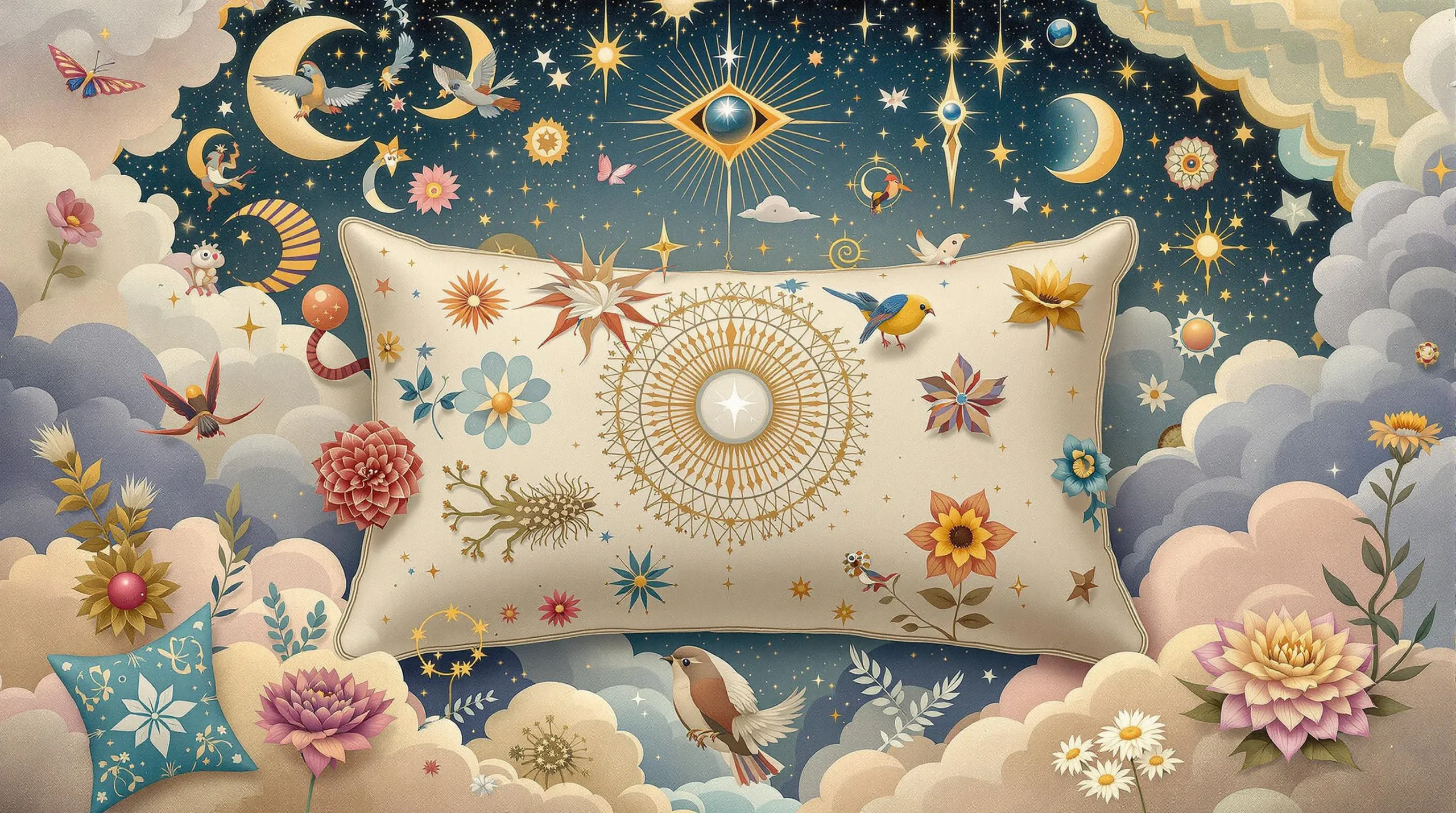


Pillow

Archetype Meaning & Symbolism

Receptive, silent, yielding, comforting, absorbent, secretive, deep, still, supportive, inert

  • Lay your head down. The world's weight is a story for tomorrow. Tonight, we listen only to the quiet hum of your own heart.

If Pillow is part of your personal mythology, you may...

Believe

  • That the most profound answers arrive in stillness, not in frantic seeking.

    That vulnerability is not a weakness but the prerequisite for true intimacy and connection.

    That rest is a creative act, a necessary fallow period for the soul to regenerate.

Fear

  • Sleeplessness: not just the physical state, but the existential dread of a mind that cannot find quiet.

    Exposure: the terror of having one's deepest thoughts, secrets, and vulnerabilities revealed without consent.

    Becoming inert: the fear of being so passive and yielding that one loses all shape, agency, and sense of self.

Strength

  • Empathy: an almost psychic ability to absorb and understand the emotional state of others without judgment.

    Patience: a deep understanding that some things cannot be rushed, that growth happens in the dark, quiet spaces.

    Sanctuary Creation: the talent for making spaces and relationships feel safe, comfortable, and restorative.

Weakness

  • Passivity: a tendency to absorb and yield to a fault, avoiding necessary conflict or self-assertion.

    Permeability: difficulty in maintaining boundaries, taking on the emotional burdens of others as one's own.

    Inertia: a struggle to initiate action, preferring the comfort of stasis over the discomfort of change.

The Symbolism & Meaning of Pillow

The Pillow is a potent symbol of sanctuary, not of the grand, architectural kind, but of the intimate, personal sort. It is the keeper of the head, and therefore, the mind, the consciousness, the soul's own quiet chamber. In one's personal mythology, the Pillow may represent the space of ultimate vulnerability and trust. It is where the armor of the day is finally removed, where the public face dissolves and the private self is allowed to simply be. It is the silent partner to our most unguarded states: sleep, sickness, sorrow, and intimacy. To have a strong connection to this archetype could suggest a life path dedicated to cultivating and protecting such spaces, both internally and for others.

Furthermore, the Pillow acts as a physical conduit to the subconscious. It is the threshold we cross each night into the wilderness of dreams. It catches our thoughts as we drift off and is there to greet us as we return. This makes it a symbol of intuition, of messages from the deep, of the wisdom that emerges not from active thought but from receptive stillness. Its mythology is not one of heroic deeds, but of profound absorption. It soaks up our fears, our plans, our passions, and our fluids, holding the unedited archive of our existence. It reminds us that much of life's essential work happens below the level of conscious awareness, in the quiet, fallow periods.

As an object of intimacy, the Pillow can also symbolize the shared space in a relationship. It bears the scent and shape of a lover, a silent testament to closeness. It can represent the comfort and acceptance of partnership, the non-verbal understanding that exists in shared rest. Conversely, a single pillow on a large bed can be a stark emblem of loneliness, while a pillow used as a barrier can signify a deep rift. Its meaning is fluid, defined by its context, yet always rooted in the deeply personal landscape of rest, dreams, and closeness.


Pillow Relationships With Other Archetypes

The Bed

The Pillow and the Bed are archetypal partners in the creation of sanctuary. If the Bed is the foundational ground, the earth of our rest, then the Pillow is the altar upon which the head, the seat of consciousness, is placed. The Bed offers full-body surrender, a place to stretch out the day's labors. The Pillow, however, offers a more focused intimacy: it cradles our thoughts, our dreams, our anxieties. One might exist without the other, but together they form a complete ecosystem of restoration. A personal mythology valuing both may suggest a holistic approach to life: attending to the needs of the body (The Bed) is incomplete without also tending to the peace of the mind (The Pillow).

The Nightmare

The Pillow has a deeply ambivalent relationship with the Nightmare. It is at once a shield and the very stage upon which the horror unfolds. One might bury their face in a pillow to muffle a scream or hide from a perceived threat, making it a temporary, soft fortress. Yet, it is also the surface that absorbs the cold sweat of terror, the object that can feel suffocating when one is trapped in a frightening dream loop. The Nightmare can turn the Pillow's comforting softness into a smothering weight, a symbol of being trapped in one's own anxieties, unable to wake or find relief. This dynamic may represent the dual nature of our inner world: a source of both profound comfort and terrifying monsters.

The Secret Keeper

The Pillow is perhaps the purest physical manifestation of the Secret Keeper archetype. It is a confidante that demands nothing and reveals nothing. It is the repository for confessions whispered to an empty room, for business plans mumbled in sleep, for the silent tears shed over a love that can never be spoken. Its relationship is one of perfect, passive reception. Unlike a human Secret Keeper who might be burdened or tempted to share, the Pillow's silence is absolute. For a person whose mythos includes the Pillow, there may be a deep understanding of the sacredness of secrets and the immense relief that comes from unburdening the soul, even to an inanimate, silent witness.

Using Pillow in Every Day Life

Navigating Grief

When loss hollows out the architecture of a life, the Pillow archetype offers a way not to fight the sorrow, but to yield to it. It is the practice of allowing oneself to be held, to surrender to the sheer gravity of grief without judgment. This may look like clearing a day to do nothing but lie down, letting tears come as they may, not as a sign of collapse but as a necessary libation. The Pillow teaches that some burdens are not meant to be carried, but to be laid down upon a surface that can absorb their weight, if only for a little while.

Creative Incubation

For the artist, writer, or innovator facing a block, the Pillow archetype suggests a counterintuitive path: radical stillness. Instead of forcing an idea, one creates a soft, receptive space for it to arrive. This is the act of “sleeping on it” elevated to a conscious practice. It could involve dedicating time before sleep to gently hold a creative problem in mind, not to solve it, but to release it to the subconscious. The Pillow is the fertile darkness where disparate thoughts may meet and merge, a quiet womb for nascent concepts.

Resolving Conflict

In a heated discussion, embodying the Pillow archetype could mean choosing to listen with absorbent silence rather than formulating an immediate retort. It is the art of creating a space of psychological safety where the other person feels heard. This isn't about passive agreement: it is about actively yielding to their perspective to fully understand it. By absorbing the initial force of their words, like a pillow catching a head, you may cushion the impact, de-escalate the tension, and create an opening for a more gentle, honest exchange.

Pillow is Known For

Dream Holding

It is perhaps best known as the silent stage for our nightly theater, the physical touchstone for the ethereal world of dreams. The Pillow catches the residue of these journeys, a silent repository for visions and forgotten narratives.

Silent Witness

It is the ultimate confidante. The Pillow is known for absorbing what cannot be spoken aloud in the light of day

tears of grief, whispered confessions, sighs of profound weariness, the silent anxieties that bloom in the dark.

Yielding Support

Unlike a wall or a rock, the Pillow provides support not through rigid resistance but through perfect, pliant accommodation. It is known for its ability to conform, to cradle, to offer comfort by becoming what is needed in that moment.

How Pillow Might Affect Your Personal Mythology

How Pillow Might Affect Your Mythos

To have the Pillow as a central archetype in your personal mythos is to narrate a life story that champions the interior world. Your epic may not be one of conquest and external achievement, but of profound internal journeys. The major plot points of your story might be moments of revelation that arrive in dreams, periods of deep rest that lead to transformation, or the quiet, steadfast support you provide that allows another character's heroic journey to unfold. Your mythos values the fallow ground as much as the harvest, seeing stillness not as emptiness, but as a time of potent, invisible growth.

The narrative arc of your life might be less a straight, ascending line and more of a spiral, circling back to places of rest and reflection to gather strength and wisdom before the next phase of being. Your greatest treasures are not plundered from dragon's lairs, but are the insights gleaned from the quiet darkness. Your story teaches a different kind of heroism: the courage to be vulnerable, the strength to be still in a world that screams for motion, and the wisdom to know that some battles are won simply by laying your head down and surrendering to the night.

How Pillow Might Affect Your Sense of Self

If the Pillow shapes your sense of self, you may see your core identity as a source of comfort and sanctuary. You might pride yourself on being a person others turn to for solace, a safe harbor in their emotional storms. Your self-worth may not be tied to action or accomplishment, but to your capacity for stillness, for deep listening, for being present. You may feel most yourself not when you are talking, but when you are absorbing the world around you, whether it's the confidence of a friend, the sounds of the night, or the weight of your own thoughts.

This could also cultivate a self-concept deeply attuned to the subconscious and the rhythms of rest. You might trust your “gut feelings” or “dream logic” as much as rational thought, viewing your inner world as a valid and vital source of information. There may be a quiet confidence in your ability to endure, not by fighting back, but by yielding and absorbing pressure. The danger, perhaps, is a self that becomes too passive, too defined by its receptivity to others, risking the loss of its own shape and desires under the weight of what it holds.

How Pillow Might Affect Your Beliefs About The World

A worldview informed by the Pillow archetype may be one that fundamentally distrusts the gospel of productivity. You might see the modern world’s obsession with constant motion, efficiency, and wakefulness as a kind of sickness, a denial of a fundamental human need. Your philosophy could be that true progress, both personal and societal, requires deep periods of rest and seemingly “unproductive” contemplation. The world is not a machine to be optimized, but a living organism that requires cycles of activity and repose.

You may also perceive the most significant events as those that happen quietly, beneath the surface of the loud, chaotic news cycle. You might believe that shifts in consciousness, the healing of trauma, and the birth of new ideas all happen in spaces of psychological safety and stillness, much like the unseen germination of a seed. Your worldview prioritizes the invisible, the internal, and the intimate, seeing them as the true engines of change, while the external world of action is merely the visible result.

How Pillow Might Affect Your Relationships

In relationships, you may gravitate towards the role of the confidante, the emotional anchor. You likely create a space where partners, friends, and family feel safe enough to be their most vulnerable, unvarnished selves. Your very presence can be soothing, a non-judgmental field where others can lay down their burdens. Intimacy, for you, might be less about grand romantic gestures and more about the quiet moments: sharing a comfortable silence, listening to someone breathe beside you in the dark, the simple act of being a safe place for another's weary head.

However, this relational style carries a risk. The Pillow, by its nature, is passive. You may have a tendency to absorb the emotional states of others without filtering, leading to emotional exhaustion. There can be a danger of your relationships becoming one-sided, with you perpetually in the role of the giver of comfort, the silent container for others' needs, while your own needs for expression and support go unspoken and unmet. Learning to be a Pillow for yourself, and occasionally turning into a rock that does not yield, becomes a crucial part of relational health.

How Pillow Might Affect Your Role in Life

Your perceived role in the grand play of life may not be the swashbuckling hero or the cunning protagonist, but the vital, often unsung, role of the Sanctuary. You are the space where the hero comes to rest, to heal, to confess their doubts before the final battle. This is not a passive role, but a profoundly active form of holding space. You may see your purpose as creating environments, whether physical, emotional, or psychological, where others can access their own strength and clarity. Your role is that of the Enabler of Dreams, the Midwife of Peace.

This role could manifest as a therapist, a bodyworker, a loyal friend, a patient parent, or simply the quiet center of a chaotic family or workplace. You understand that without places of rest and recovery, no action is sustainable. Your contribution is foundational, though it may be invisible to those who only value what can be seen and measured. You provide the literal and metaphorical support structure, the soft place to land, which makes all the daring leaps and hard falls of life possible for those around you.

Dream Interpretation of Pillow

In a positive context, to dream of a fresh, clean, and inviting pillow is often a direct message from the psyche about the need for rest and self-compassion. It may symbolize that a period of anxiety is coming to an end, and peace of mind is now accessible. The dream could be granting you permission to let go of a problem, to “sleep on it,” trusting that a solution will arise from your subconscious. Finding a perfect pillow in a dream could represent finding a source of comfort and support in your waking life, be it a person, a practice, or a newfound sense of inner peace. It is an affirmation of sanctuary.

Conversely, a dream featuring a pillow that is soiled, heavy, waterlogged, or actively smothering you carries a more ominous weight. A dirty pillow might symbolize guilt, shame, or secrets that are corrupting your peace of mind. A pillow that feels as heavy as stone could represent the crushing weight of depression or a burden you feel you are carrying alone. The most alarming version, the suffocating pillow, may be a stark metaphor for a relationship, a job, or a mindset that is stifling your spirit and leaving you feeling trapped and voiceless. It is a powerful call to examine what in your life is stealing your breath.

How Pillow Archetype Might Affect Your Needs

How Pillow Might Affect Your Physiological Needs

From a mythological perspective, having the Pillow as a core archetype places the physiological need for sleep at the absolute center of your life's practice. It’s not just about getting eight hours; it’s about the sacred ritual of rest. Your mythos dictates that the body is not a machine to be run until it breaks, but a delicate ecosystem that requires profound, restorative downtime to function. You may create elaborate bedtime rituals, investing in creating a perfect sleep environment as a form of worship to the body's needs. For you, energy, health, and vitality flow not from stimulation, but from the deep well of complete surrender to sleep.

This orientation suggests that your body's cues for tiredness are not inconveniences to be ignored or caffeinated away, but sacred messages to be heeded. In your personal story, burnout is the great dragon to be avoided, and the primary weapon against it is the shield of rest. You may believe that physical healing from illness and injury is accelerated not just by medicine, but by allowing the body to enter the deep, regenerative state that only sleep provides. The Pillow is the key to this kingdom, the humble tool that unlocks the body's innate capacity for self-repair.

How Pillow Might Affect Your Ideas of Belonging

When the Pillow archetype shapes your need for love and belonging, intimacy is defined by shared vulnerability and comfortable silence. You may feel you truly belong with someone not when you are at a loud party together, but when you can share a space of rest, dreams, and quietude. Belonging is the feeling of another's head on the pillow next to yours, a non-verbal pact of mutual trust and repose. It is the deep comfort of knowing you can be your most unguarded self with another person, literally and metaphorically.

Love, in this mythology, is a soft place to land. You may show your love by being a source of comfort and a keeper of secrets, and you may feel loved when someone provides that for you. The community you seek is one where you don't have to be “on” all the time, a tribe where rest is understood and respected. The ultimate expression of belonging is the shared dreamscape, the knowledge that even when unconscious and vulnerable in sleep, you are safe and accepted.

How Pillow Might Affect Your Feelings of Safety

The Pillow archetype deeply informs one's need for safety by focusing it on the psychological and emotional realms. For you, safety is not primarily about locks on the doors or money in the bank, but about having a mental and emotional sanctuary. It's the feeling of being able to let your guard down completely, to be defenseless without being in danger. This need for safety may drive you to curate your relationships and environments carefully, seeking out people and places that feel as comforting as burying your face in a cool pillow on a hot day.

This can also mean that threats to your safety feel intensely personal. A betrayal of trust, a harsh criticism, or an environment of constant anxiety may feel like a direct assault, a violation of your innermost sanctum. Your life's work, in a way, could be the construction of this inviolable space, both within yourself and in your immediate surroundings. The ultimate state of safety in your mythos is the ability to rest peacefully, knowing that your vulnerable, dreaming self is secure from harm.

How Pillow Might Affect Your Views of Esteem

Esteem, for one guided by the Pillow archetype, is often derived from internal and subtle sources. Your self-worth may not be built on a foundation of promotions, awards, or public recognition. Instead, you might measure your value by your ability to be a trusted confidante, the person a loved one calls in the middle of the night. Esteem comes from the quiet knowledge that you are a source of peace in a chaotic world. It is the pride of the master listener, the silent witness, the creator of sanctuary.

Respect from others is earned not through dominance or dazzling charisma, but through reliability and gentleness. You feel esteemed when others trust you with their vulnerability, their dreams, and their fears. Achievement is not a peak to be conquered, but a deep well of tranquility to be cultivated. The ultimate accomplishment, in this personal mythology, might be the creation of a life so aligned with your inner needs that you can lay your head down each night with a clear conscience and a peaceful mind.

Shadow of Pillow

The shadow of the Pillow emerges when its virtues are taken to a debilitating extreme. Its gentle yielding can curdle into complete spinelessness, a total abdication of self. In this state, the individual becomes a doormat, absorbing abuse, neglect, and the endless demands of others without protest, losing their own shape entirely. The desire for rest metastasizes into sloth and escapism. Life's challenges are not met with restorative stillness, but with chronic avoidance, hiding under the covers literally and metaphorically. The sanctuary becomes a prison, a self-imposed isolation that shuts out not only the harshness of the world, but also its joys, its challenges, and its opportunities for growth.

Conversely, a rejected or wounded Pillow archetype can manifest as its opposite: a hard, unforgiving nature. This is the person who scoffs at vulnerability, who equates rest with weakness, who can never be still. They are perpetually armored, hyper-vigilant, unable to trust anyone or anything enough to let their guard down. Their inner world is a sleepless city, full of noise and anxious motion. The shadow Pillow, whether by excess or by absence, ultimately creates what it fears most: a profound and lonely exhaustion, a life without the solace of true, deep, and trusting rest.

Pros & Cons of Pillow in Your Mythology

Pros

  • You are likely a source of immense comfort and stability for those in your life, a safe harbor in any storm.

    You possess a rich inner life and a natural inclination towards introspection and creative incubation.

    You are a masterful listener, able to hold space for others in a way that fosters deep trust and vulnerability.

Cons

  • You may struggle with self-advocacy and be prone to passivity, allowing others' needs and desires to overshadow your own.

    You risk becoming an emotional dumping ground, absorbing the negativity of others to the detriment of your own well-being.

    You might find it difficult to move from contemplation to action, getting stuck in the comfort of inertia.