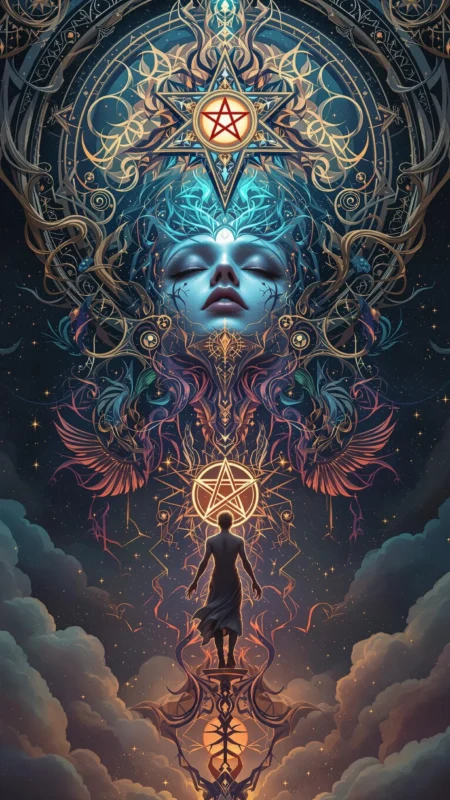
Pentagram

Archetype Meaning & Symbolism

Protective, Elemental, Balanced, Esoteric, Complex, Geometric, Spiritual, Grounded, Celestial, Interconnected

  • Each point is a world, each line a journey. I am the map where they all meet.

If Pentagram is part of your personal mythology, you may...

Believe

  • Everything is interconnected, and the patterns of the macrocosm are reflected in the microcosm of my own life.

    True strength lies not in singular power, but in the harmonious balance of multiple, often opposing, forces.

    Protection and wholeness are not given, but created through conscious intention and the structuring of one's inner and outer worlds.

Fear

  • A loss of control that leads to internal chaos, where the elements of the psyche turn against each other.

    Being fundamentally imbalanced or broken, unable to form a complete and whole self.

    That the intricate web of connections you perceive and maintain is merely an illusion, and the universe is truly random and meaningless.

Strength

  • A profound ability to see the big picture and understand how disparate parts fit together into a coherent whole.

    A natural talent for mediation, integration, and creating harmony in complex situations or group dynamics.

    A deep sense of inner completeness and resilience, drawing strength from a balanced inner world.

Weakness

  • A tendency toward over-intellectualizing or over-structuring life, leaving little room for spontaneity or organic chaos.

    Analysis paralysis, becoming stuck when unable to find the 'perfect' balance between all competing factors.

    A potential for rigidity, becoming dogmatic about your own system of balance and judging others who lack it.

The Symbolism & Meaning of Pentagram

The Pentagram in one's personal mythology speaks to a profound psychic architecture, a desire for an integrated self. It is the soul's blueprint, suggesting that the personality is not a monolith but a complex structure of distinct, vital forces. You may perceive yourself as a composite being, a living nexus of body, mind, heart, and will, all crowned by an animating spirit. The symbol rejects the notion of a fractured self; instead, it proposes that wholeness is achieved not by suppressing complexity but by honoring it, by drawing the connecting lines between the disparate points of one's own nature until they form a star. This personal mythos is one of inner alchemy, the deliberate and continuous work of turning the lead of inner chaos into the gold of a harmonized, potent identity.

The shape itself is a lesson in dynamic tension. A Pentagram is not a passive object; its form arises from the pull and push of its intersecting lines. To carry this symbol in your mythos is perhaps to understand that life’s balance is not a state of peaceful rest but an active, ongoing process of negotiation. It is the constant balancing of passion with logic, of grounding with flight, of the need for solitude with the need for community. Your life story might be one of navigating these beautiful tensions. The meaning is found not in the points themselves, but in the taut, elegant lines that connect them, in the understanding that strength and beauty are forged in the space between opposing forces.

Furthermore, the Pentagram is the quintessential map of the microcosm. Just as Leonardo’s Vitruvian Man fits neatly within its points, the symbol could represent your belief that the human being is a small-scale model of the entire universe. This fosters a worldview of profound interconnectedness and personal sovereignty. If you contain the whole cosmos, then the answers you seek are not exclusively 'out there' but also 'in here.' Your personal mythology may be one of discovery, not of new lands, but of the continents within: the earthy plains of your physical body, the watery depths of your emotions, the airy peaks of your intellect, and the fiery core of your will, all part of a single, sacred geography of the self.


Pentagram Relationships With Other Archetypes

The Circle Archetype:

The Pentagram is often found inscribed within a Circle, and this relationship is one of contained complexity within boundless unity. The Circle represents totality, eternity, and the unbroken whole of the cosmos or the community. The Pentagram within it is the intricate, multifaceted individual thriving within that larger context. For a person with this pairing in their mythos, the self is a complex system of balanced forces (the star), but it finds its ultimate safety, meaning, and power by being part of something larger than itself (the circle). It is the dance of the unique part within the divine whole, a relationship that honors both individuality and universal connection.

The Crossroads Archetype:

Where the Crossroads archetype presents a moment of divergent, often mutually exclusive, choice, the Pentagram offers a vision of integration. An individual influenced by the Pentagram might approach a crossroads not with the anxiety of choosing one path and forsaking others, but with the challenge of weaving them together. The paths of career, family, art, and spirit are not separate roads but points on a single star. The Pentagram’s influence thus transforms the mythos of 'the path not taken' into a mythos of 'the paths interwoven.' It suggests a life where one need not sacrifice the intellect for the heart, or passion for stability, but can instead endeavor to find the center point from which all paths are accessible and part of a coherent design.

The Hermit Archetype:

The Hermit retreats from the world to find inner wisdom, carrying a lantern to illuminate the darkness of the unconscious. The Pentagram could well be the secret knowledge the Hermit discovers on this journey. The lantern's light might reveal not a simple cave but a chamber whose floor is inscribed with the star, a map of the very psyche the Hermit has come to understand. The Pentagram provides the structure for the Hermit's wisdom, giving form to the elemental truths of existence. The relationship is one of search and discovery: the Hermit seeks the pattern, and the Pentagram is the pattern revealed, the sacred geometry of the soul that can only be seen in stillness and introspection.

Using Pentagram in Every Day Life

Navigating Career Choices:

One might use the Pentagram as a cartographical tool for the soul's vocation. Each point could represent a non-negotiable aspect of a fulfilling career: Earth for material stability and fair compensation; Air for intellectual challenge and communication; Fire for passion and driving ambition; Water for emotional satisfaction and connection with colleagues; and Spirit for a sense of higher purpose or alignment with one's values. The task is not to choose one over the other but to find the role or path that sits in the center, held in dynamic tension by the pull of all five points, ensuring that the work is not just a job but an integrated part of a whole life.

Resolving Inner Conflict:

When faced with a paralyzing inner conflict, a psyche shaped by the Pentagram may map the dilemma onto its points. A conflict between security and freedom, for example, is not a binary choice. Security might be placed at the Earth point, freedom at the Air point. The other points then become clarifying questions: what is the passionate cost (Fire)? What is the emotional truth (Water)? What is the guiding principle (Spirit)? By tracing the lines between them, one may see that security and freedom are not opposites but interdependent components of a larger, more complex desire for a life that is both grounded and expansive.

Structuring a Creative Project:

A novelist or artist could build their work upon the Pentagram's framework to ensure structural integrity and thematic resonance. The five points could symbolize the core pillars of the narrative: a protagonist's desire (Fire), the emotional landscape (Water), the foundational setting or rules of the world (Earth), the overarching theme or idea (Air), and the story's transcendent meaning or moral (Spirit). The creative process then becomes an act of weaving these five elements together, ensuring each is present and balanced, so the final creation feels not merely constructed, but alive, whole, and mystically coherent.

Pentagram is Known For

Elemental Harmony

The Pentagram is famously a glyph of synthesis, representing the four classical elements of earth, air, fire, and water as its lower four points, all governed and united by the fifth element, spirit or aether, at its apex. It is a visual formula for a complete and balanced cosmos in miniature.

Symbol of Protection

Throughout history, the symbol has been drawn on doorways and worn as an amulet, believed to be a potent ward against malevolent forces. Its continuous, unbroken line is thought to trap or repel negativity, creating a bounded, sacred space of personal sovereignty and safety.

Esoteric Knowledge

The Pentagram is a key that unlocks many doors in Western esotericism, from the mathematical mysticism of the Pythagoreans, who saw in it a symbol of perfection, to its central role in ceremonial magic and modern Pagan traditions like Wicca. It signifies a hidden order and the practitioner's ability to understand and work with it.

How Pentagram Might Affect Your Personal Mythology

How Pentagram Might Affect Your Mythos

When the Pentagram shapes your personal mythos, your life story may cease to be a linear narrative and become instead a geometric one. The plot is not a straight line from birth to death, but a constellation of defining points that, together, create a meaningful pattern. A seemingly random event from youth, a passionate affair, a career pivot, a spiritual crisis, a moment of profound stability: these are not just chapters in a sequence. They are the vertices of your personal star. Your myth becomes a tale of pattern recognition, of seeing the invisible lines that connect the disparate moments of your existence into a single, coherent, and often beautiful, form. The central quest of your life may be to discover and complete this pattern.

Your narrative might also be one of guardianship. The Pentagram, as a symbol of protection, could cast you in the role of a stabilizing force, a weaver of safe spaces. Your story may be about creating and defending a sanctuary, whether physical, emotional, or intellectual, where the chaotic elements of life can coexist harmoniously. You might see your purpose as holding the ring for your family, your community, or your own tumultuous inner world, ensuring that the fire of conflict does not scorch the earth of stability, and the waters of emotion do not extinguish the air of reason. Your myth is not one of conquest, but of calibration.

How Pentagram Might Affect Your Sense of Self

Your sense of self may be unusually comfortable with complexity. You might not identify as just one thing—a thinker, a lover, a worker—but as a living composite of all these roles and energies. The Pentagram provides a framework that turns potential fragmentation into elegant multiplicity. There may be a core belief that you are whole *because* you are multifaceted, not in spite of it. This can lead to a robust and resilient identity, one that doesn't crumble if a single aspect of your life fails or changes. The self is not a single pillar but a geodesic dome, deriving its strength from the interconnection of all its parts.

This archetype may also instill a powerful sense of self-containment and psychic sovereignty. If the Pentagram is the microcosm, a map of the complete human, then you may feel you are a universe unto yourself. This isn't arrogance, but a quiet, deep-seated completeness. Your validation may come not from external praise but from an internal sense of equilibrium. You are 'in tune' when all your inner elements are honored and harmonized. This can foster a profound self-reliance, a feeling that you possess, within yourself, all the necessary resources to navigate the world.

How Pentagram Might Affect Your Beliefs About The World

Your worldview could be one of seeing patterns everywhere. You may look at a political conflict, a social movement, or an ecological crisis and instinctively search for the underlying elemental forces at play. Is this a crisis of unchecked fire (aggression, consumption)? A lack of earth (instability, rootlessness)? A confusion of air (misinformation, ideology)? This lens transforms a chaotic world into a complex, but potentially understandable, system of correspondences. It is a Gnostic vision: reality is not what it appears to be on the surface, but a dance of hidden structures and sacred mathematics waiting to be perceived.

This perspective naturally cultivates a rejection of simplistic binaries. Issues are rarely black and white, good or evil. Instead, they are intricate knots of competing truths and forces, each with its own place and validity. The goal is not to declare a winner but to find the point of harmony, the elegant solution that balances the entire equation. This worldview could lead one to be a natural diplomat, a systems thinker, or a holistic practitioner, always seeking the health of the whole system rather than the victory of a single part.

How Pentagram Might Affect Your Relationships

In relationships, you may unconsciously seek a five-pointed equilibrium. A romantic partnership, for instance, must be more than just passion (Fire) or emotional connection (Water). To feel whole and stable, it may also need intellectual companionship (Air), shared real-world goals and stability (Earth), and a common spiritual understanding or purpose (Spirit). A relationship that heavily over-invests in one element while neglecting the others might feel profoundly unstable or incomplete to you, regardless of how good that one element is.

This desire for structural integrity extends to friendships and family. You could find yourself playing the role of the quiet connector, the person who ensures all points of the social star are linked. You might be the one who invites the intellectual friend and the emotive friend to the same dinner party, intuitively knowing they can balance each other. Your social impulse may not be simply to gather, but to weave: to create a network of relationships that is strong, resilient, and harmonious because all its constituent parts are honored and connected.

How Pentagram Might Affect Your Role in Life

Your perceived role in life might crystallize into that of the Integrator or the Mediator. In any group setting, from a corporate team to a family dinner, you may feel an innate pull to synthesize disparate views, to bridge ideological gaps, and to forge a functional whole from conflicting parts. Your contribution is not necessarily about generating new ideas (though you may) but about arranging existing ones into a more coherent and powerful pattern. You are the architect of consensus, the weaver of webs, strengthening the entire structure not by leading from a single point, but by ensuring the integrity of the connections between all points.

Alternatively, your role may feel akin to that of a psychological Alchemist. Your purpose is to work with the raw, chaotic, and often volatile elements of life—a disorganized project, a person's unresolved trauma, a community's anxieties—and to gently, deliberately, give them form and structure. You are the one who draws the sacred diagram over the mess. This is not about imposing order out of a need for control, but from a deep, almost spiritual conviction that within chaos lies a potential for beautiful, harmonious order. Your work is to reveal the star hidden in the stone.

Dream Interpretation of Pentagram

To dream of a perfectly formed, upright Pentagram, perhaps glowing with a soft light or drawn with a confident hand, could be a profoundly affirming symbol from the unconscious. It may signify a state of inner harmony and psychic wholeness. The dreamer might be successfully integrating the varied aspects of their life—career, relationships, intellect, passion, and spirit—into a balanced and powerful whole. The dream could be a confirmation that you are on the right path, feeling spiritually protected, and aligned with your deepest self. It is an image of the soul in a state of grace and equilibrium.

Conversely, dreaming of a broken, distorted, or inverted Pentagram may signal a period of significant inner turmoil and imbalance. The lines might be wavering, one point might be grotesquely oversized, or the entire symbol could be shattered. This could point to a specific elemental imbalance: a dominant 'fire' point might suggest burnout or unchecked anger, while a shrunken 'water' point could indicate emotional repression. An inverted Pentagram, with two points reaching upward, might symbolize a state where material concerns and base instincts are dominating one's higher, spiritual aspirations. Such a dream is a call to attention: a warning from the psyche that its sacred architecture is compromised and in need of repair.

How Pentagram Archetype Might Affect Your Needs

How Pentagram Might Affect Your Physiological Needs

For one with the Pentagram in their mythos, the physiological needs of the body may be interpreted through an elemental lens. Sustenance is not just about calories; it is about balance. The need for 'Earth' translates to grounding foods, stable sleep cycles, and a connection to the physical body. 'Water' is the need for hydration, yes, but also for the fluid movement of joints and the healthy flow of emotions, which are seen as intrinsically tied to physical wellbeing. 'Air' represents the vital need for full, clean breaths, for oxygenating the system, and maintaining mental clarity. 'Fire' is the body's metabolic energy, the need for vigorous movement, and the warmth of a healthy system. Health is the art of keeping these forces in a dynamic, harmonious dance.

When this balance is disrupted, physiological symptoms might be understood in symbolic terms. Chronic anxiety could be seen as a lack of 'Earth,' a feeling of being unmoored from the body's stability. Inflammation and burnout might be diagnosed, on a mythic level, as an excess of 'Fire,' a system consuming itself. Sluggishness and depression could be an overabundance of 'Water' or a deficiency of 'Fire.' From this perspective, healing is not just about treating a symptom but about identifying the elemental imbalance and restoring the body’s innate, sacred geometry.

How Pentagram Might Affect Your Ideas of Belonging

The need for love and belonging is filtered through a desire for meaningful structure. You may not seek to merge or dissolve into a group, but to find your essential and unique position within it, like a point on the star. Belonging is felt most deeply in a family, a partnership, or a community where each member's 'elemental' nature is recognized, valued, and seen as necessary for the balance of the whole. Love is the line that connects you to another, forming part of a larger, stronger pattern. You belong when your presence completes a sacred geometry.

A feeling of loneliness or alienation, therefore, might be experienced as being a 'disconnected point,' a star with a missing line. Rejection is not merely being excluded; it is a severing of a vital connection that compromises the integrity of the entire social form. For relationships to feel authentic and secure, they must have this quality of structural necessity. You need to know not just that you are loved, but that your unique placement in the lives of others helps hold their world, and yours, together.

How Pentagram Might Affect Your Feelings of Safety

Safety, from the Pentagram's perspective, is not a passive state but an active construction: a ward. Financial security (Earth), intellectual preparedness and awareness of one's surroundings (Air), emotional resilience to withstand shocks (Water), and the physical capacity to act or defend oneself (Fire) are the four cardinal points of a secure existence. Crowning them all is Spirit: the intuition, the gut feeling, the guiding principle that alerts you to danger and guides you toward safe harbors. True safety, then, is a holistic system where all these domains are strong and interconnected, creating a protective field of competence and awareness.

Consequently, a threat to safety is perceived as a breach in this mystical perimeter. The greatest danger is not a specific external enemy, but the internal or external force that creates imbalance and chaos. You may feel most unsafe in situations that are unpredictable, unjust, or that force you to compromise your core principles, as these threaten to shatter the very geometry of your world. A job that offers financial security (Earth) but violates your spirit feels profoundly unsafe. Security is the integrity of the whole pattern, and its loss is the ultimate vulnerability.

How Pentagram Might Affect Your Views of Esteem

Esteem, in this mythos, is likely tied to your capacity for integration and integrity. Self-worth is derived from the successful stewardship of your own inner multiplicity. You respect yourself when you are able to hold your own complexity—your intellect, emotions, physicality, and spirit—in a state of dynamic harmony. The accomplishment is not in being the best at any one thing, but in the art of weaving them all together. Esteem is the quiet confidence of a well-ordered cosmos in miniature. Respect from others is earned not through dominance, but by being a source of balance and coherence.

The deepest blows to your esteem may come from a loss of this inner balance. Failure is not making a mistake; it is the experience of being overtaken by a single element, of becoming one-dimensional. To be consumed by anger (Fire), paralyzed by analysis (Air), drowned in sorrow (Water), or stuck in inertia (Earth) feels like a profound personal failing. The shadow of low self-esteem is the terror of inner chaos, the fear that you are not a star at all, but just a tangle of meaningless lines.

Shadow of Pentagram

When the Pentagram's influence becomes excessive, its shadow emerges as a cold, rigid perfectionism. The search for balance becomes a tyranny of control. Life, in all its messy, unpredictable beauty, is forced into the unyielding lines of a geometric prison. Spontaneous passion, unruly emotions, inconvenient truths—these are not seen as parts of life but as threats to the integrity of the pattern. The individual may become a detached architect of their own existence, valuing the blueprint over the building, the map over the territory. In relationships, this shadow manifests as manipulation; other people become mere 'elements' to be arranged and balanced for the sake of the individual's perfect design, their humanity secondary to their function in the grand, sterile scheme.

The inverted or broken shadow of the Pentagram is a terrifying collapse into fragmentation. When the unifying principle of Spirit fails, the elements turn upon each other in a war within the self. The structure implodes. Intellect (Air) fuels endless anxiety loops; emotion (Water) becomes a drowning deluge of despair; passion (Fire) becomes directionless, destructive rage; and stability (Earth) crumbles into a heavy, immovable inertia. The individual may feel cursed, psychically breached, and perpetually unsafe. This internal chaos is often projected outward, leading to a worldview steeped in paranoia, a belief in malevolent forces, or a self-destructive embrace of all that is broken and imbalanced as a way to reclaim agency in the wreckage.

Pros & Cons of Pentagram in Your Mythology

Pros

  • You possess a unique framework for understanding yourself and the world, leading to a profound sense of integration and wholeness.

    Your ability to hold multiple perspectives in balance makes you an exceptional problem-solver, mediator, and strategist.

    You cultivate a strong sense of personal sovereignty and protection, feeling secure in the well-ordered structure of your inner life.

Cons

  • You may struggle with the messy, unpredictable, and chaotic aspects of life, viewing them as failures of your system.

    There is a risk of becoming overly detached or schematic in your thinking, alienating you from the raw, direct experience of living.

    Your complex inner world can be difficult for others to understand, potentially leading to feelings of isolation or being misunderstood.