Believe
 Fear
Fear Strength
 Weakness
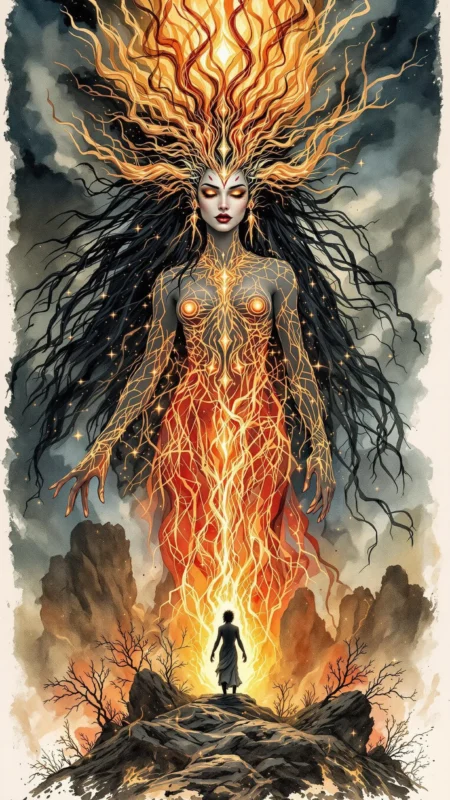
To have Pele as a feature in your personal mythology is to court the earth’s primal, untamable fire. She is not a metaphor for mere anger, but for the magnificent, terrifying process of creation itself. Her symbolism in a modern context is about the raw, explosive power that precedes all newness. She represents the force within that demands expression, the passion that refuses to be civilized into polite submission, the creative impulse that must clear its own ground before it can build. Pele symbolizes the wisdom that knows some things cannot be fixed or gently coaxed: they must be melted down and forged again. She is the patron of the brilliant, messy, and necessary upheaval.
This archetype might emerge in your mythos as the agent of non-negotiable change. Where other archetypes might build bridges, Pele creates islands. She is the moment a quiet life is interrupted by a sudden, irreversible truth. She is the decision to leave a city, a job, a self, not with a packed bag and a plan, but with the singular, burning clarity that the ground you stand on is no longer your own. Her presence could signify that your life's work is not about maintaining the status quo, but about being a conduit for a power that is both generative and destructive, often in the same breath.
Ultimately, Pele embodies a profound duality. Her lava flows are not just about obliteration, they are about terrestrial expansion. To welcome her into your personal narrative is to accept this paradox. It is to understand that the moments of greatest destruction in your life may also be the moments of greatest fertility. She is the patron saint of the scorched earth policy that makes way for the wildflower meadow. Her meaning is found in the cooled obsidian, the sharp new rock where there was once something else: proof that ruin can be the foundation of a whole new world.