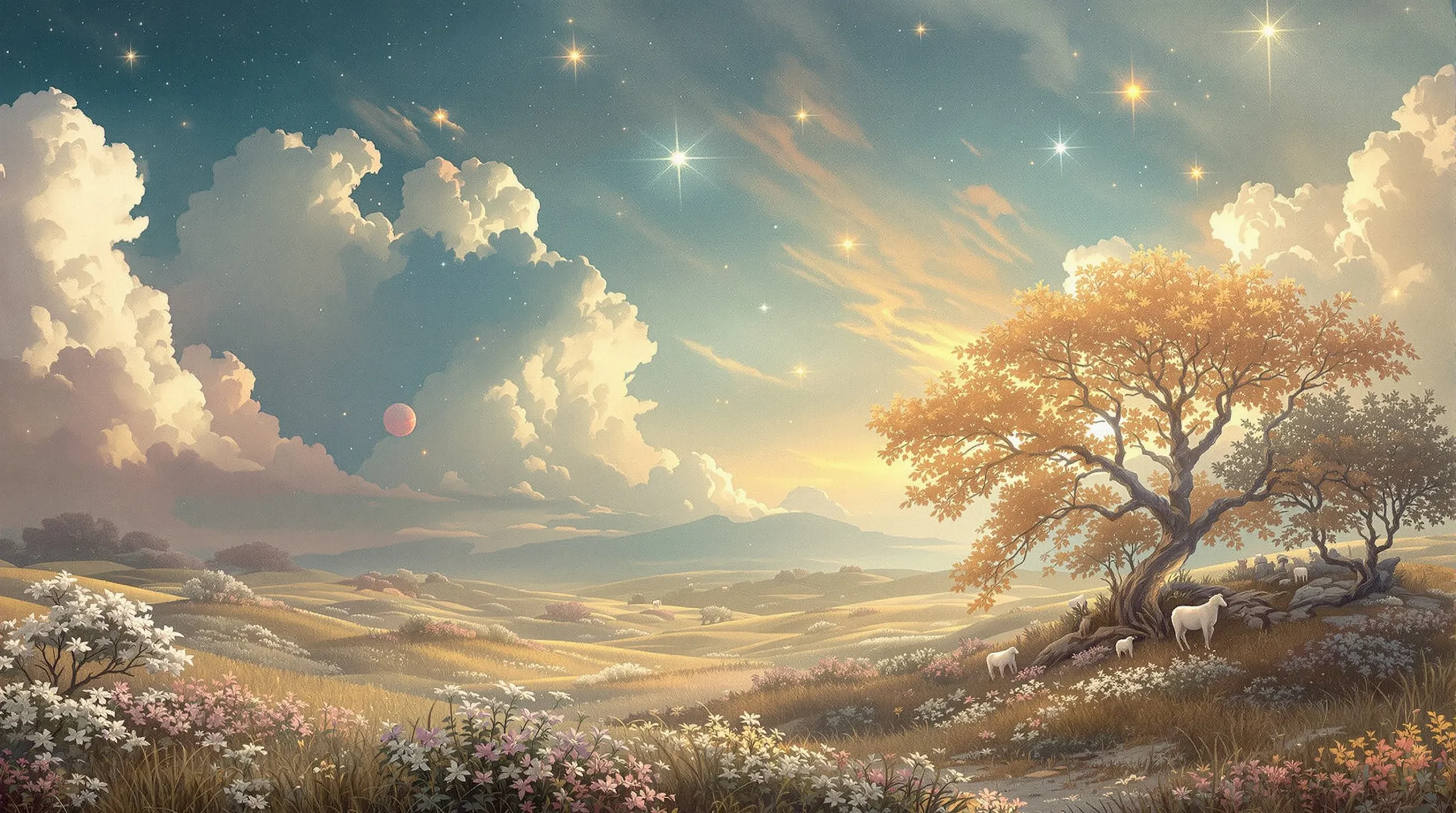


Pasture

Archetype Meaning & Symbolism

Nurturing, patient, mundane, yielding, fertile, exposed, placid, communal, cyclical, simple

  • Rest here. The deepest growth requires no audience, only sun and patient time.

If Pasture is part of your personal mythology, you may...

Believe

  • You may believe that true growth is slow, quiet, and requires patience above all else.

  • You may believe that contentment is found not in conquest, but in careful cultivation of what you already have.

  • You may believe that providing a safe and nourishing space for others is one of the highest callings.

Fear

  • You may fear sudden, violent change: the flash flood, the wildfire, the unpredicted blight that can undo seasons of slow growth in an instant.

  • You may fear being depleted, overgrazed, and left barren with nothing left to give to yourself or others.

  • You may fear being forgotten or seen as merely a backdrop for more dramatic events, a simple utility rather than a place of its own sacred importance.

Strength

  • An immense capacity for patience and the ability to find profound meaning in the long, slow work of nurturing.

  • The ability to create environments of calm, safety, and psychological nourishment for yourself and others.

  • A deep resilience rooted in cyclical recovery: knowing that even after a harsh season, with time and care, new growth will emerge.

Weakness

  • A tendency toward passivity, waiting for external forces to act upon you rather than initiating change yourself.

  • A vulnerability to exploitation, as your impulse is to give and nourish, sometimes without establishing firm boundaries.

  • A potential for boredom or stagnation, a resistance to necessary disruption that could lead to greater growth.

The Symbolism & Meaning of Pasture

The Pasture, in one’s personal mythology, may represent the profound beauty of the cultivated soul. It is not the jagged peak of heroic achievement nor the dark, untamed forest of the subconscious. It is, perhaps, the landscape of contentment, a space consciously cleared and tended for the purpose of gentle growth. To have the Pasture within you is to carry a capacity for creating psychological nourishment, for turning the raw material of experience into a place of rest and sustenance for yourself and for others. It symbolizes a life philosophy rooted in stewardship rather than conquest, finding meaning in the patient, cyclical work of maintaining a small patch of the world and making it fruitful.

This archetype speaks to a different kind of time: not the linear, arrow-like trajectory of ambition, but the circular, patient time of seasons. It suggests a belief that what is essential will eventually replenish itself if given the space and peace to do so. Life is not a series of problems to be solved but a field to be managed. Some seasons will be abundant, others will be lean. Weeds will appear and must be pulled, not with violence, but with persistence. This worldview replaces the anxiety of constant progress with the calm rhythm of maintenance, suggesting that the most sacred work is often the repetitive, unnoticed labor of care.

Furthermore, the Pasture might be an emblem of the “good enough” life, embraced not as a compromise but as a radical act of acceptance. It is a stand against the cultural demand for endless expansion and dramatic self-reinvention. The mythos of the Pasture finds its climax not in a single, triumphant moment, but in the quiet accumulation of peaceful days. It is the discovery of the infinite within the finite, the sacred within the mundane. It is a testament to the idea that a simple, bounded space, if cared for with love, can be more sustaining than the promise of boundless, untamed territory.


Pasture Relationships With Other Archetypes

The Shepherd

The Pasture and The Shepherd exist in a state of profound symbiosis. The Pasture offers the place and the sustenance, a passive, yielding ground of being. The Shepherd provides the active principle: intention, protection, and movement. Within a personal mythos, this pairing could represent the relationship between one's environment (the Pasture) and one's will (the Shepherd). Your inner Pasture may be fertile, but without the guidance of your inner Shepherd, the flock of your thoughts and energies might wander, become lost, or overgraze one area into ruin. One provides the potential, the other directs it.

The Wild Forest

The Pasture often lies at the edge of The Wild Forest, and this boundary is a potent psychic line. The Forest is the realm of the unconscious, the unknown, the instinctual, and the potentially dangerous. The Pasture is the cleared, sunlit space of the conscious mind and the tamed life. To live in the Pasture archetype is to live with an awareness of that forest edge. It may be a source of fear (the wolf that comes for the flock) or a source of mystery and potential (the hidden spring just beyond the trees). A healthy mythos often involves a careful dialogue between these two landscapes, a recognition that the managed space of life is nourished and challenged by the untamed wildness it borders.

The Storm

The Storm is an archetype of chaotic, indiscriminate power that the Pasture cannot resist, only endure. It can be destructive, washing away topsoil and flooding the field, representing life's unavoidable crises. Yet, the Storm also brings the rain that is essential for the Pasture’s survival and renewal. This relationship speaks to a deep, cosmic trust. For the Pasture-minded individual, a personal crisis (The Storm) is not merely an antagonist. It is a terrifying but potentially generative force that, once it has passed, may be the very thing that allows for new, stronger growth to emerge from the battered ground.

Using Pasture in Every Day Life

Navigating Overwhelm

When life feels like a cacophony of urgent demands, the Pasture archetype offers a mental landscape of quiet order. You might visualize a personal pasture: a bounded, serene space in your mind. The act of mentally walking its perimeter could be a ritual for re-establishing boundaries. The anxieties are not enemies to be fought, but predators outside the fence, their power diminished by the simple fact of the boundary you have set. This is not about ignoring problems, but about creating a safe internal space from which to view them with calm detachment.

Cultivating a Creative Project

Instead of a heroic battle, a creative endeavor could be seen as a field to cultivate. The initial idea is the seed. The early, uncertain stages are the period of germination, hidden and fragile. The work is not a frantic sprint but a steady tending: weeding out distractions, providing the right nutrients of research and focus, and trusting the seasons of inspiration and fallowness. The Pasture teaches that a project does not need to be forced into existence: it needs the right conditions to grow on its own time.

Recovering from Burnout

Burnout can be mythologized as an empty, overgrazed field. The Pasture archetype suggests that the remedy is not to search for a new, richer field immediately, but to honor the necessity of a fallow period. Recovery is not inaction but a different kind of action: the quiet work of letting the soil of the self-rest and replenish. It involves accepting a season of unproductivity not as failure, but as an essential part of a sustainable cycle, trusting that the capacity to nourish will return after a period of quiet care.

Pasture is Known For

Sustenance

The Pasture is fundamentally a place of nourishment. It is land transformed by intention for the purpose of feeding and sustaining life, a landscape defined by its gentle, reliable utility.

Cyclical Rhythms

It embodies the eternal cycle of consumption and regeneration. The grass is eaten, the land rests, the rains come, and the grass grows again. It is a living clock, marking time in seasons of plenty and periods of quiet waiting.

Managed Openness

Unlike the chaotic wild, the Pasture is a space of curated simplicity. Its openness is its primary feature, yet it is often bounded by fences or natural borders, representing a pocket of tamed nature, a sanctuary held within the larger world.

How Pasture Might Affect Your Personal Mythology

How Pasture Might Affect Your Mythos

When the Pasture shapes your personal mythos, your life story may subtly shift its genre from epic adventure to a pastoral poem. The central narrative is no longer about slaying the dragon or seizing the throne, but about cultivating a garden, tending a flock, or maintaining a home. The protagonist’s virtue is not courage in the face of a single great trial, but rather the quieter, more enduring qualities of patience, consistency, and stewardship. Your legend is not written in a single heroic deed, but is inscribed in the daily and seasonal rhythms of care.

Moments of profound meaning in this narrative are not explosive climaxes, but quiet, luminous events: the relief of the first spring thaw, the satisfaction of a well-maintained fence, the peace of watching a flock graze in the late afternoon sun. The story’s arc is cyclical, not linear. Its central tension is not good versus evil, but sustainability versus depletion. The greatest tragedy is not a dramatic death, but a field left barren through neglect. Your myth becomes a testament to the quiet power of maintenance and the radical choice to cultivate a small, beautiful life in a world that often demands a grand one.

How Pasture Might Affect Your Sense of Self

Your view of self may be deeply intertwined with the capacity to be a place of refuge and nourishment. You might perceive your fundamental nature as a provider of calm, a stable ground upon which others can depend. This can foster a profound sense of purpose rooted in gentle utility: your worth is measured by the well-being of those who find sustenance in your presence. The self is not a dynamic, striving hero, but a serene, reliable landscape. There is a deep identity in being, rather than in doing.

This perspective could also cultivate a sense of self that is porous and yielding. You may feel that your own boundaries are permeable, that your needs are secondary to the needs of the collective “flock” you tend. This can lead to a beautiful selflessness, but also to a vulnerability of identity. The self might feel less like a distinct entity and more like a resource to be consumed. Without periods of replenishment, there is a risk of feeling defined only by what you offer, leading to a quiet crisis of identity when you feel you have nothing left to give.

How Pasture Might Affect Your Beliefs About The World

The world, viewed through the lens of the Pasture, may appear not as a competitive arena, but as a vast quilt of interconnected fields, each with its own needs and seasons. Social and political problems might be seen less as wars to be won and more as ecological imbalances to be patiently corrected. The focus is on cultivating conditions for health rather than on eliminating pathology. This fosters a worldview rooted in systems thinking, an understanding that everything is connected and that small, consistent actions can, over time, transform a landscape.

This perspective prizes sustainability above explosive growth. Progress is not a relentless upward march, but a cyclical process of growth, harvest, rest, and renewal. There might be a deep skepticism toward ideologies that promise rapid, utopian transformations, and a corresponding faith in gradual, community-level solutions. The world’s health is seen as a matter of collective stewardship. The grand, dramatic events of history may seem like passing storms, while the real, enduring work is the quiet, daily tending of the soil of culture, community, and connection.

How Pasture Might Affect Your Relationships

In relationships, you may seek to create a pasture: a safe, predictable, and nourishing space for connection to grow. The ideal is not a whirlwind romance full of dramatic peaks and valleys, but a steady, sunlit companionship. You might express love through consistent acts of care and by providing a stable emotional environment. The goal is a sustainable partnership that can weather the seasons, a bond that is less about passion and more about a shared, peaceful existence.

This can make you an incredibly grounding and supportive partner, friend, or parent. However, you might also unconsciously take on the role of the landscape itself, allowing others to “graze” on your emotional resources without seeing the need for reciprocation. There could be a tendency to avoid necessary conflict, viewing it as a disruptive storm rather than a potentially clearing rain. The danger is in creating a relationship so placid that it becomes stagnant, a field where no new or challenging things are allowed to grow for fear of disturbing the peace.

How Pasture Might Affect Your Role in Life

Your perceived role in life, in your family, or in your community might be that of the quiet foundation. You may not see yourself as the leader or the star, but as the essential context that allows others to shine. This is the role of the nurturer, the stabilizer, the keeper of the space where life happens. There is a quiet pride in this role, a sense of being the bedrock, the reliable ground that is always there. Your contribution is often invisible until it is gone, like the air or the earth itself.

This can lead to a deep sense of purpose, but it can also feel limiting. You might shy away from roles that require self-promotion, direct confrontation, or bold, disruptive action. You may feel most comfortable facilitating the success of others rather than claiming your own. The challenge is to embody the nourishing qualities of the Pasture without becoming a passive backdrop in your own life story, to understand that the landscape itself has its own intrinsic value, separate from the flock it feeds.

Dream Interpretation of Pasture

To dream of a vibrant, sun-drenched pasture, perhaps with a peacefully grazing flock, could be a profound affirmation from the psyche. It may suggest that you are in a state of inner peace and gentle productivity. This dream could signify that a period of emotional or spiritual nourishment is underway, that you have successfully cultivated a safe inner space where your ideas, your relationships, and your soul can thrive. It is a symbol of contentment, simplicity, and the quiet joy of a life in sustainable balance.

A dream of a barren, dusty pasture, however, could be a potent warning. If the field is overgrazed, parched, or strangely empty, it might reflect a state of burnout, emotional depletion, or creative stagnation. It could be pointing to a situation in your life where you feel used up, with nothing left to give. Fences in such a dream might feel less like protection and more like a prison, symbolizing a feeling of being trapped in a role or relationship that is no longer nourishing you, a life that has become a duty rather than a source of sustenance.

How Pasture Archetype Might Affect Your Needs

How Pasture Might Affect Your Physiological Needs

The body may be perceived not as a machine to be optimized, but as a landscape to be tended. This perspective fosters a deep, intuitive connection to basic physiological needs: simple, whole nourishment (good soil), hydration (rain), rest (fallow seasons), and gentle movement (a breeze). There could be a natural aversion to overly complex diets or extreme workout regimens. Health is not about achieving peak performance but maintaining a state of gentle, sustainable equilibrium.

This archetype could also connect you deeply to the body's natural rhythms. You might feel a strong pull to align your life with circadian and seasonal cycles, feeling energetic in the long days of summer and naturally drawn to rest and introspection in winter. To ignore these innate signals—to work through exhaustion or neglect rest—may feel like a violation of natural law, like trying to force a harvest in the dead of winter. The body’s wisdom is the wisdom of the land: it knows when to grow and when to lie dormant.

How Pasture Might Affect Your Ideas of Belonging

Belonging, through the Pasture lens, might be experienced as a quiet, communal immersion. It is the feeling of being one among the flock, sharing the same ground, nourished by the same source. Connection is less about intense, one-on-one dyadic bonds and more about a gentle, collective identity. You belong not because you are special or chosen, but simply because you are here, participating in the life of the herd. It is a belonging rooted in shared space and shared sustenance.

Love, in this context, may be expressed as a form of stewardship: caring for the well-being of the collective. It is a diffuse, gentle affection, a desire for the whole flock to be safe and fed. The potential challenge is that this can preclude the intimacy of being seen as a unique individual. One might feel a deep sense of community but lack the feeling of being uniquely known and cherished, a feeling of being essential to the herd but perhaps interchangeable within it.

How Pasture Might Affect Your Feelings of Safety

A sense of safety may be profoundly linked to predictability, stability, and open sightlines. Security is the feeling of being in a known, manageable space where threats can be seen from a distance. The fence, in this context, is a crucial symbol: it is the boundary between the safe, tended world and the chaotic, unknown wild. Safety is the result of careful maintenance and clear, established borders, both in the physical and the psychological realms.

Paradoxically, the very openness of the Pasture creates a profound vulnerability. There is nowhere to hide. This can translate into a psychological state where safety feels contingent upon external protection—a metaphorical shepherd—or the continued absence of predators. This can foster deep anxiety if the systems or people you rely on for security feel unstable. Your peace may depend on a fragile truce with the chaos that lies just beyond the fence line, a constant, low-level awareness that the tranquil space is a sanctuary, not a fortress.

How Pasture Might Affect Your Views of Esteem

Self-esteem could be deeply rooted in your reliability and your capacity to nurture. You may derive a powerful sense of worth from being a source of stability and sustenance for others. The measure of your value is the health and tranquility of your personal ecosystem. There is a quiet, profound pride in being the dependable ground, the person who creates the conditions for others to thrive. Your esteem is built not on accolades, but on the silent evidence of flourishing life around you.

This foundation for esteem can be precarious, as it is often dependent on the perceived needs of others. If the flock you tend moves on, or if you enter a personal season of fallowness where you cannot provide as you once did, it could trigger a deep crisis of worth. The self-image is contingent on being useful. The challenge is to cultivate an inherent sense of value in the landscape of the self, to believe the Pasture is worthy even when it is resting, empty, and waiting for rain.

Shadow of Pasture

The shadow of the Pasture is a green and pleasant prison. It is a tranquility that becomes oppressive, a peace so profound that it suffocates all ambition, creativity, and healthy dissent. In this shadow expression, the need for safety curdles into a demand for absolute conformity. The fences, once protective, now feel like the bars of a cage. Anything that grows differently—a vibrant wildflower in the sea of uniform grass, a challenging new idea—is seen not as diversity but as a weed to be immediately uprooted. This is the tyranny of the nice, a landscape of placid denial where conflict is avoided at all costs, leading to a life that is safe but sterile, a peacefulness that is indistinguishable from death.

The other face of this shadow is a deep, seething martyrdom. The Pasture becomes utterly defined by its utility, by what can be taken from it. It allows itself to be overgrazed, its resources completely depleted, all while nurturing a silent, bitter resentment toward the flock for its natural hunger. This manifests as a weaponized passivity and a deep-seated fragility. The nurturing instinct becomes a tool of manipulation, making others feel profoundly guilty for having needs. The once-generous act of providing sustenance becomes a grim, unspoken transaction, poisoning the very ground of relationships with the bitterness of unexpressed needs.

Pros & Cons of Pasture in Your Mythology

Pros

  • You are a source of stability and calm in a chaotic world, creating spaces where others can rest and grow.

  • You possess a deep understanding of process, patience, and the power of consistent, quiet effort.

  • Your life is grounded in a sustainable rhythm that can lead to profound contentment and resilience.

Cons

  • You may struggle with asserting your own needs and boundaries, leading to burnout and depletion.

  • You might resist necessary change and risk, preferring a predictable but ultimately unfulfilling status quo.

  • Your value, both to yourself and others, can become dangerously tied to your utility and ability to provide.