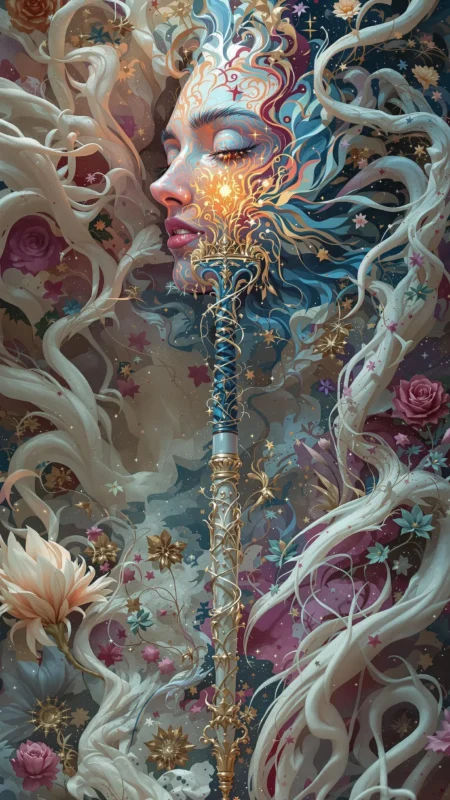


Paintbrush

Archetype Meaning & Symbolism

Expressive, transformative, precise, messy, deliberate, instrumental, creative, fluid, specific, intentional

  • Do not just look at the world. Dip into your own substance and add to it. The canvas is not a window, it is a world awaiting your weather.

If Paintbrush is part of your personal mythology, you may...

Believe

  • You may believe that reality is fundamentally subjective and that the world is a story we are all co-authoring. There is no single, objective truth, only an infinite gallery of perspectives.

  • You may believe that beauty is not a frivolous extra but a core spiritual necessity, and that the act of creating or appreciating beauty is a pathway to the divine or the true self.

  • You may believe that every human being has an innate creative capacity, and that the greatest tragedy is a life lived without expressing it, like a tube of paint left unopened.

Fear

  • You may harbor a deep fear of the blank canvas: a terror of creative emptiness, of having nothing to say or contribute, of losing your inspiration and thus your very identity.

  • You may fear being fundamentally misunderstood. The idea that the world will see your life's work—your very soul rendered in color and form—and find it ugly, meaningless, or simply ignore it, could be a source of profound anxiety.

  • You may fear the irreversible mistake. A wrong stroke, a muddying of colors that cannot be undone, representing a life choice or a damaging act that you cannot paint over or integrate into a beautiful whole.

Strength

  • You possess a powerful ability to reframe adversity. You can take the ugliest experiences and, by applying a different perspective or finding a hidden meaning, render them as necessary, even beautiful, parts of your life’s composition.

  • You are an agent of transformation. You do not passively accept your environment or circumstances; you actively seek to shape them, to add color, to compose them into something more meaningful and beautiful.

  • You have a resilient and internally-sourced sense of purpose. Your drive comes from the personal mandate to create, which can sustain you through periods of external doubt, criticism, or lack of recognition.

Weakness

  • You may have a tendency to aestheticize your problems instead of solving them. You might spend your energy 'repainting' a toxic relationship to look beautiful in your mind, rather than leaving it. This is the weakness of preferring a beautiful surface to a sound structure.

  • You can be exquisitely sensitive to criticism. Because your work is a direct extension of your self, any negative judgment of your creation can feel like a devastating personal attack, leading to creative paralysis or defensiveness.

  • You may struggle with accepting the world as it is, leading to a persistent dissatisfaction. The gap between the messy, imperfect reality and the idealized composition in your mind can be a source of constant frustration and a feeling of alienation from the un-aestheticized world.

The Symbolism & Meaning of Paintbrush

In personal mythology, the Paintbrush symbolizes, above all, agency. It is the tangible manifestation of the power to create, to alter, and to define one's own reality. To have the Paintbrush as a central object in your mythos suggests a life narrative centered not on what happens to you, but on what you make of what happens. You are the one who chooses the palette. You decide whether an experience is rendered in somber grays or defiant, vibrant yellows. It represents a profound understanding that perception is an active, creative process. The world is not a fixed photograph; it is an interactive canvas, and the brush in your hand grants you a say in the final composition.

The archetype also speaks to the nature of transformation. A brush dipped in blue is, for a moment, a blue object. Dipped in red, it is red. It is utterly changed by what it carries, yet its fundamental nature remains. This could reflect a personality that is deeply empathetic, capable of taking on the colors of others' emotions or different life situations without losing its core self. The meaning here is one of adaptive identity. The Paintbrush teaches that one can be fluid and responsive, absorbing and expressing a spectrum of experiences, while retaining the essential form of one’s own character and purpose. It is the symbol of being in the world, and coloring it, without being permanently stained by it.

Furthermore, the Paintbrush embodies the tension between precision and mess. To make a single, perfect line requires immense control. Yet, the very act of painting is inherently messy: splatters, drips, the chaotic palette. This duality may live within the individual. They might be a person who craves order and meaning but understands that creating it is a chaotic, imperfect process. It is the wisdom of accepting the splatter as part of the masterpiece, of knowing that the most beautiful works often arise from the most uncontrolled moments. The Paintbrush is a testament to the beauty that can only be found at the intersection of intention and accident.


Paintbrush Relationships With Other Archetypes

The Canvas

The relationship between the Paintbrush and the Canvas is one of pure potentiality and purpose. The Canvas is the silent, expectant void; the Paintbrush is the active, articulating force. Without the Canvas, the Paintbrush is a stick with bristles, its purpose unfulfilled, its colors unspent. Without the Paintbrush, the Canvas remains a blank, a story untold. In a personal mythos, this pairing could represent the relationship between one’s soul (the Canvas) and one’s will (the Paintbrush). It suggests a life dedicated to filling one’s potential, to making one’s inner self manifest in the world through deliberate, creative action.

The Solvent (Turpentine, Water)

The Solvent represents both purification and dissolution. It is what cleanses the Paintbrush, allowing it to move from a dark hue to a light one, signifying release, forgiveness, and the ability to start anew. A person with this relationship in their mythos may have a powerful capacity for self-reinvention. However, the Solvent can also dilute the paint to transparency, or even destroy the bristles if left too long. This suggests a delicate balance: the cleansing rituals or relationships in one's life could become destructive if overused, perhaps leading to a washed-out personality or a breakdown of one's core identity. It is the ally that must be used with respect and wisdom.

The Unseen Wind

The Unseen Wind is an archetype of chaos and inspiration, and its relationship with the Paintbrush is one of unpredictable collaboration. The Wind can subtly shake the artist's hand, creating an unexpected, sublime stroke that was better than what was intended. This is the moment of serendipity, the happy accident. Conversely, a violent gust can ruin a delicate line, sending a splatter of black across a field of pristine white. For the Paintbrush-person, this may symbolize their relationship with fate or the subconscious. They may be someone who must learn to work with forces beyond their control, incorporating life’s interruptions and unexpected shifts into their grand design, finding mastery not in total control, but in the artful dance with the inevitable.

Using Paintbrush in Every Day Life

Reframing a Memory

When a past event brings pain, the Paintbrush archetype allows one to revisit the scene not as a helpless participant but as a master artist. You may not change the facts, but you can change the lighting. You can add strokes of forgiveness, soften the hard edges with understanding, or paint a new figure in the background: your wiser, future self, there to offer comfort. The memory becomes not a scar but a complex, textured part of a larger work.

Navigating a Relationship Stalemate

In a partnership that feels gray and muted, the Paintbrush archetype suggests introducing a new color. This isn’t about grand gestures. It may be about a single, deliberate stroke: a different kind of question, a shared moment of silence acknowledged as peace rather than distance, or the conscious choice to paint your partner in a more generous light for a day. It is the art of subtly shifting the composition of a shared life.

Reimagining Professional Identity

Faced with career dissatisfaction, one might use the Paintbrush to blend the disparate colors of their skills and passions into a new professional portrait. The methodical nature of a past accounting job (a cool, stable blue) can be blended with a passion for gardening (a vibrant, chaotic green) to create a new role in landscape business management. The archetype encourages seeing one’s career not as a linear path but as a canvas on which a unique masterpiece of a life can be composed.

Paintbrush is Known For

Application of Color

It is known as the primary instrument for transferring pigment to a surface. The Paintbrush is the agent of change, the tool that allows the potential of color to become the reality of an image, turning latent ideas into visible expression.

Creation of Form and Texture:

Beyond color, it is revered for its ability to create line, shape, and texture. A fine-point brush creates delicate precision, while a broad, coarse one creates bold, impasto strokes. This capacity for varied marks makes it a tool for conveying not just sight, but feeling: the smoothness of calm, the roughness of distress.

Conduit of Vision:

The Paintbrush is fundamentally a bridge between the inner world of the artist and the outer world of the canvas. It is the final point of translation where intention, emotion, and idea are channeled into a physical act, a mark that makes the invisible visible.

How Paintbrush Might Affect Your Personal Mythology

How Paintbrush Might Affect Your Mythos

When the Paintbrush is a key object in your personal mythos, your life story ceases to be a sequence of events and becomes a gallery of curated scenes. You may see your narrative not as a line but as a series of canvases, each depicting a different era, a different self. The 'Blue Period' of your twenties, the 'Impasto Phase' of a turbulent relationship, the 'Minimalist Era' of newfound clarity. This perspective imbues life with an aesthetic dimension; failures are not just failures, they are 'studies' for a later masterpiece. Your mythos is not about achieving a destination but about the process of creation itself, the evolving style of your soul's expression over time.

This archetypal presence also shifts the role of the protagonist from hero to artist. A hero reacts to challenges presented by the world, but an artist imposes a vision onto the world. You may therefore feel that your primary quest is not to slay dragons but to render them in such a way that their meaning is transformed. Your life story becomes a testament to the power of interpretation. The central conflict of your mythos might be the struggle for the right color, the perfect composition, the courage to paint your truth onto the canvas of your days, regardless of whether the world understands the work.

How Paintbrush Might Affect Your Sense of Self

Incorporating the Paintbrush may fundamentally alter your view of self as something not discovered, but made. Your personality, your beliefs, your very identity might feel less like a solid, immutable core and more like a work in progress. You may see your moods as colors on a palette, available for use but not definitive of the entire painting. This can be liberating, granting you permission to change, to experiment with different versions of yourself, to paint over aspects that no longer serve you. The self is not a static portrait but a dynamic studio, filled with sketches, abandoned attempts, and evolving masterpieces.

Consequently, you may develop a deep, intrinsic sense of worth tied not to external validation but to your own creative agency. Your value is not in the applause for the finished painting, but in the courage to pick up the brush each day, especially in front of a blank or intimidatingly messy canvas. Self-esteem is found in the deliberate stroke, the bold color choice, the quiet act of making your mark. You are the artist of the self, and this role provides a stable identity even when the paintings themselves change.

How Paintbrush Might Affect Your Beliefs About The World

With the Paintbrush in hand, the world may no longer appear as a solid, objective reality. Instead, it could transform into a vast, interactive, and endlessly suggestive landscape waiting for interpretation. A grimy cityscape is not simply ugly; it’s a study in texture and muted tones. A political argument isn't just a conflict; it's a clash of discordant colors that could, with a skilled hand, be blended into a new, more complex hue. This worldview is active, not passive. It looks at a field of weeds and sees a canvas for a wildflower garden. Problems become blank spaces, invitations for a creative solution.

This perspective may also cultivate a deep appreciation for subjectivity. You might understand, on a cellular level, that everyone holds their own brush and paints with their own palette of experiences and biases. This doesn't necessarily lead to relativism, but to a kind of aesthetic empathy. You become less interested in whose version of reality is 'correct' and more interested in the beauty, pain, and truth revealed in how different people choose to render their world. The world is a gallery of infinite perspectives, and your role is to add your unique composition to it.

How Paintbrush Might Affect Your Relationships

In relationships, the Paintbrush archetype might move you to see connections as collaborative murals. You are not just a person interacting with another; you are two artists working on a shared canvas. This view encourages intentionality. You become conscious of the 'colors' you bring into a space: are you adding a calming blue, an angry red, a hopeful yellow? You might also become more aware of how your partner’s strokes affect your own, and how together you create patterns and compositions that neither could achieve alone.

This can also mean you view conflict differently. An argument is not a battle to be won but a moment where two artists are painting over each other's work, creating a muddy, incoherent mess. The solution, then, is not to prove who is right, but for both to step back, clean their brushes, and decide what kind of painting they want to create together. It fosters a sense of shared responsibility for the aesthetic and emotional tone of the relationship, seeing love not as a feeling to be found, but as a work of art to be consciously and continuously created.

How Paintbrush Might Affect Your Role in Life

Your perceived role in life, in your family, or in your community may shift from that of a participant to that of a creator or an interpreter. You are not just filling a pre-ordained slot; you are the one who adds color, texture, and meaning to the space you inhabit. In a family, you might be the one who artfully reframes difficult histories or who creates new, beautiful traditions. At work, you may not see yourself merely as a cog in a machine, but as the artist who can paint a more inspiring vision for the team, changing the drab atmosphere of the office with a new idea.

This role is one of immense, quiet power. It is not the overt power of the King or the Warrior, but the subtle influence of the Aesthete, who changes the world by changing how it is seen. Your purpose might feel less about achieving external goals and more about fulfilling an internal mandate: to render the world with more beauty, more truth, more intention. Your function is to be a conduit for a vision, to leave every space you occupy more thoughtfully composed than you found it.

Dream Interpretation of Paintbrush

To dream of a Paintbrush in a positive context, such as painting a vibrant landscape with ease, may signal a readiness for profound self-expression. It could suggest that your subconscious is urging you to act on a creative impulse, to start the project you've been contemplating, or to speak a truth you've held inside. A clean brush might represent a fresh start or a clear conscience, an invitation to create a new narrative for yourself. Finding a brush you thought was lost can symbolize the rediscovery of a forgotten talent or passion. The dream is an affirmation of your power to make your mark and color your world as you see fit.

In a negative context, a dream featuring a Paintbrush might manifest as a tool that is broken, dried with old paint, or has lost its bristles. This could symbolize a creative block, a feeling of impotence, or the sense that you've lost your ability to change your circumstances. Painting with a brush that only produces gray or black might reflect a period of depression or pessimism. Being forced to paint something against your will could speak to a feeling of being controlled or having your self-expression stifled by external pressures. Such dreams are not a condemnation, but perhaps a gentle diagnostic, pointing to the part of your psyche that feels its creative agency is compromised and is asking for attention.

How Paintbrush Archetype Might Affect Your Needs

How Paintbrush Might Affect Your Physiological Needs

The Paintbrush archetype can elevate creative expression to the level of a physiological need, as essential as breath or sustenance. A day without making, shaping, or interpreting may feel like a day of starvation. This translates into a physical restlessness, a hunger in the hands and eyes, when one’s creative drive is unmet. This need is not for just any activity, but for the specific, tactile process of bringing something new into being. The body itself might be seen as the most immediate canvas, leading to a focus on personal style, tattoos, or physical discipline as ways of sculpting and coloring the self, fulfilling a primal need to make the internal vision physically manifest.

Furthermore, this archetype can sensitize the body to its environment in a unique way. The physiological response to one's surroundings might be intensely aesthetic. An ugly, discordant room could cause a genuine physical discomfort, a kind of somatic dissonance. Conversely, a beautifully composed space, a particular quality of light, or a harmonious color palette might produce a feeling of profound physical well-being and calm. The body's health becomes tied to the aesthetic health of its environment, as if the nervous system itself were a canvas absorbing the colors of the world around it.

How Paintbrush Might Affect Your Ideas of Belonging

Belongingness, through the lens of the Paintbrush archetype, is not about finding your tribe but about co-creating it. You may feel that connection is an art form. You seek to belong by contributing your unique color to a group, and by appreciating the distinct hues others bring. Love and friendship are seen as collaborative masterpieces, built stroke by careful stroke over time. You might actively seek to create communities centered around a shared aesthetic, a creative project, or a mutual appreciation for a certain kind of beauty, be it in ideas, music, or nature.

The need for love may be expressed as a need for a witness to one's creative process—someone who sees and understands the painting you are trying to make of your life. True intimacy is achieved when another person not only sees the finished product but also appreciates the messy palette, the tentative sketches, and the courage it took to make the first mark. Belonging is feeling that you are a vital and inalienable color in the composition of another's life, and they in yours.

How Paintbrush Might Affect Your Feelings of Safety

For a person with the Paintbrush archetype, safety may not be found in walls, wealth, or weapons, but in the unwavering belief in one's own ability to reframe and transform a threatening situation. Security is creative agency. Faced with a hostile colleague, an unstable job, or an emotional threat, the first instinct may not be to fight or flee, but to 'repaint the scene.' This could involve creatively redefining the problem to make it solvable, using artful communication to change the emotional color of an interaction, or simply altering one's own internal narrative to see a challenge as an interesting compositional problem rather than a mortal danger.

The search for safety, then, becomes a search for the right tools and pigments. It means ensuring one has a rich inner palette of resilience, perspective, and imagination. The danger is not the monster at the door, but the loss of one's brush: the moment one feels powerless to interpret or add to the scene. True security is the knowledge that no matter how bleak the canvas, you still hold the power to add a stroke of light. This makes one's own mind and perspective the ultimate shelter.

How Paintbrush Might Affect Your Views of Esteem

Esteem, for the Paintbrush individual, is cultivated internally through the act of creation. It is the quiet pride that comes from a well-executed stroke, the satisfaction of mixing the perfect color, the feeling of successfully translating an internal vision into external reality. Self-worth is not dependent on the applause of an audience; it is forged in the studio of the self, in the disciplined and often solitary process of making. It's the esteem that comes from being a cause, not just an effect.

This means that respect from others is valued most when it is directed at one's work, vision, or unique perspective. The highest compliment is not 'you are successful' but 'I see what you were trying to do, and it is beautiful.' Esteem is tied to the recognition of one's unique mark. Therefore, the greatest blow to self-esteem is not failure, but the feeling of being unoriginal, of having nothing to say, of holding a dry brush before an empty canvas. The need for esteem is the need to feel that one's personal vision matters and contributes a unique hue to the world.

Shadow of Paintbrush

The shadow of the Paintbrush emerges when its wielder loses perspective. In its diminished form, the brush dries up. This is the soul who is terrified of the blank canvas, so paralyzed by the fear of making a mistake that they make no mark at all. They live a gray, vicarious life, observing the vibrant compositions of others but feeling utterly incapable of mixing their own colors. Theirs is a mythos of inaction, of potential unspent. This shadow aspect manifests as creative impotence, a profound sense of powerlessness, and a life story defined by what was never attempted, a gallery of empty frames.

In its excessive or tyrannical form, the Paintbrush becomes a tool of delusion and control. The wielder insists that their rendering of reality is the only one. They paint over other people's experiences, dismissing their feelings as 'bad colors' and imposing their own narrative onto every situation. This shadow artist lives in a solipsistic world of their own making, a beautiful but fragile facade that admits no outside light. They use their creative gifts to manipulate, to create surfaces that hide ugly truths, and to build a world that reflects only their own ego. It is the artist as narcissist, whose masterpiece is a lonely, uninhabitable world of one.

Pros & Cons of Paintbrush in Your Mythology

Pros

  • You are empowered with the agency to shape your own reality, finding meaning and beauty where others see only chaos or ugliness. This provides a powerful buffer against despair.

  • You can be a source of profound inspiration for others, demonstrating through your own life that it is possible to transform one's circumstances and to live with intention and creativity.

  • You possess a deep well of self-esteem and purpose that is not dependent on external validation, as it is rooted in the personal, sacred act of creation itself.

Cons

  • You may be prone to a certain detachment from practical reality, preferring to live in the world as you have painted it in your mind, which can hinder your ability to deal with concrete, un-aesthetic problems.

  • Your deep connection to your creative output makes you uniquely vulnerable to criticism and failure, which can feel like an indictment of your very soul and lead to periods of profound self-doubt.

  • There is a constant risk of dissatisfaction, as the messy, imperfect world rarely lives up to the idealized and beautifully composed vision you hold in your imagination.