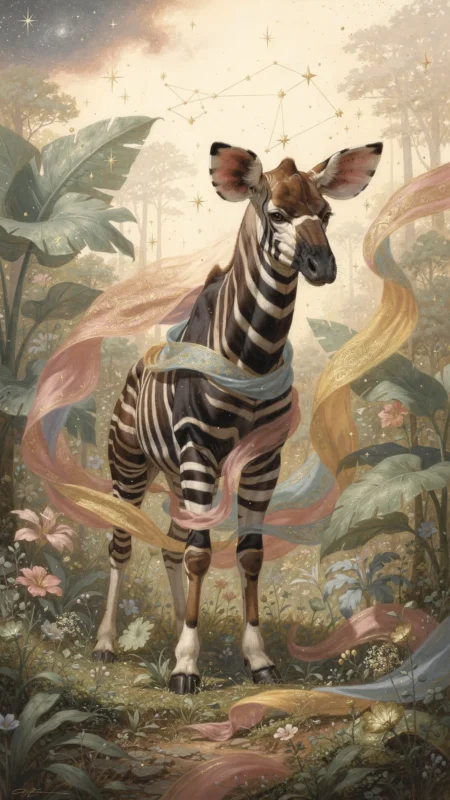
Okapi

Archetype Meaning & Symbolism

elusive, gentle, discerning, solitary, mysterious, adaptable, grounded, perceptive, ambivalent, elegant

  • Seek not the spotlight, but the dappled light of the forest, for there, truth whispers.

If Okapi is part of your personal mythology, you may...

Believe

• You may believe that true strength lies in quiet observation and introspection.
• You may believe that the greatest mysteries are found within ourselves.
• You may believe that adaptability is the key to thriving in a changing world.

Fear

• You may fear being seen as different or misunderstood.
• You may fear losing your connection to your inner self.
• You may fear being forced into situations that compromise your need for solitude.

Strength

• You may possess a keen sense of intuition and discernment.
• You may have a natural ability to adapt to change.
• You may be a gifted observer, noticing subtle details that others miss.

Weakness

• You may struggle with self-doubt and a tendency to undervalue your own gifts.
• You may find it difficult to assert yourself in social situations.
• You may be prone to overthinking and analysis paralysis.

The Symbolism & Meaning of Okapi

The Okapi, in modern symbolic terms, may represent the quiet observer within us, the one who sees and understands without needing to be seen. This creature, with its zebra-striped legs and elusive nature, could symbolize a bridge between the known and the unknown, a guide through the shadowy forests of our subconscious. Perhaps the Okapi’s presence in your personal mythology suggests a capacity for profound understanding, an ability to navigate the complexities of life with grace and quiet wisdom.

The Okapi may also embody the power of discernment. In a world of constant noise and distraction, this elusive creature reminds us to be selective, to choose our battles wisely, and to cultivate a deep appreciation for the subtle nuances of existence. Perhaps it encourages us to find solace in solitude, to seek meaning in the quiet moments, and to trust our intuition as a compass.

Finally, the Okapi could symbolize the integration of seemingly disparate parts of ourselves. The zebra stripes on its legs may represent this duality, a blend of the familiar and the exotic, the seen and the unseen. This integration may be a key to unlocking our full potential, allowing us to embrace both our strengths and our vulnerabilities, our light and our shadow.

Okapi Relationships With Other Archetypes

The Deep Forest

The Okapi’s relationship with the Deep Forest may be one of the most profound symbioses in the archetypal landscape. The Forest is not merely a backdrop but the very loom upon which the Okapi’s existence is woven. Its dappled light, falling through the high canopy, is the ink that patterns the creature’s haunches, a living camouflage that is less a disguise than a declaration of belonging. For the Okapi, the Forest could be a kind of external soul, a vast, breathing sanctuary whose quiet acoustics are perfectly tuned to its own silent footfalls. To leave it would be akin to a thought leaving the mind that conceived it—it would become unmoored, its logic and purpose suddenly thin and exposed under a too-bright, undifferentiated sky. The Forest offers a privacy so complete it borders on anonymity, allowing the Okapi to exist not as a spectacle, but as a secret whispered between ancient trees.

The Unsent Letter

There is, perhaps, an intrinsic kinship between the Okapi and the Unsent Letter. Both are vessels of a profound but unarticulated message, their meaning held in a state of perpetual, private potential. The Okapi moves through the world like a thought one has not yet found the courage to speak, its shy, retreating form a physical manifestation of a truth held close to the chest. Its discovery by the outside world felt like prying open a sealed envelope meant for another time, or perhaps for no time at all. The creature itself could be seen as a missive from the subconscious of the natural world, its zebra-like stripes a script in a language we can see but not yet decipher. It communicates not through sound or gesture, but through its very elusiveness, embodying the potent, resonant silence of all the things we feel deeply but never say.

The Archivist

The Okapi and the Archivist may seem worlds apart, yet they could be seen as colleagues in the quiet, solemn business of preservation. While the Archivist toils under a low lamp, surrounded by the brittle paper and fading ink of human history, the Okapi performs a similar function in the cathedral of the jungle. It is a living document, a biological manuscript bound in hide and bone, carrying within its DNA the deep, unwritten history of its ecosystem. The Archivist protects the story of who we were; the Okapi, in its "living fossil" status, *is* the story of what the world was long before our own narrative began. There is a shared devotion to the integrity of the past, a mutual resistance to the loud, ephemeral present. The Archivist curates what we must not forget, and the Okapi, simply by continuing to exist, reminds us of all that we have already forgotten.

Patterns of The Okapi Spirit Animal, Totem, or Archetype

If the Okapi appears as a spirit animal or totem in your life, you might notice synchronicities related to hidden knowledge and the unveiling of mysteries. Perhaps you'll find yourself drawn to the quiet corners of nature, seeking solace in solitude. Pay attention to dreams of forests, striped patterns, or elusive creatures. These could be messages from your Okapi spirit animal, guiding you toward deeper self-discovery.

You may also experience an increased sensitivity to your surroundings, noticing subtle details that others miss. Perhaps you'll find yourself drawn to the study of hidden knowledge, esoteric wisdom, or ancient traditions. Trust your intuition, for the Okapi encourages you to embrace the unknown as a path to enlightenment.

Another sign that the Okapi is connected to you may be a growing need for solitude and introspection. You might find yourself craving quiet time in nature, seeking refuge from the noise and distractions of modern life. Embrace this need, for it is in these moments of quiet contemplation that your Okapi spirit animal can speak to you most clearly.

Using Okapi in Every Day Life

Navigating Social Situations

Imagine yourself at a bustling party, feeling overwhelmed. Channel your inner Okapi spirit animal: observe, select a few meaningful interactions, then gracefully retreat when needed. This honors your need for both connection and solitude.

Making Decisions

Faced with a complex choice? The Okapi spirit animal guides you to consider all angles, trusting your intuition and adapting your approach as needed. Embrace the unknown as a path to clarity.

Creative Expression

Perhaps your Okapi spirit animal urges you to find unique ways to express yourself. Seek inspiration in the quiet corners of your mind, where your true voice resides. Let your creativity flow like the dappled light of the forest.

Okapi is Known For

• Camouflage and Stealth: Okapis possess a natural camouflage that allows them to blend seamlessly into their surroundings, a testament to their ability to navigate complex situations with grace and discretion.
• Solitary Nature: As solitary creatures, Okapis teach us the value of introspection and the importance of honoring our need for quiet contemplation.
• Gentle Strength: Despite their gentle nature, Okapis possess an inner strength and resilience, reminding us that true power lies not in aggression, but in the ability to adapt and thrive in challenging environments.

How Okapi Might Affect Your Personal Mythology

How Okapi Might Affect Your Mythos

The Okapi, as a part of your personal mythology, may infuse your life story with a sense of mystery and intrigue. Perhaps your narrative becomes less about outward achievements and more about an inner journey of self-discovery. The Okapi spirit animal could guide you toward a deeper understanding of your own unique path, one that may not always be visible to others.

Your personal mythos may also be characterized by a quiet strength and resilience, a capacity to navigate challenges with grace and adaptability. Like the Okapi, you may find yourself drawn to the unconventional, embracing the unknown with courage and curiosity. The path may not always be clear, but the journey itself becomes the source of meaning and purpose.

How Okapi Might Affect Your Sense of Self

Embracing the Okapi archetype may deepen your understanding of your introverted nature. You may find yourself more comfortable in solitude, recognizing it as a source of strength and renewal rather than a sign of weakness. Perhaps you'll begin to appreciate your ability to observe and reflect, to see the world from a unique perspective.

You may also develop a stronger sense of self-trust. The Okapi encourages you to rely on your intuition, to discern truth from falsehood, and to make choices that align with your authentic self. This could lead to a greater sense of self-acceptance and a deeper appreciation for your own unique gifts.

How Okapi Might Affect Your Beliefs About The World

With the Okapi as part of your personal mythology, you may develop a more nuanced perspective on the world. You might see beyond the surface of things, recognizing the interconnectedness of all beings and the subtle energies that shape our reality. Perhaps you'll begin to appreciate the beauty of hidden patterns, the wisdom of silence, and the power of the unseen.

Your world view could also become more fluid and adaptable. The Okapi, with its ability to navigate the dense forests, may teach you to embrace change and uncertainty as opportunities for growth. You might find yourself less attached to rigid beliefs and more open to exploring new possibilities.

How Okapi Might Affect Your Relationships

In relationships, the Okapi may influence you to seek deeper connections based on mutual understanding and respect. Perhaps you'll become more discerning in choosing your companions, valuing authenticity and emotional intelligence over superficial charm. You may find yourself drawn to those who share your appreciation for solitude and introspection.

You may also become more adept at navigating the complexities of interpersonal dynamics. The Okapi's gentle nature could inspire you to approach conflict with empathy and understanding, seeking resolution through peaceful means. You might find yourself drawn to creating harmonious relationships built on trust and mutual support.

How Okapi Might Affect Your Role in Life

The Okapi may guide you toward a life role that allows you to utilize your unique gifts of observation, intuition, and adaptability. Perhaps you'll find yourself drawn to careers in fields such as research, writing, or counseling, where you can use your insights to help others. You might also be drawn to creative pursuits that allow you to express your inner world.

Your perceived role in life may not always be visible or easily defined by conventional standards. Like the Okapi, you may prefer to work behind the scenes, making a quiet but significant impact on the world. Your role may be less about seeking recognition and more about fulfilling your soul's purpose.

Dream Interpretation of Okapi

Dreaming of an Okapi in a positive context, such as a peaceful forest setting, may symbolize a period of growth and self-discovery. Perhaps it suggests that you are on the right path, trusting your intuition and embracing the unknown with courage. It could also represent a time of increased creativity and inspiration, urging you to express your unique gifts.

Dreaming of an Okapi in a negative context, such as a caged or threatened animal, could signify feelings of being trapped or misunderstood. Perhaps it suggests that you are neglecting your need for solitude and introspection, or that you are allowing others to define your path. It may be a call to reclaim your personal power and assert your authentic self.

How Okapi Archetype Might Affect Your Needs

How Okapi Might Affect Your Physiological Needs

From a mythological perspective, the Okapi's connection to the earth and the forest may heighten your awareness of your own physical needs. You might feel a stronger urge to connect with nature, seeking nourishment from fresh air, sunlight, and whole foods. Perhaps you'll become more attuned to your body's rhythms, honoring your need for rest and rejuvenation.

The Okapi’s gentle nature could also inspire you to treat your body with kindness and respect. You may find yourself exploring practices like yoga, meditation, or mindful movement, seeking to cultivate a sense of inner peace and harmony. Perhaps you'll embrace a more holistic approach to health and wellbeing, recognizing the interconnectedness of mind, body, and spirit.

How Okapi Might Affect Your Ideas of Belonging

The Okapi, as a solitary creature, may challenge your conventional notions of belonging. You might realize that true belonging comes not from fitting in with the crowd, but from embracing your unique individuality. Perhaps you'll find yourself drawn to smaller, more intimate communities where you can connect with others on a deeper level.

You may also discover that your Okapi spirit animal helps you find a sense of belonging in nature. The forest becomes your sanctuary, a place where you feel connected to something larger than yourself. Perhaps you'll develop a deeper appreciation for the interconnectedness of all living things, recognizing that you are part of a vast and intricate web of life.

How Okapi Might Affect Your Feelings of Safety

With the Okapi as a guide, your sense of safety may shift from external validation to internal resilience. You may realize that true security comes not from controlling your environment, but from cultivating a deep sense of self-trust. Perhaps you'll begin to see challenges as opportunities for growth, trusting your ability to adapt and thrive in any situation.

The Okapi's elusive nature could also inspire you to create safe havens for yourself, both physically and emotionally. You might find yourself drawn to quiet spaces where you can retreat from the demands of the world and reconnect with your inner self. Perhaps you'll develop stronger boundaries, protecting your energy and emotional well-being.

How Okapi Might Affect Your Views of Esteem

The Okapi's quiet confidence may inspire you to cultivate a sense of self-worth that is not dependent on external validation. You might begin to value your unique qualities, recognizing that your strengths lie in your ability to observe, discern, and adapt. Perhaps you'll develop a deeper appreciation for your introspective nature, seeing it as a source of wisdom and insight.

You may also find that your Okapi spirit animal helps you to define success on your own terms. You might realize that true success is not about achieving external goals, but about living a life that is aligned with your values and purpose. Perhaps you'll begin to measure your worth by your inner growth and your contribution to the world, rather than by external measures of achievement.

Shadow of Okapi

When the shadow of the Okapi emerges, your inherent gifts of discernment and introspection may become distorted. Perhaps you become overly critical of yourself and others, isolating yourself from meaningful connections. Your need for solitude could transform into a fear of vulnerability, preventing you from forming genuine bonds. The Okapi spirit animal, in its shadow form, may lead to paranoia and mistrust, hindering your ability to connect with the world around you.

Alternatively, a suppressed Okapi archetype could manifest as a lack of discernment and an inability to set healthy boundaries. You might find yourself constantly seeking external validation, losing touch with your own inner compass. Perhaps you become overly adaptable, losing your sense of self in the process. The shadow Okapi, in this form, may lead to a feeling of being lost and adrift, disconnected from your true purpose.

Pros & Cons of Okapi in Your Mythology

Pros

• Enhanced intuition and discernment.
• Increased adaptability and resilience.
• Deeper connection with your inner self.

Cons

• Potential for social isolation and difficulty forming close relationships.
• Tendency toward overthinking and analysis paralysis.
• Risk of losing your sense of self in the pursuit of adaptability.